
Newsletter 11 March 2024
Gbiota Newsletter
11 March 2024
Why start a Newsletter
I have many friendly followers whom I chat with regularly. They know me well enough to be frank and they say
“Colin, we know you are trying to persuade people of the benefits of eating healthy food full of living beneficial microbes, but we already know that, and what we want is more detailed information on how to set up Gbiota beds and boxes.
You have a lot of good stuff on your web but there are so many articles that it is almost impossible to find what we are looking for and things keep on changing.”
I know they are dead right, but I spend much of my time experimenting trying to find better ways.
Anyone with experience in experimentation knows that most experiments fail but occasionally there is one that really works.
That happens to me all the time, but I cannot write up the full documentation until I have tested that it really does work so I have to go back and retest, maybe several times until I am sure I can tell people this really works.
So I thought I would write a Newsletter which is really a lab diary that tell people what I did today and see if this is popular with my readers.
Here is my first write up and I look forward to the feedback.
Types of users
My largest group of users are home gardeners, they have an area where they can set up Gbiota beds to create the Wickimix soil which is really the heart of the Gbiota system.
This group does not have any real problems, they are typically experienced gardeners, and if they have any issues they can email or ring me or set up a video chat where I can talk them through their problem.
That seems to work pretty well.
The second largest group are people who live in an apartment, don’t have much gardening experience, and seem a bit reluctant to ask for help.
The third group is community or commercial growers who have plenty of expertise and can easily make Gbiota beds to supply either Gbiota box or Wickimix.
I want to expand this group and they could help the apartment dwellers. But to do that I have to increase the number of apartment users.
Today’s experiments
Today I am working on how to make Gbiota better for people living in an apartment.
Boxes OK
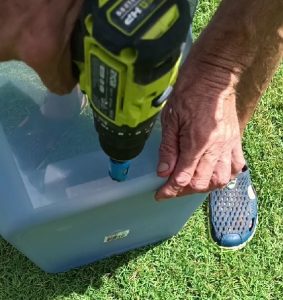 There does not seem to be much of a problem with making the boxes, they are just a box you can buy from a hardware store, they do need a few holes to be drilled but that does not appear to be an issue.
Growing plants OK
Neither does the actual growing of the plants seem to be a problem, they are probably already growing house plants anyway.
The big issue is creating the Wickimix. The main input is organic waste - in an apartment it is typically waste food.
Nutrients OK
But Wickimix needs other ingredients. It needs some soil as most of the action is on the surface of the soil particles, clay is really good as the fine particles have a huge surface area.
But it also needs a source of nitrogen, gardeners may have access to fresh chicken manure which is the best as it is full of microbes but it is possible to buy processed chicken manure which is nice and clean but has lost a lot of the microbes.
Next it needs minerals, a home grower may buy in bulk and store but an apartment dweller can still buy packets, and supplements like blood and bone can also be readily purchased.
There does not seem much alternative to buying these from the store, mixing them all up, and putting them into a box that can be easily stored so no problem.
In addition, of course, we need worms which are an integral part of the Gbiota system.
Pongy food waste - not OK
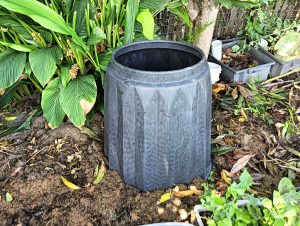 The real problem for the apartment dweller is how to handle the pongy food waste.
With a garden this is no problem, a couple of compost bins or rotating bins work fine but having compost bins in an apartment is very not OK.
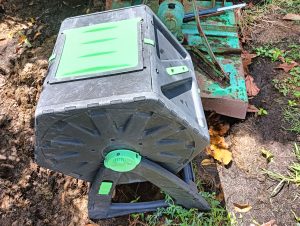 The smell problem can be solved by sealed containers but those pesky flies still seem able to smell out a delicious fly meal - at least in Sunny Queensland where I live.
Two experiments
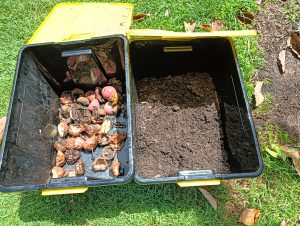 So I have two experiments.
In the first, I have two boxes. One contains the nutrients mix the other is for the waste. When I have some waste I simply put it into the second box and cover it with the nutrient and worm mix from the first box.
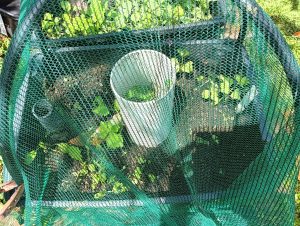 In the second experiment, I go back to an old system, the compost tube.
This is a pipe (about 100mm) that goes right down to the base of the box. This gives two input pipes, one for the water (or more correctly soil blood) while the second is for the organic waste.
When I put any organic waste into the compost tube, I cover with the nutrient mix and also flush with water. This takes any decomposed material to the bottom of the box where the friendly worms kindly distribute it throughout the box.
Easy access
If I can get enough apartment dwellers to start eating food full of beneficial microbes this will encourage commercial growers to start producing Wickimix and Gbiota boxes which will make access available to many more of the population and cut down the number of people having a foot amputated from diabetes, which is what Gbiota is all about.
Wait and see
Now it is just a case of wait and see. From the viewpoint of the Gbiota system they will both work fine in breeding the beneficial microbes, the question is which is the most user-friendly for an apartment dweller.
Let me know
I now want to find out if this style of chatty newsletter works for my reader base so please drop me an email and let me know what you think.
Colin

 I recently wrote an article
 That is not what happened, it can only be described as a lead balloon - but why?
 Take something as simple as a bicycle. Was the bike invented because some enterprising applied mathematician studied the theory of gyroscopic couples and the self-centering action of the offset in the forks and so invented the bicycle.

 My innovation to reduce the number of people having their legs chopped off is based on a simple observation that the body has an inbuilt intelligence that regulates what and how much we eat and where and how much fat we store.
 But, and here comes the punch line, my body, or rather my intelligent control system has learned over time that if I eat certain foods or drinks I replace these salts.
 But the problem is we have no idea how it works. In my younger days, I used to write sophisticated software, solving partial differential equations and writing self-learning software. I could be described in Australian slang as a gun coder.
 Or we can recall one of my favourite quotations.
 So let’s get back to my solution for reducing the number of amputation from diabetes.
 My solution is simple, grow plants in living soil full of beneficial microbes and nutrients, and eat the plants while they are still fresh so they feed the gut-brain which forms our intelligent control system.
 The general view of the medical profession is that this is not a tried and proven method that has gone through the normal scientific verification process.
 Learn about the Gbiota technology of growing plants without toxic chemicals by creating the right conditions so the beneficial microbes out breed and out compete the harmful microbes - Eco balance.
 Support our gut health movement
 ‘Prevention better than cure’ looks at our gut brain.
 ‘Health starts in the soil’ looks at the critical issue of soil biology


 My wife, Xiulan is a medical doctor, a surgeon, but she became diabetic, her foot started to turn black and our medical advisers were saying they may need to amputate.
 Diabetes is caused by fat in the wrong place, at first in the muscles and then in the pancreas.
 But
 We live in an age of hype and super sophistication. People just do not believe that a complex disease like Diabetes can be overcome in such a simple and inexpensive way.
 Then actually create soil full of beneficial microbes and minerals, grow plants and eat them while they are really fresh before the microbes die.
 Our gut-brain decides how much and where we store fat and then regulates our appetite - how much we want to eat.
 The Gbiota system solves this by loading the regenerated soil into boxes so instead of buying already harvested plant people can buy boxes (which they swap over) with growing plants which they pick and eat at home while still genuinely fresh.
 Many people are quite rightly worried about the toxic chemicals in their food.
 Two hundred years ago the great Mathematicians like Newton and Leibniz knew how to solve coupled partial differential equations, but they could not do it - there was too much computation.
 Today I realised that our bodies have a highly sophisticated control system but it needs the right species of microbes to work effectively but that the wrong species make us sick or even kill us.
 This is what the Gbiota technology is all about, creating the conditions so the beneficial microbes out-compete and out-breed the harmful microbes.
 Yes, we do grow vegetables. But that is not the point. Let’s face it, if you just want a cabbage, and aren’t bothered about beneficial microbes, you can buy one from the supermarket at an amazingly low price.
 We need to feed the beneficial microbes and that is just so easy.
 What does it cost us to manage this system? We need to collect organic waste, any organic waste which would otherwise be converted into greenhouse gases in waste tips. We also need minerals, typically in the form of rock dust which is readily available as a waste product from quarries.
 I need to talk about these together as they are linked.
 In addition to these large pores there are channels made by the creatures of the soil, particularly worms but also rotting root systems which provide channels through the soil.
 Gbiota beds are, as their name suggests are in-ground beds. We have recently suffered major flooding from climate change so I now use raised beds so they are really on-ground beds.
 Gbiota boxes are a lot smaller so don’t have the production capabilities of beds but they do have the big advantage that they can be used at home to grow plants.
 I drill a hole in the side as low as I can then use a rubber grommet and connector to make a swivel tube.
 I cut a piece of Ag pipe to fit neatly into the base.
 I then fill the base of the box to about a third of the height of the box (eg about 100mm) with organic waste. I then add a nutrient mix, containing minerals, manure, and trace minerals, (typically available in blood and bone) on top with of course the worms to process the organic waste.
 I set the swivel tube to the vertical position and fill the box to the top of the swivel tube through the filler pipe.
 At mid-week, which is the maximum length of time I want the soil blood to be stagnant I twist the swivel tube down and catch the soil blood in a suitable container (eg milk bottle - I am into recycling) for reuse on the next cycle.
 Just think what is happening here. When I flood the base of the bed I am expelling the stale air that always accumulates in the soil from the biological action. Rotting organic waste can make growth inhibitors - who wants that?
 Gbiota bed work on the same principles as boxes, partial flood and drain and recirculate. But the mechanics are a bit different.
 The food system underlies re-solving Diabetes. I was a kid in the war, everyone ripped up their lawns and grew vegetables fertilised with organic waste, and if you were lucky enough to be able to access it, that valuable resource - manure.
 Many of my readers know that I am a bit OCDish about how our food system is compromising community health.
 Mice are cute little creatures who are happy to eat each others pooh. Many other animals such as elephants, eat their pooh as well to develop their gut.
 Within twenty minutes of a cell forming it is dividing (breeding) - beat that you randy teenagers.
 I have learned that there are a few people who are quite prepared to go to all the trouble of creating living soil, what is generally referred to as regenerative growing, and grow their own plants and eat while genuinely fresh.
 The modern chemical industrial food system is highly productive producing large quantities of standardised energy food at economic prices.
 A further key feature of the Gbiota system is that plants can be grown at home in Gbiota boxes full of living soil so they can be harvested and eaten straight away - pick and eat.
 It is turning dirt into soil.
 Most people can tell the difference between a jellyfish and a fellow human being (I would worry about their sex life if they can’t). A jellyfish is like a bag full of squishy stuff while a human body is rigid with a structure.
 This is analogous to what is happening in the soil. Soil is hard and solid and nutrients are simply not available directly to the plants.