Health from microbes in living soil

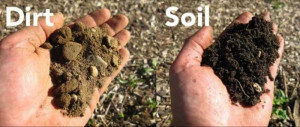
Living soil is the foundation of human health. Beneficial microbes unlock minerals for plants. When we eat fresh, nutrient-dense food grown in that soil, those nutrients and microbes help strengthen our own gut microbiome.

Protect Our Food

This document is published under the Creative Commons. You may copy and republish it without further permission, provided you acknowledge Colin Austin at Gbiota.com.

A PDF version is available should you wish to email a contact who may be interested.


I am stunned by what is happening in the world: the blocking of essential fertilisers in the Hormuz Strait, and the harm that ultra-processed food is causing to global health.

But I am just one person and can do nothing about this.

Yet I have a feeling that I am not the only person in the world who is alarmed as they watch the world go crazy. It may also be that if we worked together, we could bring a little common sense and practicality into the world.

So I thought I would write this somewhat lengthy homepage on my website and see if anyone reads to the end and says, “Yes, I will be in this too”.

If this is not for you, then why not forward the web address gbiota.com, or the PDF version, to a contact who may be interested. It is published under the Creative Commons system for easy distribution.


Crazy World

We live in a sophisticated but fragile and crazy world. A political problem in the Hormuz Strait and our fuel and fertiliser supplies are under siege, threatening our food supply.

Is it sensible to ship a third of the fertilisers needed for food production through such a sensitive region?

But we can use this as an opportunity to overhaul our failing food system. We need a food system that provides all the nutrients and microbes our bodies need and is sustainable. Let me explain.

2.5 to 8 Billion

At the end of the last world war, the global population was 2.5 billion; it is now 8 billion. This dramatic increase in population was only made possible by a total, yet silent, revamp of the food system.

At the end of the war, many large factories producing munitions and explosives based on nitrogen were converted to making nitrogen fertilisers.

This needed a large amount of energy and so became linked to fossil fuels.

Simultaneously, the Green Revolution, pioneered by Norman Borlaug, enabled the exploitation of nitrogen-based fertilisers, resulting in a dramatic increase in food production to feed the exploding population.

It was hailed as one of the great advances in food technology.

Major advances typically come with a side effect that needs correcting, and this is true of the Green Revolution.

Energy and Metabolic Food

The bulk of the food we eat is burned to provide energy. We can call this energy food.

A much smaller amount of food is used to build and replace our body parts as they wear and age. I would prefer to call this bodybuilding food, but bodybuilding conjures up images of super-strong muscular people. However, this applies to everyone, so I call it metabolic food.

The ratio of energy to metabolic food is very important for health.

Over the hundreds of thousands of years when we were evolving, metabolic food was abundant, but energy food was in short supply, so we evolved a natural craving for energy foods, primarily sugars and fats. There is a certain balance of sugars and fats that we humans just love and is called the bliss point.

Throughout human history, we have sought foods that provide energy close to this bliss point, and it has worked incredibly well.

Our natural foods were high in metabolic foods and low in energy foods, so our craving for energy foods worked very well for us.

Good carbohydrate fiber rich food | GbiotaBut the Green Revolution changed that. There was a dramatic increase in energy foods, which fed the world, but there was only a minor increase in metabolic foods that looked after our bodies. The natural ratio of energy to metabolic foods had been shifted to a surplus of energy foods and a shortage of metabolic foods.

Consequences

As they say, there have been consequences. We have what is commonly called a mind, but is more accurately labelled our subconscious brain. In lay terms, our bodies have a mind of their own, and this mind fully understands that there is a shortage of metabolic foods entering our bodies and leaps into action to protect us.

It sends messages down to our gut saying there is a shortage of metabolic food, get busy and make those hormones which will make our body, where we both live, crave more food, so I can send yet more instructions to build up a store of metabolic foods.

Or in lay language, get fat.

Getting Fat – Good or Bad?

Our mind is a survival machine; its job is to keep us alive and well for as long as possible, so it thinks that storing fat is good, and generally it is.

But our mind has not evolved to learn to cope with this excess amount of energy food, so it often gets it wrong, storing far too much fat, so we can end up not just a bit podgy but grossly obese, or simply storing this excess fat in places where it should not be stored.

It may store some in our arteries, leading to a heart attack, or some in our pancreas and muscles, so we become insulin resistant and then fully diabetic, or even worse, in our brains, where we become senile, wondering who those funny kids are who keep calling you granddad.

This is the underlying cause of chronic disease, and apart from causing a great deal of misery and overloading our health system, currently, three out of four people will die from a chronic disease.

So What Can We Do About It?

All that sounds pretty miserable, so what can we do about it?

The answer is surprisingly simple and inexpensive: just fix our food system to restore the balance of energy to metabolic food.

Let us not fool ourselves that there is some magic pill from the fake pill brigade or even a genuine pill from our sophisticated biochemistry industry. The first thing we have to do is fix our food so it has the right ratio of energy to metabolic food.

And that is a lot easier done than said, to twist the old phrase around.

What We Do

That is what this website is all about: how to create this energy-to-metabolic ratio.

The chemistry of energy food is very simple; all you need is some combination of carbon and hydrogen that your body can digest and then burn to form energy, carbon dioxide and water.

The chemistry of metabolic food is more complex but still very doable.

We need a combination of minerals, vitamins, phytonutrients and microbes.

Minerals, Vitamins, Phytonutrients and Microbes

Minerals

We need a number of critical minerals. Many, such as magnesium, iron and zinc, are well recognised. Others, such as selenium and iodine, are still essential but only needed in very small quantities.

All we have to do is look to the mountains, yes literally, I am not joking, where they are in volcanic rocks. We just need microbes, particularly fungi, to break them down so they are available.

Microbes are very obliging as they breed like crazy; all you need is the right conditions.

Currently, our fertilisers are based on petrochemicals or mining-specific minerals, in particular phosphorus, which is rapidly running out.

If we carry on as we are, we will run out of phosphorus in fifty years, and then, as they say on TV, we will have a situation.

The World is Finite

But there is an even greater threat: the supply is finite and will eventually be exhausted. Phosphorus is the critical mineral with only a fifty-year known supply. What happens when that is exhausted?

Fifty years may seem a long time, but should we be concerned right now? Let us look at the case of Nauru, which seemed at one time to have an almost inexhaustible supply of guano, seabird droppings rich in phosphorus.

Nauru was one of the richest per-capita countries in the world with what seemed an inexhaustible supply. After all, seabirds keep on producing more.

But it wasn’t that they ran out gradually; it was the way they ran out. One day there was a plentiful supply, the next day the excavators hit rock, and there was none. It was abrupt, like the closure of the Hormuz Strait, and now Nauru is one of the poorest countries in the Pacific, and the world lost access to a valuable resource.

Sustainability is such an important topic; I will be coming back to that in force later.

Vitamins

We have a good understanding of vitamins and can make many of them ourselves, for example Vitamin D, with a bit of help from sunlight.

Most others we can get from plants. The most famous of all is Vitamin C, which we can get from many fruits.

When the British discovered that limes would last a long time, they started adding them to ships’ stores, hence the nickname “limeys”.

One vitamin in particular is B12, which we cannot make ourselves and is made by fungi. Some animals eat fungi, so when we eat their meat, we may get an adequate supply of B12, but otherwise it tends to rank high on the list of deficient nutrients.

Phytonutrients

Sadly, we have a poor understanding of phytonutrients, despite their widespread occurrence.

For example, a single tomato may have a thousand different phytonutrients. Apart from making tomatoes taste nice, we have little understanding of what they do and how they work.

The only advice I can offer is: if the plant tastes good, then eat it. Many plants taste very different, and much better, when just picked than even a short time later. It is sad that so many people have never tasted plants immediately after picking, as they taste so much better.

We can only assume that they are also much healthier.

Microbes

We have long known that microbes are essential for digesting our food and making it available to us. It is only in the last few decades that we have begun to understand the important role they play in health.

This was first discovered in experiments with mice, where fat mice could be made skinny and skinny mice could be made fat simply by swapping their pooh.

This was later found to also be true in humans, with the delightful medical procedure of faecal transplants.

Knowing how concerned some people are about looking slim, I would have expected that pooh-swapping parties would have become fashionable in trendy neighbourhoods, but apparently not.

But it does raise the question of where we get our gut microbes.

We know that at the beginning of life, we get them from mum, both at birth and from breast milk. But that is just the start.

Thereafter, we mainly get them from food, but it seems that close personal contact also transfers microbes. A good excuse for young couples snogging away.

Microbes are particularly important as they regulate our bodies. That means making the change from a linear to a circular food system. This website shows how, but first, why we have to make the change.

Complex Problem, Simple Solution

There is the old saying that for every complex problem, there is a simple solution that does not work. But there are solutions, and that is what this website examines, so why aren’t we working towards a solution?

Let us see what we can learn from history. Modern humans, like us today, lived sustainably for two hundred thousand years. We can see from the remains that they were large, fit and healthy. They lived in tribal communities, but arrowheads in bodies showed that they were also aggressive toward other tribes.

They lived in their territory until they had exhausted the natural resources, then moved on, allowing the land to recover. This may have been sustainable, but it limited the maximum population to under a million.

Agriculture Changed the World

Then we invented agriculture, but not the toilet, and mostly died young from disease.

Plagues, like the Black Death, could wipe out half the population. But we learned to store food, and that tempted other tribes. City warfare started, and only a few cities lasted more than a couple of centuries.

We learned about hygiene, the population increased, and the social unit increased from the city-state to the nation, and modern warfare started, not because the people wanted war, but because of psychopathic leaders.

But two world wars and the invention of the atomic bomb were enough to curb the ambition of the psychopaths.

Agriculture | Gbiota

The Green Revolution and the Anthropocene

Technology, particularly the Green Revolution, gave us an ample food supply, and the population exploded from 1.5 billion to 8 billion.

All those mouths had to be fed, but with technology, we increased food production faster than the population. But it came at a cost; we entered a new era, the Anthropocene, in which humans began to recognise that they were having a major impact on the world.

The word “sustainable” became widely used and understood, and it seemed the world was heading toward a long, peaceful future.

The Disinformation Age

Then humans came up with another innovation that, at first, looked like it would be the greatest and most beneficial innovation of all time. It is represented by what we now call a mobile phone, but in reality it is an extremely sophisticated computer system that connects to the world.

It just happens to look small and simple.

And let us face it, an innovation that lets people watch cute cat videos while sitting on the bus must be one of the greatest and most beneficial innovations of all time.

But it turns out that it does have a nasty side. It allows all those psychopaths who would otherwise be leading us to war for the industrial killing of other humans to devise something even more damaging to society: the wonder of disinformation.

Disinformation may lack the blood and gore of earlier tyrants, and they may be wearing tailored business suits rather than army fatigues, but their effect is equally damaging.

The convincing of the masses that the extract of some weird plant from a remote corner of the world is going to solve the global health problem is in no way progress. It leads to the slow but insidious destruction of our food system.

We do not need a disinformation campaign saying that everything is fine as long as we take some magic pill. We need to face the harsh reality that the way we manage our current food system is, in the short term, making us fat and sick, and in the long term is unsustainable.

In short, that means changing from a linear food system of mining, growing, harvesting, eating and disposal to a circular food system in which waste is recycled.

The reason there has been so much resistance to the change from linear to circular is that linear is seen as profitable in the short term, while circular is seen as expensive.

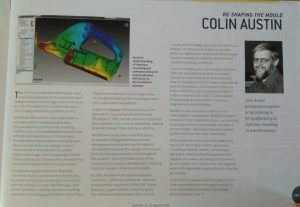
As you can see from the following article, I built up Australia’s leading exporter of technical software and was recognised as one of our leading innovators, but I saw that developing a food system that satisfied all our nutritional needs and was sustainable was the major challenge facing us all.

Changing the Food System

I decided to sell my company and use the resources to see if I could develop the needed technology. When I talk to people about this technology, I see they anticipate it will be complex and expensive.

The reverse is true. Any competent nutritionist can tell you exactly what types of food you should be eating. We know what we should eat. But what matters is how that food is grown. The prevailing view is that the only way we can feed the eight billion people on Earth is by industrial chemical farming.

That is wrong; we can grow the needed nutrient-rich food more cheaply and effectively locally.

I understand you may not believe me, so let me introduce you to my friends: easily grown high-nutrient foods.

Some of My Nutrient-Rich Food Friends

Now let me introduce you to a few tough characters who are my friends: spinach, flax, winter melon, purple amaranth and passionfruit. They have tough roots, are either long-lived or readily seed, grow in poor soil, and have a natural defence against insects.

They do not need any expensive fertiliser; they just need you to bury kitchen waste nearby and a bit of water. They will provide you with food with minimal work, through the political chaos we live in, and for free.

But do not think that being free means they are not good. My wife Xiulan, a medical doctor, is diabetic. Despite taking sophisticated modern drugs, her foot started to turn black, and the doctors were recommending that her foot needed amputation.

Instead, she started eating these plants, particularly winter melon, which has huge fruits that are a meal in themselves, and she still has both feet.

Just because things are free and simple does not mean they are of no value, and we must not assume we can only live in a world of fragile, high-tech systems and AI.

If it is simple, free and works, then that is better.

But face the facts, there is only one word to describe the situation where one third of the world’s fertiliser, on which our food supply depends, should be dependent on a politically unstable part of the world: crazy.

So what can we do about it? Some people think they can adopt a lifestyle of total self-reliance. I have tried that, and it is not viable.

Recycle or Perish

Throughout history, there has been a distinct pattern.

A state would become productive and wealthy. It used its prosperity to build a military and would then subjugate other states by threat or force.

It would gradually transfer its production to its subjugated states while increasing its military capability until its soil was degraded and its productive capacity diminished.

Then, after several centuries of power, it would collapse. Time and time again, this has happened.

Read The Shortest History of the World by David Baker or Goliath’s Curse by Luke Kemp, both enlightening reading on the troubles of the modern world.

We survive, long term, by recycling. Over twenty years ago I was using a system of collecting all the toilet waste, trenching it, then growing fast-growing legumes such as acacia, then letting the creatures of the soil recycle the toxic waste, probably full of pathogens, into nutrient-rich, highly productive soil.

Recycke_Gbiota

Intelligent and Naturally Cooperative

So let us ask what has allowed us to become the dominant creature on the planet? We are intelligent and naturally cooperative; we form tribes, and when led by a wise and committed elder, it works incredibly well. When a nation is led by a psychopath, disaster follows.

So how can we assure a safe and healthy food system? If we live in a high-rise apartment, we cannot have a wheat or rice field and keep a cow, a pig, and a chicken on our balcony.

Energy from the Supermarket, Nutrients from Home

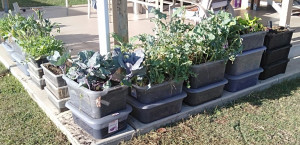
We can certainly buy energy food from the local supermarket and supplement this with highly nutritious fresh food we grow in boxes. That certainly works and is how I currently live.

But there is an even better way I learned as a kid in the war: Victory Gardens. Yes, I am very old.

These may not have provided us with delicious Wagyu beef, but they did provide us with a basic food supply that was both fresh and healthy.

A feature of these Victory Gardens is the way people cooperated as part of a working community, contributing what they did best. Some people had land, others labour; some grew plants with specific skills, but they all cooperated, sharing their skills and facilities so the community benefited as a whole.

Food was being used as a weapon of war, and we survived. We can do it again to survive the combined threat of political aggression and the damage we are inflicting on our natural resources.

So why not join the Gbiota social movement here?

How Food Works

But first, we need to understand the basics of how food works and why our modern food system is a threat.

Your mind, your subconscious brain, is a highly sophisticated survival machine, the result of a billion years of evolution, with one objective: to keep you alive, fit and healthy so you can successfully pass on your genes to the next generations.

From the very first suck it is learning what foods you need. It sends signals to your gut, the gut-brain connection, to generate hormones so you want to eat the foods that will ensure you stay alive, fit and healthy.

If you do not eat the right amount of the right foods, it will send signals to the gut to produce yet more hormones, so you eat yet more food and then store it as an emergency supply.

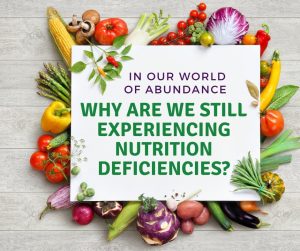
Modern food is lacking critical nutrients. These deficiencies are why there is an epidemic of chronic diseases with the common cause of the wrong fat in the wrong place: in the arteries leading to heart attack, in the pancreas leading to diabetes, and in the brain leading to strokes and a more general problem of lower health and lifestyle from being overweight.

Widely Reported Deficits in a Modern Diet

CategoryDetails
Elements needed by plants
Elements available from the air or waterCarbon, Oxygen, Hydrogen
Primary elements from the soilN, P, K
Secondary elementsCa, Mg, S
Trace elementsMn, Fe, B, Zn, Cu, Mo, Cl, Co
Widely reported dietary deficits
Elements needed by plants but we may need higher dosesCa, Mg, Zn, Fe, Cu
Essential extra elements needed for healthSelenium, Iodine, Vanadium, Chromium
Vitamins humans are generally short ofOmega 3, B12, B6, E, K

The reason for these deficiencies is that modern agriculture relies on chemical fertilisers, which are carefully formulated to provide all the nutrients plants need. But we have more complex needs than plants, which can be readily resolved if you know how.

On this website, you can learn how to resolve these deficiencies and train your mind how to generate the hormones that will keep you alive, fit and healthy.

You can start by reading the 6-page article, “Understanding Food,” for free here.

You can then buy our e-books, particularly The Survival Machine, here.

You can then join the Gbiota social movement to learn how to grow and eat foods that provide the nutrients our modern diet lacks here.

But right now, I am particularly anxious to hear from people who understand the importance of food security and the role it plays in health and would be prepared to consider becoming local tribal leaders in this movement.

If this could be you, please email me at co***@****ta.com

Join Us

Gbiota is a community where people learn how to grow and use these foods, share practical experience, and support each other through the transition.

Members receive regular e-books explaining the science and practical methods, guidance on how to grow and use microbiome-rich foods, shared experience from others doing the same thing, and ongoing updates as the technology develops.

You can either:

– sign up for our newsletter and watch how we are going.

– read our e-books and see what we have already learned.

– become a member and be on the front line of learning how to change the set point.

Colin Austin In The Media

Colin Austin, founder of Gbiota, is an award-winning Australian innovator recognised for inventing the Wicking Bed system and a pioneer of Computer Aided Design, and recognised as one of Australia’s leading innovators.

Colin Media Logos | Gbiota

Join the Gbiota Movement

Connect with others improving their gut health, growing their own food, and learning how to naturally regulate appetite.