
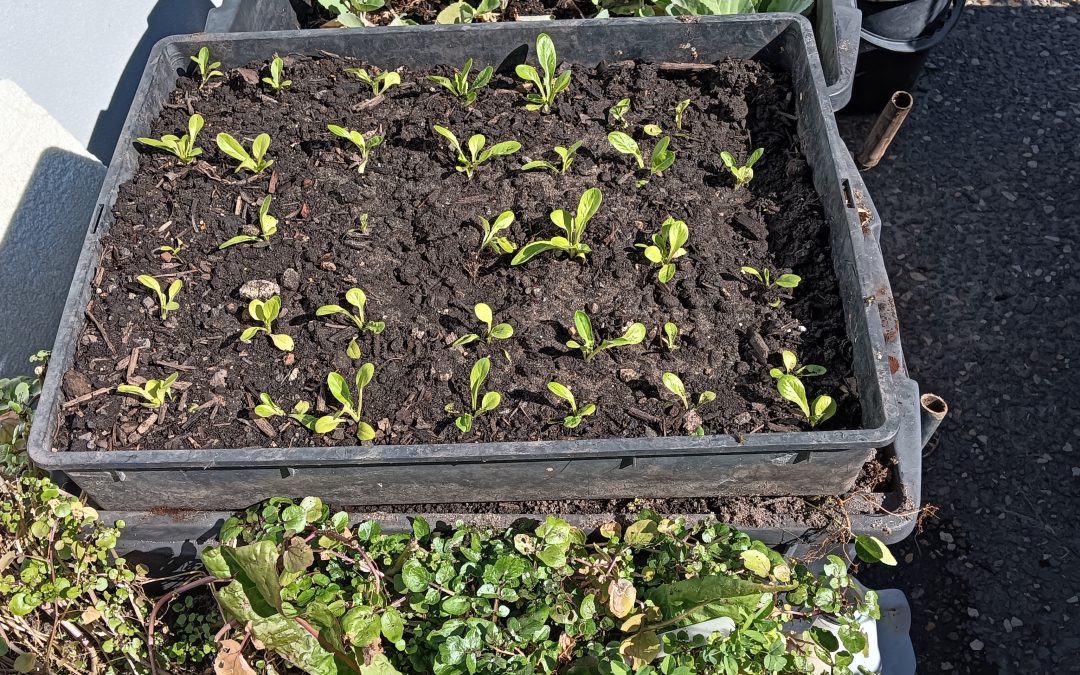
Daughter beds
Last updated 2 Nov 2026
Preface
It has been over thirty years since I came up with the idea of Wicking Beds. The original idea was to use weeds’ amazing ability to extract nutrients from poor soil and create a layer beneath the root zone where a nutrient-rich solution would wick up to provide both water and nutrients to the plants.
The snag with this idea is that this nutrient-rich solution needs to be kept moving so it never becomes stagnant.
But the idea of watering the plants from below caught on and led to the widespread adoption of Wicking Beds using a subsurface reservoir of clean water.
But we are now suffering from a food system loaded with energy food, but low in nutrients and, most importantly, the microbes which form part of the intelligent system that regulates our bodies.
This makes supplying our bodies with nutrients and these beneficial microbes even more important, so I have been faced with the problem of how to develop a system, like my original Wicking beds, but solving the problem of avoiding stagnation and ensuring adequate aeration.
I solved that problem but hit a new snag – the concentration of all those nutrients led to the problem of reverse osmosis.
By good luck, the solution to reverse osmosis has led to a much more effective and lower-cost system, as I explain below.
Reverse osmosis.
In my previous articles, I have talked about how we use soil blood to supply nutrients and microbes for the next irrigation.
But if you don’t want your plants to suddenly die, there is an important fact I need to explain.
Plants take up water, nutrients, and microbes from the soil by osmosis, when the stronger solution absorbs fluid from the weaker one.
Normally, the solution in the plant root is stronger than in the soil, so the flow is into the plant, and all is well.
But the soil blood coming from the Gbiota boxes, with an abundance of reprocessed food waste, can be very strong, as we can see by a very dark, almost black colour.
If this soil blood is used directly for the next irrigation, it can be so strong that we get what is called reverse osmosis, where water is sucked out of the roots of the plants, and they die.
This can be very dramatic; one day the plants are growing vigorously in nutrient-rich soil, and the next morning they are all dead.
This may seem a major disadvantage, but we can turn it into a major advantage by creating a system of daughter boxes.
How daughter boxes work
I spend my life experimenting with Gbiota boxes, so it is a dynamic situation, but I will describe my current technique.
We have to think about this as an integrated system of mother boxes –
Gbiota worm boxes
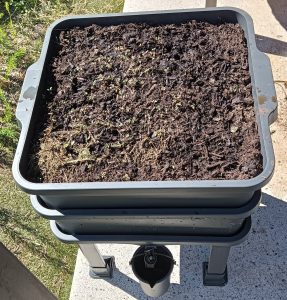 the Gbiota worm boxes, which produce an excess of over-rich soil, soil blood, and beneficial microbes
Daughter boxes
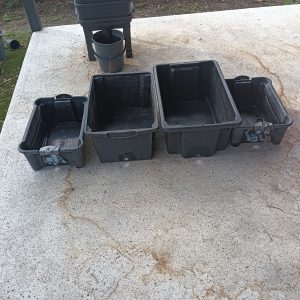 and the daughter boxes, which can be very simple: virtually any convenient, inexpensive box that fully utilises these excess inputs.
The leaky plug
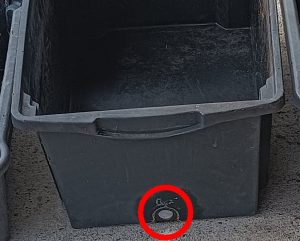 I have been trying a new method I call the leaky plug which is based on the well tried method of leaky dams I have been using in garden beds.
I drill a hole, about 20mm diameter in the side of the box near the bottom.
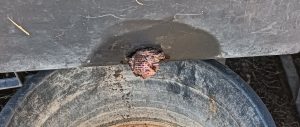
I partially block the hole with a piece of cloth, not too tight so it blocks the hole so it cannot drain but tight enough to hold in place.
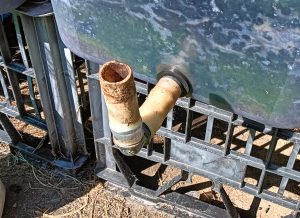 I am trialling this against the well-proven method of swivel tubes I have been using for years to control the flow through the boxes, so they are well tried and tested.
The advantage of the swivel tube is that it gives manual control of the water level. The base of the box is saturated for a period while the water wicks throughout the box.
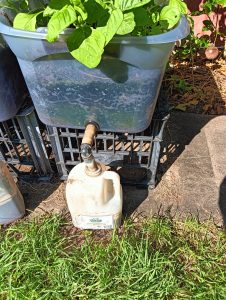 You set the saturated level by adjusting the swivel tube angle and the time the water remains in the box before draining.
This is fine for people from that fringe group like me who are a bit OCDish about growing their food, but everyone has to eat, and I want to develop a system that almost everybody can use.
My model is the nominally hypothetical single mum (but actually real) I call Mary, with two jobs and three kids, who is rushed off her feet.
She doesn’t have time for all this tech stuff, and the leaky plug may suit her. Just drill a hole in the bottom of the box, plug it with a piece of dishcloth and let the water slowly drip out over time.
These can be very simple, virtually any convenient, inexpensive box.
I spend my life experimenting with Gbiota boxes, so it is a dynamic situation, but I will describe my current technique.
I fill about one-third of the box with organic waste to act as the sponge layer. I fill the rest of the box with soil that has been well-aggregated so it stays porous.
If necessary, eg the soil is too dense, I will mix vermiculite in with the soil.
I partially block the hole with a piece of cloth, not too tight so it blocks the hole so it cannot drain but tight enough to hold in place.
I seed in the normal way.
Irrigation
Before daughter beds, I used to take my black-looking soil blood, dilute it until it was straw-coloured, and measure out enough to saturate the soil; then I watered the plants as usual with a watering can and rose.
Since daughter beds, I have changed my approach.
I use clean water to irrigate the worm beds, letting it flow through the bed to be caught in the drain.
Hopefully this is not too concentrated (shown by the dark rather than straw colour) and can be used directly on the daughter beds.
Since I adopted this full flow-through process, I haven’t had any problems with the soil blood being too strong, but if that ever happens, I would simply dilute it.
Soil
There is a similar issue with concentration in the soil. The centre box, where the worms are feeding on the organic waste, has very rich vermicast, which is too rich to use directly, so I mix it with available soil.
The much-despised clay can make really good soil if you have enough calcium ( I add dolomite and volcanic rock dust) and the microbes to aggregate the soil.
The mechanics of this may sound simple but are important.
When I water the surface, it wets the soil, with a flow front moving down the soil profile.
But soil is never perfectly uniform, and water will find a crack and flow down it without properly wetting the soil.
Eventually, it will reach the base of the box, but the cloth plug will restrict flow, so the base will become saturated.
The water will then, by a combination of wicking, evaporation and condensation, wet out the bulk of the soil.
Over time, the water will leak out from the leaky plug, and as the water leaks out, it will suck in fresh air.
The soil breathes, maintaining a balanced water-to-air ratio essential for breeding the right microbes.
There is a knack to packing the cloth plug just right. It should give a steady drip so the box fully drains.
Previously, I used taps to manually control the flow, but life being what it is, it is easy to forget and let the box stay saturated too long. The leaky plug system solves this human problem.
I am still learning, but it looks as though one Gbiota worm box can support up to 4 daughter boxes.
These daughter boxes can be stacked while the seeds germinate, so you can use more boxes in a restricted space, like a balcony. It looks like a very simple, effective, and inexpensive process.
However, in my experience with innovations, the good sides show up first (note AI), and the bad things show up later, so I am running a trial over time.
The future
Let me give you a picture of what this could mean for all those people who want to be food reformers eating metabolic food but only have a balcony.
They would need at least two Gbiota worm boxes. They need two so they can alternate, giving the worms time to produce Vermicast, which makes such nutritious soil.
This will be used in the daughter boxes, but it will likely be too rich, and we want Goldilock soil.
We take any suitable box for the daughter box; we dont want it too heavy unless your Tarzan so between 20 to 30 litres may be a good size. The depth depends on what plants we intend to grow, fast growing plants like baby Broccoli only need 200mm while hungry plants, like Tomatoes will need nearer 300mm.
We are going to make these into sponge beds which I better explain.
A wicking bed has a water reservoir that contains stationary liquid water. This water needs to be clean and free from nutrients so it does not go putrid.
In Gbiota boxes we want to include nutrients means that the water cannot be left stagnant and must be regularly recycled to incorporate oxygen from fresh air.
