
Gbiota Newsletter
11 March 2024
Why start a Newsletter
I have many friendly followers whom I chat with regularly. They know me well enough to be frank and they say
“Colin, we know you are trying to persuade people of the benefits of eating healthy food full of living beneficial microbes, but we already know that, and what we want is more detailed information on how to set up Gbiota beds and boxes.
You have a lot of good stuff on your web but there are so many articles that it is almost impossible to find what we are looking for and things keep on changing.”
I know they are dead right, but I spend much of my time experimenting trying to find better ways.
Anyone with experience in experimentation knows that most experiments fail but occasionally there is one that really works.
That happens to me all the time, but I cannot write up the full documentation until I have tested that it really does work so I have to go back and retest, maybe several times until I am sure I can tell people this really works.
So I thought I would write a Newsletter which is really a lab diary that tell people what I did today and see if this is popular with my readers.
Here is my first write up and I look forward to the feedback.
Types of users
My largest group of users are home gardeners, they have an area where they can set up Gbiota beds to create the Wickimix soil which is really the heart of the Gbiota system.
This group does not have any real problems, they are typically experienced gardeners, and if they have any issues they can email or ring me or set up a video chat where I can talk them through their problem.
That seems to work pretty well.
The second largest group are people who live in an apartment, don’t have much gardening experience, and seem a bit reluctant to ask for help.
The third group is community or commercial growers who have plenty of expertise and can easily make Gbiota beds to supply either Gbiota box or Wickimix.
I want to expand this group and they could help the apartment dwellers. But to do that I have to increase the number of apartment users.
Today’s experiments
Today I am working on how to make Gbiota better for people living in an apartment.
Boxes OK
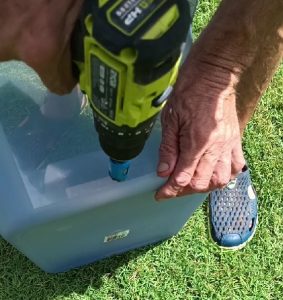 There does not seem to be much of a problem with making the boxes, they are just a box you can buy from a hardware store, they do need a few holes to be drilled but that does not appear to be an issue.
Growing plants OK
Neither does the actual growing of the plants seem to be a problem, they are probably already growing house plants anyway.
The big issue is creating the Wickimix. The main input is organic waste - in an apartment it is typically waste food.
Nutrients OK
But Wickimix needs other ingredients. It needs some soil as most of the action is on the surface of the soil particles, clay is really good as the fine particles have a huge surface area.
But it also needs a source of nitrogen, gardeners may have access to fresh chicken manure which is the best as it is full of microbes but it is possible to buy processed chicken manure which is nice and clean but has lost a lot of the microbes.
Next it needs minerals, a home grower may buy in bulk and store but an apartment dweller can still buy packets, and supplements like blood and bone can also be readily purchased.
There does not seem much alternative to buying these from the store, mixing them all up, and putting them into a box that can be easily stored so no problem.
In addition, of course, we need worms which are an integral part of the Gbiota system.
Pongy food waste - not OK
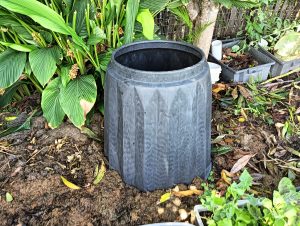 The real problem for the apartment dweller is how to handle the pongy food waste.
With a garden this is no problem, a couple of compost bins or rotating bins work fine but having compost bins in an apartment is very not OK.
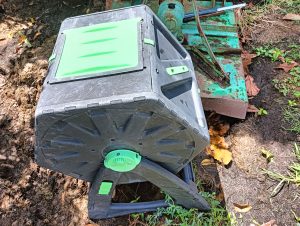 The smell problem can be solved by sealed containers but those pesky flies still seem able to smell out a delicious fly meal - at least in Sunny Queensland where I live.
Two experiments
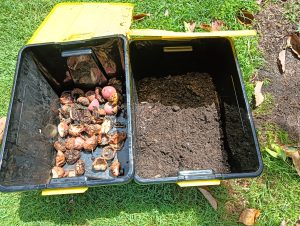 So I have two experiments.
In the first, I have two boxes. One contains the nutrients mix the other is for the waste. When I have some waste I simply put it into the second box and cover it with the nutrient and worm mix from the first box.
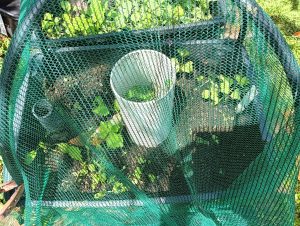 In the second experiment, I go back to an old system, the compost tube.
This is a pipe (about 100mm) that goes right down to the base of the box. This gives two input pipes, one for the water (or more correctly soil blood) while the second is for the organic waste.
When I put any organic waste into the compost tube, I cover with the nutrient mix and also flush with water. This takes any decomposed material to the bottom of the box where the friendly worms kindly distribute it throughout the box.
Easy access
If I can get enough apartment dwellers to start eating food full of beneficial microbes this will encourage commercial growers to start producing Wickimix and Gbiota boxes which will make access available to many more of the population and cut down the number of people having a foot amputated from diabetes, which is what Gbiota is all about.
Wait and see
Now it is just a case of wait and see. From the viewpoint of the Gbiota system they will both work fine in breeding the beneficial microbes, the question is which is the most user-friendly for an apartment dweller.
Let me know
I now want to find out if this style of chatty newsletter works for my reader base so please drop me an email and let me know what you think.
Colin
