

Our food should keep us healthy and be produced in a sustainable way. A couple of hundred thousand years ago, when we were hunter-gatherers with a population of just a few thousand, there was an abundance of land and natural resources. Now, as our population approaches ten billion, we need a new technology. We simply cannot feed ten billion people by trotting into the forest and digging up a few tubers to eat.
Technology Should Benefit the Community
Technology is a double-edged sword. It can work for the benefit of people, providing what we all need, or it can concentrate power and wealth in the hands of a few while causing pain and misery for the majority.
Throughout my life, I have been dedicated to the development of technology. As a pioneer of Computer-Aided Engineering, I was recognised as one of Australia’s top innovators by the Institute of Engineers.
I believe in technology and see it as the way we will survive on our planet, but technology must work for the benefit of the community—not to create unimaginable wealth for a few while the rest of the population suffers the consequences.
Don’t believe me? Just watch the news and see the tensions in society caused by the misapplication of technology.
Some Basic Facts
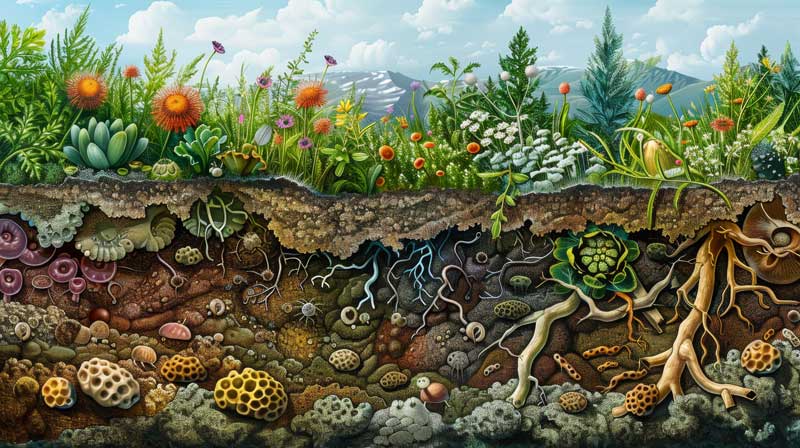
Humans cannot live in isolation; we are totally dependent on the other living creatures on this planet. Take the case of microbes.
For the first three billion years of Earth’s existence, it was a dead, inert rock spinning around the sun. Then, presumably from a meteorite, microbes appeared. They broke down rocks to form soil, releasing minerals locked within, and life began to flourish.
Have no doubt—we are totally dependent on the smallest creatures on the planet.
How We Misused Our Technology
Life is never simple. There is always a balance between good and bad, and there are harmful microbes that have killed humans on mass.
Our response has been to develop technologies based on extensive use of chemicals to replace the microbes that have regenerated nutrients and recycled organic waste for millions of years. This has been highly profitable—for some—but it creates a much bigger crisis for the future.
If there were no alternative, this short-sighted approach might be understandable. But there is.
The Alternative Approach
The alternative is Gbiota technology, which is so simple it is often overlooked: create the conditions that favour beneficial microbes so they outcompete and outbreed harmful ones.
This is not a novel idea; it happens in nature. There are no polar bears in Africa and no antelopes in the Arctic because life adapts to its environment. Change the conditions, and the dominant species will change.
Adoption

The question is, how do we get these ideas adopted? Short-term financial benefits help—this technology is cost-effective—but that alone is not enough. The community must recognise that this is the right thing to do for the long-term benefit of society. That is why I say that Gbiota is more than a technology—it is a social movement for the health of both people and the planet.
