The microbes in our gut communicate with each other to provide real intelligence, they monitor our bodies and generate hormones to control our appetite. Traditionally, there were plenty of microbes, so we had healthy guts, but there were also harmful microbes which caused disease. Modern food is deficient in beneficial microbes, so we have poor gut health, which has led to the epidemic of chronic diseases.
Both beneficial and harmful microbes breed very easily, but it is possible to control the species by controlling the conditions to favour the beneficial microbes.
Microbes breed very rapidly but also die very rapidly, they exist in a state of dynamic equilibrium.
People can easily breed beneficial microbes at home by controlling the conditions. It is simple and inexpensive, but it does take a little training, and they need starter soil to begin.
The Gbiota technology
The Gbiota technology manages the conditions so that the beneficial microbes (the good bugs) outcompete and outbreed the harmful microbes (the bad bugs).
This is based on the principle of ecological balance – creating the right conditions and ensuring that beneficial microbes prevail.
It is not a lab process where a few species of microbes are bred under tight conditions but where a full spectrum of microbes are bred.
A healthy gut needs this full spectrum of living microbes.
It is a simple process which anyone can do; even people living in an apartment can breed a full spectrum of living beneficial microbes in containers at a much lower cost than conventional probiotics.
Microbes create life
Microbes create life. For three billion years, the Earth was a sterile rock whirling around the sun.
Then, from somewhere, probably a meteorite, microbes appeared. They broke down the rocks to form soil, plants grew, and creatures that ate the plants followed. The world became, and still is, a hub of life.
Microbes and symbiotic relations
The microbes are everywhere and have formed partnerships or symbiotic relations with the plants and the creatures, which include us humans.
They digest our food, making liberating energy and creating a whole range of complex chemicals we need to make and replace our body parts, and most importantly, the microbes in our gut communicate with each other, creating swarm or group intelligence. This forms part of the intelligent control system which regulates our bodies, ensuring we have an adequate supply of oxygen, water, air and nutrients.
We are only alive because of the symbiotic relations we have with the microbes. The microbes in our gut control our appetite, so we want to eat the right amount of the right sort of food, and also much of our immune system.
These are the beneficial microbes or good bugs.
But there are also the harmful microbes which attack us and make us sick or kill us.
The battle of the good and bad bugs
This battle between the good bugs and the bad bugs has been going on since the very first humanoids appeared.
We are still here, so we won, but only at a terrible cost from plagues and diseases. We won because more often than not, the conditions favoured the good bugs so there was a large enough supply of good bugs breeding in the soil, entering the plants and then our gut for us to survive.
Smart creatures
But we are a smart creature and developed technologies, not just medical technologies to help us fight the bad bugs, but technologies of clean water, sewage and hygiene.
We did not just survive, we became the dominant creature on Earth.
Our horrible mistake
That is, until we made a horrible mistake. We changed the way we grew our food. It may be full of fats, sugars and flavourings so it taste eally good but it is deficient in the microbes that keep us healthy.
We were no longer breeding the beneficial microbes in the soil; we lack the spectrum of microbes in our gut, particularly those that form our intelligent control system which regulates our bodies so we gat fat and sick and prone of chronic diseases.
But it is very easy to fix.
Infections and non-infections (chronic) diseases
So while we had largely won the battle over infectious diseases, we faced a new crisis – the crisis of epidemic chronic or non-infectious diseases such as obesity, diabetes, heart attacks, cancer and dementia.
But we are a smart creature and have the technology to resolve that epidemic of chronic diseases. We just have to study how we have been managing the conditions to favour the good bugs, which we have been doing for the last million years.
Updating the old technology to modern conditions
We can’t replicate what we used to do because there are now billions of people on earth, and we do not have the land area, but we can use the time-tested processes and apply them to growing plants in containers designed to breed beneficial microbes.
What is Rhizosoil?
Rhizosoil is the soil in the Rhizosphere. For the last billion years or so, it has been the centre of life based on mutual cooperation and recycling.
Plants capture carbon dioxide from the atmosphere and energy from the sun to create sugars that they exude from their roots. This feeds microbes in the soil, which break down the rocks to make nutrients available for the plants.
Microbes enter the plants and animals (including humans), eat the plants, and the microbes form the gut-brain, which regulates our bodies so we eat the right sorts of foods and don’t overeat.
In the past, we and the animals would excrete these microbes back into the soil, where they would continue to breed.
Natural recyclers
Recyclers in the soil, the worms, larvae, ants, beetles, nematodes, etc, would reprocess the waste organics for food for the plants and creatures.
Perfectly sustainable, but with one disadvantage for the animals. If the conditions were not right, harmful microbes would cause disease, which in the case of humans, meant that very few people reached their natural maximum age.
Synthetic fertilisers
Humans broke this system by adopting synthetic fertilisers, which, although very effective in producing large quantities of food, led to the weakening of the microbial system that forms our gut-brain, which regulates our bodies, particularly our appetite, leading to an epidemic of chronic or non-infectious diseases.
The modern product, Rhizosoil, is a modern development based on the traditional cycle but with careful control of the conditions. Hence, the beneficial microbes out-compete and out-breed any harmful microbes.
Buying Rhizosoil
Rhizosoil can be purchased as an inoculant so that virtually anyone can breed beneficial gut microbes at home.
The microbes in Rhizosoil need to be fed by adding organic waste, such as kitchen scraps.
How to use
The simplest method is to mix with organic waste and place it at the bottom of any growing container. This works fine for a period, but as soon as the food supply is used up, the microbes will die, so they need to be replaced, which costs money.
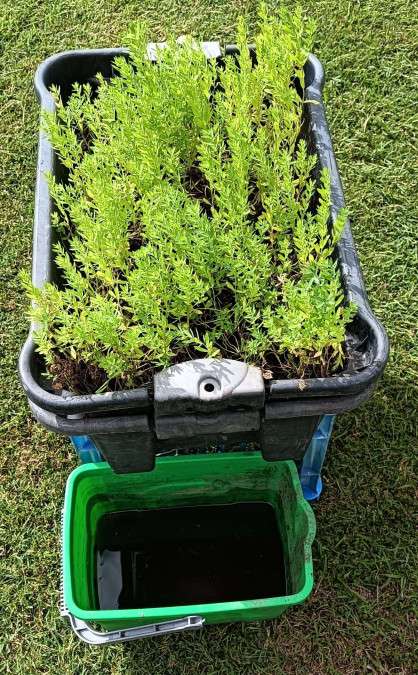
A far more efficient method is to use the Gbiota biobox system, which has two nesting boxes. The bottom box is filled with organic waste together with the Rhizosoil, while the top box grows plants.
A system of flood and flush is used to circulate the liquid in the soil, which we call soil blood as it provides the essentials for life, so the are regularly flushed with fresh soil blood.
The boxes must be small enough so they can be easily lifted and refilled with fresh organic waste.
Compost tubes can be used in larger containers which are too heavy to lift.
Practical realities
Rhizosoil contains living creatures which will quickly die. It is normally supplied in 5 Kg packs supplied by post, but must be opened and mixed with the organic waste on arrival.
There is also a question of supply. Rhizosoil is grown in special beds, and it takes several months to produce from the finite number of beds currently available.
To manage this issue, we have set up a system where you notify us of your desire to purchase Rhizosoil. We notify you by email when Rhizosoil is nearly ready (it is a living product) so you can confirm your purchase. If you do not confirm, the option is passed to the next person in the queue.