Fat and sick

Fat and sick


food cravingsAcross the globe people are getting fat a sick from an epidemic of diseases like diabetes, heart attacks and dementia.

Why?

Our gut brain has trillions of cells which communicate with each other to create our gut brain which evolved over millions of years to regulate our appetite, emitting hormones to tell us when we need to eat and when to stop eating because we are full.

If we do not have the right microbes in our gut brain it simply does not work as it should so we have no proper control over how much we eat - so get fat and sick.

Where do the beneficial microbes come from?

From plants eaten fresh.

large treeHow do plants give us beneficial microbes?

Plants work by evaporating water from their leaves.

Water may be a liquid but the molecules have a great attraction for each other to inside a plant they have a tensile strength like a steel rope.

This enables them to pull water up from the roots to great heights. If water did not have tensile strength there would be no tall trees.

As water it taken out of the root system it becomes a very strong solution so more water will enter the root system by osmosis, water going from a weak to a strong solution.

As the soil in the root zones dries our more water will wick in from wetter soil away from the root zone.

But plants need food, they can extract carbon dioxide from the air and water from the soil to make sugars by photosynthesis.

But they also need minerals which are generally in the soil as rock particles which are insoluble so the plant cannot access them.

So the plant exudes sugars from its roots which attracts and feed microbes in the soil. These, particularly the fungi, can break down the minerals so they are soluble and bio-available and feed the plants and later us.

exuding sugarsSome of these microscopic beneficial microbes are carried into the plants by this flow of water from wicking, osmosis and tensile forces into the plants and if we eat the plants while they are still fresh, before the microbes die, they will enter our gut to form our gut brain and keep us healthy.

swivel tubeThis process of growing plants to feed our gut brain is what the Gbiota technology is all about.

It is neither complicated nor expensive, virtually anyone can grow gut brain food by recycling organic waste into nutrient rich, living soil full of beneficial microbes.

It can be done in a garden or in pots.

Why not join the Gbiota movement and help change our food system to reduce the risks of getting fat and sick.

Loading

Health starts in the soil

Health starts in the soil

Health starts in the soil

Every day we here stories of doom and gloom about food, price hikes from floods and droughts, problems with the supply chain from Covid, lack of nutrients and beneficial biota leading to diabetes, heart attacks and dementia.

It all sounds pretty miserable so why not do something about it. Here we are focused on solutions.

You can read many articles analysing the food situation here.

price hikes

Before I start I just need to make the point that we are not facing a general shortage of food, we are producing more than enough energy food to feed the entire world now and into the future. While most of the food we eat is simply burned as fuel it is essential that we eat food that will feed our gut brain.

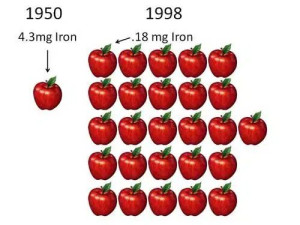
soil-depletion-apples-colin-austin-gbiota

Our gut brain is really important - there is simply no way to be healthy without a healthy gut. It is a real brain which talks to our head brain though the Vegas nerve to control our appetite so we don’t overeat on the wrong sort of food and start down the road to diabetes, it manages the complex chemicals needed to replace our body parts as they age and wear and host much of our immune system.

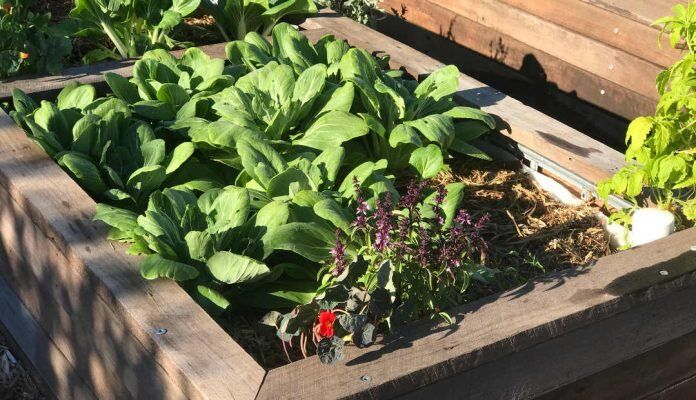
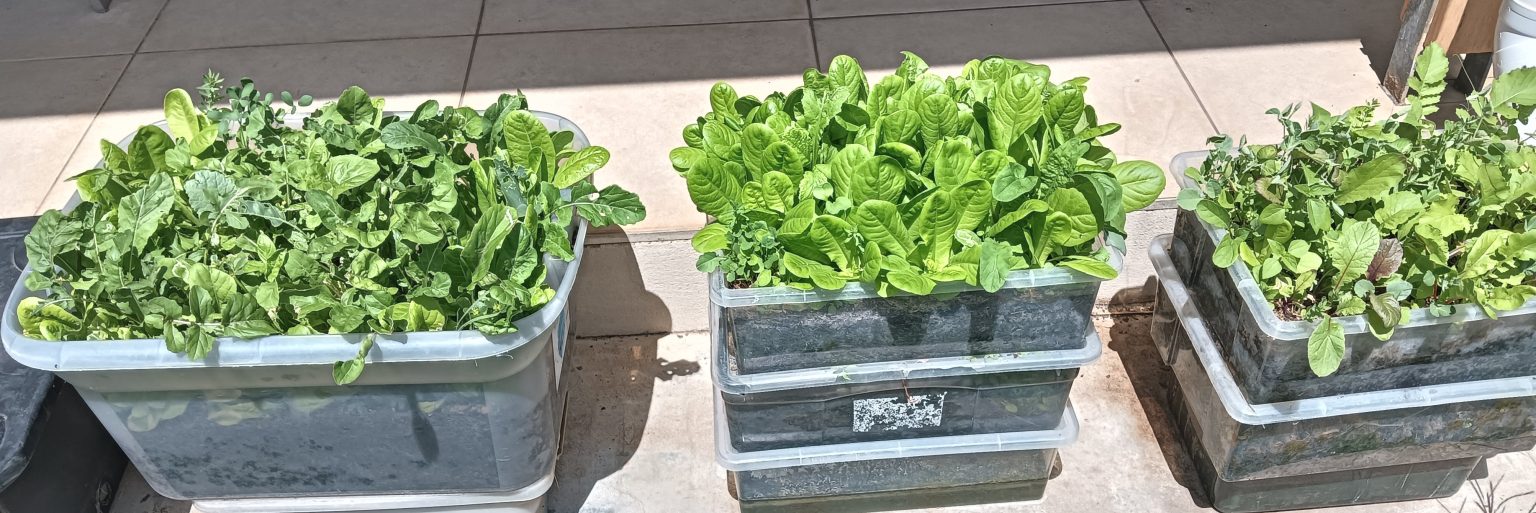
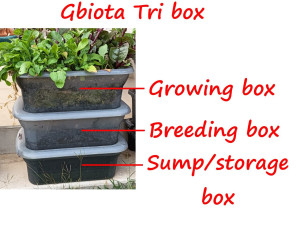
The Gbiota Biobox system allows people to have fresh vegetables which feed our gut brain growing in their home, even if they have no garden, time or gardening skills.

There are two groups of people in the scheme.gbiota-box-colin-austin-gbiota

Group 1 consumers or biofoodies

There are the people who just want to eat the food that will make them healthy. It is just a reality that the minute a plant is harvested that it starts to deteriorate. Within twenty four hours the level of some critical nutrients will have dropped by half so there is no real alternative but to grow gut food at home.

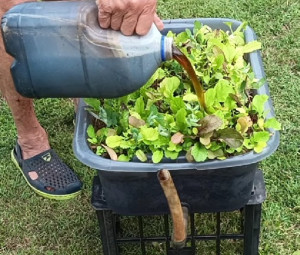
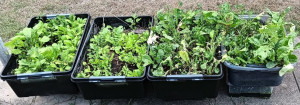
The Gbiota box system makes this very easy - really just watering, adding nutrients and harvesting.

It is a lot cheaper but above all the quality is just so much better - full of minerals, nutrients and beneficial biota which feeds our gut brain.

However the Gbiota Biobox needs soil, not just any old soil but soil which is full of nutrients and living biota such as microbes, fungi and worms.

This is where the second group comes in.

Group 2 community growers

Community growers are typically experienced growers with a garden who are prepared to grow the special soil - Wickimix - for their local community. Naturally they get paid for this service so it can be a nice paying hobby.

They agree to work to a protocol of adding the required minerals and inoculants to grow the Wickimix - supported of course by the Gbiota team.

How it works

This is the way it works. It starts with a box, any box of any size that suits - just a small 20 litre box if you want just want to grow baby greens on your windowsill or a bigger one if you want to grow large plants.

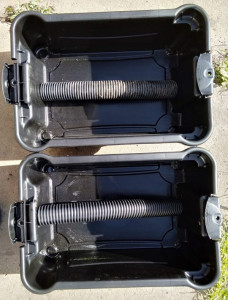
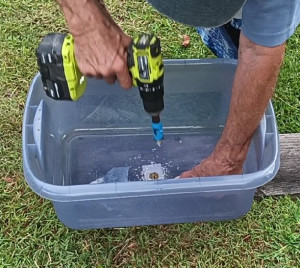
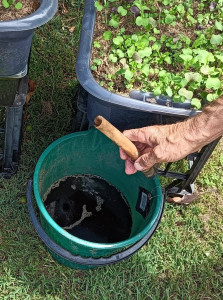
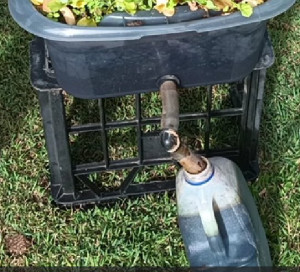
A simple irrigation fitting is installed at one end to form the swivel drain and a piece of drainage pipe connected to distribute the water - and that is all there is to it.

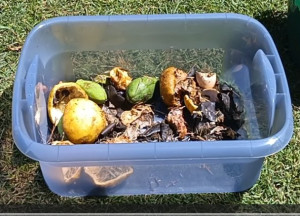
Now we start with food scraps from the kitchen.


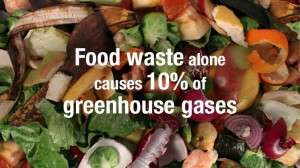
Food scraps are one of the crimes of the century, we just throw them into the bin where they end up as land fill decomposing to form the worst sort of green house gases.

Yet they are full of nutrients which can be recycled into fresh healthy food - future generations will just laugh at us.

Now there can be a bit of a problem with smells and flies if they are not handled right but if you do it yourself there is none of these problem that occur when food scraps are left lying about for any time.

food-waste-colin-austin-gbiota

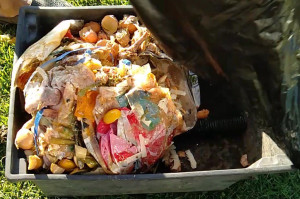
We just fill the base of the bed with fresh food scraps. It may seem that we are overwhelmed with food scraps but when we start to recycle them they become a valuable commodity which is in short supply so we may made need to add other organic waste like grass clippings.

waste-food-colin-austin-gbiota

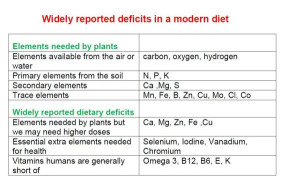
But that is not enough - we need minerals like magnesium, iron for the ladies, zinc for the men, copper, selenium, iodine, vanadium and chromium.

These are readily available in volcanic rock dust but they are still rocks that are insoluble so we cannot absorb the minerals - for that we need micro-biota, the bacteria and particularly the fungi that can dissolve the rocks.


So we add Wickimix which looks like and acts like soil but is actually made by breeding beneficial micro-organism in an in-ground Gbiota bed. This is a bit more complicated but you can buy Wickimix on line from a licensed local grower.

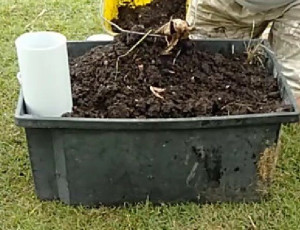
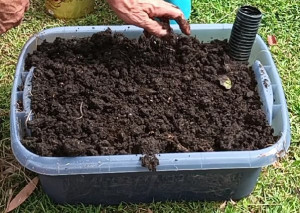
The bed can then be seeded and covered with a thin layer of Wickimix.

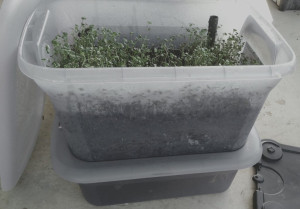
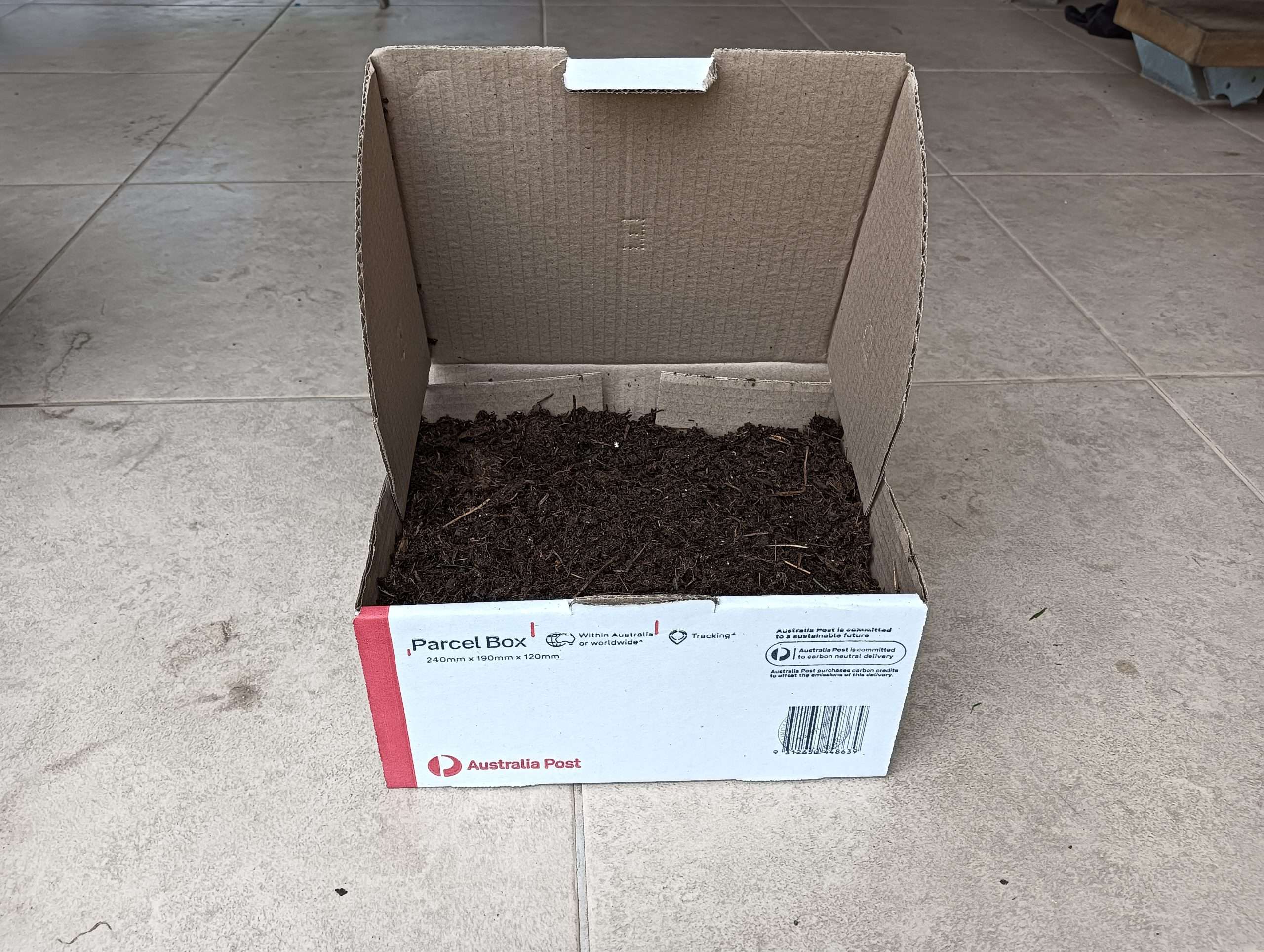
soil-in-wickimix-box-colin-austin-gbiota

 It is that easy.

Now that is fine when first setting up a Gbiota box - there will be plenty of nutrients and beneficial biota at the start.

But you will be taking these nutrients out of the bed so after a period the soil will become old and tired.

This is where the compost tube comes into play. It is simply a tube which is pushed into the soil, the soil is soft so just a bit of wriggling and the tube will go to the bottom of the bed.

The excess soil is simply cleaned out and used as a mulch then the tube filled with fresh food waste.

Food waste may be good stuff but it attracts the tiny vinegar flies and those pesky blowies. This is why you add extra Wickimix on top of the food waste so the worms and the microbes can get busy breaking the food waste down.

Some people like to save up their food waste in a separate container for a few days and then put into the Gbiota box but an alternative is to set the box up at a convenient place and just add the food waste as needed, a plug is needed to stop flies getting at the waste until they are covered with Wickimix.

Recycling food waste make economic and environmental sense, and cost little money and is easy.

The plants we grow acts as natural pre and pro biotics feeding our gut brain which is critical for our health.

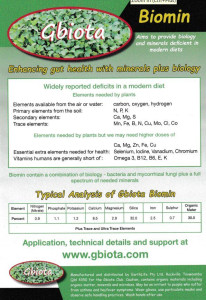
biomin-label-colin-austin-gbiota

First step

First step is get your copy of food for health, it is free you just have to download.  Below is the official automated download system which like most over engineered computer systems works when it feels like it, don't go away just email me directly at colin@gbiota.com

Loading

Food and our nature

Food and our nature

Food and our nature

Colin Austin © 15 December 2023 This document it published under the creative commons system which means it can be freely copied and distributed without further permissions.
The only restriction is that the source Colin Austin at gbiota.com should be acknowledged.

Abstract

changeHomo eructus, our ancient ancestor was a puny little creature that barely survived.

But it discovered fire and learned to cook and the extra nutrients led to a bigger brain and the combination of intelligence and cooperation led to humans becoming the dominant creature on earth.

We have the technology to produce goods on such a scale that we should all be enjoying a wonderful life - yet we are not.

Why? Aggression.

We need to understand why this creatures which has such in built advantages of intelligence and cooperation should put this all at risk by aggression.

Simply changing our food changed our nature - our DNA.

Changing food has since occurred a number of time always with the same effect, a change in our nature and DNA.

We are now in the midst of a major change to our food, increased consumption of sugars and fats and a failure to feed our gut brain.

This is again changing our very nature, we are getting fatter, our health span is decreasing and above all we are becoming more aggressive - hangry.

Do we really want to breed a new species of humanity that is fat, sick and aggressive?

Would it not be better just to feed our gut brain which has been evolving over thousands of years to control our appetite naturally?

Food and our nature explains all and what we can do about it. It goes against the current trend of a quick publicity grab, it is a long article for serious concerned thinkers.

It analyses the link between food and our nature and what we can do about it - the action plan.

But will the click bait society win or will we put the effort into serious thinking then act?

Tell me at colin@gbiota.com

Introduction

We know for sure that the food we eat can make us fat and sick, but what if it can affect our very nature, our DNA and make us a less aggressive and more cooperative creature. In this article I put forward the arguments for this idea.

Internet marketing experts tell me that my web has too much text and that people just want a few cute sayings and lots of graphics and videos.

Well I am not Taylor Swift in the mass entertainment business, I am trying to make a viable world for Elowen my great grand daughter and the others that follow.

I know that the world is not going to be changed by an eighty four year old man, even if he is still fit and healthy, I have to convince a smallish number of younger thinking people who have the energy to persuade the world to change the food they eat so people can live a healthy life with greater cooperation and less aggregation.

I have to create a social movement.

If this could be you, please keep on reading, despite it being very untrendy text.


Humans – one of the great apes

We can trace our ancestry back to homo erectus who first appeared some million years ago. A pretty unsuccessful creature that barely managed to survive until what is probably the most significant event in history.

Wait – its coming.

But we are just one of a very mixed family. Our cousins the chimpanzees are one of the most aggressive creatures on the planet indulging in totally pointless mass genocide of their own species which make humans look relatively restrained.

But our other cousins, the Bonobos, are the exact opposite friendly cooperative and indulging in unrestrained sex which make the Californian hippies of the sixties look totally restrained.

How can we start to stitch these facts together for the benefit of our great grand kids?


Fire – the technology that changed us

Fire just came, we don’t know how but suddenly we had fire.

We could now cook food to make if more digestible - the result - our gut shrunk and our brain increased in size which led to us becoming the dominant creature on the planet.

This is the theme I will keep on coming back to - we change our diet and there is the immediate and obvious effect but there can be a much more important and longer term effect.

We did not methodically set out to discover fire so we could cook and grow bigger brains, fire was simply a random occurrence that changed us and the world.

Back to Taylor Swift

Our bigger brains gave us more sophisticated language, music and dancing.

Music and dancing may not seem a big deal in the survival movement but they were.

Dancing is part of our mating ritual but it is much more, it is part of our hunting skill. Our bodies are not naturally well suited for hunting, we are a bit lite on in the claws, teeth and beak departments.

We need to hunt in packs with coordinated synchronised movement. You see that pre-planned, well rehearsed, coordinated movement every time you watch a footy match.

Synchronised movement, or mass dancing, is universal in hunter tribes and is a rehearsal for the synchronised and coordinated activities in hunting large and ferocious creatures.

Even the concept of rehearsal requires brain power which was enabled by fire.

You can’t beat that for dramatic events.

Brain power and aggression

The early hunter gatherers didn’t just wonder around aimlessly, they had a defined area which they thought of as their territory.

It may be two hundred thousand years ago but those early hunter gatherers had similar brain size, and presumably similar intellectual capabilities as modern man.

When they were hungry they suffered pain and understood that they were totally dependant for their food supply on the land that supported them.

They were also totally dependant on other members of their tribe so cooperation and intelligence became key to us not just surviving but becoming the dominant creature on the planet.

All because we learned to cook - and no I am not promoting chicken wings and chips.

If they felt our food supply was secure they would trade with other tribes without conflict. Pretty good - we all win.

However if they felt that the other tribe was a threat to their food supply by invading their land they would be extremely aggressive, the most aggressive creature on the planet that inflicts incredible harm on members of our own species.

Not as bad as our cousins the chimpanzees who go in for total pointless killing of their own species but don’t expect any gold medals from the UN.

Fortunately the chimpanzee don’t have atomic bombs which could annihilate their species (ps and us).

How we think

How did this mess happen. It is useful to contemplate how we think.

We do not think every new situation out from scratch - thinking is a slow and tedious process. So we have evolved to pre-think through a large number of situations and have answers almost ready when needed - we just pick the most relevant pre-solved solution.

Look at a baby – as soon as it gets hungry it senses pain and starts to scream and yell and get real angry until mum feeds it. Getting food is its one and only mission in life and if it does not get fed it gets real angry.

Getting angry is a pre-solved solution – and it certainly works on mum.

As baby grows up it soon works out that food comes from the land, it’s land. It expands its pre-solved solution to become angry when anyone threatens its source of food - it’s land.

Protecting our bit of land, our territory has become ingrained into our thinking.

We don’t go through a process of logically working out how important that piece of land is to our needs, it is ingrained into us that this is our land and we will commit any violence or atrocities to retain that land.

It is so powerful that it almost appears to be a natural instinct - but it is not - it was ingrained into us when mum did not feed us quickly enough.

Changing this ingrained thinking is what makes changing paradigms so hard.

For now I just make the point that we become a nasty aggressive creature when our food supply is threatened. I will come back to that theme later when I talk about the threat that climate change has on our future.

Cause, effect and enabling

Much of modern science involves establishing statistical correlations and then trying to work out which is the cause and which is the effect.

Enabling is an equally powerful effect. Fire did not directly give us the bigger brain to undertake rehearsals - it was an ‘enabling factor’.

In my younger days (I have never worked out why teenagers find it impossible to image that old people were young once and snogged behind the bike shed - or whatever teenagers do now).

I was a pioneer in computer aided engineering, writing software to solve complex engineering problems.

Often the basic physics had been understood for centuries, Newton with his understanding of the laws of mechanics and the development of the calculus could have easily solved the problems I solved - if he had had access to computer technology.

I was able to solve these problems because of the enabling capability of the modern computer.

There is no more important illustration of this than in climate change. We have known the basic physics of climate change for almost a couple of hundred years, it is only with the immense power of modern computers can we predict what this actually means on a global scale, or more important to me to Bundaberg where I live. Ps Bundaberg is prone to flooding so I have empathy for low lying countries.

The central theme

The central theme is that food does more than change us in the short term - yes eating too many chicken wings and chips and yet more chips followed by a double serve of cheese cake will make us fat, sick and probably diabetic - but it can also change our very nature.

Fire changed our DNA creating a smaller gut (not a big deal) but a much bigger brain ( a very, very big deal) which literally changed the world.

Agriculture and Seeds

The next big shift was agriculture. Our best explanation is that some hunter gatherers harvested wild grains and stored them to eat in the winter.

Probably they had plenty of grains that year so they just threw the old ones away, they grew and they accidentally discovered agriculture.

We shrunk

Agriculture changed us as a species. We know from fossilised records that hunter gatherers were quite large people, size matters when you trying to bring down a Mastodon.

But when we developed the technology of agriculture we physically changed as a species.

We became smaller, physical size is not so important in an agricultural society, so the laws of evolution allowed smaller people to survive.

But there was a much more important change - our immune system.

Our immune system

Even more dramatic was the development of our immune system.

Hunter gatherers lived in small communities and moved around so disease was not a major issue in the survival battle.

More directly we had a fresh place to poop every time.

Agriculture led to high concentration of people in static cities, conditions which naturally led to disease.

(In London the Thames became an open sewer and the smell got so bad they had to shut down parliament on bad days - it was not the politics that stunk it was the river.)

So natural selection led us to develop enhanced immune systems with survival of those with the most developed immune system which had been trained to defend against the local diseases of that time.

We see this in other creatures, bats living in caves full of fermenting bat shit have evolved an incredible immune system protecting them from diseases which kill us.

There has certainly been a lot of debate whether the Covid epidemic in humans originated from bats who were totally immune to Covid.

Colonisation

We certainly know from the era of colonisation that the diseases from the colonising humans decimated the native human populations who had not developed immunity to these new diseases.

It is startling to think that a little change in technology from finding that a few stored seeds would grow would lead to fundamental changes in us as a species.

How will modern food change us?

This should certainly make us wonder what the effects of the current changes in our modern food system will be on us as a species, not just in the short term but in the long term.

We don’t have to predict, the short term is happening right now. We have become fatter and sicker with reduced health spans. Diabetes, heart attacks and dementia have reached epidemic proportions.

I know a bit about diabetes, my wife is both a medical doctor and diabetic. She monitors her blood sugar very carefully but sometimes she over does it a bit and her blood sugar drops down to low.

I don’t need to see her blood sugar levels, she just get angry for no particular reason (other than living with me). There is a medical term for it hangry, angry because the blood sugar is low and she feels hungry.

I look at all the violence and wars on the News and ask myself if there is any connection between this anger and the real or imagined fear of hunger.

Medicine and modern food

The next major shift was more deliberate but again the cause was external.

Until recently three out of every five babies born died within the first five years, then another died as they the reached teenage and died doing dangerous things - as teenagers do.

Four out of five dying before reaching maturity kept the global population down, but then we improved our medical technology and most babies would reached adulthood.

In the hundred years before I was born the global population trebled and in my life time trebled again.

Fertilisers and the green revolution

By this time we had fine tuned the process of innovation, the development of technology and science and we responded with fertilisers - particularly the fixing of atmospheric nitrogen by the Haber Bosch process, the green revolution, chemical industrial farming and food processing.

We now produce food at a far higher rate than the increase in global population - a spectacular technical achievement.

On the surface it looked like a fairy tale, ample food and increasing life span. What could possibly go wrong?

Climate change

The first warning that this fairy tale may not have a happy ending was climate change. Floods and drought were making it more difficult to maintain food production - not a general decline but random events in time and geography causing local food shortages.

We only have to look at Pakistan where lack of food from climate change is causing a new generation to grow up stunted from lack of food.

To add to our worries, agriculture and our food system shipping food around the globe, is a significant source of green house gases.

May be we could console ourselves that our technological prowess has resolved worse problems so it is time for action but not panic.

Chronic diseases

But then something much more sinister appeared, the rise of chronic diseases like diabetes, heart attack and dementia which rose to epidemic levels.

These diseases have always existed but on a small scale, the epidemic scale is man made and is a direct result of a change of our food technology.

There was no doubt that this is happening - but why, we need a nice neat scientific explanation.

The first hypothesis to achieve popularity was fat or more specifically the wrong fat in the wrong place.

We quickly learned that diabetes is a two stage process, at first we store fat in our muscles and developed insulin resistance - which at first is not a major issue as the pancreas simply makes more insulin.

We don’t know, in fact we cannot know, but we suspect that there is a large number of people who are pre-diabetic but there are no symptoms and they go undiagnosed.

It is only when the pancreas gets cluttered with yet more fat and cannot make insulin that we have a real problem.

And it is a very real problem, every eight seconds someone unfortunate soul has a limb amputated from diabetes.

Too much fat – not so simple

So the initial fashion was to reduce fat intake and wherever possible our food become low fat.

But we still just got fatter and these chronic diseased kept on increasing so we needed a new villain – and that villain was sugar.

Sugar - the new baddie

So cakes smothered in icing and marzipan were reserved for Christmas but again this was no more effective than the low fat diets. We still got fatter and sicker.

Life span, which had been steadily increasing plateaued - but worse health span, how long we remain fit and active, reduced alarmingly creating a major problem of generation of older unwell people.

Nutritionist, bio-chemist, micro-biologist and engineers.

The field of food and nutrition is very clearly the province of nutritionist, bio-chemists and micro-biologist and there is no place for dumb old engineers.

But let me tell you a bit about my training as an engineer.

Strength of materials

The first lecture was about strength of materials. We were taught that people generally preferred it if things just didn’t break the first time you used it and we were told the poem of

The one horse Shey (cart)

that lasted a hundred years and a day

then disappeared into a pile of dust.

(Even Mr Google does not know the correct spelling of an Irish Cart).

It was only later, after I left University and entered the commercial world that how strong to make things was not decided by the engineering department based on what was needed but by the marketing and account department on what they could sell at a profit.

We were given the rule – if in doubt make it stout.

My Engineering faculty did not win any prizes for their poetry.

Thermodynamics and entropy

The next lecture was on thermodynamics and the wonders of Entropy.

Entropy is one of those magic words which has entered into common usage without anyone having any idea what it actually means.

Engineering is really all about power and its creation, transmission and use.

I have found myself spending a lot of time thinking about the human body as a thermodynamic machine which is very different to the way a nutritionist thinks about the way the human body works.

It is a very simple thermodynamic machine with a fuel inlet, combustion chamber and exhaust pipe. Any engineer knows that you input high quality energy, convert some of that to mechanical energy and get rid of the lower quality energy through the exhaust pipe.

That is what entropy is all about, measuring the quality of energy.

Nutritionist pay a great deal of attention to the high quality energy content of the fuel that goes in but very little to the low quality energy that comes out, understandably it is a shitty topic.

Control theory

The third lecture was about control theory.

It is fine to have machines which don’t break, and generate lots of power but you must have a control system so they don’t go bizzerk.

It can be as simple as an on/off switch but more likely to be a PID controller.

P for Proportional means you adjust you adjust the power in proportion to the error or offset. But that can lead to instability so we have a D for derivative function which really means damping.

But even with all that you still get a permanent offset or error so we have an I for integral function which gradually nudges the machine back to is set point.

All very simple and mechanical.

But years later I found myself writing computer aided engineering software for which I was recognised as one of Australia’s leading innovators.

One of the projects was writing control software (actually for an irrigation system) where you don’t really know how the system works.

So we play a little game and just nudge the system a bit in one direction and see what happens, and we can keep on doing this until we really understand how the system works, even if it is changing daily (and in an irrigation system plants have a habit of growing and needing more water).

This is generally described as self learning software for the simple reason it learns and keeps on learning and adjusting to the new circumstances.

Our gut brain as a self learning system

This is exactly how our gut brain (a combination of our gut and head brain) works.

From the first suck on mums boobs to when we die our gut brain is monitoring what we eat, recording what the effect is on our body and deciding whether this is good of bad.

Every time we eat anything we are training our gut brain control system and it will remember that throughout our life.

If good - eat a bit more next time, if bad eat a bit less next time. And the sole point of this is to keep us alive.

We can see that this leads to effects which are in direct conflict with the calorie theory of diet which argues for restricting calorie intake to reduce excess fat.

In many cases this could be exactly the wrong thing to do.

It is going to be very difficult for recognised experts in the field, who have built up reputation for their knowledge that they got it wrong so the concept of our gut brain as a self learning intelligent control system will be rubbished.

What makes if even more difficult is that we have virtually no idea how the gut brain control system works at the code level.

This is the challenge for the next generation of researchers and it wont be easy - our gut brain is a complex and sophisticated device perfected over millions of years of evolution.

This makes changing the paradigm a hazard occupation which any sensible person should avoid. Unfortunately my brain missed out on its allocation of sensible.

What does this means in practice?

The advice of the current calorie paradigm is to stop stuffing yourself with chicken wings, chips and cheese cakes.

This sounds pretty good unless your basic diet happens to be chicken wings, chips and cheese cake in which case you are training your intelligent control system that it needs to be stacking away any food that comes it way for emergencies as the food source is not reliable and has a habit of disappearing (as people try diet after diet after diet).

The advice from the intelligent control school is go out and stuff yourself with food that is full of nutrients. In practise that means fruits and vegetables grown in living, nutritious soil.

You don’t have to advice people to stop eating chicken wings, chips and cheese cake because their intelligent control system will say that it has plenty of reliable food and I don’t want you getting fat in case you get attacked by a tiger, need to run to catch the train or probably more important attract a suitable mate so my microbes will continue their happy lives.

Jumping silos

A bit of silo jumping is sometimes very useful and although I am not a micro-biologist I did learn that our gut contains trillions of cells and they can communicate with each other to provide real intelligence.

To a dumb old engineer like me this is really interesting as thinking about our gut brain as a control system like my self learning software explains so much.

It is not simply too much fat or too much sugar - it is our control system that has gone wonky (technical engineering term for failure to function correctly) and is sending out signals to store the wrong sort of fat in the wrong places.

We are all familiar with stories of people who have either gone on an extreme diet -or simply been starved as has so often happened in wars - and end up monstrously fat.

It is just our self learning control system gone wonky.

So what to do about it?

There are two possible reasons why our gut brain control system would go wonky.

The first is that we are simply not feeding our gut brain the sort of food that gut brains need so it goes wonky and sends out signals to say ‘just feed me’.

So we do and get fat.

The second is a bit more of a problem, the cells in our gut brain breed like crazy and die like crazy, they are like ants in an ant nest, same old nest but new generations of ants.

This happens if we are not replenishing our gut brain on a continuous basis with the right sort of food that leads to the right sort of species breeding in our gut.

Either way does not really matter, we just need to feed our gut brain the right sort of food so our control system does not go wonky.

Growing gut brain food

So how do we grow gut brain food?

It may seem that the obvious experts to talk to are the specialist in the gut biome.

The snag here is that how the gut brain works as an intelligent control system is incredibly complex and the raw truth is that we have no idea how it works, let along fixing it.

But there is an old saying that the art of science is managing truth, the art of engineering is managing ignorance.

Engineers have been bumbling around with no real idea on what they are doing until they find a system that actually works.

The ancient Romans built the most spectacular aqueducts without finite element analysis, (computer based stress analysis like I used to write).

They did have a rather effective incentive scheme, they had the engineer sit under the arches while they removed the scaffolding. No worries about strict employment regulations, if the aqueduct collapsed he’s already dead and buried so go get a new one.

The Romans were not the most subtle of people.

Ecological balance

We may not fully understand the science but we know exactly how to do it. It has been happening naturally for millions of years.

The answer lies in the soil. If you have the right soil with the correct microbes and nutrients and grow plants in that soil then you end with with a happy gut brain that does not go wobbly.

It is as simple as that. If you ask me how I know I will just reply because you are here. Humans evolved from homo erectus who lived some million years ago. Homo sapiens evolved much later some two hundred thousand years ago.

We simply would not have evolved into modern man without having a fully working gut brain control system.

All we have to do is to study the conditions that allowed the gut brain control system to evolve then using modern engineering technology to create similar conditions.

That is really both very simple and inexpensive, just a question of turning dirt, organic waste and minerals into living soil and that is what the gut brain (Gbiota) technology does.

Technology is not the problem, we know exactly how do it. It is not a problem for the micro-biologist, it is an engineering problem to create the right condition for the required species of microbes.

That is an engineering problem - I am an engineer and have been doing this sort of stuff for ages, probably long before you were born.

There is a much bigger problem ahead and that is the problems of creating a paradigm shift.

Food revolutions, the changing species and the changing planet

I have tried to show that every time there has been a revolution in our food system there has been unintended consequences - that it has changed us as a species.

The Haber Bosch process for fixing atmospheric nitrogen was certainly one of the great technical achievements of modern technology but we have to consider the unintended consequences of that technology.

It has allowed a ten fold increase in the size of the human population.

Without fixing nitrogen we would be totally dependant on the microbes and algae which naturally fix nitrogen. There is no way that these could support the current population so now we are totally dependant on this fertiliser revolution.

Don’t get me wrong, I am not saying that fixing nitrogen is bad, I am saying that we must understand the implications - the unintended consequences.

We must understand this in the light of the other technologies which may be beneficial in isolation but are leading to climate change and the localised threat to the food supply.

The pre-solved response to lack of food is anger and aggression - it is ingrained in us all. (Actually the anger comes from lack of sugar in the blood stream but lets not nit pick.)

It is not just a question of any old food, we need food that will feed our gut brain.

We are not home yet

But paradigms are funny things. People can go along for many years using an old paradigm which is working moderately well for years, just not bothering to adopt a new paradigm because it is in the too difficult basket.

The internal combustion engine has been the accepted paradigm for cars for over a century. Actually the very first cars were electric, Thomas Edison had an electric car but the internal combustion engine became the accepted paradigm.

It was only the threat of climate change that forced a change in the paradigm which initiated a major period of development of electric cars which is almost there but not quite.

A bit more in the way of longer range, flexible solar panels on the roof and bonnet so it can charge while parked, better charging and we will be there - but the paradigm has changed so we are investing in the development - we just have to do the grunt work and it will all happen.

The gut brain paradigm

This is the exact opposite of the case of our gut brain control system - the grunt work on the gut brain control system has largely been done, but we have yet to change the paradigm so that we are all eating gut brain food.

How do we change a paradigm? Well I have been in the paradigm busting business for years. My computer aided engineering software showed that many of the ways we had been designing things were just plain wrong.

Telling experienced, high ranking designers that they had been doing it wrong is a hazardous occupation. I don’t think anyone tried to assassinate me but I am sure many wished I would just go away and let them get on with their jobs as usual.

I may have a few bruise marks on my back, paradigm busters are not generally welcome or popular but I have learned a bit about the process of paradigm busting, it is hard and does not get any easier.

The internet and paradigm busting

You may think that in the internet age of unlimited access to information that paradigm busting would have become easier. But it is not for two rather sad reasons.

The first is that the internet has turned into a Hype Machine with masses of information which is clearly manipulative, designed to sell stuff, and does not accurately portray the real situation. (Posh way of saying fibbing).

People have stopped believing what they see on the internet.

The second it attention span. The internet is focused on grabbing attention (so someone can sell you something).

The concept of sitting down and reading a long article belongs to a bygone age, not the modern age of a thirty second scan.

Conventional wisdom

But the major problem is still one of adjusting the conventional thinking which says people get fat simply because their calorie intake is greater than what they burn.

We can start by correcting that to what they burn and shit out and how much they shit out is determined by their intelligent control system.

It is very clear that the calories in calories out theory is too simplistic. Some people eat vast amounts and are as skinny as a rake while others get fat from walking past the extractor fan of a restaurant in the street.

People get fat because their gut brain decides it needs to store more fat and sends out signals for us to eat more food (or shit out more food waste).

The fact that our gut brain instructs us to eat more food may mean we end up eating more food so there is a direct correlation between how much food we eat and how fat we get.

But the cause of getting fat is not eating more food, that is the ‘enabling’ factor, enabling us to store more fat, the cause is our gut brain deciding we need to store more fat and sending our signals so we eat more.

Sounds like semantics but there are people going on extreme diets all over the world. All they are doing is training there gut brain that there is a risk of a food shortage so it better store more fat. Exactly the opposite of what is needed.

Show me the code

All this would be easily resolved if I could put up a few slides showing the code that the gut brain uses to decide how much fat we need to store.

But I can’t. No one knows how the gut brain works at the code level - we just know that is what it does.

A very inconvenient truth but true.

Solutions

So how do we go about getting a paradigm shift.

The fact is that there is an entire professional body who has built its reputation on the calorie in calorie out theory. They are not going to suddenly turn around and say ‘whoops, I got that wrong - sorry’.

We have to accept that most people will not want to change but there is always those rebels, entrepreneurs or intropreneurs (enterprising people working inside large organisations) who are looking for something different and willing to change.

They are out there - it is just a question of finding them.

It much more effective if these rebels have recognised expertise in the area so they become the influencers who make change happen.

Someone who already has expertise in nutrition or at least a science background.

They become advocates for the new technology.

But that is not enough, in an age when no one believes anything on the internet.

There has to be some practical way of demonstrating that this works for real, not some finding hidden away in a statistical nightmare.

Fortunately this is reasonably easy.

People are all different so there is no absolute truth in this business, you can only say that a certain percentage of the people will benefit from this technology - but statistics are not convincing.

So instead of looking for a universal truth we focus on the individual - one at a time. Just let one individual eat a gut brain diet for say three weeks - which is long enough to change the gut biota.

If this is working for them they will feel a change in their appetite, they will feel satisfied and food cravings will disappear. Their gut brain will lead them to eat what their bodies need without a highly restrictive diet.

But being convinced at the logical level is not enough. We have to understand the convenience factor and the desire to conform.

Convenience

Modern food is incredibly convenient. Just toss a packet of processed food into the shopping trolley or pick a take away - so easy.

The food industry loves it, they are making big money from the current system and the customer loves it because it is so easy.

Conformity

But the biggest obstacle is conformity. We are a heard animal and like to fit in and not be thought the weirdo.

But get a group of thinking people, the health professionals, doctors, nurses, nutritionists, teachers etc doing it then it becomes the accepted thing.

It is just a physical reality that microbes have a short life so gut brain food must be either grown at home (which has many advantages, cost, reliability and food security) or at least locally - but it does mean a change.

At one time people washed themselves and their clothes in communal baths - we can thank the Romans for that trend. But with the modern technology of plumbing it is the norm to wash ourselves and our clothes at home - and it is easy.

We need a similar change with gut brain food - it just needs to become the norm to have a box or so of gut brain food growing on the windowsill, balcony or patio.

Why bother

I just want to go over the reason why we should bother.

There is the short term reason that we are suffering from an epidemic of diseases resulting from the gut brain deciding that we need to store the wrong fat in the wrong places or more simply people are getting fat and sick.

We are attempting to treat this by restrictive diets which don’t work - rather than feeding our gut brain which does work - and is simple and inexpensive.

The cost to both the individual and the community is massive.

That should be enough to convince most people but there is a bigger issue which really scares the gadgibers out of me. (Gadgibers is a word that Mr Google does not know but is used by people who have longed since passed their teenage years to mean scares the shit out of them.)

As I have tried to show every time there has been change in our food system, our bodies have made a short term adjustment to adapt in the short term and a longer term adjustment as we change our DNA and become a new variant of the human species. For example our bigger brain.

How are we going to adapt to a wobbly brain? As they say the problem with prediction is it has not happened yet but we do know for sure what happen with a wobbly gut brain when it is not being fed the right sort of food - we become aggressive.

Do we really want to run the risk of breeding a new variant of homo sapiens with the dominating feature of extreme aggression? Do we not have enough of that already and should we not be looking to breed a new variant with a higher level of cooperation.

What I have just said (eg conclusion)

What I have just said is so incredibly important let me hit the key points.

Our modern food system of ultra processed inert food is causing a major health hazard - an epidemic of chronic or non-infectious diseases.

This is caused by our gut brain failing to operate as an effective intelligent control system.

Our gut brain is the result of thousands of years of evolution, is a highly sophisticated system and we have no real idea of the mechanics of how it works.

But we do know that we have to feed it gut brain food and we know how to do that, it is simple and inexpensive but means some changes to our food system (grow at home or at least locally so food is eaten fresh).

Modern nutrition science is strongly influenced by the calorie in calorie out theory which need to be replaced by the feed our gut brain approach.

Proponents of the calorie theory are likely to be highly resistant to this change.

In any profession there are always rebels, we need to locate them to form a Gbiota or gut brain movement. We can classify these as concerned thinkers or Tier one.

These tier one group needs to recruit a wider group of people prepared to act as guinea pigs (Tier 2) and go on a diet which contains sufficient gut brain food. They need to monitor themselves to see if they feels satisfied, any food craving stop and they generally feel that their gut brain is acting as a functioning control system.

This Tier 2 group are then encouraged to participate as part wider program aimed at the feed your gut brain approach becoming accepting as the new paradigm replacing the old calorie paradigm. Tier 3

If you want to discuss with me any issues from this article of just chat email me at colin@gbiota.com


Loading

Food and our nature

Try it

Just try it - it is neither expensive of difficult

I am proposing that you make your own soil from food and organic waste, add mineral and microbes to create a soil teaming with beneficial microbes and nutrients and grow plants and eat them while fresh.

This will increase your chances of a long and healthy life.

But why should you believe me?

We live in the age of the hype machine.

The food industry contracts mega farms to grow the raw materials for our food under tightly controlled conditions with specified amounts of fertilisers. It then processes this food in highly automated factories which produces food which is almost irresistible, verging on the addictive.

It then spend billions of dollars on clever, but highly manipulative promotion to get us to buy its products.

It is a highly efficient industry, highly efficient in making profits less so in protecting our health and the soil on which future generations depend.

And it is all so easy. Just throw a packet of this or that into a supermarket trolley. And if you are not sure it is working for you you go next door and get a blood test which shows you are deficient in this or that mineral or vitamin.

You can then buy from another major industry the pharmaceutical and supplement industry some pill containing the missing iron, zinc, magnesium, vitamin B12 or D or whatever is missing.

It is all so easy but is a misuse of technology.

I am not part of the hype machine, I don’t make wild claims and guarantees and special offers. I have no proof that this will work for you, everyone is different. But I do say you can try this for yourself and you will know if this is working. It is simple - if you stop craving food and feel satisfied it is working for you.

Why do I do this? Elowen my great grand daughter.

Our ancestor Homo Erectus was on this earth some million years ago, then two hundred thousand years ago homo sapiens, with the advent of technology, appeared with a huge brain. What was that technology? Fire which enabled us to cook and make food more digestible.

Our gut shrunk and our brain grew and we went on to produce ever more sophisticated technology. Better weapons so we could kill each other more effectively, one of the dark sides of humanity but technologies which could make life so much better or destroy the earths ability to feed us.

I was recognised as one of Australia's leading innovators for my pioneering work on computer aided engineering. I believe technology must work for the benefit of our species, not destroy the earth.

I may be old, who want to listen to an eighty four year old man, even if he is still fit and healthy.

But if I don’t fight for what I believe in, that technology should work for the benefit our species who will?

And anyway bingo and bowls are boring.

Loading

Inoculants

Inoculants

Inoculants

It is easy when growing Gbiota plants to become focused on the plants, which you can see, and forget that the real aim is to enhance the gut biota, which you cannot see.

Engineering problem

The key to the Gbiota system is the engineering problem of creating the right conditions to favour the beneficial microbes and out-breed the harmful microbes. Beneficial microbes generally prefer aerobic conditions, while the harmful microbes breed in anaerobic conditions, except for fermentation which is anaerobic but can be beneficial. But you still need some microbes and fungi to start the process and this is what inoculants are for – they are the starter microbes. I am tempted to say they don’t appear out of thin air – but that is not true. I read that every time we breathe in we can suck in some fungal spores which are literally floating in thin air.

Microbes are everywhere

Microbes are just everywhere, but we don’t want to rely on random events – we need those starter microbes, the inoculant. People have known about inoculants for ages. It has been standard practice for donkey’s years to save some old compost to get a new pile of compost going. But we don’t want just any old bugs which will get a compost heap going – we need the sort of microbes which will enhance our gut biota and that is a bit more of a challenge.

Google inoculants

Just Google “inoculants” and see their long and glorious history. Centuries ago farmers understood the benefit of legumes to capture nitrogen and had worked out that they needed to collect untouched soil from the roadside to mix with their legume seeds. There are thousands of kilometres of country roads in Australia with a border between the road and the local farmland. I used to think this was provided by the local councils for the benefit of old men with a swollen prostate, but maybe it is in honour of those pioneering farmers. Now of course legume seeds come pre-inoculated but you can readily buy a suitable inoculant if you want. Inoculants are also widely used in preparing silage but this time the inoculant is some variant of the Lactobacillus family. Then we have the mycorrhizal fungi inoculants which are sold on almost every street corner (well nearly, but they are so common). So inoculants have a long history – but what sort of inoculant do we need to enhance our gut biota?

Starts simple and gets complicated

When I first started to understand that the gut brain is our control system and the gut brain was really important to health, I found only a limited number of species were of interest in the science community. For example: Prevotella, Ruminococcus, Bacteroides, Firmicutes, Peptostreptococcus, Bifidobacterium, Lactobacillus, and Clostridium for gut health. The good news was that inoculants were readily available – maybe not as nice pills but as something you could poke in closer to the gut (e.g. up your bum). So I deluded myself that this was going to be easy. But then the number of species of interest grew up to a thousand and, to make life even more complicated, they all worked in some form of close organisation we like to call swarm intelligence. This was beginning to look more than a little difficult. Then, just as I was beginning to think it was impossible, a few leading-edge researchers began to say that a thousand species may be conservative and it could be in the tens of thousands of species and sub-species. The idea that you could have a thousand little vats bubbling away producing a specific species is ridiculous – increase that to ten thousand and clearly this has gone way past being absurd.

Science and engineering

One of my favourite sayings is that science is the art of truth and engineering is the art of ignorance. Think back to the time of the Romans: they did some totally spectacular engineering, particularly the aqueducts carrying thousands of tons of water across deep valleys. And no – they did not have finite element stress analysis to calculate out all the loads and stresses. Instead they adopted a different, simpler and more brutal approach. They built the aqueduct with the wooden structure holding up the arches, then they would sit the engineer under the central arch and remove the supports. If he got it wrong that was the end of him – an old-fashioned incentive scheme. It sure made him use the best technology that was available to him at the time.

Do what you can then fill in the holes

So how does that help us resolve the problem of making a suitable inoculant? There are some excellent inoculants already on the market made by brewing up minerals and microbes. We understand this well, so it makes an obvious starting point. But how do we start filling in the hole caused by thousands or even tens of thousands of microbial species forming our gut biota? And just in case you are feeling brilliant, we have the issues of our DNA which is different for everyone and then there is epigenetics which switches our genes on and off. Logically, starting with a clean sheet of paper, I would have to say it is impossible – but for one overriding factor. Going back over a million years, the creatures we have evolved from have solved that problem and, certainly for the last two hundred thousand years, when modern humans emerged, we have been doing that highly successfully. You want proof? We are here. We have only had a real problem with our gut biota since we invented modern industrial chemical agriculture and started killing off that complex maze of beneficial microbes that live naturally in the soil – the bacteria, fungi, nematodes and that army of small and large creatures that inhabit the soil, each with their own gut biota contributing to the variety that exists in natural undisturbed soil. So my approach is exactly the same as the poor Roman engineer – make the best use of the technology that is available at the time. And that is simply to start with the inoculants that are available now, then use the principle of creating the right conditions that benefit the beneficial microbes. We already have the technologies of flood and drain and recycling soil blood; using organic waste supplemented by additional minerals; growing green manure crops that are known to encourage microbial and fungal activity in the soil (like sunflowers and other deep-rooted plants); avoiding any toxic chemicals – and letting the microbes, fungi and creatures of the soil breed away.

So what happens next?

You simply have to order the inoculant. I supply in nominally 4 kg packs, often together with a seed pack of green manure, baby greens, diabetic plants etc. I post on Mondays so you receive it before Friday and you then put the inoculant straight into a pre-prepared box with organic waste as per the video. To find out the current availability and price of inoculants please email me at colin@gbiota.com.

Loading

What science tells us

What science tells us

Let us look at what science can tell us about life as though our lives depend on it - as they do.

Back to the start

The earth is some four billion years old, which is a very long time. Just dead inert rock the only living life was microscopic organism we call microbes, we don’t know whether they came as the earth was formed of shortly after.

Very slowly they started to break down the rocks to form soil but that was a very slow process without energy to power the breakdown so it took several billion years to make the poorest of soil.

desert-colin-austin-gbiota

Plants capture energy and life explodes

But after a long period, just a few million years ago there was enough soil for plants to grow and plants could capture energy from the sun and the whole world just exploded with life.

These creatures are now pretty much extinct which is something we should think about when we consider the future of humanity.

Symbiotic relations -
you scratch my back and I will scratch yours

These creatures formed a symbiotic relationship with the microbes, meaning the microbes would look after the animals and the animals would look after the microbes, one dies then both die.

The microbes bred in the animals stomach digesting the food the animals ate, but they did much more. They produced a whole range of chemicals that the animals needed for their body parts but above all they formed an intelligent control system which regulated the animals bodies.

The intelligent control system

This evolved into a highly sophisticated system, like a modern super computer, monitoring the animals needs and sending out hormones which made the animal hungry so it searched for more food or made it feel full so it stopped eating.

Along come the humans

A mere two hundred thousand years ago humans appeared inheriting these intelligent control system and it worked fine and these early humans had no idea that they had microbial super computers in their bodies.

These microbes needed to be fed which happened automatically as these early humans simply ate plants growing in living soil or in some cases eating animals that fed on plants growing in living soil.

people-on-boat-colin-austin-gbiota

Early agriculture and manure

Then some ten thousand years ago humans started to grow food on a large scale by developing agriculture but this relied on animal manure to fertilise the soils and they still collected wild plants so they were still feeding their gut microbes so their intelligent control system was still working fine.

Chemical industrial agriculture

But then, in my life time - a flash in the geological time scale - humans developed chemical industrial agriculture.

At the start we had no idea about us having an intelligent control system regulating our bodies so we thought this chemical industrial farming was a great bonanza proving enough food to feed the entire worlds population - which it can if we distributed food equitably.


Food is more than calories

But then we started to learn a bit more about how the body worked. Dietitians became obsessed by calories and engineers, like me, began to think of the body as a thermodynamic machine - like a steam engine.

Steam engines are pretty forgiving machines, you have a boiler and just burn something to make steam. It does not matter much what you burn, coal, oil, gas, wood, hay, old plastics - it is just fuel.

This calorie of fuel thinking became deeply embedded in out thinking and it was thought that if you got fat it was because you were eating too many calories and the solution was simply to go on a diet and you would loose weight.


We got that wrong

And sadly it worked - for a bit. Then real world evidence began to show that people who went on a highly restricted calorie diet would loose weight initially then end up fatter than ever.

Then we developed so highly sophisticated measuring devices like mass spectrometers and DNA testing machines which gave us a totally new insight in how the body actually worked.

Bio-chemistry - the success story

We very rapidly developed an understanding of the complex subject of bio-chemistry and learned about the complex chemicals which we need to maintain our bodies. We found that many of these chemicals were manufactured in our gut and that the plants that we have been eating throughout our history produce a whole range of chemicals which we labelled phyto-chemicals or more flatteringly phyto-nutrients.

Phyto-nutrients turned out to be incredibly complex - a single tomato may have over a thousand different phyto-nutrients which we could now identify but we had really very little idea of how our body used them.

The power of evolution

This should have caused a bit of concern as evolution is an incredibly effective, if brutal, system which tends to eliminate things which are not effective.

Or more simply nature does things for a purpose.

But despite these little glitches we can be pretty confident that we have a solid understanding of the complex chemicals that our bodies need and that providing these chemicals is far more important than the trivial job of making sure we have enough fuel or calories.

We can pretty much give ourselves a tick when it comes to understanding our bio-chemistry.

Our gut brain - we are not there yet

But the story is very different when it comes to understanding how our gut brain works.

We have found correlations that certain species of gut microbes lead to us becoming fat or skinny and we have developed some rather off beat medical procedures of poking pooh from a skinny person into the bum of a fat person and seeing that the fat person becomes skinny or vice versa.

Observation is not understanding

But this is just an observation - we may be able to identify the particular species of microbes which have led to such a transformation but we simply have no understanding of the mechanism of how our gut brain works.

But we do know that it is far more sophisticated than we originally thought. It has a memory and is learning from the moment we are born.

That is why if we are subject to a period of food shortages, either by events or deliberately by self inflicted diets our gut brain will send out hormones so we store more food so we end up fat.

Deficiencies in modern diets

This happens automatically with our modern diets. People are getting fatter and it is not simply because we are eating more.

We are - but that is not the real reason. Our gut brain senses we are lacking critical nutrients and gut food and sends out signals for us to eat and store more food.

Cravings Food | Gbiota | Colin Austin

We can use without understanding

We may not fully understand how our gut brain works but that is not a big problem, we survived for two hundred thousand years without even knowing we had a gut brain.

But it raising the question of how we manage ignorance.

We don’t know what we don’t know

The majority of species that have ever existed have now gone extinct. While there is no reason to believe that humans will avoid becoming extinct the two hundred thousand years we have been in existence is very short, many species have been around for a hundred million years so - we are only getting started.

Unless of course we make ourselves extinct, which we could easily do with an atomic war, climate change or destruction of our soils. But that would be human induced extinctions - surely we can’t be that daft.

May be not extinction but widespread misery

Far more likely is the widespread misery we can cause, in fact that is happening right now. Just turn on the news and see the misery caused by refugees trying to escape the misery caused by climate change.

Avoiding the misery

So how do we avoid man made misery? We just study evolution and see what has worked after thousands of years. That is the basis of the Gbiota technology.

But who is going to implement this technology? Will it be the mega corporations which dominate our food industry? Will it be Governments acting to protect their populations?

Possible - but unlikely.

Want to be healthy - do it yourself

But what we know will work is individual people taking the initiative and growing their own gut food.

That is why I have put so much effort into developing a version of the Gbiota technology which is really simple and easy to use. May be not quite as easy as going to the supermarket and throwing a few items into the shopping trolley but still easy enough for my fictitious character Mary - single mum with three kids I living in a flat.

If she can do it so can you so join the Gbiota movement and grow your own gut food.

Loading

Gbiota soil

Gbiota soil

Gbiota Soil

Creating fresh soil

Creating soil is the number two challenge facing humanity, after climate change. We know exactly how to do it – it has been happening for billions of years, naturally covering much of the earth in a layer of fertile soil. Then mankind had this idea that the only purpose of soil was to hold the plants upright and that we could supply all the nutrients the plants needed. This idea is not just wrong, it is one of the biggest goofs mankind has ever made. We need the microbes in the soil and our use of inert chemicals is at the root cause of the modern epidemic of chronic diseases. The snag is that the way nature created soil takes centuries – we need to do it in twelve weeks. This is not just a challenge for the chemists and microbiologists, it is an engineering problem of how to create the right conditions for the microbes to create the soil. I am an engineer, so that is my job.

Soil – teaming with beneficial microbes and nutrients

The aim of Gbiota technology is to enhance gut health by growing plants in soil teaming with beneficial microbes and nutrients. Creating soil is right at the centre, so I have written this post focusing on how we make soil in the Gbiota system. Creating soil is about turning dirt into soil, and for that we need a combination of the fine particles in dirt and the creatures – from tiny to large – which live off organic matter.

Clay

Let us start with clay. I have lived most of my life on yukky clay soil. When it rains it turns into a super adhesive, grabbing hold of your boot, pulling it off so you are left standing on one foot, waving the other foot in the air while you try and extract your boot which is firmly stuck in the yukky clay. When it stops raining it just holds onto the water, refusing to drain even on a slope. But when it eventually dries out it turns into concrete, so hard you cannot get a fork into it.

The magic of carbon

Yet clay can be turned into one of the most productive soils. Get the organic matter working as it should and the microscopic clay particles are coated in a thin film so the individual clay particles no longer cling together but form a loose aggregate with a friable texture. Clay typically contains a good spectrum of nutrients but in their natural state they are firmly locked in so the plants cannot access them. But the soil creatures, particularly the fungi, can penetrate the particles, releasing the nutrients and making them bio-available so the plant can access them. The clay, only suitable for making pots, has been turned into one of the most productive soils by the power of organic matter and the soil microbiology.

Food waste and the myth of surplus

I read estimates that between 30–40% of food grown is wasted (e.g. not eaten). Certainly there are vast quantities doing little more than create greenhouse gases.

If organic matter, meaning carbon based, is so wonderful, why not grow plants in this waste food? Nice idea, but there is a little problem of osmotic pressure which means that water will always move from a weak to a strong solution.

That is one mechanism that makes plants work. As the concentration, or strength, of the solution is higher in the roots of the plants than in the surrounding soil, water will flow into the root system.

If it did not, then we (and everything else) would be dead.

So if, for some reason, you wanted to kill a plant then putting a bunch of waste food into a blender to make a super strong solution and putting this around the root zone would kill off the plants by simply sucking the water out of the plants.

I have done this many times in my experiments with Wicking Beds by just letting the solution get too strong. We live in the era of fake news so if you don’t believe me just put a plant into concentrated chicken shit and watch it die.

Goldilocks got it right – not too strong and not too weak, just right.

Growth inhibitors

But, as the adverts say, there is more. As waste food decomposes, as it always will, it creates both liquids and gases which act as growth inhibitors. One of these gases is methane, a powerful greenhouse gas and growth inhibitor.

And if you are still not convinced, there is yet more.

Nitrogen

For organic matter to decompose it needs nitrogen which it sucks out from anywhere it can. You can see this as plants turn yellow from lack of nitrogen.

In my early Wicking Beds I used sawdust as it was readily available and pretty much free. I admit I am a bit OCD-ish about recycling, so I wanted to use this waste product, which I did very effectively by making sure there was plenty of chicken shit available to power this decomposition.

Recycling that works

There is a lot more to recycling waste food than tossing in a few composting worms and microbes to a box of food waste. I am not at all sure that we have found the best possible way – as yet – but I do know ways that work.

The religion of composting

Composting has become a virtual religion. Waste must be laminated with layers of green (nitrogen-containing material) and layers of brown (carbon-containing material) with an exact ratio of carbon to nitrogen and no foreign wastes like citrus skins, onions etc.

And have no doubt this works. The pile will start off with low-temperature microbes and gradually (and sometimes not so gradually) the temperature will build up as heat-loving microbes replace the cold-loving microbes and, when the materials get used up (releasing a lot of gases to the atmosphere), the temperature will drop and we have compost.

And let us face it, this is pretty good stuff even if it has lost a lot of its original nutrients and probably has the wrong sort of microbes for our gut brain.

Fungi, beetles and more

But let us get lazy and instead of this almost precision process of high-tech composting we just bury the food waste in the soil – what would happen?

Well first we would miss the nice smell of the compost. Well, I think it is nice but my wife does not, and neither of us are keen on the flies that it attracts.

But then a whole spectrum of life would move into the decomposing waste.

Fungi would come along, the citrus skins would go mouldy (that’s the fungi at work) and other creatures with teeth would also appear and chew on the hard bits.

Much as I love worms they don’t have teeth, they have a gizzard like a chicken which grinds up the food which needs to be broken down into a more digestible form.

So why bury rather than compost?

It is a bit slow and does not fit into our ideas of production line manufacture we have learned from the car industry – put the engine in at this station and the wheels at that station.

Continuous improvement

So how can we do this in the Gbiota system? The Japanese manufacturers popularised the idea of continuous improvement and this is my approach.

This is the way I do it now, and it works, but maybe tomorrow I will find a better way – who knows.

But I do have some preconceived ideas of what I want to achieve in developing this system.

Do it at home

The whole point of the Gbiota system is to breed the beneficial microbes which will form our gut brain.

But these microbes have a very short life so it is really much more practical to develop a system which people can do at home rather than a major centralised facility.

We now have a major food problem because we have a centralised food system which produces lots of food, but the food is not healthy food, so we have a major health epidemic.

The reason is that it is more economic to mass produce poor food rather than grow food which is healthy. We are suffering from a man-made food crisis – not of quantity but of quality.

The destruction of our soils and its effect on food production is only second to climate change as a threat to our species.

Some people care

But individual people care about their own health, so the aim of the Gbiota project is to enable people to grow their own food which is healthy for them rather than a centralised system which makes money for the mega corporations.

My aim is to give those people who actually care about their health, specifically gut health, an alternative that they can use for themselves and under their control.

We eat every day

It may seem easy to grow food but we both eat and collect food every day, so we need a system of continuous collection of waste and production of food.

It takes time to both create soil and grow plants so we must synchronise those together.

I think in terms of a twelve-week cycle. It takes about twelve weeks to process food waste until it can be used to grow plants and it also takes about twelve weeks to grow baby greens from seeds.

On the growing side – the number of boxes needed depends on the size of the family and the space available, but for a typical family we may be talking about six boxes, so we need to seed a new box every two weeks.

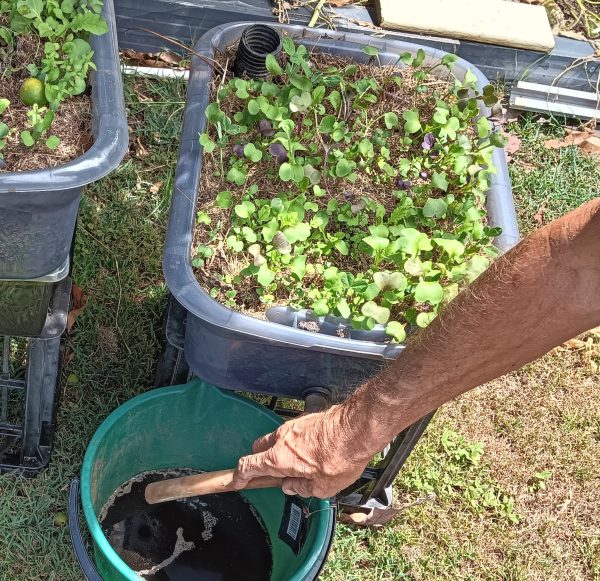
This is pretty simple. Every couple of weeks we just take a box that has finished its growing period, put a lid on it and flip it over. Load the base, no more than half full, with freshly processed soil, flip the previous soil back into the box, clean up and reseed.

Creating fresh soil

We now come to the big challenge – how to turn organic waste, particularly food waste, into soil teaming with beneficial microbes and nutrients. Sounds simple, but it is not. This is the best way I have found to date – it works and is pretty simple – but I spend my time trying to find an even better way. That is what I do when I am not writing my posts. As an engineer I would describe this as a dynamic problem as opposed to a static problem. It would be a static problem if we just had a mountain of food waste and all we had to do was to turn it into a mountain of healthy soil. But it is a dynamic problem with a steady stream of waste food being produced every day and us needing a supply of fresh soil to put into a fresh Gbiota box every couple of weeks or so.

Collecting the waste

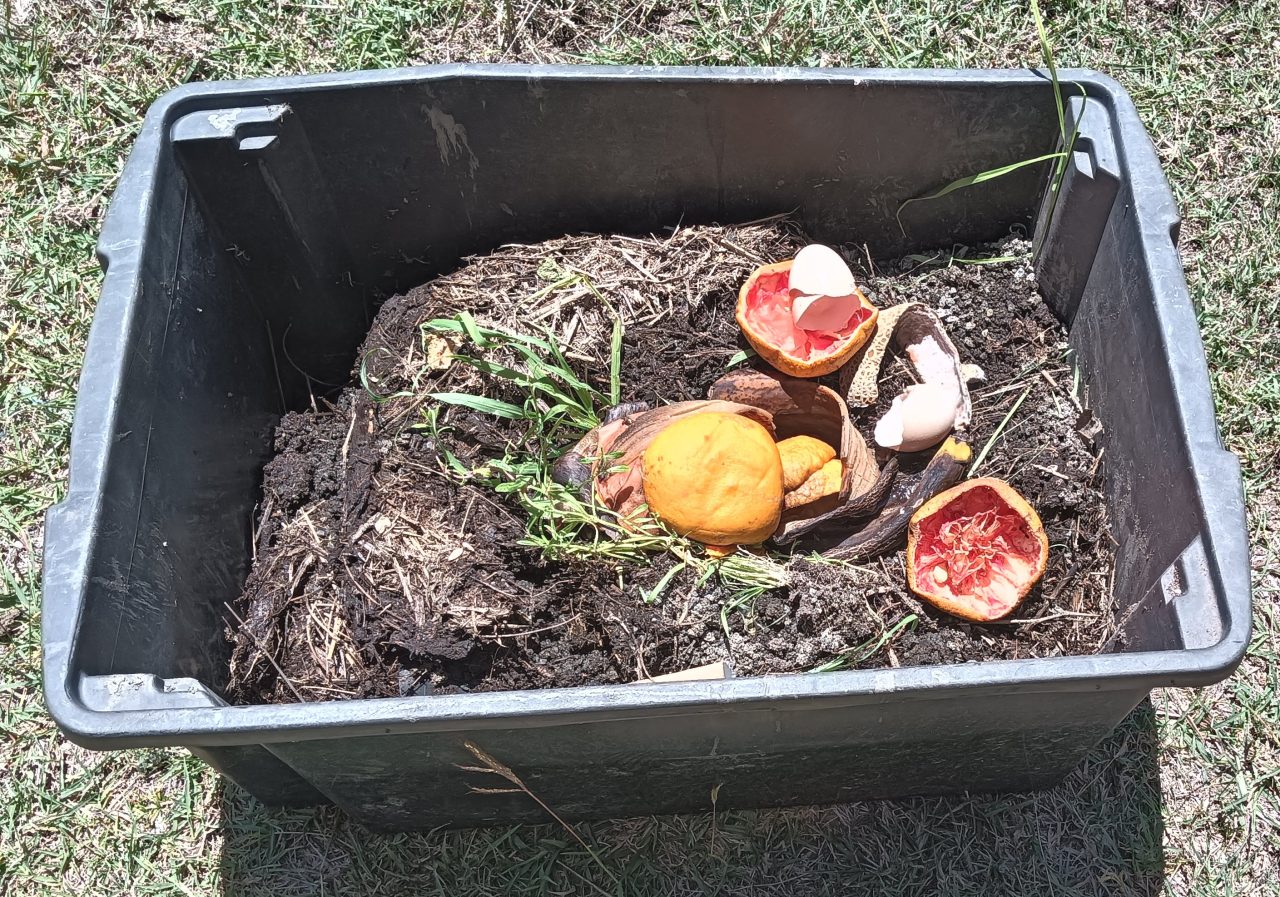
Food waste is produced on a continuous basis – the remains of the apple we have just eaten, the coffee dregs that got us going this morning. And that bit of chocolate that I could not finish in the evening – no, that is a lie – I am a pig and a chocoholic and would never leave a bit of chocolate. But you get the message. What I do is to have a number of containers, typically old yoghurt containers, around the house to collect any food waste. I empty these into a box which I keep on my patio. Actually I have two boxes because this is an ongoing process.

Initial decomposition – the first box

The first box is for the first initial stage in the decomposition process. The last thing you want is a box of smelly rotting food on the patio – that will result in an earful from my wife (believe me, I know). Food is a high-energy input – too high for growing plants – so I typically add a low-energy source like grass clippings or any vegetation that has been chopped up into little bits.

Nitrogen

Then I need to add a source of nitrogen – the decomposition process takes a lot of nitrogen. I use chicken manure partly because it is readily available and my boxes are outside on the patio so smell is not an issue for me. It is possible to buy processed chicken manure but any microbes will be long dead, though there are other sources. Blood and bone is really good and can be bought in small packages with other additives.

Minerals

Now I add minerals in the form of crushed rock. The best rock dust is from volcanic rock which contains a broad spectrum of trace minerals and, if available, can be bought cheaply from a local quarry. Bauxite, which contains magnesium – a critical mineral – is more widely available. The other two minerals commonly in deficit are iron and zinc. Trace minerals are available in retail packs but are expensive. These are readily available in retail packs and can be stored and used when needed.

Inoculant

But now we come to the difficult one – the inoculant which contains a broad spectrum of soil creatures including microbes, fungi and worms and, more particularly, worm eggs which are less robust and less likely to die in transport. I am looking to set up local breeders but at this moment I can supply directly in 4Kg packs which is enough for twelve weeks. At this moment these are only available in Australia and there are some quarantine restrictions in Western Australia and Tasmania. I am looking for growers. The best process is to set up the box and, when ready, order the inoculant (email me at colin@gbiota.com) which will be posted on the next Monday and will need to be emptied straight into the box. Please note, and this is important, inoculant contains living creatures so cannot be stored. I add trace minerals to my inoculant but I still recommend adding some bauxite-based rock dust which also adds texture to the mix, or failing that some regular garden soil or, yes, even clay which is actually nutrient rich. It is important to keep the box moist. Hopefully you will have read the introductory article on Gbiota Triboxes and read the discussion between having a box with holes in the base feeding into a storage container and the swivel tube system. For growing boxes I came out in favour of the swivel tube as it is so easy, but in this case I have a preference for the box with holes in the base as the last thing you want with labile (fresh) compost is it sitting in water and the holes in the base allow complete drainage.

Decomposition – the second box

The first box will get the decomposition process started but our aim is not to simply compost but to breed the beneficial microbes – a bit different. Plants exude sugars from their roots which attract and feed beneficial microbes. It is not really practical to grow plants in this first box, as we are regularly adding fresh food waste so it is not really suitable for growing plants. But when the decomposition process has progressed, some material (maybe 15–25% of the box) can be taken out and placed into a second box with some soil. It is now possible to grow a green manure crop with plants like buckwheat, snap peas, alfalfa, mung beans, amaranth etc. in this semi-matured compost. As the compost is taken out it is replaced by new food and organic waste. This is an ongoing regular process rather than a one-off. There are pretty tough plants which can grow quite happily in this rather young, labile, toxic compost. The breeding process will continue in this second box with the partially decomposed material feeding the worms. Just make sure when you are transferring the material that you have a good supply of worms and don’t hurt them when transferring. Worms may not appear to be aggressive but they have a long memory and will rip you to bits when you are buried – that’s bullshit of course – worms are very well mannered so wait until you die before they rip you to bits – very polite.

The growing box

Every couple of weeks or so some material is taken out from the second box and placed in the base of a growing box which is then re-filled with the existing soil.

The relay race

It is a bit like a backwards relay race. A hole is made in the second box and the material used for a growing box. The hole in the second box is then filled with material from the first box. Then the hole in the first box is refilled with new fresh waste. Difficult to explain but easy when you see it in action. Watch the video “The gut brain food cycle”: https://youtu.be/ddlN47Hy2OY.

Not just baby greens

I have been promoting baby greens for the good reasons that they are the most nutritious and easy to grow without having to worry too much about the pesky insects. But you are not limited to baby greens – any conventional plant can be grown even if it has a long life. I have a box of spinach which has been growing longer than I can remember. But I am using the soil blood from the upstream boxes which both wets the soil and delivers valuable nutrients and microbes. Great stuff this soil blood – one of the best things about the Gbiota system.

Loading

Tribox story

Tribox story

I am busy writing up the latest manual on how to make and manage the latest Gbiota boxes when I realised I needed to tell the Tribox story.

Tribox – the grandfather

The Tribox is the grandfather of the latest Gbiota boxes. The top box is essentially a normal growing box, just like the millions of pots that are used across the globe. It is filled with soil or, if no soil is available, commercial potting mix, and then seeded and watered on a regular basis. tribox-diagram-colin-austin-gbiota
Read more here – Gbiota intro The growing and breeding boxes have a hole or multiple holes so that all the water can drain away. Waterlogged soils not only kill the plants but allow harmful organisms like root-eating nematodes or E-Coli to breed. We control the species of organisms in the soil by controlling the conditions – specifically the balance between water, air and nutrients. This is called Eco-balance and has been tested over millions of years. Read a longer article about evolution here. drilling-tribox-hole-colin-austin-gbiota
The difference between a regular growing pot and the top Tribox is that a conventional pot is watered with fresh, clean water, while the top Tribox is watered with a brown liquid full of nutrients and living microbes which we call soil blood. It does the same job as our blood – circulating nutrients and living cells around the system. The middle box in the Tribox tower is where the microbes breed. It is initially filled with organic waste, typically kitchen waste, but it could be any organic waste – grass clippings are particularly useful as they are low in nutrients and balance out the often over-rich food waste. Plants don’t like too rich a soil – read here about how water moves, where I explain osmosis. The middle box has holes in the base to drain any excess liquid away. The bottom box is purely to catch the excess water that drains away. soil-blood-gbiota-bed-colin-austin-gbiota

Circulating soil blood

There are two absolutely essential features of the Gbiota system. Read more here. In a conventional growing pot the water is essentially stagnant; in a Gbiota box the soil blood is regularly flushed and drained away, adding nutrients and microscopic life to the soil.

Flood and drain

Beneficial microbes need to breathe. If there is no oxygen then harmful microbes like root-eating nematodes or E-Coli will breed. In the Gbiota system the boxes are partially flooded, which expels any stale air, and then drained, sucking fresh air back into the soil. water-air-nutrient-colin-austin-gbiota

People are busy

The Tribox works fine but has one disadvantage – to add extra organic waste to the middle breeding box or to collect the soil blood from the bottom box, the boxes in the tower have to be lifted off to allow access. Honestly, not really a big deal, but people nowadays seem to be excessively busy and just don’t have any spare time – even if the benefits are a longer, healthier life and avoiding all those horrible chronic diseases which occur because our modern food system is not feeding our gut brain. The gut brain goes into emergency mode and makes us store the wrong fat in the wrong places. Read more here. I want everyone to benefit from the Gbiota system and have a healthy gut, so I think: how can I make this system as simple and easy to use as possible? types-of-food-colin-austin-gbiota

Merging the middle and top boxes

The first step was to merge the middle and top boxes so, instead of having a box for growing the plants and a separate box for breeding the microbes, we just have one box with the bottom full of organic waste to breed the microbes. NB: you don’t just throw a bunch of rubbish into the bottom of the box. You need an inoculant with starter microbes and minerals to feed them (and you). This is all covered in our manuals. For direct help you can contact me at colin@gbiota.com. trixbox-waste-colin-austin-gbiota
The top is to grow the plants which act as carriers for the microbes to our gut brain. There are arguments for and against merging the boxes. The argument for is that plants exude sugars from their roots which feed the microbes, which is clearly good. The argument against is that labile or young compost produces both methane gas and other growth inhibitors. The only way to tell is to do experiments – which I have done – and, if done properly, this system of a single box with two layers works fine. This reduces the number of boxes from three to two, but to circulate the soil blood the top box has to be lifted off, the soil blood poured into another container, then the soil blood poured onto the top growing box. tribox-top-growing-layer-colin-austin-gbiota

Two down to one

But we can reduce the number of boxes to just one by fitting a swivel tube to the base of the box so we can drain the soil blood and flood the growing box. This makes operation extremely simple – just drain the soil blood out into a temporary container (I am using an old 3 litre milk bottle), twist the swivel tube into the upright position so it does not drain, then pour the soil blood onto the growing box. What could be simpler? But the question is: will it work as we expect? Again, there is only one way to find out – run some experiments. tri-box-swivel-colin-austin-gbiota

The experiments

I did this and what did I find? I had two sets of boxes in my experiments. The first set of boxes had the two boxes, with the top box having holes in the base allowing the soil blood to flow into the storage box below. The second was just a single box with a swivel tube and a milk bottle to collect the drainage. triboxes-vegetable- colin-austin-gbiota

tribox-milk-bottle-colin-austin-gbiota

Some things in life you cannot miss

No one is fully in control of their lives and it just so happened that, at the end of the experiments, I had to take an extended trip for a vital mission – actually to attend my granddaughter’s high school graduation. As the boxes with the swivel tube were really little more than modified Wicking boxes I thought I would be smart and flood the boxes and leave the swivel tube in the up position so there would be a reserve of water for the plants.

What did I learn?

At the start of the experiments I was at home so I could manage everything and it was just obvious that the swivel tube system was the easiest to use. I have been playing around with Wicking Beds for some three decades now and know the big danger is having the soil too wet, so I was very careful to ensure I was not over-watering. With the swivel tube system there is always some water left in the bottom of the box so I fitted a sight tube (just a bit of ag pipe pushed into the soil) so I could check that the water had been used up before I watered again. That put the swivel tube system in the lead over the two-box system and it was clearly the system I was going to promote. But when I was away for the best part of a week I had been too clever by half in trying to use the swivel box as a normal Wicking Bed with a built-in water supply. When I returned the plants had started to turn brown – a sure sign that they were suffering from waterlogging. However, the plants in the twin box system (which had a hole in the base so there was no possibility of them becoming waterlogged) were fine. The plants were showing signs of beginning to wilt after being left, but as soon as I watered them they sprang back into life. tribox-wilting-colin-austin-gbiota

triboxes-vegetable- colin-austin-gbiota

So what is the action plan?

I had started to write the manual promoting the swivel tube system, but I have just put that on hold while I repeat the experiments – making sure I twist the swivel tube into the drain position and allow time for the plants to use the remaining water in the base of the boxes before re-watering. I am pretty sure that as long as I don’t do silly clever-cloggy things and try and store excess water so the soil is left saturated, this will work fine and will be my recommended system. However, having been involved with supporting people using Wicking Beds for many years, I know that people so love their plants that they cannot resist over-watering. So I will give them the option of using the twin box system with holes in the base of the box which pretty much guarantees that the soil will never become saturated.

Today’s punch line

Use the swivel tube system – it is just so easy – but fit a sight tube so you can see the water level and don’t keep on topping up with water unnecessarily, however much you love your plants. Waterlogged soil is no good for plants. And if you want to ignore my advice – just grow watercress. It just loves water and it is full of iron anyway. Next read About Gbiota.

Loading

Gbiota meaning

Gbiota meaning

Gbiota meaning

Colin Austin©12 November 2023 This document is published under the creative commons system which means that it may be duplicated, copied and distributed without further permissions other than acknowledging the source Colin Austin at gbiota.com

Ask me what Gbiota is all about and I would reply the survival of our species. You may think that I would be talking about climate change, the degradation of our soils or even some new plague.

And certainly I will talk about those – but later. First I have to talk about what Gbiota is really about.

Charles Darwin and the survival of the fittest

And to start I will talk about Charles Darwin – one of the worlds great lateral thinkers. Humans love to simpify complex ideas into a simple phrase like survival of the fittest, which is a gross over simplification of what Darwin actually said.

Richard Dawkins and the selfish gene

To explain what he actually said I would have to refer to another great lateral thinker – Richard Dawkins with his theory of the selfish gene. This is complementary to Darwin’s thinking - saying that all creatures, including humans, are dominated by the survival of the genes.

Passing on our genes

It is simple – all creatures die and those species that do not pass on their genes have long since gone extinct.

Humans are no exception, our prime purpose is to pass on our genes and despite all the advances in technology the only way we can do that is to find a mate of the opposite sex, copulate, have children and care for those children until they are old enough to look after themselves and repeat the process.

Protecting our genes

Our natural instinct is to protect our genes and in the first instance that will be out direct children.

But similar genes will be in our family, so we have a natural instinct to protect their children, and hence similar genes, of our brothers and sisters and other close relatives.

But we are not an animal that is well equipped of solo survival so we have evolved into a tribal creature and withing that tribe their will be similar genes so again we have a strong desire to protect these similar genes within the children of our tribe and as we have our matured to form complex societies, the children and genes of people in the same country.

Why we go to war

It has been a long standing puzzle to me why we go to war, and to risk the total annihilation of our species in an atomic war, when we are all the same species. OK there may be local variations in trivial issues like skin colour and other trivial adaptation to local conditions, but we are all the same species.

So why do we go to war, and indulge in mass killings of the creatures of the same species? This is a distinctly human characteristic not found in other animals, they may kill for food but the do not risk total annihilation of their species.

Thanks to Charles Darwin and Richard Dawkins we can now understand that this is this innate desire to protect the genes closest to ours.

Finding a mate

Humans are a complex creature with a variety of sexual desires.

But look at all the couples you know, some couples will be very similar, as that helps preserve similar genes while others are very different as it is somehow instinctive that increasing the diversity of the gene pool is more sustainable.

There is a strong desire to have healthy children to pass on our genes and it is natural to look for a mate which will lead to the protection of our genes by having healthy children.

The role of fat in selecting a mate

As we have this in-built desire to protect our genes it is natural that we will look for a mate which will lead to the healthiest children. Now whether this offends modern protocols, fat plays an important part in this selection.

It may offend social norms but we use fat to help us select a suitable mate that will protect our genes.

Different cultures may have different interpretations of what distribution of fat indicates a partner that will lead to children with healthy genes, in some cultures fat is considered a good sign while in others being skinny is considered a good sign.

But despite the social enigma, we simply cannot deny that fat, and its distribution, is a factor in selecting a mate, even if it is subconscious.

Where we store fat

At last I am getting to talk about Gbiota, you may say with relief.

But first let me say that fat is not bad, we have evolved in a world where food supply was unreliable or at least seasonal so we have evolved to store fat to survive. Fat is essential.

We store fat in three different ways.

There is subcutaneous fat meaning fat just under the skin. This fat is decidedly beneficial. I have read nothing negative or harmful about this type of fat, it provides a layer of thermal protection and also physical protection and in all cultures is considered attractive.

However the prime storage area for fat is our bum – that is what it is there for – to store fat when food is in short supply.

Different cultures have adopted different views on storing fat in the bum but whatever is considered appropriate, and may be admitted openly in the various cultures, a nice rounded bum is universally considered a good indicator of a mate that will ultimately lead to healthy children and the protection of our genes.

The third storage are is visceral fat, fat around or in our vital organs.

Medically this fat is generally considered harmful and is the major cause of the modern epidemic of chronic or non-infectious diseases such as diabetes, heart attacks and dementia.

However there is some evidence that a certain level of this fat can actually be beneficial and lead to a longer life.

It is plausible that at some time there will be a scientific paper showing a bell shaped curve for the health benefit of fat with an optimal level of fat – Goldilocks fat, not too skinny and not to fat – just right.

So what makes us fat (or skinny)

At last I am getting close to talking about the Gbiota technology but there is a couple of points I need to make.

Medical science naturally looks at the body as consisting of separate organs requiring specialist expertise – after all if we have tooth ache we go to a dentist not a gynaecologist.

But the body is not like a car production line with separate organs and limbs being assembled at various stages along the production line. We are a totally integrated system.

No where is this more evident than with our gut and head brain. They are integrally connected via the vagus nerve and a whole range of hormones or signally chemicals circulating around in the blood stream.

Also the gut is not just a simple organism for digesting food – it consist of trillions of cell which communicate with each other to provide genuine intelligence.

But the simple fact is that we have really very little idea how the gut works as a brain but we can get some idea by looking at swarm intelligence.

Swarm intelligence

Swarm intelligence is actually common in the natural world and occurs when there are many individuals each with limited intelligence but combined they exhibit a greater level of intelligence that the sum of all the individuals.

We see this in flocks of birds, herd animals, many social insects like ants and bees and we can learn a lot from studying these but there is one swarm intelligence that is particularly valuable as a learning aid and that is slime mould.

This has no central brain like us, just what looks like a sloppy mess, but it does show signs of what we would call real intelligence.

Experiments have been done in which they put slime mould in a maze with food and as expected the slime mould has no knowledge of where the food is so just churns around in a random way until it finds the food.

That is neither interesting or surprising.

But, and this is the interesting point, put that same slime mould which has no real brain and it somehow now knows where the food is and so goes straight for it.

Why is this so interesting? It shows that swarm intelligence has learning capabilities and a memory and be trained. It is like modern artificial intelligence, it has no real intelligence or understanding, which is a distinctly human characteristic, but it can learn and be trained.

Back to the gut brain

Our gut brain works the same way that swarm intelligence works, it has no understanding – as our head brain has, it is just a collection of trillions of cells which communicate with each other to provide swarm intelligence which does have memory and can be trained.

We know this from studying cases where people have been deprived of food.

During the second world war people in Holland were starved and naturally lost a lot of weight, but when food became available they put on a lot of weight – they became obese.

That period of starvation had simply trained their intelligent control system to store fat whenever food was available.

Every living creature has some form of intelligent control system which regulates it bodies, whether that is temperature, breathing rate, heart rate, or appetite.

Our gut brain in action

Our gut brain regulates our appetite, deciding how much and what sort of food we want to eat. It learns this over time. It can sense if we are short of a particular mineral or vitamin, it learns that if we eat a particular food it may provide that missing mineral or vitamin.

Then in the future, if senses that we are short of that particular mineral or vitamin it will sends out signals saying eat that particular food that has previously provided that mineral or vitamin.

We see this happening in hot and dry Queensland. We can sweat a lot but we do not notice this because it is so dry the sweat just evaporates without trace, but that sweat contains many minerals.

At first we just feel thirst because of the loss of water, but just drinking water does no satisfy us, we hunt around the kitchen thinking I want something but I am not quite sure what, then we see a food that contains the missing minerals we develop an irresistible desire to consume that particular food or drink.

This is our gut brain at work.

Faecal transplants

One of the seminal experiments in changing our gut biome is by the yukky process off faecal transplants. Took the pooh of a fat person and poke it up the bum of a skinny person and they will get fat, and vice versa we can make a fat person skinny.

Using DNA sequencing we can readily identify the particular species of microbes makes us fat or skinny.

But that is purely an observation and does not provide the mechanism.

For that we have to understand that our gut brain is an intelligent control system. We all have a super computer in our gut. Unfortunately we have no idea of the code that drives that super computer.

If we change our gut biome we change how our super computer works, it may decide that we need to store extra fat and send out signals, which in reality we cannot resist long term so we end up fat (or skinny).

This is the basic reason why so many diets that restrict calories fail. By restricting calories we are training our gut brain to store more fat so when we finish the diet, which may have initially been successful in loosing weight, we end up fatter than ever.

Bit frustrating but life was never meant to be easy.

Association and mechanism

I would hate to be pedantic but it is so important to differentiate between association and mechanism

We do not get fat because we eat too much, there is certainly an association but simply eating too much is not the mechanism.

The mechanism is more complex.

We get fat because our gut brain has decided we need to store more fat. It send out signals for us to eat more, (which we can’t resist long term) so when there is a surplus of food the gut brain decides where that extra fat should be stored.

There is undoubtedly an association between eating to much and getting fat in the wrong place but eating too much is not the mechanism – it is the change in the gut brain.

What a couple

Let me illustrate this with the story of an odd couple – my wife Xiulan and me.

I am a natural pig – I was bought up in the second world war when food was in very short supply. I was trained (by a bang on the side of the head – very different era back then) not to waste food so even to this day I never leave food on the plate but eat everything in front of me.

I enjoy eating and that is my excuse.

I do have a bit of a belly but I am not diabetic – in fact for an eighty four year old I am pretty fit and healthy and go for a walk every day, ride my bike and dig my garden.

But I am an engineer and a bit of a messy person, I just eat the leaves from the plants in my garden, I don’t bother to wash them - just check that there are no caterpillars hiding away, hopefully successfully.

The net result is that while I overeat most passes through at high speed with just enough time for my gut to grab the nutrients as they wizz pass.

With the amount I eat I should be diabetic – but I am not.

My wife Xiulan is a medical doctor, a surgeon who is verging on being fanatical about cleanliness. She became diabetic and her foot was turning black and the doctors were saying she needed to have her foot amputated to avoid sepsis.

I managed to persuade her to change her diet and eat a lot of fresh vegetables grown in our garden and I am pleased to say it worked and she still has her foot.

She is naturally slim (unlike me) but she recently had an infection, went on antibiotics and developed a bit of a tum. She had not changed her diet but she had changed her gut biota which was the mechanism for her putting on extra weight.

The antibiotics did not cause her to develop a tum, the mechanism is that the antibiotic changed her gut biota to change which then caused her to store extra fat.

This mechanism is why we should not be feeding farm animals antibiotics. They certainly make the animals fatter which earns more money for the farmer but those antibiotics end up in us and are certainly a factor in the increase in obesity.

Our modern diet

Historically humans are not a fat creature, if you are a hunter gatherer with frequent contact with ferocious animals being fat means you are more likely to be eaten and the laws of natural selection say that it is difficult to breed from inside the stomach of a tiger so that genome becomes extinct.

Our hunter gather (and some modern tribes societies still eating healthy food) naturally have a healthy, divers gut biome.

But our modern food system is both short on essential trace minerals, which feed not only us but the microbes that make up our gut biome but much more important it is lacking the broad diversity of microbes that make up a healthy gut.

By our failure to understand the importance of a healthy intelligent control system, in the form our our gut, we have screwed up our gut brain.

This has led to the modern epidemic of chronic or non infectious diseases – not just obesity which is just the starting point but diseases that stem from the wrong fat in the wrong place like heart attacks, dementia and the fastest growing disease - diabetes.

It is important to understand that this increase to epidemic status is man made. These diseases are natural and have always existed but their rise to epidemic status is man made.

So what is the solution?

There are two parts to the solution.

The first is technical – how to regenerate a healthy intelligent control system or gut brain.

That is actually the easy bit – all we have to do is feed the gut brain which is what the Gbiota technology is all about. Fortunately it is easy, virtually any one can do it – it is based on recycling organic waste, particularly food waste so is inexpensive and gut brain food actually cost less then going to the supermarket.

It is also environmentally friendly recycling organic waste that would otherwise end up as green house gases.

This is technology has been developed over many years, it exists and is available right now.

But and it a big but, it required a behavioural change. Gut brain food is easy to grow but microbes have a very short life, one hour in a microbes life is equivalent to a year of human life.

So there is not much option other than to grow gut brain food at home and eat while really fresh.

Sounds so simple, and it actually is, until we get to the second challenge of how to get a societal behaviour change.

This is even more difficult in an economic system with food companies are spending literally multi billions of dollars in very clever but manipulative marketing to convince us that their food is healthy (when it is decidedly not).

Behavioural change

Creating behavioural change is not easy, made all the more difficult against this barrage of clever promotions.

In reality it is impossible to achieve by a conventional advertising and promotional approached – in the internet age people are almost immune to the promotional approach.

But they will take notice of people they trust and respect.

These are the leaders of future change to a new way we manage the earths resources.

Fortunately, even in the internet age where we are treated like dumb donkeys to be led the way they want, there are still many thinking people still left who understand that the world is descending into a sustainability crisis by the mass destruction of our natural resources – particularly from climate change and our soil structure (see I told you I would get around to that).

So the next step is to find some way of identifying these leaders for change – the paradigm busters.

These may be a small minority of the population but they are crucial for the survival of our species.

We then have to persuade them to study the real issues – like I have tried to do here and in the numerous articles I have written on food and sustainability.

There are literally hundred of such articles on my web and aslo on my YouTube videos @colinaustin1000.

We then have to rely on these people taking the initiative and using their power of influence sometimes by person to person but also using the power of the internet to influence people for benefit of the community.

This is a contrast to the way promotion works in the internet, which tend to be for the benefit of a privileged (wealthy) minority at the expense of the majority of the community.

I am Colin Austin please join me in my crusade.


Click below to read the full article here as a .pdf  please note this is published under the creative commons systems so you can copy and distribute as you wish without further permission other that acknowledge authour  colin austin @ gbiota.com

gbiotameaning

Loading