

Gbiota Videos

Gbiota Videos

This video library covers the core ideas behind Gbiota—how microbes shape soil, plants, appetite, energy, and long-term health. These short explanations help visitors understand why gut-brain food matters, how to grow it, and how communities can build a healthier future.

Understanding Health, Longevity & Appetite

We choose our lives

How to choose whether we live a long and healthy life or are fat and sick.

How your gut controls your appetite

Changing your gut microbes is much easier than you thought.

Fit or fat – gut microbes create the hormones

Store-bought plants often lack the beneficial microbes needed for a healthy gut.

Control appetite with gut microbes

How we need to change our food system to avoid overeating.

Why we get fat and sick

We get fat and sick because of deficits in modern food and missing beneficial microbes.

Ruminations – why at 85 am I still fit and healthy?

The long-term impact of breeding beneficial gut microbes.

Soil, Water & Living Ecosystems

Living soil

How eating plants grown in living soil improves health.

Living soil matters – it affects your health span

Soil biota improves gut biota, appetite control, and healthy longevity.

Living soil matters

The importance of mineral-rich, biological soils in human health.

No water – no food

How water movement in soil determines whether food heals or harms.

From soil to health

How improving soil biota enhances human gut biota and health.

How to Grow Gut-Brain Food

Your health your choice

How to grow plants in organic waste to feed your gut microbes.

Become a gut-brain food grower

Why we need local growers producing microbially rich plants.

Gbiota plants for gut health

How regenerative growers breed beneficial microbes in soil.

Growing plants to breed gut bugs

Practical guidance on microbe-rich plant growing.

Grow gut brain food — the starter

The simple first steps to begin growing gut-brain food.

The gut brain food cycle

Anyone with a patio or verandah can grow gut-brain food.

Grow gut microbes

How to improve health by breeding microbes at home.

Try it for yourself

Create living soil and eat fresh—judge the benefits firsthand.

Technology, Society & The Gut-Brain Food Movement

Taming the wild beast of technology

How technology can benefit communities instead of harming them.

A compassionate society

Why we need a gut-brain food industry.

Coordinators required for health project

Building community capacity for healthier living.

Creating a gut-brain food industry

How Gbiota technology ensures beneficial microbes out-compete harmful ones.

The Gbiota box story

The evolution of growing containers for microbe-rich food.

Growers for gut health

Calling for regenerative growers to supply the community.

Gbiota: Transforming Health Through Microbial Balance

A revolutionary approach to combating chronic disease.

Fake news, fake people and fake food

How fake food lacks the microbes that power our gut-brain.

Fire, flood and technology

Technology should be our servant—not our master.
 

Loading

Minister’s Reply on Water Reform and Water-Saving Innovation (2006)

Minister’s Reply on Water Reform and Water-Saving Innovation (2006)

In May 2006, Malcolm Turnbull MP replied to Colin Austin’s letter about Australia’s water policy and new technologies to harvest more rain. The reply outlines the Australian Government’s commitment to national water reform through the National Water Initiative, alongside funding support via the $2 billion Australian Government Water Fund and the Water Smart Australia program. It explains how project proposals were assessed through the National Water Commission and where guidelines could be found.


Context and Purpose

This page preserves a formal response from the Australian Government to a citizen’s submission on water policy and practical technologies that could help Australia harvest and manage water more effectively. The letter is addressed to Mr Colin Austin at Kookaburra Park Eco Village (Gin Gin, Queensland) and acknowledges his earlier correspondence about “water policy and new technologies to harvest more rain in Australia.” The purpose of this post is to present the content in a clear, readable format while keeping the original meaning intact.

Letter Details

From: The Hon. Malcolm Turnbull MP, Parliamentary Secretary to the Prime Minister
To: Mr Colin Austin, Lot 55, Elzards Way, Kookaburra Park Eco Village, Gin Gin QLD 4671
Date: 11 May 2006
Subject: Water policy and new technologies to harvest more rain in Australia

Acknowledgement of the Original Letter

The letter opens by thanking Mr Austin for his letter dated 27 March 2006. It notes that the topic raised concerned “water policy and new technologies to harvest more rain in Australia.” This acknowledgement matters because it places innovation and practical technology inside a broader national policy discussion, rather than treating it as a purely local or private issue.

National Water Initiative as the Core Reform Framework

The reply states that the Australian Government is committed to improved water management in Australia and “led the development of the National Water Initiative (NWI).” The NWI is described as having been considered by the Council of Australian Governments and signed by the Australian Government and the governments of all states and territories. In the letter’s wording, the NWI is presented as the “blueprint for water reform in Australia over the next decade.”

The letter further explains the intended direction of the reform: when implemented “fully and effectively,” the NWI would result in a “nationally-compatible market, regulatory and planning-based system” for managing both surface and groundwater resources across rural and urban use. In other words, it frames reform as a whole-of-system change—markets, regulation, and planning working together—rather than a single policy lever.

Funding Support Through the Water Fund

Beyond policy architecture, the response refers to direct financial support. It states that the government established the “$2 billion Australian Government Water Fund” to support the NWI and to help fund practical water solutions. The letter highlights that this funding support would be delivered “primarily through the Water Smart Australia programme.”

Water Smart Australia and Practical Projects

The Water Smart Australia programme is described as a large project programme that supports “on-the-ground water resource projects.” The intended outcomes are spelled out clearly: projects that make a significant contribution to sustainable and efficient management of Australia’s water resources, and that promote the uptake of new technologies and practices. The letter also includes an important boundary: the programme was “not intended as a substitute” for the existing water supply responsibilities of states, but it is positioned as a meaningful national commitment to innovation and best practice.

How Proposals Were Assessed

The letter explains that administration of the Water Smart Australia programme was undertaken by the National Water Commission (NWC). It states that all project proposals put forward for funding would be given careful consideration by the NWC against the programme guidelines, and that proposals would be considered on a competitive basis before advice was provided to the government for final decision. This section clarifies that funding was not automatic: it was structured, criteria-based, and competitive.

Where to Find the Guidelines

Finally, the reply notes that the guidelines for the programme could be found on the National Water Commission’s website, listed in the letter as www.nwc.gov.au. The letter closes by thanking Mr Austin again for writing about the issue and expressing trust that the information would be of interest. It is signed “Yours sincerely” by Malcolm Turnbull.

Colin Austin — © Creative Commons. Reproduction permitted for private use with source acknowledgment; commercial use requires a license.

Download ‘Minister’s Reply on Water Reform and Water-Saving Innovation (2006)’ (full PDF)

Loading

Aquaponics by Igor

Aquaponics by Igor

This is a post from one of our users Igor Grossman in Melbourne about his aquaponics systems. Although a different technology the basic aims of high nutrients and active biology are similar to Gbiota beds

[pdf-embedder url="https://www.gbiota.com/wp-content/uploads/2026/04/aquaponic.pdf"]

Loading

Gbiota easy

Gbiota easy

This is the simplest way to grow Gbiota food at home. It works extremely well, even though it does not include the automated flood-and-drain features of a full Gbiota bed. It is the best starting point for new growers.

What Gbiota Food Is About

Gbiota food focuses on beneficial soil biology and the nutrients needed to support a healthy gut microbiome. The goal is to breed good soil microbes, grow plants that act as both prebiotics and probiotics, and strengthen human gut biology. To breed beneficial microbes, you must feed them the organic material they thrive on. They break down this material for energy and outcompete harmful organisms. This microbial cycling has sustained life on earth for millions of years.

How to Make a Simple Gbiota Bed

This method uses basic materials and works in nearly any backyard.

1. Choose a Box or Crate

Use any crate, wooden box, polystyrene box, or tote. Ensure there are holes in the base for drainage.

2. Collect Labile Organic Waste

Gather young, partially decomposed organic waste or equivalent material. This provides food for beneficial soil microbes.

3. Measure the Compost Volume

Fill the crate once with labile compost to measure the quantity needed, then tip it out onto the ground. Alternatively, dig a hole the size of the crate and fill it with labile compost. This is especially effective when using food scraps, as it reduces odour and insect issues.

4. Add a Compost Slurry

Create a slurry using mature compost or a mix of compost and soil (at least 50% compost). Worm castings or mushroom compost work very well. Fill the box with this slurry.

5. Sow Seeds

Spread seeds densely across the surface of the wet slurry. Dense planting works well for baby greens and fast-growing crops.

6. Apply Gbiota Mix

Apply approximately 3 litres of Gbiota Mix per square metre. Gbiota Mix contains:
  • A full spectrum of minerals, including trace elements essential for human health
  • Specific microbial organisms that break down minerals and feed plants
Lightly water if needed to ensure contact between mix and seeds.

Why Worms Matter

Healthy soil biology and healthy gut biology are linked. Soil contains beneficial organisms that help break down organic matter. Worms play a major role: they rely on microbes to release nutrients, just as humans rely on gut microbes to digest food. In a well-fed Gbiota bed, worms often appear naturally. If not, they can be added manually. Keep feeding them with organic waste by lifting the box and adding more material to the compost layer beneath. This creates a closed system without attracting excessive flies.

Harvesting by Tipping

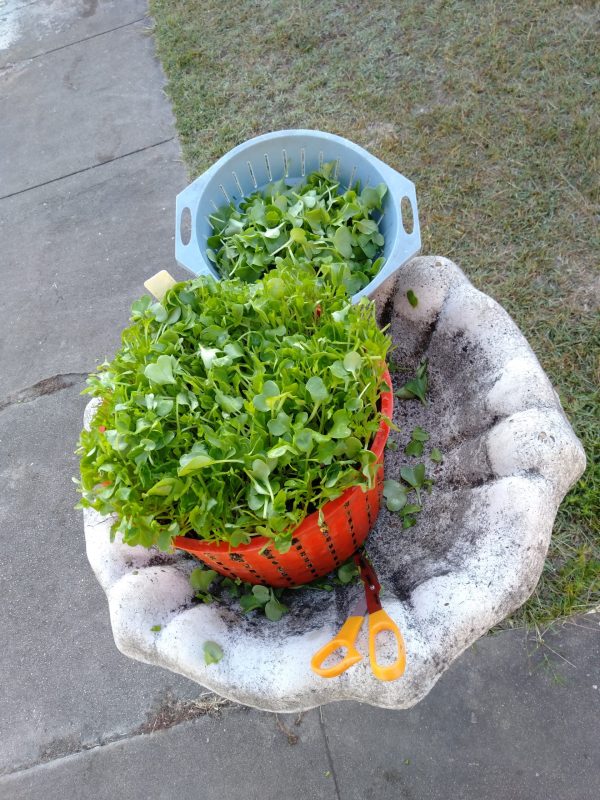
Baby greens are ideal for this system. When shoots reach around 50 mm, cut the growing tips. Cutting early encourages multiple regrowth cycles. Leave the lower leaves (“mother leaves”) intact—these power the plant’s regrowth. If you cut too low, the plant may not recover. Tipped greens can be used in salads, wraps, or blended into smoothies with fruits, extra virgin olive oil, milk, water, and spices such as turmeric, cinnamon, and black pepper.

Plant Life Cycle and Timing

Growth is slow during germination because the plant is using nutrients stored in the seed. As roots and leaves develop, the plant begins drawing nutrients from the soil and growth accelerates. Start tipping before the plant reaches maturity. Mature plants do not regrow well. Ensure mother leaves remain to continue photosynthesis and energy production.

The Floating Water Table Principle

This simple Gbiota system uses the floating water table effect. Water naturally moves toward finer particles, helping the bed retain moisture without flooding the coarse compost beneath. This allows worms to move freely while keeping the top layer consistently moist.

Loading