Website under rework, you are welcome to watch as  make changes and you can email me from contact


In-Ground Gbiota Beds

In-Ground Gbiota Beds

Sump Beds vs Basic In-Ground Beds

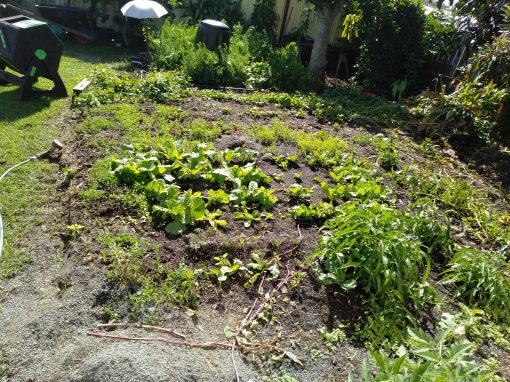
Sump beds were the first in-ground Gbiota beds developed to take advantage of the partial flood and drain cycle. They are automated with pumps and timers and are well suited to commercial or larger-scale growers. Many home growers, however, are put off by pumps, timers and wiring. To make Gbiota beds more accessible, we developed basic in-ground beds. These are extremely simple, very effective, and only need a manual check on water levels. For most home growers, the “tool kit” is just a spade, some Ag pipe, clay or plastic film, and a bit of energy to dig a shallow trench. Basic in-ground beds are almost embarrassingly simple, which is why they’re ideal for home and small-scale growers. They can even be partially automated later if needed. Understanding the drainage principles is important so you don’t end up with a soggy bed that favours harmful microbes.

Early Sump Beds

I started promoting wicking beds in 1995 to improve water efficiency and reduce watering frequency. Many of these early wicking beds effectively became self-watering pots. In 2015 I learned more about gut biota and its impact on health span. It became clear that the same wicking principles could be used to breed beneficial microbes by maintaining “Goldilocks” moisture levels in the soil – consistently moist but never saturated. flat-bed-colin-austin-gbiota
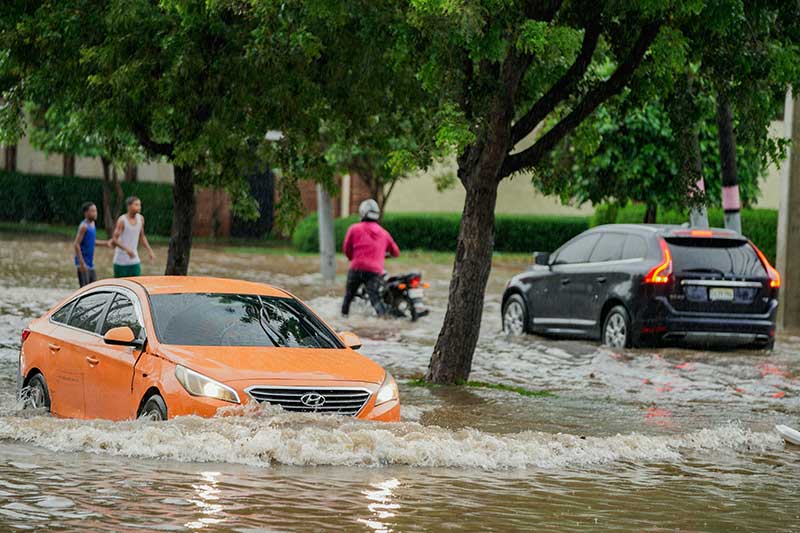
These early Gbiota sump beds were built during a dry period and used the partial flood and drain principle. The entire bed was raised above the parent soil and any excess water drained back to a sump. Beds were about two metres wide, lined with plastic sheet and hidden under the soil, so they appeared as large raised beds. The system was fully automatic, with overflow returning to the sump. The main challenge then was supplying enough water under very high evaporation and minimal rainfall. Over-saturation simply wasn’t an issue. In recent years, with heavy and more frequent rain events, beds needed redesigning to handle extreme rainfall and avoid prolonged saturation.

Sump and Pump In-Ground Beds

In-ground Gbiota beds have several advantages:
  • They stay connected to the existing soil life.
  • They can be built large enough to feed a family.
  • They can be automated and scaled.
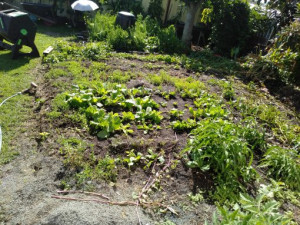
I have built beds up to 50 metres long, but many growers will be happy with beds around 10 metres. Multiple rows can easily give you 50 m² of productive area. With current climate conditions and frequent storms, I now build all in-ground beds as raised ridges. Even in heavy rain, the top of the ridge stays above saturation so roots can survive and plants can regrow after flooding. The layout uses:
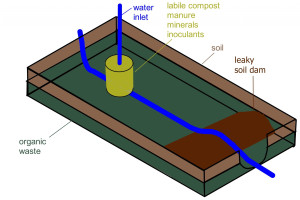
  • A sump or micro dam to collect drainage water.
  • Channels that collect drainage from multiple rows.
  • A pump on a timer that periodically feeds a manifold at the top of the beds.
  • Ag pipe along each row to distribute water and support the partial flood and drain cycle.
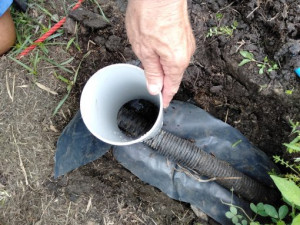
Earlier systems simply bent the Ag pipe up to the surface and used it as a fill point. With more intense rainfall, I now use a larger inspection/fill pipe sitting over the Ag pipe so I can see and feel the moisture level in the base of the bed.

How to Make an In-Ground Gbiota Bed

1. Dig the Trench

  • Dig a trench no deeper than about 300 mm. With heavy rains, a depth of about 200 mm or less is often enough when combined with a raised ridge.
  • Plan for the bed surface to finish above the parent soil level to improve drainage.

2. Create the Impervious Layer

Install a base layer to hold water long enough for it to wick:
  • Most commonly, use plastic film about 1 m wide with a 100 mm lip on each side, giving an 800 mm wet “channel” down the centre.
  • Alternatively, dig down to a heavy clay layer and line the trench with clay. This works but over time the clay may convert to more porous soil, so the bed may need rebuilding later.
The base must be flat and level. Test this by partially filling with water and checking for even depth.

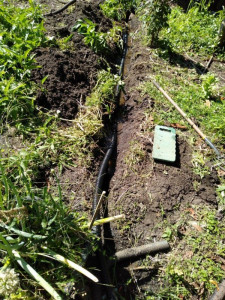
3. Fit Ag Pipe and Inspection Tube

  • Lay Ag pipe along the base of the trench so it is level.
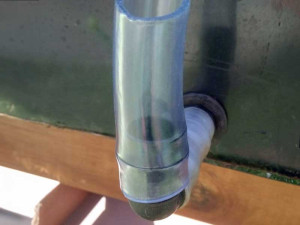
  • At the inlet end, fit a larger vertical filler/inspection pipe over the Ag pipe and cut the bottom at an angle. This should be wide enough for you to reach down and feel soil moisture.
  • At the outlet end, build a leaky soil dam at least 50 mm high so water must flood the base before it can escape.
The plastic film typically covers an 800 mm wide central base section. Wicking will lift water up and over the ridge and into adjacent soil, giving an effective productive width of around 1.5 metres, which is convenient for access.

4. Leaky Dam and Irrigation Cycle

The Ag pipe runs along the base, then up and over the leaky soil dam. The dam:
  • Holds water back until the base of the bed is flooded to about 50 mm.
  • Allows excess water to flow back into the sump once the level reaches the top of the dam.
With an automatic sump and pump, the bed is usually flooded once early in the day. This gives time for the water to wick up into the root zone and drain back to the sump during the heat of the day when evaporation is highest.

Filling the Bed with Growing Media

After the base and pipework are in place, fill the trench in layers:
  • Bottom organic layer: about 200 mm of organic waste (green waste, shredded plant material, food waste).
  • Manure and minerals layer: about 100 mm of manure, often blended with rock dust for additional minerals and improved structure.
  • Topsoil/growing layer: about 100 mm of good soil and/or finished compost for seed germination and root growth.
The finished surface should be raised above the original soil level to ensure good drainage during heavy rains.

Inspection Tubes and Moisture Management

In addition to the main fill tube, you can add one or more inspection tubes mid-row. These allow you to check whether water has drained away properly after irrigation or heavy rain. In wet periods, these tubes are useful for confirming that the base is not staying waterlogged. In practice, you can also use indicator plants (such as tomatoes) at key points in the bed: wilting suggests the soil is drying and irrigation is needed.

Feeding Worms and Soil Life

Worms are central to Gbiota beds. They:
  • Feed on organic matter and produce vermicast, a highly fertile soil.
  • Help shape soil structure and improve aeration.
Ways to feed them include:
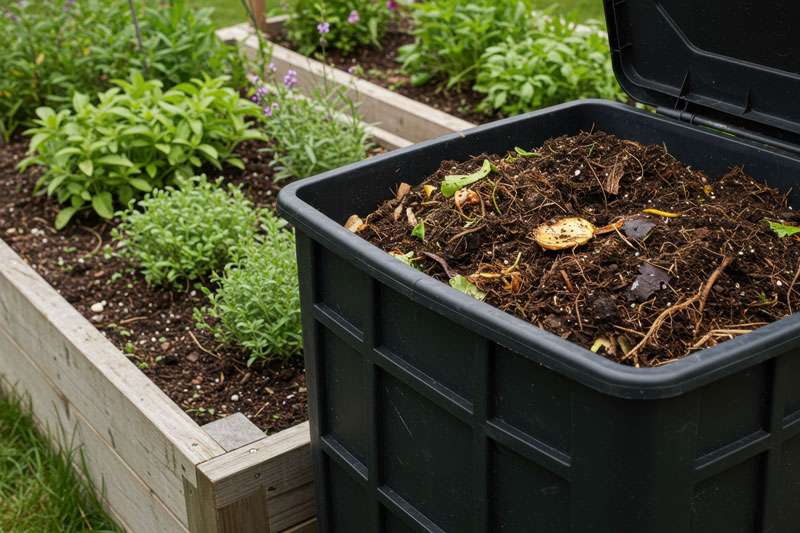
  • Placing open-bottom compost bins on the bed so worms can access the compost.
  • Burying perforated containers filled with compost.
  • Periodically digging a narrow trench down to the base, refilling it with organic waste, manure and minerals, as when the bed was first made.
This trench method both feeds the biology and produces excellent structured soil. The excavated soil is valuable and can be reused in Gbiota boxes for growers who don’t have access to in-ground beds. Water will also wick up and over the edge of the plastic film into surrounding soil. This zone can be used for deep-rooted crops such as alfalfa to make full use of water and nutrients. Paths on either side of the bed can be mulched with lawn clippings to suppress weeds and feed worms.

Growing Soil for Gbiota Boxes

In-ground beds are not only for producing vegetables; they are also a way of growing soil for Gbiota boxes. You can periodically:
  • Dig out the soil in a narrow trench above the Ag pipe, or lift the pipe and dig to the base.
  • Refill the trench with fresh organic waste, manure and mineral-rich material.
This buried material decomposes naturally and is processed by soil life, creating a deep layer of vermicast and biologically active soil. This approach avoids fly problems common in open compost systems and keeps nutrients cycling within the bed.

Basic In-Ground Gbiota Beds (No Sump)

Many people don’t want the expense or maintenance of pumps, timers and sumps. Basic in-ground beds offer a simpler option that still uses partial flood and drain cycles, but with manual watering and no sump. Instead of returning water to a sump, basic beds use soaker or capture zones at one or both ends of the bed to make use of overflow water.

Layout of a Basic In-Ground Bed

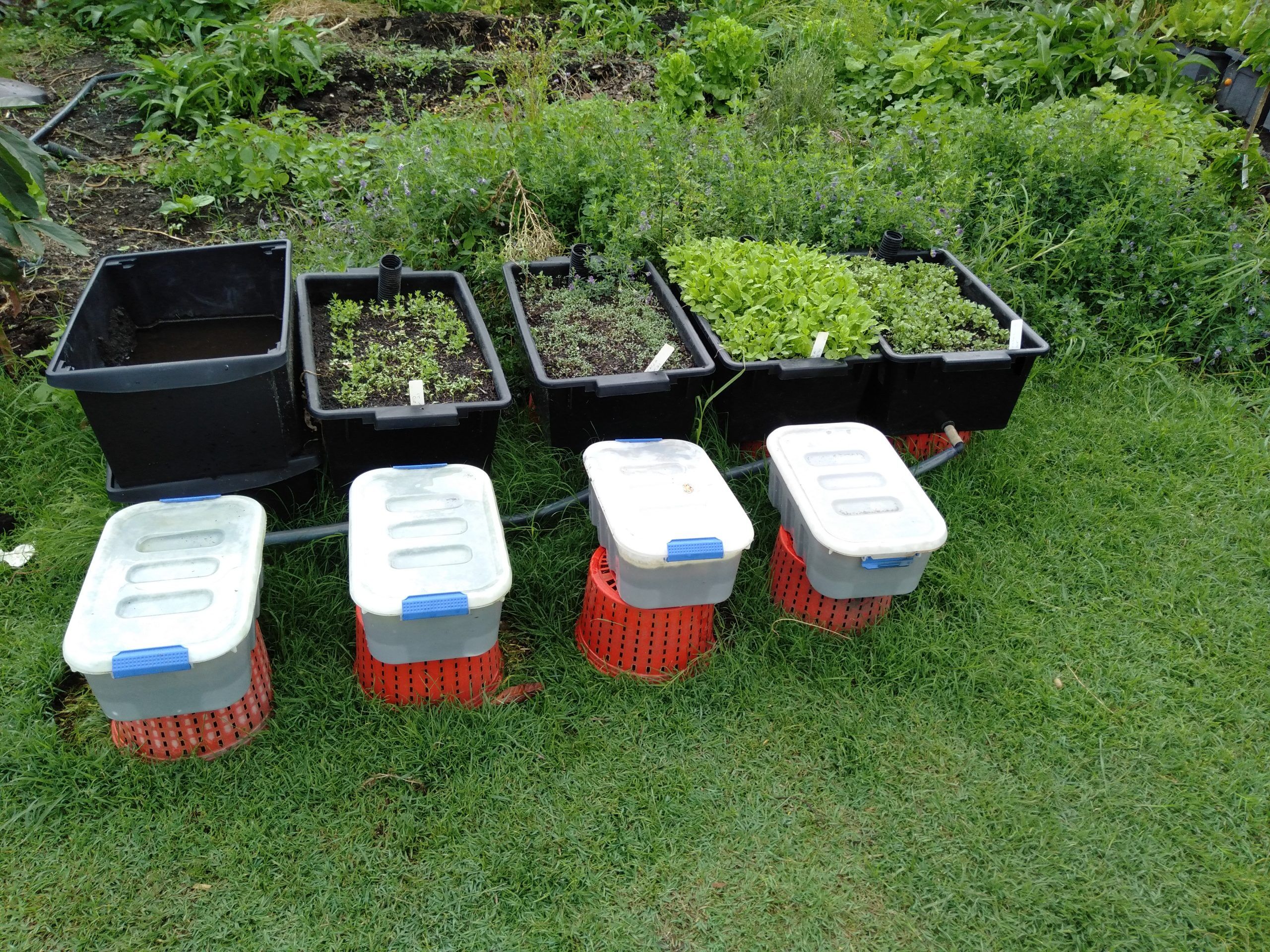
In the test bed layout:
  • A central filler/inspection tube is installed over the Ag pipe.
  • The plastic film runs to the very end of the bed, with one or both ends open so water can escape into the soaker zones.
  • The Ag pipe stops about 1 metre before each end and is curled up to the surface.
  • The last metre on each end is filled with soil to form soaker beds that capture overflow water.
down-tube-colin-austin-gbiota
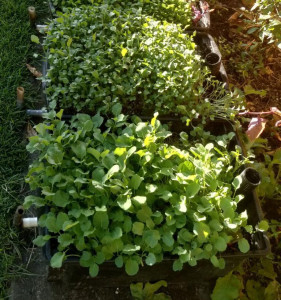
The soaker beds are ideal for water-loving plants such as lettuce, tomato, spinach or linseed, so excess water is not wasted. To check drainage, you can:
  • Feel the soil at the bottom of the inspection tube.
  • Observe the soaker-bed plants – wilting or stress can indicate dry soil.

Manual Watering and Moisture Cycles

If you are happy to water most days, a simple method is:
  • Trickle water into the inspection tube until about 50 mm of water has accumulated in the base. This is usually enough for a full hot day.
  • On days when you want longer intervals between watering, you can fill to around 100 mm, as long as you allow water to drain or be used by plants before watering again.
The essential rule is to maintain a deep wet–dry cycle:
  • Flood the base, let water wick up and feed the plants.
  • Allow liquid water to drain or be used so the bed is not waterlogged for more than a few days.
Even after liquid drains away, moisture held in the soil by surface tension will keep plants growing for several days, depending on climate and crop type.

Feeding Soil Organisms in Basic Beds

Feeding and maintaining biology in basic in-ground beds is very similar to sump beds. You can:
  • Use small compost bins on the surface.
  • Bury perforated containers of compost.
  • Dig narrow trenches down to the base and refill them with layers of organic waste, manure and growing medium.
This narrow-trench approach is very effective for keeping soil structure, biology and nutrient levels high, and for continuously growing high-quality soil for Gbiota boxes.

Loading

Food for health

Food for health

Download as .pdf

health-soil31aug22

Health starts in the soil

Colin Austin © 31st Aug 2022
This document is published under the Creative Commons system which means that it can be freely copied or republished without further permission - the only provision is the Standard Creative commons requirement that the source Colin Austin www.gbiota.com should be acknowledged.

Abstract

Part 1 reviews why we need to be breeding beneficial biota in our soils.

Historically four out of every five people died before their natural age from an infectious disease. Both medical science and our food system has responded by finding better ways of killing these pathogens. While largely successful we have also inadvertently reduced the number of beneficial biota which has led to an upsurge in non-infectious diseases such as diabetes, heart attack and dementia.

We have learned the hard way that we are totally dependant on these beneficial biota.

Part 2 is where we get practical and look at ways of breeding these beneficial biota in the soil. The focus is using organic wastes as the prime resource as it is clear that climate change is a threat to our food system and we need to move to a circular system based on recycling whatever is available.

Breeding the beneficial biota in food waste in a Gbiota bed does require space, time and skills which means its use is limited to experienced growers but we are promoting a system where skilled community growers prepare Wickimix - a growing media for wicking beds full of minerals and beneficial biota - is used to fill Gbiota boxes which gives access to healthy food to virtually everyone, even those living in apartments and with no time.

Fundamental shift

This is a fundamental shift in how Wicking Beds and our food system operates. Wicking Beds have been widely used for years and are seen as a self watering system to make life easier for gardener.

Gbiota boxes are still Wicking Boxes but there role is to change our food system so instead of all our food coming through the conventional system of mega farms and supermarkets some of our food will be grown at home in peoples houses or apartments providing plants deliberately grown to act as pre and pro biotics to feed our gut biota.

This is a very different ball game (or paradigm shift).


Part 1 The story of good and bad bugs

Four year old kids

Medical research is at an unprecedented level of sophistication so we should all be enjoying an unimaginable level of good health - yet we are not. We need to understand why, not at the level of the fashionable three word slogan, eat less exercise more or eat more greens we really need a deep understanding of what it going on.

Anyone who has experienced a four year old kid will know they just keep on asking question as they try and understand the world around them. We have to be equally frustrating as we keep on asking why, why why.

Simple solutions to complex problems

We live in an era of simple solutions to complex problems, inflation - just raise interest rate, health problem just take some magic pill - good for the advertising wiz kids but may be not so good for our health.

Let us take for example one of the most rapidly increasing diseases in this modern age - diabetes.

Diabetes

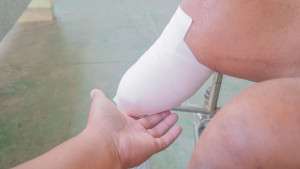
Every eight seconds some has a limb amputated from diabetes. Is diabetes serious? - big yes. Can it be solved by taking a pill - no way. Pills may help but they are no solution - so we have to keep on asking why.

Just asking why once does not give the answer, we just have to keep on asking why, why until we understand what is the real issue.

The first why tell us that with diabetes the blood flow is restricted so the limb starts to get gangrene. True but that does not help us much so we need to ask why do we get diabetes.

We know the feature of diabetes is high blood sugars which would normally be resolved by the Pancreas injecting extra insulin into the blood stream. But after a period of high insulin level the body becomes less sensitive to insulin which, at least initially, is not an issue as the pancreas simply make more insulin. On the road to diabetes but not there yet.

But after a period of time the pancreas begins to accumulate fat which reduces the capacity to create the insulin level to control the sugar level - then we have real diabetes.

amputated-leg-colin-austin-gbiota

Why does the pancreas stop making insulin?

So the next why is why does the pancreas become saturated with fats?

Because we are eating the wrong amount of the wrong sort of food.

But why? The answer to that lies in the gut biota - which controls appetite. The gut will send out hunger signals if either the gut biota is not correct or the body is short of critical nutrients - even if we are more than full of other foods.

We simply don’t feel satisfied if we are missing just one single essential nutrient or we have the wrong sort of gut biota.

Now we are getting closer to a solution - we need to ensure we are feeding our gut the right sort of food to get the needed gut biota and ensure that there are adequate amounts of the critical nutrients in our diet.

How we die?

But thinking like a four year old we have yet more questions. How we die? How long will I live? Kids just never give up.

Now you may have seen the statistics that a few generations ago the average age at death was in the low thirties and now is around eighty. Fantastic you may say - but it is more complicated than that.

Back then kids died from some infectious disease. Three out of five kids would die before they reached the age of 5 and another one would die in their teens so four out of five kids would die before the reached the age of thirty.

But if they lived until they reached thirty they were likely to live to an old age in fact typical of the age we are dying at now.

Although the average age at death may mathematically have been in the early thirties in reality very few people died in their thirties, they either died well before or long after the average age of death which mathematically was the early thirties.

Premature deaths

There is a certain age when we just die of old age - there may be some name on the death certificate but essentially it is just old age. But most deaths are premature - we die before we reach that age limit of some disease - it used to be some infectious disease which we have largely overcome but more commonly we will die prematurely from some chronic or non infectious disease.

But what makes us die Daddy?

Now that is a really penetrating question, stunningly so for a four year old. Infections used to be the most common cause of death, followed at a distance by accidents which were not properly treated so they died again from infection.

Before Covid I could have rabbited on about the enormous success we had had in beating infections and even so we have done a pretty good job.

But now deaths from Chronic or non infectious diseases have spiralled through the roof. Deaths from the side effects would be the classic example and no doubt our four year old will grill us on this.

The Covid paradox

Our smart four year old may point out how many people are dying from Covid so doesn’t that support the theory that we must kill of all those pathogens - whatever the damage to the good bugs.

But our smart four year old will ask why is it that some people get Covid and they don’t even know or the symptoms are so small it does not matter while millions of other people die despite the best medical technology.

I have yet to find a technical paper which has studied the relationship between Covid and gut biota but why some people die of Covid and others are hardly affected, has received medical research.

The two leading factors appear to be diet and stress. It is likely that people eating a healthy diet have a healthier gut biota which supports the argument that we should be paying attention to the good bugs.


Good bugs and Bad bugs

Let us not fool ourselves - there are really bad bugs which will make us really sick or even kill us. Modern antibiotics may have prevented us from dying from these bad bugs but they are largely still out there waiting to kill us.

So, throughout society we now take great precautions to prevent these bad bugs spreading and becoming a serious problem.

This is particularly true in our food industry and you can go into any Supermarket and be pretty confident there are no harmful bugs in the food you buy just waiting to kill you. OK there may be a very occasional outburst of E-Coli but they are pretty rare.

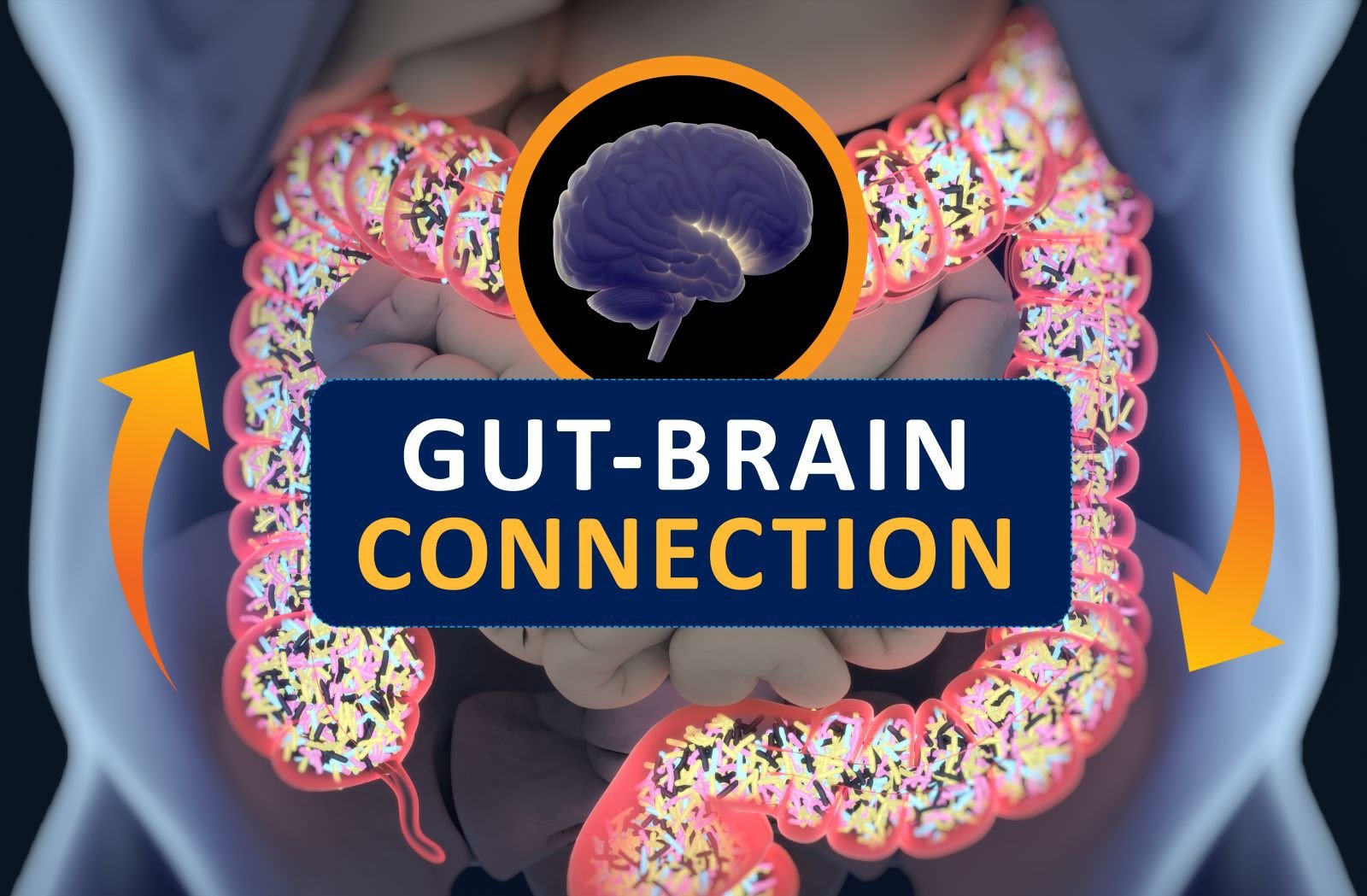
But there also good bugs which are totally essential for life, they are all over and in our bodies, particularly our gut. If you read any of my articles you will see it is almost impossible for me to write without saying how important our gut biota is, a real brain controlling our appetite, replacing our body parts and hosting our immune system.

Our gut brain is just essential for health and it is just a feature of modern life that in our efforts to avoid pathogens, the bad bugs, we have killed of many of the beneficial biota - the good bugs.

Much of our modern food system is really just large scale hydroponics with the nutrients being supplied by fertilisers and the soil doing little more than hold the plants upright.

Some growers will even go to the length of injecting methyl bromide into the soil to completely sterilise the soil and kill of all living creatures.

We are very good at killing everything but it is not so easy to kill the bad bugs and not the good bugs.

This is not healthy.

The punch line

So let me reiterate the punch line - we used to die largely from infectious diseases but we have managed to control the harmful bugs which kill us but we have also killed off the good bugs we need so we now largely die from chronic or non infectious diseases.

With the armaments of modern chemistry we are very good at killing things - but we don’t really have the technology of killing of the bad bugs without killing the good bugs on which our lives depend.

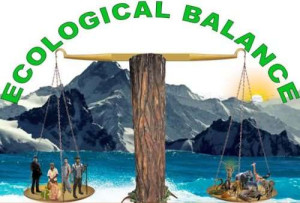
So what is the alternative? Ecological balance

Ecological balance

There has been some form of life on earth for the best part of four billion years yet the world is full of life - for a start there are some eight billion humans. How is it that so many humans have survived when there are all these bad bugs about?

These pesky four year old kids keep on coming up with the most penetrating questions.

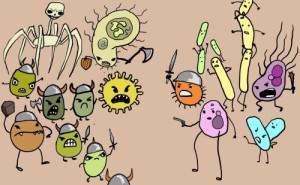
But this time the answer is simple - ecological balance. If the conditions are right the good bugs can simply out breed the bad bugs. May be not eliminating them but reducing their numbers so they become manageable.

Most people have E-Coli in their guts and they do no harm and no one even knows about it.

That is what the Gbiota system is all about, creating the right conditions so the good bugs can out breed the bad bugs so we can live a healthy life by growing plants which we eat to feed our gut biology.

One critical factor entails managing the moisture level so the good bugs can breed away and it is not too wet which are the conditions the bad bugs will breed in.

First line of defence

Now let me be very clear on a key point. Eating a diet full of beneficial biota is the first line of defence in living a healthy life and may well protect us from becoming sick. But it is only the first line of defence and not an alternative to the benefits of our modern medical system.


Who has the best guts?

The Gut Biota is the hot topic in medical research so there is a sea of studies to ponder over. We understand that the trillions of cells in our gut communicate with each other acting like a super computer. But what is clear is that the variety of different species has a significant impact on how well our gut brain works - just a few cells of a specific species can have a major impact.

From these studies we learn that the groups living a more natural life have a much healthier and more varied gut. So what do they have in common? It is not some specific plant - that magic plant which will solve all our problems from some remote part of the world is just a marketing myth - may be a very profitable myth - but still a myth.

Some groups are living on Tubers, other wheat, other rice, some sweet potatoes - there is no magic plant. But all the food is grown in soil which is near natural - full of decomposing organic matter with no toxic chemicals and almost always eaten fresh. This is an important point to note.

But before you go and adopt a hunter gather life style by sharpening up the broom stick handle to convert it to a spear to capture an antelope for dinner there is one point to notice - there are just a few thousand people living an old life style - there are some eight billion people in the world and we would run out of fresh antelope within a few days.

We have to learn the lesson from the past but we have to use modern technology to apply the lessons.

To breed the beneficial microbes we need a broad spectrum of inputs some carbon, some nitrogen, a range of minerals, inoculants to start the process and air and water. We also have to consider the need to move to a circular society where we recycle our waste food and organic wastes.

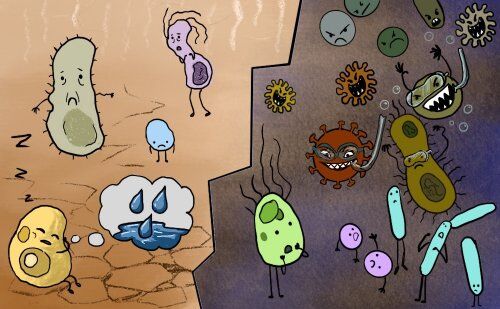
In fact air and water are the most critical - if the soil is too dry the biota will not breed - or at the other extreme too wet - the soil becomes anaerobic so we will end up with harmful biota.

We need that Goldilocks moisture - not too dry and not too wet - just right.

That is what the partial flood, drain and wicking system is all about.

Testing

How do we know if the Gbiota system is working. DNA testing can identify the various component in in your gut. We all have different gut biota so it is really best to be tested before starting eating Gbiota food and after to identify the changes.

The Gbiota team can organise independent testing. The results can show a change in gut biota and identify a change in variety and a shift to species which are generally considered more beneficial which indicates a probability of better health.

A lot simpler is to see if there is a change in food carvings which indicate either a lack of critical nutrients of a poor gut biota. If cravings are reduces accompanies by a weight loss then it is working but this does not mean you will be resistant to some unknown pandemic yet to emerge.

Part 2 - The practical side - breeding beneficial biota

 All this may seems very theoretical but in Part 2 we get down to the nitty gritty practical side of making it all happen.

Breeding the beneficial biota in food waste in a Gbiota bed does require space, time and skills. It may be an excellent way of growing gut food but it does require land, time and skills to operate correctly which means use is limited to those with a garden and the skills.

We are promoting a system where skilled community growers set up in ground Gbiota beds to breed the beneficial biota to grow Wickimix a growing media for Wicking beds. This is used to fill Gbiota boxes which gives access to healthy foods to virtually everyone, even those living in apartments with no time.

Fundamental shift

This is a fundamental shift in how Wicking Beds and our food system operates. Wicking Beds have been widely used for years and are seen as a self watering system to make life easier for gardener.

Gbiota boxes are still Wicking Boxes but there role is to change our food system so instead of all our food coming through the conventional system of mega farms and supermarkets some of our food will be grown at home in peoples houses or apartments providing plants deliberately grown to act as pre and pro biotics to feed our gut biota.

This is a very different ball game (or paradigm shift).

Gbiota beds

I am including this section on Gbiota beds as they are important because they are used to make Wickimix, the growing media with the beneficial micro and macro biota and minerals which are used in the Gbiota boxes. There are some people who want to know how they work even though they will not be using the technology directly and is just background information.

We have separate detailed documentation and provide technical support on how to set up and run Gbiota beds as it is such a critical part of the process.

If you just want to have gut food growing in your own home skip this section and go to the section on Gbiota boxes.

Creating the conditions to breed beneficial micro-biota

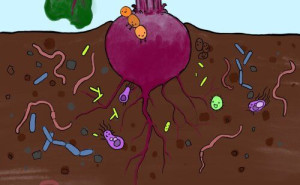
The main purpose of a Gbiota bed is to grow the growing media (soil) but even to do that we need to grow plants - they capture the energy from the sun and carbon dioxide to make sugars which they exude from their roots to attract and help breed the beneficial biota that in turn provide the plants with water and minerals that the plant finds difficult to extract by themselves.

This link between the plants providing energy and the soil biota providing water and nutrients is the greatest deal in the history of the world.

This is how a Gbiota bed works. We have a sump which holds water or rather compost tea. A pump controlled by a timer, periodically picks up the water which flows through sub-surface pipes to saturate the soil in the base of the bed with any extra water returning to the sump. At the end of the cycle the compost tea drains back into the sump.

A key feature is when the pump is running and the trench filling it is expelling the gases - like ethylene - which act as growth inhibitors and when the water drains away it sucks fresh air back into the soil. Water will wick up into the root zone providing a steady supply of nutrient rich tea to the plants.

Not exactly rocket science but it must be done right for it to work, as it should, to breed the right species of beneficial biota which will enter the plants which we will eat to enhance our gut biota.

paper it is a fully automated system but there is a big difference between automated and maintenance free - after all we are dealing with what some may think is pretty yukky water which has a great capacity for blocking up the pumps and pipes. So maintaining the system and ensuring that the inputs are controlled to breed the right species of biota is not exactly the activity for a working mum with a bevy of kids.

Water - that weird stuff

We are so used to water that we probably never bother to think what weird stuff it is. We may just get a bit angry when it expands when it freezes and burst our water pipes and certainly one of the weird features of water is the way it expands when it freezes - that is highly unusual.

 But that is only the start. Water has a fetish - it just loves other things and itself.

Water has a tensile strength just like a steel rope - that is how trees work. Here in Australia we have the Mountain Ash which grows to over a 100 metres tall. How does water get to the top? Simply by waters tensile strength. Water evaporates from the leaves and water is literally pulled up from the root zone (which is filled with water by a combination of osmotic and wicking actions).

Water is also attracted to other substances, when you come out of a shower you are covered in water droplets that don’t run off. Water has a fetish about your skin and just holds on tightly to your skin.

But is also has a fetish about soil, at least most soils, so you can wet a bit of soil and the water will just stay there, it won’t just keep on going downwards under gravity nor far sideways.

This is great - if the water did not stay in one spot hugging the soil there would be no life on earth. The plant roots, certainly aided by the fungi and soil biota will suck the water and dissolved nutrients out of the soil and into the plants so we have food to eat. Great!

Clay sludge

This fetish of water in liking things leads to the peculiarity of the sludge which is formed when clay (or soil containing clay) get seriously wet. Technically sludge is thixotropic which means that when at rest it has shear strength - in other words is behaves like a solid. This is caused by the water molecules bonding to the clay particles.

 This is an effect that many frustrated gardeners have experienced when the put in a drain to get rid of excess water in clay and despite the care in making the drain slop downward the water appears to defy gravity by refusing to flow.

But once the head (water pressure) reaches a certain level the water bonds are broken, the water flows freely in a big gush.

This is how we get the ever increasing landslides, the water builds up to an over saturated level but at some point the system collapses with disastrous results.

While there is no danger of a Gbiota bed causing a land slide it is important that the bed drains properly so it is properly aerated. It is particularly important in the base of the bed where water must flow freely to distribute the water uniformly to the biota and plants.

This is important in managing the bed and why we need to ensure a high organic content.

The flood, drain and wick cycle

But how do we get water to move through the soil so it waters a larger area. We simply have to add more water so it becomes saturated with the larger pores in the soil full of water when it will wick across the soil. Water will then move to fill the smaller pores.

But we do not want soil that is so saturated that the harmful pathogens will breed up so we have to do what nature has been doing for years, go through a cycle of wetting and drying.

To get the beneficial biota to out breed the pathogens we have to use a deep cycle, in other words we wet the soil so the water will flow and wick to other areas then allow it to drain. This is what the flood, drain and wick cycle is all about and is at the heart of the Gbiota system.

A community grower, eg a grower who is growing the soil for other people in their neighbourhood will use pumps and timers (or a solar panels with pump) which will automatically generate this deep cycle.

A consumer will typically have to create this deep cycle manually - that is why I have spent so much time to explaining about the weird properties of water.

So I will use block capital to emphasise this key point DO NOT KEEP ON TOPPING UP YOUR BOX WITH WATER USE A DEEP CYCLE.

Top and bottom watering

An interesting experiment is to take an old fish box and fill with soil. Pour a little water on the surface and it will not go down to the bottom (defying gravity is one of water weird properties) it just sits there.

Add more water and the soil will become saturated and then the water will start to flow downwards. But soil is never uniform so it will find a crack in the soil and move downwards leaving an area which is not properly whetted.

But the worse thing is that the surface layer will be saturated and seal off the lower layers from the air - we have the worst condition which will breed harmful micro-biota.

Now compare this with the bottom feeding system of the Gbiota bed. We saturate the base of the bed - there is no avoiding this - water won’t move through the soil until there is a zone of saturated soil.

The water, using the wonders of surface tension and wicking action, will slowly wick towards the surface.

But soil is never uniform with small and big pores. Surface tension will work in the small pores pulling the water upwards, but there will not be enough surface tension in the larger pores so they remain full of air - which is what we want to breed the beneficial micro-biota.

There is always a gradient in wicking action so as we get nearer the surface only the finest pores will be whetted leaving a pathway for air to enter the lower soil levels.

But we have a layer of saturated soil in the base which we drain out - and as it drains it will suck fresh air into the soil above.

The water - or rather compost tea returns to the sump ready for the next cycle.

The water is always moving - it is a continuous cyclic process - with the water never being stagnant for any length of time which will breed the harmful micro-biota which at worst will send us scurrying for the toilet and at worse will make us seriously ill or - the ultimate - dead.

Like any good film there are goodies and badies and we are just fiddling the system so the goodies win. You can call it cheating or creating an ecological balance - as you wish.

Gut biota has a short life cycle

Another very important factor is that the plants need to be eaten shortly after harvesting. Some component of the complex biota inside the plants will have a half life of only twenty four hours.

This is essential for the health benefits but also they taste so much better when fresh. We don’t have taste buds for nothing - they evolved to tell us when food was healthy.

So while Gbiota beds may be a great piece of technology they are really limited to people with a garden, growing skills and time and are happy spending their time recycling waste food, playing with manures and piles of rock dust and cleaning out pumps when they get blocked up from the organic waste. (That’s me if you hadn’t got the message).

But the aim of the Gbiota system is that everyone should have access to healthy gut food. Not everyone has my obsession with recycling and doesn’t mind a bit of yuk.

So we have made a two stage process.

Experienced local growers with a garden, time and the necessary skills (and think it would be rather nice if their grand kids had real food to eat) will set up Gbiota beds with the prime aim of growing Gbiota soil - which we call Wickimix.

This has to be a local operation so the Gbiota team provides the training and support to local community growers so they can set up these Gbiota beds to grow Wickimix which is put into boxes to grow plants which can be picked and eaten without the excessive delays that inevitably occur with remote growing.

Biota boxes

Everyone has a gut and it essential for health that we feed it gut food. The Gbiota box system make gut food available to virtually everyone, even people living in apartments with not garden, time of gardening skills.

Nothing special about the box

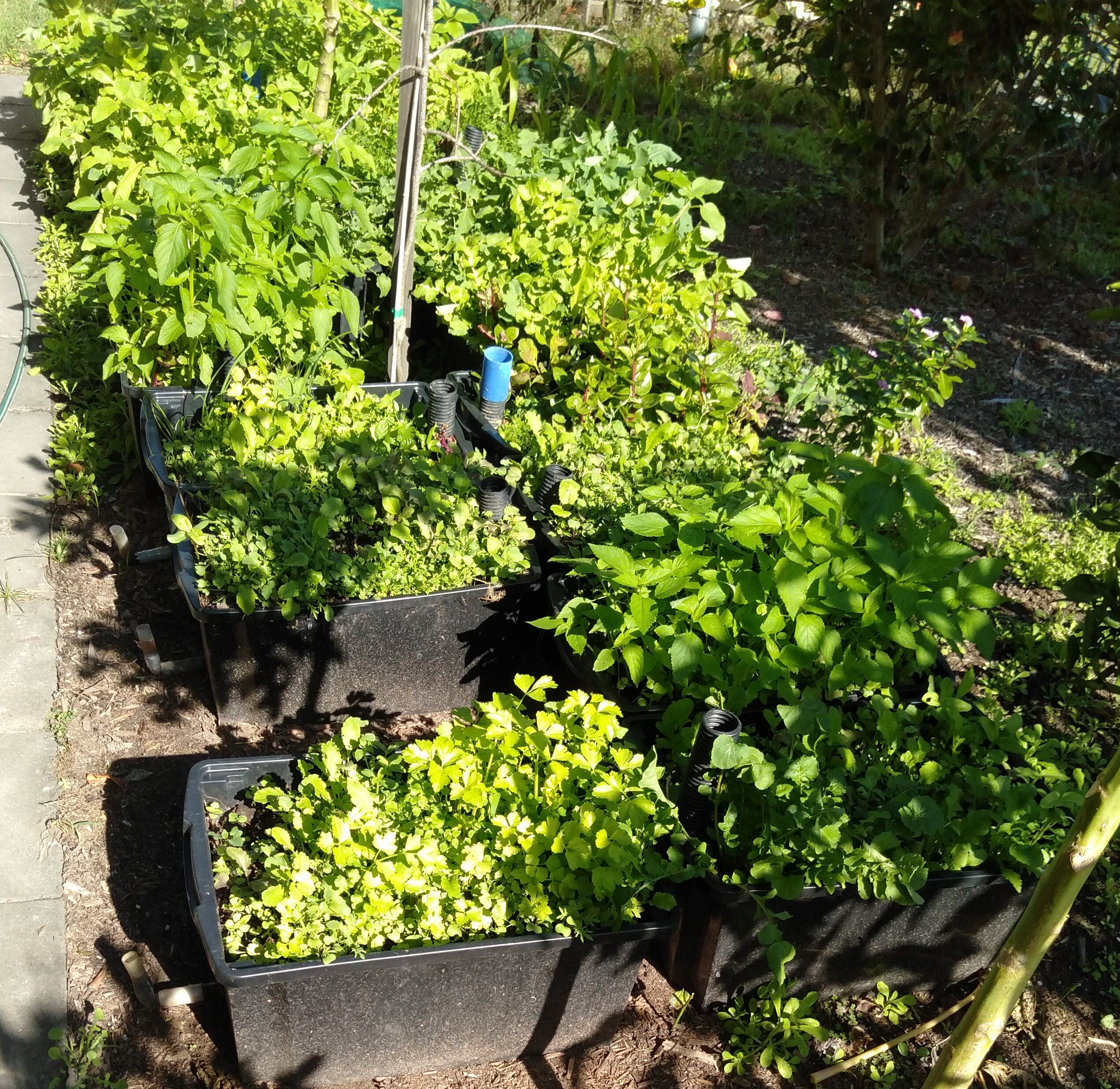
The box can be any shape or size to suit. It could be just a simple 20 litre tote box from the local hardware store or a full sized container bed a couple of metres long, there is no magic about the box itself - it is what that goes into the box that matters.

It does need a drainage hole drilled in the base and a standard irrigation fitting with a bit of drainage pipe in the bottom - people can make these themselves or the local grower can provide these as a finished unit.

Choosing a system that suits you

Small boxes

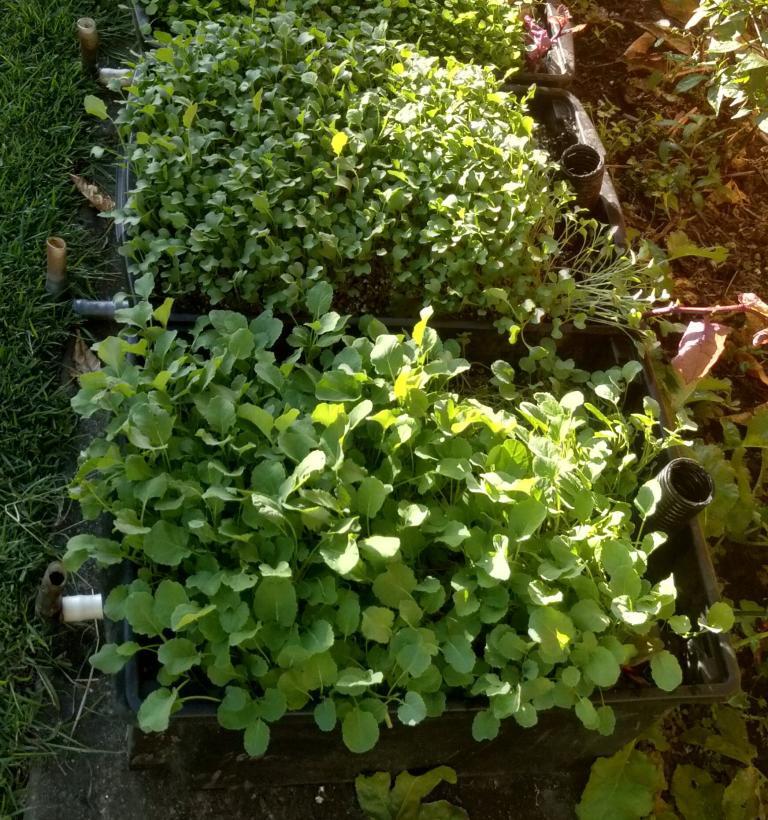
Peoples circumstances vary. If you are living in an apartment with little space the easiest way is simply find a local grower and buy a small Gbiota box of baby greens already growing, just water when needed and then swap the complete box (with new Wickimix) for another one when finished.

Your grower will make, fill the box with Wickimix which is full of biota and nutrients and seed the box for you.

Dead simple, just give the box a bit of water and harvest the plants when ready and leave all the problems to the local grower. You don’t need much space, a balcony or a widow sill is fine (plants do need a bit of sunshine).

 Gbiota boxes have a swivel pipe on the bottom which shows the water level. You can simply swivel the tube and see if any water comes out. If there is still water in the bed do not water, just wait until there is no water running out. You can actually wait a day before you water as there will still be plenty of water in the soil.

If there is still water in the box after a week you should let it drain out (catch it in a container - it is full of nutrients) so the water is never stagnant for any length of time.

You may like to help the grower - and the world - by donating your food waste to your grower so it can be recycled.

These small boxes, which are light enough to be swapped, are such an easy way to have fresh gut food growing in your home or apartment.

If you are not used to growing they are a great way of getting started.

But if you are ambitious you can move up to larger boxes which are too big to move about.

Larger boxes

If you have a larger space you may want to set up a larger box which can grow much more food and start recycling your waste food yourself.

These large boxes are just too big to move so you will need to know how to operate them properly to create the right conditions where the beneficial biota will out breed the harmful biota.

How to make a larger home Gbiota box

Start by choosing the size of box you want, the same principles apply to all large boxes (eg boxes too large to be just swapped).

You can make them yourself or ask your local grower to do it for you.

Don’t get confused - Wicking Beds are often used as a self watering system Gbiota beds and boxes still use the Wicking principles but were developed to breed beneficial micro-biota and are actually a lot simpler than the self watering wicking beds.

 Simply drill a hole of the right size to fit your irrigation fitting as shown as low as possible int the box. Connect this so a 90 degree bend with a swivel or sight tube on the outside and fit a piece of drainage pipe to the inside.

This can either just fit along the base or you can curl up to the surface. (The only reason for the curl is to help clean out the pipe should it get blocked - but you can also clean it out by connecting a hose pipe to the swivel tube. This can really amuse the kids as you can use the hydraulic pressure to lift the entire soil mass - great fun and teaches them about hydraulics.

Then make the compost tube. There are two ways to make a compost tube.

In soil compost tube

Take a length of regular pipe, about 100mm diameter and cut the bottom end at an angle of bout 45 degree (so the worms can get in) and the other end so it will sit about 200mm above the box.

Some people like to drill some holes just below the surface level of the soil, this makes another passage for the worms to enter and also lets the decomposed food waste flood out into the box.

I prefer to keep lifting the tube up as it fills which give more space for the food waste.

Normally you would put this in the box before filling so it will be empty.

You just put your food waste into the compost tube and cover with Wickimix - just enough to keep those pesky flies out.

Use the tube to water which will flow out of the bottom end taking some of the composted food waste with it.

You may find that you are making waste food faster than it composts so you pull the tube out, clean out the tube and wriggle into the soil in another area and use the contents of the tube as a mulch.

Depending on your Yuk tolerance you may prefer to use a surface or on soil tube.

On soil tube

The on soil tube is even simpler - just a length of pipe, about 300mm long which you just press into the top of the soil (to hold it in place) and fill with compost and Wickimix as with the in soil tube. 100mm diameter is fine but in a bigger bed 150mm diameter by 300mm high gives a good volume.

This is simply wriggled into the soil so it is not easily knocked over and filled with food and organic waste and periodically covered with Wickimix before the flies become a problem.

When full it is simply emptied and the contents used as a mulch.

 But we want the water to go right down to the base, so simply make a hole by pushing a stick down to the bottom of the box or better still use an auger to make the hole.

I have a collection of augers and hole makers I have brought from the local market for a few dollars. But that is just me - a stick or trowel works fine.

Filling the box

I usually fill my boxes in a series of layers which may look good at the start but the box will end up full of worms which will happily move the soil around.

If I am feeling wealthy I may go and buy some Vermiculite (a fine water holding rock) and fill the base to a depth of about 50mm. Or if I want to play with my slasher I will chop any prunings and small sticks laying around to make a woody base layer.

It is important to have a porous, freely flowing layer in the base.

Next I will add all the food waste I can find and make a second layer then add a layer of manure which helps the food waste to rot down.

Finally I will fill the bed with Wickimix from my Gbiota bed or in your case your local community grower. That layer need to be at least 100mm thick so the plants have a zone to put down their roots.

Then just seed and cover with Wickimix in the normal way.

How to manage a larger box

Feeding

To keep the bed working at maximum performance we need to both feed and water the bed.

Food waste is simply pushed into the tube. If you have a climate anything like mine in about two days there will be a mass of vinegar flies and within a week an even bigger mass of blow flies - which is not nice.

You may be lucky and get some Black Soldier flies which is good, except if you are not used to the larvae they can be a bit of a shock first time you see them but they are really good at breaking down food waste.

But you can solve this problem and add extra nutrient to the system by collecting the food waste over a few days in a sealed container, or just out put them in he freezer, then put the waste into the tube and covering with a good layer of Wickimix. Wickimix contains worms and the biota to break down the food waste.

You may collect food waste at a faster rate then it is broken down in which case you can simply move the tube to another location, just pull out the tube, push out any remaining contents and then wriggle down into a new spot. It is a good idea to clean out the tube so the new food waste goes straight to the bottom of the bed.

Before refilling with food waste it is a good idea to add some porous material to the base, either Vermiculite or slashed up woody waste. This will keep the base porous.

Some people find this a bit of a messy operation (because it is) so an alternative is just to have a piece of pipe sitting on the soil.

You can water the bed from the tube. If the tube get full you can lift the tube up (either in or on ground tube) and simply flush the contents out flooding the top of the bed.

Watering schedule

I only start the proper Gbiota watering cycle when the seeds have germinated and the root system has developed.

As I explained, and is important, you do not want to have the soil saturated for any length of time as this will create the conditions where the pathogens can grow. The soil needs to be whetted enough to make the water spread throughout the bed, then allowed to drain - or at least the water used up so there is a period when the soil is fully aerobic.

It needs to cycle with the flooding expelling any foul gases then drained to suck in fresh air so the bed is aerobic for most of the time.

In a Gbiota bed this automatically done by the pump and timer system which works really well without any thinking but in a box it needs to be done manually. (There is no reason whey you cannot fit a pump and timer system to a box but for most people this is just too much of a bother but some people just like playing with pumps - I happen to be one of that weird breed).

The flooding process is done by putting the swivel tube so it is vertical then watering, normally from the Compost Tube.

Stop when you see watering entering the swivel tube as it will continue to fill as the water peculates down through the soil. Catch any water as you really don’t want to be wasting the overflow which is full of nutrients and beneficial biota.

Cycle lengths

The beds with pumps and timers are automatic and will operate on a daily cycle or even several times a day. But the Gbiota boxes are manual and most people do not want to be watering daily so the question is how long a cycle can be used without the beds turning putrid.

The answer seems to be that you don’t want to go for more than a week without the base of the bed drying out.

This seems to work fine but I prefer to use a cycle twice a week.

But here comes the good news;-

I also use a system where I plant some thirsty plant like tomatoes, lettuce or my favourite - spinach. They can suck the water out so fast that the free water (water in the base of the box) has been used up within two or three days but there is still enough water left in the soil pours to keep the plants moist.

This is really easy, never bother with the swivel tube, just fill the box until the water reached the top of the swivel tube then leave for a week. It is a very easy and convenient system but there is a bit of a learning phase to get the system working right by checking the water in the base of the bed is not going putrid by taking a sample using the swivel tube.

Mr Murphy visits

Mr Murphy, of the famous and very true law,’ if things can go wrong they will’ has a habit of visiting. When Wicking and Gbiota beds (and a Gbiota bed is really just a Wicking bed used to breed beneficial biology) are first made they generally work famously with a really active biota and excellent growth rates.

If you keep the worms and biota fed they can keep the bed working nicely for a very long time with a nice open porous soil, but if - for example - there is a series of heavy rains then any fine clay particles can wash down to the base - the biota stop breeding and the plants struggle.

Just empty the box, save the soil and reload the base of the box with fresh open organic material and put some of the soil back to fill the box and start again.

If you are into the philosophy of minimal soil disturbance (like me) just break the reworking up into stages, replace one half or third of the box, let the biota recover then do the next zone.

Getting started

The first question is do I want to be a grower or a customer.

If you want to be a customer - which means you just buy  boxes from a local grower which probably sit on a patio or by a window - all you have to do is find a local grower.

It needs to be local because the whole point of the Gbiota system is to enhance you gut biome which mean you must eat fresh.

But how do I find a local grower? What you really need to be doing is to set up a local group - nothing formal just a bunch of people talking to each other.

This is something you really have to do yourself but we have set up a social media site so you can make contact with similar minded people in your area. Just go to the Community on the menu and this will take you straight to the social media site (www.gbiota.club) where you can register.

This is a confidential site but you will need to fill in the areas which describe your location.

Hopefully this is self explanatory but if you have any problems then just contact me at colin@gbiota.com

I you just want ot be a home grower then all you need to is to sign up as a grower - you can go to account or you will be asked to register if you try and access any grower posts.

But the whole idea is to create a local community food system so we hope you will become a community or even a commercial grower.

You will need to tell other people that you are a a community grower so you should join the social media site by registering at the community on the menu.

As this is a social operation you may be happy just having people pop round to collect their vegetables of boxes but you can also use the shop facility which is the multi vendor site pickandeat.shop to become an internet trader.

Again I may suggest you get in contact with me first at colin@gbiota.com so I can guide you through the set up process.

Please note that Gbiota is a registered trade mark which you are automatically entitled to use by registering as a grower.

If you would prefer to chat (yes I am a real person) and I will try and sort out any problems by email but if I can’t solve your problem straight away we can end up on a Zoom or Skype call.

Next read Community food

Loading

Community food

Community food

Growing Gut Food

Colin Austin © 1st Aug 2022
This document is published under the Creative Commons system which means that it can be freely copied or republished without further permission - the only provision is the Standard Creative commons requirement that the source Colin Austin www.gbiota.com should be acknowledged.

Preface

In the last eighty years the global population has tripled however the food industry has increased the supply of basic energy food 40% faster than the increase in population and this can be expected to continue in the immediate future.

Our supermarkets are full of energy food and there is more than enough energy food to feed the planet - people are not starving because there is not enough food but for reason of equity, failed politics and distribution failures.

But even in the affluent west there has been a reduction in the mineral content of the food which is bad - but far worse is that the food no longer feeds our gut brain which is the intelligent control system for our bodies.

Our intelligent control system has evolved over thousands of years to tell us what and how much we should eat. Modern energy food is simply not feeding our intelligent control system - our gut brain so across the western world people are getting fat and sick.

It is not simply because we are overeating - it is because our gut brain is telling us to overeat to make up for deficiencies on our food system not because we have suddenly turned into little piggies.

On top of this we are now seeing the effect of climate change on our food system, with ever increasing droughts and even worse floods which destroy the soil.

This is a difficult problem which required serious thought, in today’s digital world we have come to expect complex problems to be solved by catchy slogans - eat less exercise more. Sorry you don’t solve complex problems by catchy slogans - this is a long article which goes into the details of the problems and how we can solve them.

large food companies

A key component it establishing local food communities to grow food which is genuinely fresh and contains the essential minerals which will feed our gut brain.

This is a process which won’t be driven by growers but by consumers using the power of the wallet to drive change.

brown-wallet-colin-austin-gbiota

Overview

Growers breed beneficial microbes in organic matter in the soil, also adding rock dust which is broken down by the microbes into accessible minerals forming nutrient rich biologically active soil.

This soil is placed into Bioboxes which are seeded and plants grown. The microbes and minerals enter the plants we eat. The boxes are supplied to customers who harvest and eat the plants full of living microbes to enhance the gut brain which controls appetite, manages replacement of body part as they age and wear and host much of the immune system.

Our gut brain is the key to good health.

Consumer get gut food which is genuinely health at an affordable price, growers get paid for what they like doing while the Gbiota team provide the technology of growing gut food.

What we urgently need are growers who can supply their local community.

Food for Health

How to thrive, be fit and healthy in the future crazy world

Abstract

 Colin Austin was selected by the Institute of Engineers as among the top one hundred innovators in Australia for his pioneering work on Computer Aided Engineering. But he started life with people, largely women digging up their lawns to grow food in the Victory gardens which supplied some 40% of fresh food in the war.

He now sees the supply of food that will make us healthy as the critical challenge of our era. He says while we have made dramatic increases in food production, with the advent of chemical industrial farming our food is lacking the essential ingredients for health.

colin-austin-gbiota


 We need to feed our gut brain which is our regulator and protector. We face the threat 24/7 from some infectious disease, maybe a cold, flue, Covid, Monkey pox or something totally new or from an internal threat - accumulation of fat in our pancreas causing diabetes, our arteries causing heart attack or our brain causing dementia.

Poor diet is not the cause - it just removes our protective shield.

He says we need a two pronged approach, the technology of growing food that will make us thrive and be fit and healthy plus changing to a local community based food system which provides food with the essential minerals and living biota that form our gut brain which controls out appetite, replaces our body parts and hosts much of our immune system.

You can read this now - delay until you are waiting in hospital to have your leg removed from diabetes - but leave it too long and a heart attack or dementia will mean it is too late.
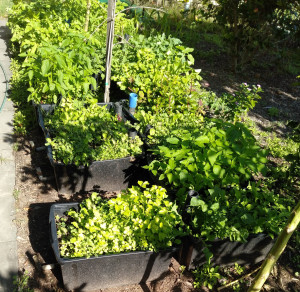
gbiota-boxes-colin-austin-gbiota


Health start in the soil

Summary

The aim of the Gbiota team is to provide expertise on how to grow food that leads to good health.

The basic technology is straight forward - just add essential minerals to the soil, breed beneficial biota in organic matter and carefully control the moisture level by a system of partial flood, drain and wicking action, then grow selected plants. But there are two fundamental issues.

Taste and food cravings

The bulk of the food we eat is for energy - it is just fuel - largely sugars, fats and carbs. In our evolution we were short of energy food so we evolved to crave energy food. Today our modern food system provides us with ample energy food - but we still have the cravings for energy food.

But we also need a whole range of complex chemicals, minerals, vitamins, phytonutrients, micro-biota etc which are not burned as fuel but from part of our bodies - we call these gut food.

In the young soils in our evolution these were abundant so we did not develop a natural craving for these foods - just a craving for energy food, sugars, fats and carbs. This is at the core of our modern health problems.

Given the choice of cheese cake or boiled Brussels Sprouts most people go for the cheese cake. But our gut brain detects the deficiencies and send out signals so we eat more - typically more sugary, fatty food.

This actually changes our gut biota, which makes us crave yet more sugary fatty food.

This is the core reason for lower health levels and the increase in non-infectious or chronic diseases like diabetes.

It is pointless just growing really healthy food if no one eats it so we have to make the food really tasty so people actually want to eat it. Variety is the key - I grow some 27 different varieties, both vegetables and herbs. When added to a conventional sugar fatty food it adds both flavour and health benefits.

Fresh and living

Healthy food contains a mix of complex chemicals and living biota which happily breed away inside the plants. When the plants are picked they start to deteriorate, within twenty four hours of harvesting some critical components will have dropped to half.

Fresh has come to mean not gone rotten which is very different from eating ‘living’ food.

The conventional food system with mega farms and long distribution systems simply cannot deliver food before this deterioration has become significant.

This is fine for home growers but how do we make ‘just harvested’ plants widely available to the non-gardeners?

This is the major challenge facing the Gbiota food movement. We need a system of setting up local food systems where customer can pick and eat before the critical components deteriorate.

Become a Gbiota™ grower

This article aims to give an overview of the gbiota technology and how the local food community system works.

It is not intended as an instruction manual.

This detailed technical information is available to registered Gbiota™ Growers who are expected to follow the guide lines to ensure that quality is preserved. Having assured quality benefits both customers and growers.

The Gbiota team role is to support the growers with technical and umbrella marketing services - we are not in the business of supplying Gbiota produce.

Introduction

 Despite what they try and tell you health does not come from some health bar full of sugars and fats - nor does it come from an extract from a plant in some remote corner of the world.

Adverts may say its existence was revealed by the last remaining monk who happened to die last Wednesday but passed the magic secret on to an executive of some mega company who just happened to be hacking his way through the jungle and just five jars are available on special.

old man having fun

The Internet may be one of the greatest innovations of our era but it has been taken over by the modern version of the snake oil salesman.

Simply eat real food grown in real soil and don’t be taken in by the manipulative marketing.

snake-oil-con-man-colin-austin-gbiota

Health starts in the soil

 Health start in the soil and the trillions of microscopic creatures that make dirt into soil. These minute bugs process the minerals essential for our health so they are available in our food and they enter the plants which we eat where they form part of our gut brain which controls our body. They are essential for life.
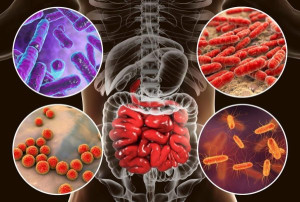
gut-brain-2-colin-austin-gbiota

The fake world

 In our fake world of manipulated promotions and famous celebrities we have been destroying the very microbes that make real soil and allow life to flourish.

This fake world may feel a lovely comfortable place to stay, but every eight seconds someone has a limb amputated from diabetes.



But if you are ready to move on from this fake world we can regenerate soil to grow real food to keep us healthy.

We can breed these beneficial microbes in waste food, organics and manure so they can regenerate real soil to make us healthy.

It is not so comfortable as the fake world, there are no famous celebrities whose job is just to be famous but if you can handle the thought of rotting fish heads and chicken manure then welcome to the real world - and you may just keep your leg or fight off Covid.

So let me start with the story of soil.


The story of soil

A long time ago (actually four billion years)

When the earth was first formed, some four billion years ago, is was just rocks which contained a broad spectrum of minerals.

 Microbes very slowly broke these rocks down forming soil but it was very slow as there was no energy to drive the system.

break down rocks


But eventually - after some three billion years there was enough soil produced for plant for plants to grow leading to the greatest innovation of all time - photosynthesis. The plants would take the energy from the sun to make sugars which they exuded from their roots which fed the soil microbes leading to an explosion in the growth of soil.

Rocks are insoluble so we can’t digest them but the soil biota break them down turning the minerals into soluble compounds animals, like us can digest.
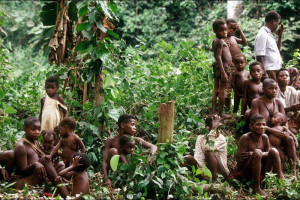


Food cravings

Animals appeared that ate the plants then other animals that ate the animals that ate the plants. Eventually our ancestors appeared which did both. They were a successful creature - we had abundant food for our bodies (I am going to call this gut food) but we needed energy food - sugars and fats - so we evolved to crave sugary fatty foods which was in short supply - but did not develop cravings for gut food, which was abundant.

Hello agriculture

 Then we developed agriculture which increased our supply of energy food but the soil was still young so there was plenty of microbes in the soil to continue to break down the rocks and release the minerals.

Agriculture led to cities with large populations where disease could readily spread and babies and young people died at an incredible rate - four out of five people would die before reaching adult hood. Those that survived lived a long life.

The prime cause of death was infectious diseases which killed the young.

They will tell you that the average age at death was 32 and that is technically true. It is just that so many people died really young it shifted the average - those that lived into adulthood had a long life. Very few people dies aged 32, That statistics for you.

Missing minerals

 We grew plants in this soil and over many years the minerals in the soil became depleted, but we learned we could use chemicals to fertilise the plants.

It worked and modern chemical industrial agriculture was borne. But diseases like diabetes, heart attacks and dementia increased.
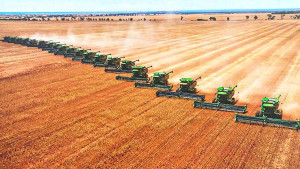
modern-farming-fertiliser-field-colin-ausitn-gbiota

Then after the second world war we developed synthetic fertilisers creating the chemical industrial agricultural revolution which increased agricultural output dramatically.

But it killed of the microbes in the soil so the rocks were no longer being broken down to release minerals. Farmers compensated by using chemical fertilisers containing the minerals to grow the plants.

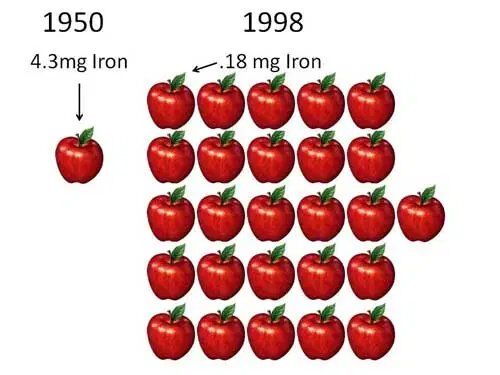
But we need more minerals than plants do so we became deficient in certain minerals.

You are probably aware you are low in Magnesium because the majority of the population are low in Magnesium.

If you are a female you probably also realise that you could be low in iron.
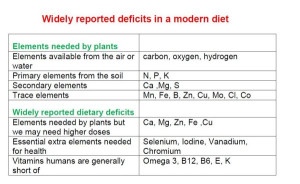


If you are male then you may not have caught up with the sniggering that if you are a sexually active male that one night of happy frolicking can deplete your zinc reserves. That is bad as zinc is important to our immune systems.

But the choice is not just between Covid or a happy night. By modifying your diet, you can ingest more zinc together with all the other minerals - magnesium, calcium, zinc, iron, copper, selenium, iodine, vanadium and chromium that are essential for health - all readily available from volcanic rock dust.

And no - you do not need you own private volcano - volcanic rock dust it readily available and it continuously being replaced - totally sustainable - as are the other key inputs - waste food and organics and manures.

But these shortage of minerals are something new - there used to be plenty of minerals in our food and we evolved with them over hundreds of thousands of years.

Food balance

 There is nothing wrong with eating energy food, even though sugars, fats and carbs are considered harmful. We need energy and could not survive without energy food. But we also need, in much smaller quantities, gut food - the mineral, vitamins and living biota which are essential for health.

It is a question of ratios. If we don’t eat enough gut food out gut brain senses the deficiency and send out signals for us to eat more. And if we just eat more energy food we will still not feel satisfied and will eat yet more which is the road to chronic diseases.
amputated-leg-colin-austin-gbiota

Our Gut Biota (they really matter)

Even more important - the microbes in the soil enter the plant which we eat and forms our gut brain which controlled our bodies. Out gut brain regulates our appetite, replaces our body parts as they wear and age and hosts our immune system.

Medical science is continuously improving and we have gained control over many infectious diseases. The main cause of death swapped from infectious disease to non infectious, or chronic, diseases like diabetes, heart attacks and dementia. (That just changed with Covid, hopefully only temporarily).

On balance our life span did not change that much but our health span reduced.
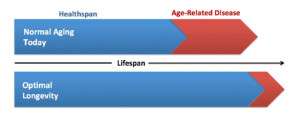
health-span-data-colin-austin-gbiota

Cussed Covid

 Then along came Cussed Covid and changed the rule book and we went back to the old pattern where infectious diseases killed more people that chronic or non infectious diseases.

Does that blow my argument that we should be eating food grown in mineral rich, biologically active soil? Well exactly the opposite. Doctors wanted to know why some people died of Covid while others seemed to dash around like normal even though they had Covid.

As expected they found that people who were fully vaccinated tended not to die. Lucky for them - they whole medical profession would have looked a bit of a dork if vaccination increase the risk of death. But they found two other factors - diet and stress.

Stress was expected - as it is well known that when stressed our bodies get flooded with cortisol which shuts down our immune system. Evolution had decided that if you were being chased by a hungry tiger looking for an easy meal - which is generally stressful - that it is better to shut down anything that is not needed and run that bit faster.

Diet also was a major factor, people eating a poor diet - high in sugars and fats - low in nutrients - were prone to dying from Covid.

That was also expected, we already knew that our Gut Biota is an important contributor to our immune system.

Whichever way we look at it - eating healthy food grown in healthy soil leads to a healthy gut leads which in turn leads to a healthy body.

Do I really have to spend half this article saying the bleeding obvious? Lets get down to the real issue - how to get real healthy food.

The three big challenges

OK we know what we have to do - sounds so simple - just persuade people to eat plants grown in nutrient rich, biologically active soil. How can that be difficult?

There are three problems

- to work out how to make the nutrient rich biologically active soil and make the plants readily available at an affordable price

- to show that it actually works

- to persuade people to change their diets.

Making nutrient rich biologically active soil

 This should not be a problem because that is exactly what has been happening in nature for thousands of years.
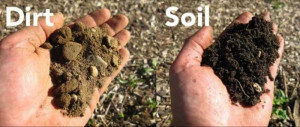


The snag is that it takes centuries to make soil naturally - it is a slow process and with our modern chemical agricultural system we are using it up much faster than it is being made.

But we do understand the process and with a bit of smarts and controlling the conditions we can make healthy soil much faster.

We need minerals - it is easy enough to get the minerals - there is plenty of volcanic rock (and it keeps on popping up) with a broad spectrum of the needed minerals.

But that is pretty useless as it is not soluble so we need the microbes to break down the rocks to form the complex soluble compounds we need.
forest-colin-austin-gbiota

We need the microbes to break down the rocks.

Microbes are particularly randy, making rabbits look like nuns - all we have to do is feed them and create the conditions for them to breed.

 Food waste is particularly good for breeding the microbes but virtually any waste organic material will work. To get the process to work fast we need nitrogen and we can readily get that from manure.

Getting a load of food waste, manure and rock dust is not exactly rocket science.

But there are thousands of different sorts of microbes and we just want the beneficial ones and to do that we have to control the conditions. We need the right moisture level - not too wet and not too dry, Goldilocks moisture and we must keep it moving so it does not become stagnant.

But this is what I do - in my younger days I was a pioneer of the computer simulation of fluid flow and if I am honest this is really pretty simple to do with the partial flood and drain and wicking system that is really at the centre of the Gbiota technology.

I and many growers have been using this for years - it works fine - so we can tick this problem of making soil and growing plants off the list of problems to solve.
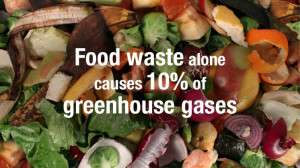
food-waste-colin-austin-gbiota

Proving it works

We live in the digital age which unfortunately has been hijacked - particularly by companies trying to convince people that their product - whether it is some health bar, packaged food or some bland looking pill is actually healthy - even though it is not.

Modern advertising is very effective, clever manipulation based on psychology - very effective but people are now getting very cynical and are looking for sound evidence.

The sort of question people will ask is

- how do I know that eating real food grown in real soil will actually make me have a longer health span (and live longer)?

- how do I know that this will stop them chopping my leg off as it turns black from diabetes?

- how do I know it will prevent me getting dementia or any of the classic chronic diseases.

- how do I know that it will reduce the risk of dying from Cussed Covid.

 People may be interested in general trends but they really want the answer to is how it affects them, and people are very different so it is virtually impossible to answer for single individual. Statistics and probabilities are just not convincing.

The question is ‘How will it work for me?’

It is next to impossible even to even show a statistical trend. Fancy trying to get volunteers for that gold standard double blind test with one group eating hamburgers the other group eating real plants, blasting Covid viruses up their noses and counting the number of dead bodies.

 But there is one very simple experiment we can do which gives information on a specific individual - and that is to monitor food cravings. Our gut brain is smart enough to send out food craving signals when it decides we are not getting the right sort of food.

That is the primary mechanism why people become overweight - their gut brain says I am not being fed properly with the right balance of energy to gut foods, so it says - go out and eat more and more - and if that more is yet more energy food - sugars and fats - then people get fat and sick.

Cravings Food | Gbiota | Colin Austin

Answering the ‘will it work for me’ question.

It is however straight forward to carry out a test to see how a particular individual will respond.

Our gut Biota has a short life so it only takes a couple of weeks to find out if the food cravings have disappeared. If this works for a particular individual it is obviously sensible for them to keep on eating that diet.

But food craving are a complex issue.

Much of our modern highly processed food contains flavouring which are addictive (don’t ask me to make a polite comment on the ethics of that).

The food industry spends a lot of big money on promotion and they do it very well using all the techniques of psychological advertising to convince us to buy their food.

Then unfortunately there are people like me (sorry to say) - I can look at the last piece of cheese cake and it will hypnotise me so I have no option but to put it out of its misery and into my tummy.

That is why I have a good swig of my green smoothie before putting myself under temptation.

This may not satisfy the most fastidious academic but it really boils down to a personal decision - do I want to reduce the risk of them chopping my leg off from diabetes and becoming decrepit in my older years or do I start eating real food now?

If the answer is yes we have to move onto mechanics of developing a ‘real’ food supply chain.

Changing the food system (or a bit of it anyway)

The key issue is that the beneficial biota and some of the phyto-nutrients in the plant will begin to deteriorate as soon as the plant is picked.

Fresh is a misused word - it has come to mean not gone rotten - we really need a new word which means still maintaining its original nutrients.

How about we use the word ‘living food’ meaning that the micro-biota in the food is still alive.

This is where the conventional food chain fails.

The conventional food chain having large farms supplying over long distances certainly aims to provide food that has not gone rotten - but simply cannot supply living food eg before the micro-biota and the nutrients degenerate - what I call gut food.

But it is very good at supplying energy food - sugars, fats, and carbs. We need lots of energy food, it is just fuel and it does not matter whether it is old or new - as long as it has not gone rotten.

Energy is by far the largest component of the food we need - at least 80% - probably more. The supply chain is already there and working fine - so why change it - at least for now? What we should focus on is gut food which may only be a small part of our diet but is absolutely critical.

It comes down to this ratio of gut food to energy food. It can be as simple as sprinkling freshly cut leaves onto a traditional meal. There is a whole area of technology on how plants can act as sugar blockers and slow down the absorption of sugars into the blood stream which leads to sugar spikes.

Just Google sugar blockers but there is a couple of slides below.

I should just emphasise the importance of eating a wide variety of plants. I use a mix of conventional vegetables like Broccoli but also add a range of herbs. This is important for health but it just makes the food taste so much better. Healthy food only works if people actually eat it.

This is something that local growers - either community growers or smaller commercial market gardeners supplying their local community can do very well.
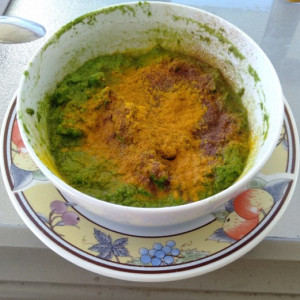
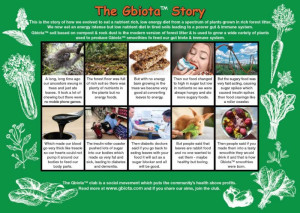
green-smoothie-colin-austin-gbiota

the-gbiota-story-stamp-colin-austin-gbiota


plants


 Local community food

 It is not rocket science - we just need healthy soil full of minerals and the soil biota which can break down the rock and form our gut brain which controls our bodies.

The biota in the soil and in our guts has a short life but breeds rapidly. Even within twenty four hours there is a significant drop in nutrition.

Modern chemical industrial farming is very effective at supplying us with energy food - sugars and fats. We have evolved to crave these but they are just not able to provide that nutrients and living biota we need for a healthy gut.


 This can really only be done by growing food locally in nutrient rich, biologically active soil so it can be eaten shortly after picking.

That is why we need a local community food system.

There are two parts to the Gbiota project - the first is the technology of breeding the beneficial biota in the soil the second is a social movement where growers and consumers cooperate together in a local community food system.

The most effective system is for a grower to recycle food waste, add manure and minerals and use the partial flood and drain system to give the Goldilocks moisture level to breed the beneficial biology to create the nutrient rich soil full of beneficial biota.

This soil can be used to grow plants or to load into Bioboxes for customer to grow their own plants.

They can start with just a bare box and take care of all the growing themselves, they can have a box with specific plants growing or they can have a box loaded with an array of companion plants to give a broad spectrum of plants and their biota which are grown as baby greens.

This is the most effective when coupled with the twin box system which makes everything so easy for both grower and consumer.

The twin box system

 A grower will supply two Bioboxes to a customer. The first is empty and will be filled with kitchen waste - the second is growing plants ready to be harvested.

After a period the boxes are swapped for new boxes with the grower using the kitchen waste to grow more soil and replace the box with growing plants with new plants ready for harvesting.

The grower and customer may enter into a long term relationship where the Bioboxes are swapped on a routine basis. This ensure the customer has a stable supply without having to worry about breaks in the supply chain while the grower has an assured demand and can plan and grow in confidence that the there is a demand for the work invested.

Action plan

You have got so far and maybe you have decided this all makes sense - but what to do next?

If you are a potential customer is it is simple - just go to gbiota.com click on community and register as a customer. The aim is to link you up with a local grower so it is important to give enough details of where you live to help this linking.

If you are a potential grower it is a bit more complex.

Probably the first thing is to contact me at colin@gbiota.com so we can set up a Skype or Zoom link and have a bit of a chat and got through the next steps - which are -

- register on gbiota.com/community as a grower

- go to gbiota.com/shop and register as a vendor and create you own home page - this, like everything in the wonderful world of computer, is pretty easy when you know how, but a mystery if you don’t - but we can talk you through so don’t throw the computer at the wall in frustration just yet.

As part of this process you will create your own icon on the geolocation map which will help potential customers find you and make contact

All this is free

- go to gbiota.com and register as a community grower. This is a subscription area which give you access to all our publications on how to grow gut food. Currently there is a grace period where you just pay $5 for 100 days, if things don’t work out as you expected then you can cancel at any time. After that you make a regular monthly payment of $10.

This entitles you to access to all the growing publication, support by either email or a video call (don’t be cautious about asking for help, we have all had to face the weird problems in going from instructions to the real world)

- create your gbiota bed, the in-ground gbiota bed, to start growing soil. You will need to access a sources of organic waste (often provided by your customer when you get going, manure and volcanic rock dust (if you are in Australia we have organised for the supply of Biomin from an Australian company, if you are overseas then you need to search for volcanic rock dust.)

- create you own local customer base. We can help in locating potential customers and you can use our web as a source of more contacts. We operate under the Creative Commons system (apart from the grower section) so you can copy, and circulate without asking for further permissions (just acknowledge source).

You may start with neighbours and friends but you may want to use social media and other promotions to expand your operation. (Note our current focus is on community growers eg for people who are doing this as a paying hobby with a strong focus on social benefit. If you operate a commercial business supplying food products as your primary source of income then you need to upgrade to becoming a commercial grower.)

- set you own prices, terms and conditions. This includes transport or collection of boxes. They are your customers and the deal is directly between you and your customers, our role is purely to provide information, technical support and web services.

- get going. We strongly recommend you use our subscription services where you enter into an ongoing relation with your customer. This benefits both customers, who get a secure supply chain at a good price, while the grower gets a regular and reliable business.

- have a party to celebrate becoming a successful gbiota grower.

Summary

The aim of the Gbiota team is to provide expertise on how to grow food that leads to good health.

The basic technology is straight forward - just add essential minerals to the soil, breed beneficial biota in organic matter and carefully control the moisture level by a system of partial flood, drain and wicking action, then grow selected plants. But there are two fundamental issues.

Taste and food cravings

The bulk of the food we eat is for energy - it is just fuel - largely sugars, fats and carbs. In our evolution we were short of energy food so we evolved to crave energy food. Today our modern food system provides us with ample energy food - but we still have the cravings for energy food.

But we also need a whole range of complex chemicals, minerals, vitamins, phytonutrients, micro-biota etc which are not burned as fuel but from part of our bodies we call these gut food. In the young soils in our evolution these were abundant so we did not develop a natural craving for these foods.

Given the choice of cheese cake or boiled Brussels Sprouts most people go for the cheese cake. But our gut brain detects the deficiencies and send out signals so we eat more - typically more sugary, fatty food.

This actually changes our gut biota, which makes us crave yet more sugary fatty food.

This is the core reason for lower health levels and the increase in non-infectious or chronic diseases like diabetes.

It is pointless just growing really healthy food if no one eats it so we have to make the food really tasty so people actually want to eat it. Variety is the key - I grow some 27 different varieties, both vegetables and herbs. When added to a conventional sugar fatty food it add both flavour and health benefits.

Fresh and living

Healthy food contains a mix of complex chemicals and living biota which happily breed away inside the plants. When the plants are picked they start to deteriorate, within twenty four hours of harvesting some critical components will have dropped to half.

Fresh has come to mean not gone rotten which is very different from eating ‘living’ food.

The conventional food system with mega farms and long distribution systems simply cannot deliver food before this deterioration has become significant.

This is fine for home growers but how do we make just harvested plants widely available to the non-gardeners?

This is the major challenge facing the Gbiota food movement. We need a system of setting up a local food systems where customer can pick and eat before the critical components deteriorate.

Become a Gbiota™ grower

This article aims to give an overview of the the gbiota technology and how the local food community system works.

It is not intended as an instruction manual.

This detailed technical information is available to registered Gbiota™ Growers who are expected to follow the guide lines to ensure that quality is preserved. Having assured quality benefits both customers and growers.

The Gbiota team role is to support the growers with technical and umbrella marketing services - we are not in the business of supplying Gbiota produce.

Getting started

The first question is do I want to be a grower or a customer.

If you want to be a customer - which means you just buy a box from a local grower which probably sit on a patio or by a window - all you have to do is find a local grower.

It needs to be local because the whole point of the Gbiota system is to enhance you gut biome which mean you must eat fresh.

But how do I find a local grower? What you really need to be doing is to set up a local group - nothing formal just a bunch of people talking to each other.

This is something you really have to do yourself but we have set up a social media site so you can make contact with similar minded people in your area. Just go to the Community on the menu and this will take you straight to the social media site (www.gbiota.club) where you can register.

This is a confidential site but you will need to fill in the areas which describe your location.

Hopefully this is self explanatory but if you have any problems then just contact me at colin@gbiota.com

I you just want ot be a home grower then all you need to is to sign up as a grower - you can go to account or you will be asked to register if you try and access any grower posts.

But the whole idea is to create a local community food system so we hope you will become a community or even a commercial grower.

You will need to tell other people that you are a a community grower so you should join the social media site by registering at the community on the menu.

As this is a social operation you may be happy just having people pop round to collect their vegetables of boxes but you can also use the shop facility which is the multi vendor site pickandeat.shop to become an internet trader.

Again I may suggest you get in contact with me first at colin@gbiota.com so I can guide you through the set up process.

Please note that Gbiota is a registered trade mark which you are automatically entitled to use by registering as a grower.

If you would prefer to chat (yes I am a real person) and I will try and sort out any problems by email but if I can’t solve your problem straight away we can end up on a Zoom or Skype call.


Download as .pdf

communityfood31aug22
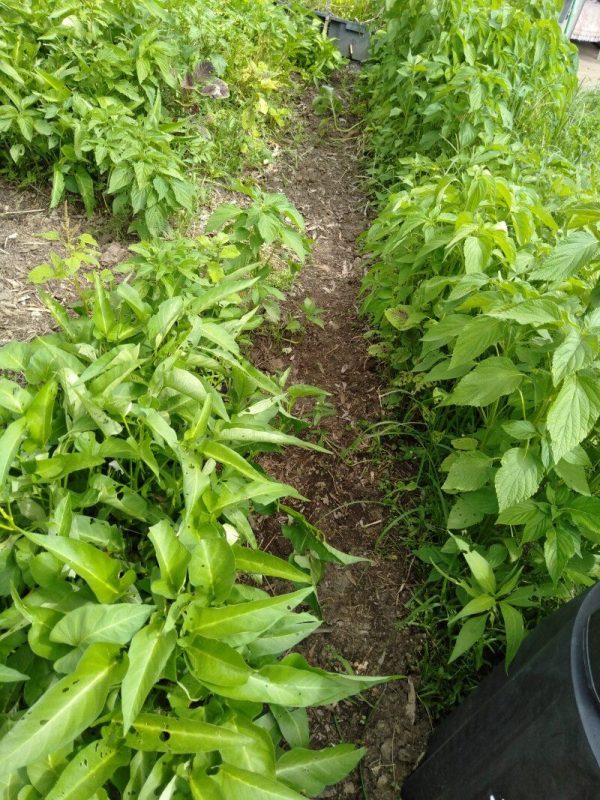
Loading

How Gbiota beds work

How Gbiota beds work

Partial Flood and Drain in Gbiota Beds

Gbiota beds and Gbiota boxes are based on wicking-bed principles but are specifically designed to breed beneficial soil biology and support gut-healthy food. Conventional wicking beds are often used as self-watering pots. Many have a base filled with inert material such as stones. The water in this lower reservoir is intended to stay relatively clean and can stand for long periods without going putrid, as long as it remains inert. Gbiota beds are different. They are filled with organic material that feeds beneficial microbes and soil creatures. This biology-rich zone must not stay saturated for long periods, or it will favour harmful microbes and lead to anaerobic, smelly conditions. In Gbiota boxes, drainage is controlled by a swivel tube at the very base. This allows the water to be fully drained after irrigation so the bed can return to a moist but aerated state. The goal is to keep the soil at what we call Goldilocks moisture – not too wet and not too dry. In Gbiota beds this Goldilocks moisture is achieved using a leaky dam. The dam holds water back just long enough for it to wick evenly through the bed before the excess drains away. In newer soaker beds, the design uses zones where water can spread and wick into special areas, again followed by drainage. This cycle of partial flooding and draining is critical. During the flood phase, stale air and gases (such as ethylene from decomposition) are pushed out of the soil. As the water drains away, fresh air is drawn in, giving the soil biology the oxygen it needs to thrive.

Hydraulic Flow – Spreading Water Evenly

To spread water along the length of a bed we rely on hydraulic flow. The base of the bed must include a layer that is largely impervious to water so it can build up and move sideways. This base can be created by:
  • A plastic liner or membrane
  • A natural clay layer
  • A compacted soil layer
Most Gbiota beds are long, so we use an Ag pipe (or similar perforated pipe) along the base to move water quickly along the bed. Water then flows a shorter distance sideways through the soil to irrigate the full width. ag-pipe-colin-austin-gbiota Traditionally the Ag pipe was bent up to the surface to act as a fill point. In newer designs we often add a larger vertical fill/inspection pipe so you can see the water level when filling manually. The lowest layer around the pipe is a coarse, porous zone that helps distribute water. This can be made from:
  • Wood chips or shredded branches (a micro hugelkultur layer)
  • Vermicast or coarse compost
  • Channels made and maintained by worms and other soil creatures
We do not want to saturate the full depth of the bed for long periods. Excess water should either drain away via an outlet or be monitored through the fill pipe so you can stop filling at the right level. The water needs to stay in the base long enough to wick upwards to the root zone (often several hours), but not long enough to become stagnant and encourage harmful biology.

Food for Soil Biology and People

To breed soil biology we must feed the bugs as well as the plants. A new Gbiota bed is usually built in layers:
  • Bottom layer – porous base: Coarse material such as wood chips, shredded branches or coarse vermicast to create air-filled pores and water pathways.
  • Middle layer – organic waste: Food scraps and green organic waste that break down to feed microbes, worms and other soil life.
  • Manure layer: Animal manures (e.g. from chickens) to add nitrogen and accelerate decomposition.
  • Top layer – growing media: Finished compost and good-quality soil for seed germination and root growth.
In practice this structure is only temporary. Once the bed is operating, worms and other creatures quickly mix everything into a biologically active, crumbly soil—essentially vermicast-rich topsoil with a strong microbial population. As crops grow, you will need to re-feed the bed from time to time with new organic materials, manures and minerals. The exact timing and quantity depend on the type of bed, climate and crops, but the principle is the same: keep the biology well fed so it can keep feeding you.

Loading

Food and the gut biome

Food and the gut biome

About food


Before describing how Gbiota beds work I need to have a bit of a preamble about food..

Energy food

The bulk of the food we eat is just burned for energy. We are really just a walking talking thermodynamic machine just like any other thermodynamic machine from a steam engine to a rocket ship.

We are also a warm blooded creature so we need fuel just to keep us warm. It has been estimated that 80% of the food we eat is simply burned as fuel.

It is dead simple - we just burn carbon and hydrogen to give of carbon dioxide, water and lots of energy. It really does not matter what the food is, sugar, carbohydrates, fats or whatever - it is just energy.

woman-and-fast-food-colin-austin-gbiota


Body building food

But unlike a steam engine we are continuously replacing our body bits from birth until death. Some bit we replace very quickly, like hair - other bits like teeth we do not change much throughout our life.

When people say I am not the man I used to be they are right, every three months or so on average I have a new body.

The chemistry is complex but bio-chemist with their sophisticated tools like mass spectrometers have it pretty well sorted out.

children-smiling-in-garden-colin-austin-gbiota

They can tell us what chemicals our bodies needs and what foods we should eat - easy enough to look them up to see the range of common and trace minerals we need from simple calcium, through magnesium and zinc etc to the trace minerals like selenium.

But we don’t just need the mineral which is generally insoluble - we need a very specific compound containing that mineral. That specific compound may be produced in our gut or it may be produced in the soil by the microbes or fungi.

That is the second type of food and while it does not seem to have been rigorously investigated we can guess that some 15% of the food we eat is just for replacement.

trace-minerals-table-colin-austin-gbiota

 Gut and Brain food

Now comes the difficult bit, our bodies have a built in control system - it is a combination of our two brains - one in our head and the other in our gut. We can’t separate them as they work so closely together.

And whatever people may like to tell you we have no idea how this control system actually works.

We do know that in our gut and head brain there are trillions of cells which communicate with each other to provide intelligence and take decisions. It is like having a super computer inside out bodies continuously taking decisions.

We run up a flight of stairs and begin to pant and puff and our heart rate starts to increase, we feel tired and our muscles seem to not want to work.

That is all decided by our intelligent control system and we know a bit about this by studying the chemical and electrical signals racing around our bodies.

But we have really no idea how the code that drives this control system actually works.

gut-brain-2-colin-austin-gbiota

It is a bit like having a mobile phone. I am not good at mobile phones but I have flotilla of grand daughters who - with a great deal of eye rolling and muttering about stupid oldies - will show me how to use them. They do this because they understand that while oldies may appear to be stupid they can actually be useful acting as free Uber drivers, driving instructors or later as lenders of cars to go to their parties.

So with a bit of a struggle I can actually use my phone - but I still have no idea of the code that is driving the phone.

colin-with-grandkids-colin-austin-gbiota

And I probably never will - it is the nature of code. You see at one time my day job was writing complex computer code to solve coupled simultaneous equations to solve engineering problems, particularly fluid flow which was my speciality. I knew the basic mathematics - that has been known since the days of Newton and Fourier but I did not know how to solve these non-linear coupled partial differential equations directly.

So I had to use a method then called predictor corrector, then the name changed to self learning then artificial intelligence or pattern recognition. But whatever flash term is the fashion of the day it is still basically organised trial and error.

moldflow-colin-austin-gbiota


You make a guess for the answer and put that into the equations and get an error. Based on that error you make another guess and with a bit of luck the error is smaller so you make a third guess. As you do this you build up a picture of how they work so can make better and better guesses until you have a solution which is good enough.

So you write up the code and the calculations are so complex that you have absolutely no idea how it is going to work. So you test and re-code until you get it to work and then you may have something that is useful.

That is what it is like with a mobile phone.

But our brains are a level of complexity higher. With a computer the chips are standardises and you know how they should work. Our gut brain is another story - there are not just trillions of cells but there are thousands of different sorts of cells which work in different ways.

But - and this is the crunch line - they keep on changing with what we eat and so will give different answers.

At least with a mobile phone I can plug it into any charger and it will work the same. Now imagine if the food that the mobile phone lives on - electricity - varied from day to day and charger to charger.

One day you could take a selfie and you would look like a beautiful princess - the next day you recharge your phone on a different charger and take a similar selfie and you look like a frog.

That is what we face with when we think about food to feed our gut brain. We change our food, our gut biota changes and thinks in a different way - one day we have food cravings and want to eat all the time - then we change our diet and change our gut biome and feel full and can’t stand to eat another thing.

Observations of real experiments show this is what happens but how can we expect to understand why it is happening.


But we know this is what happens by experiments of fat and skinny mice. If we change their gut biota (by the simple process of pooh swapping) we can make a fat mouse skinny and a skinny mouse fat.

We can do the same with humans by a more refined process of faecal transplanting.

fat-and-skinny-mice-colin-austin-gbiota

Good and bad bugs - ecological balance

It is just a fact of life that are beneficial and harmful microbes or more directly good and bad bugs. Throughout human history we have face the dangers of bad bugs with the bulk of the people dying from some infectious disease before they reached maturity.

But some eighty years ago we began to develop the technology of killing off the bad bugs, with antibiotics and toxic chemicals and our food system became relatively inert - free from any bugs (good or bad). This seemed to work and we dramatically reduced the death rate from infectious diseases and the population exploded - trebling in less that my life span.

But we learned the hard way that when we killed off the good bugs that we fell prey to chronic or non infectious diseases.

Learning how to breed the good bugs while controlling the bad bags is the great technical challenge we face.

The solution can be termed ecological balance.


Douglas Adams wrote : "The answer to the ultimate question of life, the universe and everything is 42.

This may be very profound but it still does not answer one question. Over some million years we have developed a brain - an intelligent control system which decides what and how much we should eat.

Then humans - with all their wisdom developed a food system which destroyed this brain - this wonder of nature - with a crappy food system and substituted it with a complex system of weird and wonderful diets - often requiring us to measure out every calorie and micro gram of each ingredient that we eat which has left us fatter and sicker than ever.

It is a great pity Douglas died before he could explain this mystery to us all.

Gbiota food

Gbiota food is really about growing food to feed our brain. To do that we have to feed the microbes that already are living in our gut - that’s a pre-biotic.

But we also have to breed new microbes in the soil, which will go into the plants that we will eat and hence from part of our gut brain - that’s a pro-biotic.

To breed these microbes we have to feed and water them - for that we need the food that the microbes want to eat and that will include many of the minerals that we need as well.

Now the snag is that there are good bugs which will make us strong and healthy and bad bugs which at best just want to use as a comfy home to breed in - but unfortunately they often get it wrong and kill us.

To breed the good bugs - without the bad bugs taking over - we have to manage the conditions, which means food and water.

Food is the easy bit of that battle - water is the difficult bit. Bugs just don’t breed well without any water. The good bugs like it moist but not too wet (aerobic) while the bad bugs breed when it is wetter (anaerobic).

We need that magic Goldilocks moisture level.

I need to talk about that most mysterious substances we take for granted - water.


Loading

Health starts in the soil Part 2

Health starts in the soil Part 2


Health starts in the soil

Every day we here stories of doom and gloom about food, price hikes from floods and droughts, problems with the supply chain from Covid, lack of nutrients and beneficial biota leading to diabetes, heart attacks and dementia.

It all sounds pretty miserable so why not do something about it. Here we are focused on solutions.

You can read many articles analysing the food situation here.

Before I start I just need to make the point that we are not facing a general shortage of food, we are producing more than enough energy food to feed the entire world now and into the future. While most of the food we eat is simply burned as fuel it is essential that we eat food that will feed our gut brain.

Our gut brain is really important – there is simply no way to be healthy without a healthy gut. It is a real brain which talks to our head brain though the Vegas nerve to control our appetite so we don’t overeat on the wrong sort of food and start down the road to diabetes, it manages the complex chemicals needed to replace our body parts as they age and wear and host much of our immune system.

The Gbiota Biobox system allows people to have fresh vegetables which feed our gut brain growing in their home, even if they have no garden, time or gardening skills.

There are two groups of people in the scheme.

Group 1 consumers or biofoodies

There are the people who just want to eat the food that will make them healthy. It is just a reality that the minute a plant is harvested that it starts to deteriorate. Within twenty four hours the level of some critical nutrients will have dropped by half so there is no real alternative but to grow gut food at home.

The Gbiota box system makes this very easy – really just watering, adding nutrients and harvesting.

It is a lot cheaper but above all the quality is just so much better – full of minerals, nutrients and beneficial biota which feeds our gut brain.

However the Gbiota Biobox needs soil, not just any old soil but soil which is full of nutrients and living biota such as microbes, fungi and worms.

This is where the second group comes in.

Group 2 community growers

Community growers are typically experienced growers with a garden who are prepared to grow the special soil – Wickimix – for their local community. Naturally they get paid for this service so it can be a nice paying hobby.

They agree to work to a protocol of adding the required minerals and inoculants to grow the Wickimix – supported of course by the Gbiota team.

How it works

This is the way it works. It starts with a box, any box of any size that suits – just a small 20 litre box if you want just want to grow baby greens on your windowsill or a bigger one if you want to grow large plants.

A simple irrigation fitting is installed at one end to form the swivel drain and a piece of drainage pipe connected to distribute the water – and that is all there is to it.

Now we start with food scraps from the kitchen.

Food scraps are one of the crimes of the century, we just throw them into the bin where they end up as land fill decomposing to form the worst sort of green house gases.

Yet they are full of nutrients which can be recycled into fresh healthy food – future generations will just laugh at us.

Now there can be a bit of a problem with smells and flies if they are not handled right but if you do it yourself there is none of these problem that occur when food scraps are left lying about for any time.

We just fill the base of the bed with fresh food scraps. It may seem that we are overwhelmed with food scraps but when we start to recycle them they become a valuable commodity which is in short supply so we may made need to add other organic waste like grass clippings.

But that is not enough – we need minerals like magnesium, iron for the ladies, zinc for the men, copper, selenium, iodine, vanadium and chromium.

These are readily available in volcanic rock dust but they are still rocks that are insoluble so we cannot absorb the minerals – for that we need micro-biota, the bacteria and particularly the fungi that can dissolve the rocks.

So we add Wickimix which looks like and acts like soil but is actually made by breeding beneficial micro-organism in an in-ground Gbiota bed. This is a bit more complicated but you can buy Wickimix on line from a licensed local grower.

The bed can then be seeded and covered with a thin layer of Wickimix.

It is that easy.

Now that is fine when first setting up a Gbiota box – there will be plenty of nutrients and beneficial biota at the start.

But you will be taking these nutrients out of the bed so after a period the soil will become old and tired.

This is where the compost tube comes into play. It is simply a tube which is pushed into the soil, the soil is soft so just a bit of wriggling and the tube will go to the bottom of the bed.

The excess soil is simply cleaned out and used as a mulch then the tube filled with fresh food waste.

Food waste may be good stuff but it attracts the tiny vinegar flies and those pesky blowies. This is why you add extra Wickimix on top of the food waste so the worms and the microbes can get busy breaking the food waste down.

Some people like to save up their food waste in a separate container for a few days and then put into the Gbiota box but an alternative is to set the box up at a convenient place and just add the food waste as needed, a plug is needed to stop flies getting at the waste until they are covered with Wickimix.

Recycling food waste make economic and environmental sense, and cost little money and is easy.

The plants we grow acts as natural pre and pro biotics feeding our gut brain which is critical for our health.

First step

First step is get your copy of food for health, it is free you just have to download. Below is the official automated download system which like most over engineered computer systems works when it feels like it, don’t go away just email me directly at colin@gbiota.com

Loading

Bit of a mess

Bit of a mess

Unless you are a total hermit you can’t have missed that the world is in a bit of a mess - Covid, bush fires, floods droughts and food shortages.

When the price of an iceberg lettuce rises from $2 to $13 then you have to notice. OK the price has now dropped down to $7 so everything is going to be OK - no that is just because they are shipping them in from miles away. Things are bad and are going to get worse.

I thought I would Google to see how much carbon dioxide was emitted in the recent bush fires - 700 million tons - compared that with a total emission from Australia of 500 million tons. My going to the shops on my bike rather than driving my car is not going to have much impact on that - however good it may make me feel that I am making a contribution.

So what can I do that will have an impact, particularly to the food crisis and the wobbly food chain?

Here is my plan and I hope that you will join me.

Some twenty five years ago I started to promote Wicking Beds, not my invention - anyone who has seen a desert oasis will realise that nature invented them first - like many things we think are a technical breakthrough. I just copied nature.

They went viral and now there must be many thousand of people with a Wicking Bed in their back yard happily growing a few vegetables. But there are billions of people who don’t have a back yard, time, skills or even the interest in growing some of their own food.

Before I start on my plan can I just say that food waste contributes 10% of global greenhouse gases and is a criminal waste of nutrients.

So here is my plan, I try and persuade these home gardeners to become community growers. They make two Wicking Boxes, except I now call them Bioboxes because I use them to breed microbes for our gut health - but that is another story.

One is empty the other full of growing plants ready to harvest. The customer (I call them biofoodies from my interest in gut health) loads all their kitchen waste into the empty box, (provide with a lid to avoid pongs). On a regular basis these are swapped for fresh boxes - one empty the other full of fresh food plants.

The community grower now adds minerals and inoculants to the food waste and breeds up beneficial biota in Gbiota beds to make nutrient rich soil which are used to grow really healthy food in Bioboxes for the Biofoodies happily living away in their apartments or wherever.

They don’t have to worry about anything other than a weekly watering.

I have tested the technology, it works fine I just need the cooperation of community growers.

If you feel you may like to participate in this project can you can either email me and we can work though any issues you may have or just go straight to www.gbiota.com read a bit more about the project then hopefully register as a community grower.

You would not only be contributing to the community but you can earn money in the process.

If you just want to be a Biofoodie customer I would like to hear from you too. Customers matter


Loading

Community growers

Community growers

"Enhancing

"Action

Food for a healthy gut

zincIf you looking at this web I assume you are interested in your health and understand that you just cannot be really healthy unless you are eating healthy food.

You are probably aware you are low in Magnesium because the majority of the population are low in Magnesium.

If you are a female you probably also realise that you could be low in iron.

If you are male then you may not have caught up with the sniggering that if you are a sexually active male that one night of happy frolicking can deplete your zinc reserves. That is bad as zinc is important to our immune systems.

But the choice is not just between Covid or a happy night. You can ingest more zinc together with all the other minerals that are essential for health.

But these shortage of minerals are something new - there used to be plenty of minerals in our food and we evolved with them over hundreds of thousands of years. So what changed?

My next post will explain more.

Is there a food crisis?

supermarketThe supermarkets are full of food - how can there be a food crisis? OK there are people who do not have enough food but that is because of equity and food distribution, but we are growing enough food. The problem is we are growing too much of he wrong sort of food and not enough of the right sort.

health spanIs the food we eat making us healthy? There is a big difference between health span and life span. We may be living longer life span has increased significantly but health span is dropping.

Why is that?

food typesWe need food for energy, basically for fuel. The majority of the food we eat we burn off just for energy - it is simply fuel. There is no shortage of energy food - the energy comes form the sun, the plants extract carbon dioxide from the air to make carbs. These are processed to make our modern foods full of sugars, fats and carbs - available in abundance.

But we need more than energy food (or fuel), we need food full of complex chemicals - minerals, nutrients, vitamins etc to replace our body parts as they wear and age. These are lacking in our modern food system. Many people supplement there diet with pills which works after a fashion but is expensive.

What are the best foods for gut health?

gut brain connectionBut the real crisis in food to feed our brains. Yes brains - we have two brains - one in our head and the other in our gut. Our gut is a genuine brain with trillion of cells talking to each other, like in a super computer.

Our head brain and gut brain talk to each other through the vagus nerve to form our intelligent control system which manages our bodies.

They need to be fed and we are just not feeding our intelligent control system - this is the real food crisis.

Our intelligent control system is much smarter than we have given it credit for. It senses if we are getting the right amount of the right sort of food.

fat girl

If it senses we are not getting the right sort of food it will send out hormones to make us feel hungry and eat more. If we are just eating fuel food - sugars, fats and carbs we will just eat more of the same and get fat and sick and our health span will drop.

On our modern diet people in middle age have reached the end of their health span - they may live for a lot longer but they will not be healthy.

Even young adults are beginning to reach the end of their health span.

This web site is about how to increase our health span and that means eating the right sort of food. We need food rich in minerals and the complex chemicals to replace our body parts but most important of all we have to feed our intelligent control system which manages our body.

Our intelligent control system manages our appetite, the replacement of body parts and our immune system - we simply cannot be healthy without feeding our gut and head brain.

That is easy - we just have to eat fresh plants grown in nutrient rich, biologically active soil.

These plants are full of both the essential nutrients and the living biota which forms our gut brain, they are natural pre and pro biotics.

This is what the Gbiota technology is all about.

They must be fresh - as soon as they are picked the beneficial biota start to die - within twenty four hours the levels may have halved.

There are many people across the globe who are using the Gbiota technology to grow these plants in their home garden and it works really well. They can just go down to their garden and pick the plants and eat them straight away.

But not everyone has the land, time and skills to grew their own food and it is just not possible with the supermarket system to have food that fresh.

GBIOTA BOXThat is why we developed the Gbiota Biobox system.

We are campaigning to persuade the home growers to become community growers.

They literally grow the soil in their gardens - put the soil into boxes and grow plants.

The boxes are light enough to be economically transported to people in the local community, the plants - often baby greens as they are the most tasty and nutritious, are grown in the boxes just requiring watering.

The boxes are simply swapped for a fresh box when needed. This is not a charity but a sustainable and economically viable alternative food system.

The growers are not just providing a community service they are receiving a regular additional income while the customers have a regular supply of fresh food with worrying about the supply chain having a hitch.

To make this work we have both a private social media site and e-commerce facility built into our web so people can order their boxes in advance.

The first step is to register on this social media site - the Gbiota team can then support you through this new way of growing and supplying gut food.

This web is split into a number of sections

food - is packed with articles on food and health

growing - is for the growers showing how to grow food to feed our gut brain (nb growers are expected to conform to certain standards to use the Gbiota™ name, register as a Gbiota grower and pay the subscription fee)

community - Gbiota is more than a technology - it is a social movement so we can all eat better

shop - this is where growers and consumers can buy and sell on line

We are busy upgrading this site - this is the end of the new front page - but we are still leaving the old front page for now (dont worry you can still see it here - there is so much information on this site we are trying to make it easier to navigate).

I want to meet you

Greta ThunbergIf you live in cloud cuckoo land you may believe that there will be a continuous supply of healthy food way into the future. Dream on.

But if you live in the real world you will see we are on a high speed train heading straight for a cliff and that cliff is a major food crisis where the supermarkets are full of food loaded with sugars, fats and carbs which will make us fat and sick.

But no real food.

labmeatIf you are like most people you will think that the magic 'they' will fix it. They being the Governments, some mega corporation or some techno brain breeding meat in a test tube.

But out there - somewhere - is one person - a combination of paradigm buster and entrepreneur with a bit of spirit who sees that we can have a real food system that will make us healthier and cost less by learning from evolution - and that is the Gbiota system. That person will be prepared to take action to make that happen.

Unlike most people they have a longer attention span than a few seconds and will start by reading about the Anthropocene here.

I would really like to make contact with that person - please email me at colin@gbiota.com

This is a Gbiota Biobox.

gbiota boxThe soil is full of beneficial microbes living and breeding in the organic matter in the soil.

These microbes enter the plant which we eat to form our Gut biota, our gut brain, which acts as the intelligent control system for our bodies. It decides if we have have eaten enough of the right sort of food and tell us when to stop eating.

Our modern inert food is why we are so much fatter than our ancestors.

The soil is filled with rock dust which we cannot absorb, but the microbes break it down into complex chemicals we can absorb. These go to replace our body parts as they age and wear.

Our gut brain also controls much of our immune system protecting us 24/7 from infections. Our gut brain is one of the most important yet neglected organs in our bodies.

All you have to do is to turn the swivel pipe drain to drain the box so the compost tea in the box does not go putrid, reapply to the plants and refill the box through the inlet tube.

When finished just swap for a new box. So easy

You need to eat the leaves before the beneficial microbes die, just pick and eat, make into a smoothie, add to a sandwich or roll or just top your normal meal.

Far better and much cheaper than any pill.

To learn more about food and how it affects our health read here

To learn more about how to grow plants that will make us healthy read  here

To learn how to participate in the Gbiota healthy food movement read here

We live in an age where peoples concentration is measured in seconds - for that surviving section of the world who are prepared to sit and read a serious article about how to survive the Anthroprocene read here

We are told that modern food is healthy - and it is true it is full of sugars, fats and carbs which give us energy. But it is dead, sterile, lifeless and we need those beneficial microbes and they are just not there.

This is a bad thing.

Bad things happen when good men stand by and do nothing - Abraham Lincoln

Not having enough real gut health food to eat at an affordable price is a bad thing.

fat person in shopModern food makes us overfull but under nourished. Healthy food is grown in soil full of beneficial biota and minerals.

How do we change things for the better?

walletIt is simply the power of the wallet. One person going into a supermarket has no buying power.

Form a group then you have real buying power and can buy directly from growers who are committed to growing healthy plants in healthy soil.

It is healthier and costs less.

We have the technology of growing healthy soil - that is what this web site is all about but to benefit from this technology people need to join or form their own local food buying group.

gbiota clubFirst step simply register that you want to buy real food grown in living soil in our community area - it costs nothing and you can make contact with other people who want to eat healthy food grown in real soil - we call them biofoodies and growers committed to regenerating their soils.

You get healthy food and have priority to food when things go bad - growers have a stable customer base so can invest in their soils - everyone wins. Just take the trouble to join and participate in a community food group

The Gbiota teams is here to help you set up and run these groups - we do it because bad things happen when good men (and women) stand buy and do nothing.

kidsIf you, and your grand kids and their grand kids want to eat healthy food then join the Gbiota social movement. One person can do nothing - a community of like minded people can make thing happen.

Join the Gbiota social movement here.

Signs of a healthy gut - Good and Bad bugs

Say the words micro-biome, micro-biota, bugs or germs and most people think of bad things that must be exterminated.

The fact is that there are good bugs, they are on a skin, hair, nose, mouth, our gut and even our brain. We are totally dependant on them and simply could not exist without them.

Microbes have a short life and breed like crazy. If we get the conditions right the good bugs will simply out breed the bad bugs.

The basic principle underlying the Gbiota technology is to have a food system where we create the right conditions where the good bugs out compete and out breed the bad bugs so we can have a long and healthy life.

Here are our choices -

Option 1

forest clearingWe can stay with our current food system where we chop down the last bits of remaining forest for land which we destroy with chemicals so we can grow crops to feed to animals locked in cages and covered in their own shit which end up polluting our rivers.

amputationThe food is full of fats, sugars and carbs so we get fat and sick and may have a leg chopped off from diabetes and will end up decrepit before we die young.

We destroy the soil so our grand kids never get to eat real food and all this so mega corporations can make mega profits.

Chemical industrial agriculture is a major source of green house gases but far worse - it is destroying the soil on which all life depends.

That is the cost of doing nothing and why ordinary people like you and me need to act.

We cannot leave it to the profit motive for us, our grand kids and their grand kids to have healthy food. It is up to us to act. Bad things happen when good men (and women) stand by and do nothing.

Join the Gbiota community food movement here.

Option 2

old man having funOr we can eat fresh fruit and vegetables grown in living nutritious soil maintained healthy by recycling organic waste and manures. We can live a long and active life into old age and our grand kids and their grand kids can eat real food.

But we have to take action starting with just three action points.

First -

we have to read and watch the videos to understand the basics of how food affects our health here.

If we want to develop a deeper we can go to food and videos.

Second -

we must show that we are committed to a healthy and sustainable food system by saying this is me and I am committed to supporting growers that regenerate their soil to give me healthy food by buying from them.

Read more here

If you are a grower whether just a home, community or commercial grower, then you can invest in regenerative growing.

walletThis is the power of the wallet, or many wallets - far more powerful than any mega-corporation.

The solution is just so simple - just form a group and buy directly from growers dedicated to regenerating their soils.

You do this by registering here - it costs you nothing but shows your commitment.

Third-

Greta Thunbergyou must tell your friends so they join the movement for growing food in a sustainable way that will keep us healthy.

I am powerless to change the food system, you and me together will still have little impact but if we can create a social movement of real food for the community we can make that change so our grand kids and their grand kids can eat real food.

What next for community growing?

Join the Gbiota club -

The Gbiota club is a private social media site. You have to be a member to see what other members are doing, post and share information and chat.

It is a totally free community service, your information is confidential within the club and we expect members to respect social norms.

There are four categorises -

Biofoodie - means you just want to buy Gbiota food from a local grower. By registering you are telling potential local growers that you are a potential customer. It costs money and time to set up Gbiota beds so if people don’t register there will be no growers.

Home grower - means you just want to set up your own Gbiota beds or Bioboxes for personal use only.

Community grower - means you are not running a commercial business but are supplying your local community typically with a financial exchange.

Commercial grower - means you want to set up Gbiota beds and sell plants or Bioboxes to your local community.

Our gut health controls our body - it needs to be fed gut food

[mailpoet_form id=4]

Loading

Action plan

Bioboxes

Bioboxes

You can go to the supermarket and buy energy food, loaded with sugars, fats and carbs at a reasonable price.

But try and buy fresh vegetables, what they call fresh is days or weeks old by which time most of the goodness has long gone.

If you are a keen and skilled gardener you can grow you own and just pick and eat so it is genuinely fresh.

But what happens if you don’t have land, skills or time. That is where Gbiota Bioboxes come in to play. Fresh fruit and vegetables growing at home and buying directly from the grower at a lot lower cost and with a reliable supply chain.

The grower uses the Gbiota beds to grow soil, using organic waste, manure and minerals to grow the biota and mineral rich soil. This soil is then loaded into Bioboxes.

The boxes are large enough to grew a useful amount of food but light enough to be readily transported.

The key is in the soil, Wickimix is a living soil with microbes, bacteria, fungi and worms specificially grown in Gbiota beds to be used in any Wicking bed.

They are offered at three levels.

Customer can simply buy what we call a clean skin - a box loaded with soil ready for the customer to seed and grow plants as the wish. This costs some $50 per box.

The next level is what we call a swapper. The box is seeded and the plants grown ready to harvest using the tipping system where just the tips of the plants are harvested and allowed to regrow.

After a period the plants become old and the boxes are simply swapped for another box.

This costs some $70 per box.

At the top of the list is the extreme box which is planted with a combination of some 27 different varieties of plants. This is definitely the best way to go as with gut biota variety of plants and microbes is the way to go.

This costs some $80 per box.

The boxes, on any system can simply be swapped for fresh box reloaded with fresh soil and nutrients and that only costs some $20 per box on swap over.

But again logistics come into play. It just makes no sense to have a mega farm producing Bioboxes and shipping them over large distances - it is simply not the way this alternative food system should be moving.

A much better approach is to set up local growers who are geared up to supply the boxes to their local customers - who we call biofoodies.

These would be viable, local independent business not part of some mega corporation.


Loading

lettuce

lettuce

Iceberg lettuce - was $2 now - if you can find one $13.

The food crisis is here and it is here to stay. Don’t be deluded that after the floods have gone and Putins war is over everything will go back to normal - it won’t.

The Gbiota movement focus is how to grow food, in a sustainable way that we, our grand kids and their grand kids can eat food that will make them healthy.

We don’t sell food, or anything, we just provide the know how - the growing technology for those people want to buy or grow food that will make them healthy.

Food and health is complex and there are hundreds of technical articles and videos on this site so first a simple overview.

lettuce-supermarket-granddaughter-colin-austin-gbiota

The raw facts are that -

- the population explosion and the increasing consumption per person are putting great strain on the earth to grow enough food

- we need food for energy and food for our body.

cars-over-population-colin-austin-gbiota

Energy or fuel is not the problem - we can capture the suns energy using plants, algae and plankton to create carbs, sugars and fats from the carbon dioxide in the atmosphere.

We can process this to make synthetic food which tastes and feels like real food.

The real problem is food to feed our brains.

corn-field-colin-austin-gbiota

We have two brains - one in our head which is human the other in our gut which is made from trillions of cells which communicate with each other to form a super computer.

They communicate with each other through the vagus nerve providing an intelligent control system for our body. Together they regulate our breathing, heart rate, repair and replacement of organs as they age and particularly appetite.

If they are working properly we get signals telling us we have eaten enough so we naturally regulate our food consumption.

In our modern food system we have an abundance of energy food or fuel but we are not producing enough of the sort of food that feeds our brains.

gut-brain-2-colin-austin-gbiota

What makes this so serious is if we eat largely energy food our brains sense they are not getting enough brain food and send out signals for us to eat more - and if we eat yet more energy food we are on the road to non-infectious diseases like diabetes, heart attacks and dementia.

amputated-leg-colin-austin-gbiota

This is not some problem for the distant future - it is happening right now. Every twelve seconds someone has a limb amputated from diabetes.

Brain food is complex - if we feed our gut the right sort of food the beneficial biota out breed the harmful biota and if we feed our gut the wrong sort of food the harmful biota out breed the beneficial biota.

beneficial-biota-colin-austin-gbiota

We can no more make synthetic gut food than we can make synthetic human babies - but we have made a pretty good job of making human babies by simple observing the conditions in which they thrive.

This is the basis of the Gbiota technology - create the condition of food and water where the beneficial biota thrive.

In practise this means breeding beneficial biota in organic waste, manures and minerals, controlling the moisture level and growing plants which we eat shortly after picking.

gbiota-bed-diagram-colin-austin-gbiota

This cannot be done with the conventional food system of mega farms and transporting food over long distances. We need a local food system where people can buy and eat plants while still fresh.

modern-farming-fertiliser-field-colin-ausitn-gbiota

The ideal system is the Gbiota Biobox where people buy boxes with growing plants which they nurture in their own home and simply pick and eat.

We provide the technology of growing this gut food to local growers both home and commercial.

bio-boxes-colin-austin-gbiota


Food and health is complex and there are hundreds of technical articles and videos on this site you may like to read an introduction to Gbiota here or watch this introductory video.

This site is about how to grow gut food.


Our gut brain is intelligent, with trillions of cells which communicate with each other working like a super computer. We have no idea of the code that makes if work but we know for sure that it controls our appetite so we don’t over or under eat, replaces our body parts as they age or wear and hosts much of our immune system.

Our gut is the key to health and we need to feed it the right sort of food so it works properly and that means looking after the soil in which our food grows.

Our gut biota has a short life and can be readily changed simply by what we eat, this site shows how to grow this beneficial gut food which really originates in the soil.

You may prefer to start by looking at our video section where there is some hundred videos produced over the last twenty five years looking at soil, water and the basic principles of how to grow food that will lead to a healthy gut.  Also here is a good background read.

gut-brain-2-colin-austin-gbiota

Our gut controls our body - it needs to be fed gut food


[mailpoet_form id=4]

Loading

About Gbiota

About Gbiota

The Gbiota Community

An online community where groups can chat and exchange information – particularly on preferred plant species which are suited to the locality and season.

You can share information on plants, food and cooking with people from the same locality or further afield.

A safe, non-commercial space to network and find like-minded people.

Gbiota community

Learn More and Join


Our gut controls our body – it needs to be fed gut food

The Gbiota local food movement

Our focus is how to grow plants to enhance our gut brain – breeding beneficial biota in the soil is by far the most effective and cheapest way of enhancing our gut brain and has been tested over hundreds of thousands of years.

What’s a Biofoodie

A Biofoodie is someone who wants to enhance their gut brain by ensuring that at least some of their food is grown in soil that is full of living biota, organic matter and minerals which lead to a healthy gut brain.

Our webs

Our web is in three parts. Here (gbiota.com) we focus on the technology. Community is a social area where people can exchange information on anything of interest – what plants grow well in this area, speciality plants, how to prepare and cook food. Shop provides a system where Biofoodies and growers can trade among themselves.

We do not make, buy or sell anything but we try to bring like-minded people together for mutual benefit.

Much of the site is open but some areas require you to log in – for details read here.


Sunlight the power

We humans need energy – and where does that come from? Literally out of thin air.

The sun shines and plants take carbon dioxide from the air and water, and break these down by photosynthesis to make chemicals containing carbon and hydrogen – full of potential energy.

We eat the plants (or animals that eat the plants), turn the chemicals back into carbon dioxide and water and bingo – we have a supply of energy, lots of it.

As plants take energy from the sun and carbon from the air, they exude sugars to attract and feed the soil biota and eventually die to further feed the soil biota.

Biota breeding

Modern chemical industrial agriculture produces more than adequate supplies of energy food, but is often low in essential minerals and normally lacking in living biota.

But things are never as simple as they seem. We need to regulate the supply of energy. If we do not have enough energy food we feel tired and fatigued, and conversely if we eat too much energy food we get fat and unhealthy.

So we have evolved a system – our gut brain – to regulate how much food we eat by making us feel hungry or full. Trillions of cells in our gut communicate with each other like some super computer which regulates our bodies.

Our gut biota breeds inside us depending on the food we eat but it originates in the soil.

Biota entering plant roots

The biota enters the plants’ roots

We eat the plants to create trillions of cells which act as a second brain.

Our bodies need more than energy – we need a whole range of minerals to make and replace our body parts as they wear. Again these come from plants which make phytonutrients which we eat.

These phytonutrients originally come from rocks or rock dust in the soil. Rocks are not soluble, but there are micro-organisms in the soil which break down the rocks into complex chemicals which are soluble so the plants can absorb them to produce the phytonutrients we can eat.

Gut brain

Growing plants in nutrient rich, biologically active soil is essential for a healthy gut.

Why we need gut food

Our gut brain regulates what and how much we eat, replaces cells as they age and hosts our immune system.

Our gut brain is critical to our bodies, but to do its job it needs food – gut food – which is not the same as the food we may eat. If we don't feed it the right gut food the wrong sort of biota will breed in our gut, and the gut brain will not work as it should.

Time tested

While we were evolving over hundreds of thousands of years, the soil was young and full of both minerals and the living biota which made the system work well.

Our modern chemical industrial agricultural system may be very efficient in producing energy food but is relying on synthetic chemicals to feed the plants rather than organic wastes which are produced naturally. Our soils are becoming inert, lacking the available minerals and biota we need for our health.

We may try to correct for this by supplementing our diet with pills, which may work to a degree but they do not have the diversity of natural biota, are expensive, and still do not give us the healthy gut brain which has looked after us naturally for hundreds of thousands of years.

We all need to eat

While our focus may be on the technology, we want everyone who wants a healthy gut brain to have ready and affordable access. Continue reading to see how we make the technology widely available at an affordable price.

Because we don’t spend money on advertising healthy gut brain food, it is often cheaper than branded food – you can help spread the word by letting your friends know of the Gbiota local food movement.


Gbiota box 1

A local grower breeds beneficial biology in a mix of organic waste and minerals

The Gbiota growing system is a way of growing plants in soil with a high nutrient content from organic waste, manures and minerals, and careful regulation of the moisture level so the biota can breed.

Local growers produce this biologically active soil, load it into Bioboxes and seed with either a green manure crop or food plants which are grown to the stage of being ready to start eating.

Gbiota box 2

Boxes are delivered to the customer typically with plants ready to harvest – often using the tipping method where just the tips are harvested and are allowed to regrow.

Food waste and minerals may be added through the compost tube to continuously feed the soil and its biota.

These nutrients are flushed into the box during watering.

Gbiota box 3

The Gbiota Biobox

The Gbiota Biobox is a system where growers can produce soil with the living biota and minerals, load this soil into boxes with the Gbiota moisture control system. They can be planted so that almost anyone, even if they have no gardening or growing experience, can eat freshly picked fruit and vegetables.

Instead of buying already harvested plants, Biofoodies buy plants still growing in the Bioboxes and harvest at home just before eating.

They often use the tipping method where just the tips are harvested and the plants are allowed to regrow. This is a very healthy and cost-effective system.

Gbiota box 4

Food waste and minerals may be added through the compost tube to continuously feed the soil and its biota.

At the end of harvest

When the soil is depleted, the boxes can simply be swapped for a fresh one with plants already growing or the soil can be topped up with new young soil.

The beauty of the Gbiota Biobox system is that almost everyone can have the health benefits of genuinely fresh food grown in nutrient rich biologically active soil.

Gbiota food simply tastes better.

[mailpoet_form id="4"]

Kid shovelling

I am a real person

I am a real person – not some computerised zombie. I am lucky, I have had a long and good life and seen many changes in the world.

When I was a kid I had a weekend job on a chicken farm – bluntly shovelling shit – but I earned enough to buy a bike. But I learned that our food system was based on manure.

Read the full article here

Fat and skinny mice

Changing the food paradigm

Take a fat mouse and feed it the poo of a skinny mouse and it too will become fat. Take the poo of a skinny mouse and feed it to a fat mouse and it will become skinny too.

And it works with humans too.

It is not just about being fat or skinny – our whole body and temperament changes with gut biology.

Read more here

Gut health

From chemistry to biological intelligence

In the wonderful world of food the established paradigm, based on chemistry, has been incredibly successful. In my lifetime, we have increased food production by a factor of 4.3 – just totally stunning. At the centre of this success is nitrogen – we learned how to capture nitrogen from the air to make fertilisers and whoom! food production just went through the roof.

Read more here.

Gbiota bed principles

The Gbiota technology

Feeding our gut brain by eating plants grown in natural wild biologically active nutrient rich soil is not new – we have been doing it for millions of years so it is well tried and tested.

The Gbiota technology is based on studying the natural process and learning how to apply the lessons in a modern setting – see overview of Gbiota Bioboxes here.

Loading

About Gbiota

About Gbiota

The Gbiota Community

An online community where groups can chat and exchange information – particularly on preferred plant species which are suited to the locality and season.

You can share information on plants, food and cooking with people from the same locality or further afield.

A safe, non-commercial space to network and find like-minded people.

children-smiling-in-garden-colin-austin-gbiota

Learn More and Join


Our gut controls our body – it needs to be fed gut food

The Gbiota local food movement

Our focus is how to grow plants to enhance our gut brain – breeding beneficial biota in the soil is by far the most effective and cheapest way of enhancing our gut brain and has been tested over hundreds of thousands of years.

What’s a Biofoodie

A Biofoodie is someone who wants to enhance their gut brain by ensuring that at least some of their food is grown in soil that is full of living biota, organic matter and minerals which lead to a healthy gut brain.

Our webs

Our web is in three parts. Here (gbiota.com) we focus on the technology. Community is a social area where people can exchange information on anything of interest – what plants grow well in this area, speciality plants, how to prepare and cook food. Shop provides a system where Biofoodies and growers can trade among themselves.

We do not make, buy or sell anything but we try to bring like-minded people together for mutual benefit.

Much of the site is open but some areas require you to log in – for details read here.


Sunlight the power

We humans need energy – and where does that come from? Literally out of thin air.

The sun shines and plants take carbon dioxide from the air and water, and break these down by photosynthesis to make chemicals containing carbon and hydrogen – full of potential energy.

We eat the plants (or animals that eat the plants), turn the chemicals back into carbon dioxide and water and bingo – we have a supply of energy, lots of it.

As plants take energy from the sun and carbon from the air, they exude sugars to attract and feed the soil biota and eventually die to further feed the soil biota.

Biota breeding

Modern chemical industrial agriculture produces more than adequate supplies of energy food, but is often low in essential minerals and normally lacking in living biota.

But things are never as simple as they seem. We need to regulate the supply of energy. If we do not have enough energy food we feel tired and fatigued, and conversely if we eat too much energy food we get fat and unhealthy.

So we have evolved a system – our gut brain – to regulate how much food we eat by making us feel hungry or full. Trillions of cells in our gut communicate with each other like some super computer which regulates our bodies.

Our gut biota breeds inside us depending on the food we eat but it originates in the soil.

Biota entering plant roots

The biota enters the plants’ roots

We eat the plants to create trillions of cells which act as a second brain.

Our bodies need more than energy – we need a whole range of minerals to make and replace our body parts as they wear. Again these come from plants which make phytonutrients which we eat.

These phytonutrients originally come from rocks or rock dust in the soil. Rocks are not soluble, but there are micro-organisms in the soil which break down the rocks into complex chemicals which are soluble so the plants can absorb them to produce the phytonutrients we can eat.

Gut brain

Growing plants in nutrient rich, biologically active soil is essential for a healthy gut.

Why we need gut food

Our gut brain regulates what and how much we eat, replaces cells as they age and hosts our immune system.

Our gut brain is critical to our bodies, but to do its job it needs food – gut food – which is not the same as the food we may eat. If we don’t feed it the right gut food the wrong sort of biota will breed in our gut, and the gut brain will not work as it should.

Time tested

While we were evolving over hundreds of thousands of years, the soil was young and full of both minerals and the living biota which made the system work well.

Our modern chemical industrial agricultural system may be very efficient in producing energy food but is relying on synthetic chemicals to feed the plants rather than organic wastes which are produced naturally. Our soils are becoming inert, lacking the available minerals and biota we need for our health.

We may try to correct for this by supplementing our diet with pills, which may work to a degree but they do not have the diversity of natural biota, are expensive, and still do not give us the healthy gut brain which has looked after us naturally for hundreds of thousands of years.

We all need to eat

While our focus may be on the technology, we want everyone who wants a healthy gut brain to have ready and affordable access. Continue reading to see how we make the technology widely available at an affordable price.

Because we don’t spend money on advertising healthy gut brain food, it is often cheaper than branded food – you can help spread the word by letting your friends know of the Gbiota local food movement.


Gbiota box 1

A local grower breeds beneficial biology in a mix of organic waste and minerals

The Gbiota growing system is a way of growing plants in soil with a high nutrient content from organic waste, manures and minerals, and careful regulation of the moisture level so the biota can breed.

Local growers produce this biologically active soil, load it into Bioboxes and seed with either a green manure crop or food plants which are grown to the stage of being ready to start eating.

Gbiota box 2

Boxes are delivered to the customer typically with plants ready to harvest – often using the tipping method where just the tips are harvested and are allowed to regrow.

Food waste and minerals may be added through the compost tube to continuously feed the soil and its biota.

These nutrients are flushed into the box during watering.

Gbiota box 3

The Gbiota Biobox

The Gbiota Biobox is a system where growers can produce soil with the living biota and minerals, load this soil into boxes with the Gbiota moisture control system. They can be planted so that almost anyone, even if they have no gardening or growing experience, can eat freshly picked fruit and vegetables.

Instead of buying already harvested plants, Biofoodies buy plants still growing in the Bioboxes and harvest at home just before eating.

They often use the tipping method where just the tips are harvested and the plants are allowed to regrow. This is a very healthy and cost-effective system.

Gbiota box 4

Food waste and minerals may be added through the compost tube to continuously feed the soil and its biota.

At the end of harvest

When the soil is depleted, the boxes can simply be swapped for a fresh one with plants already growing or the soil can be topped up with new young soil.

The beauty of the Gbiota Biobox system is that almost everyone can have the health benefits of genuinely fresh food grown in nutrient rich biologically active soil.

Gbiota food simply tastes better.

[mailpoet_form id=”4″]

Kid shovelling

I am a real person

I am a real person – not some computerised zombie. I am lucky, I have had a long and good life and seen many changes in the world.

When I was a kid I had a weekend job on a chicken farm – bluntly shovelling shit – but I earned enough to buy a bike. But I learned that our food system was based on manure.

Read the full article here

fat-and-skinny-mice-colin-austin-gbiota

Changing the food paradigm

Take a fat mouse and feed it the poo of a skinny mouse and it too will become fat. Take the poo of a skinny mouse and feed it to a fat mouse and it will become skinny too.

And it works with humans too.

It is not just about being fat or skinny – our whole body and temperament changes with gut biology.

Read more here

Gut health

From chemistry to biological intelligence

In the wonderful world of food the established paradigm, based on chemistry, has been incredibly successful. In my lifetime, we have increased food production by a factor of 4.3 – just totally stunning. At the centre of this success is nitrogen – we learned how to capture nitrogen from the air to make fertilisers and whoom! food production just went through the roof.

Read more here.

Gbiota bed principles

The Gbiota technology

Feeding our gut brain by eating plants grown in natural wild biologically active nutrient rich soil is not new – we have been doing it for millions of years so it is well tried and tested.

The Gbiota technology is based on studying the natural process and learning how to apply the lessons in a modern setting – see overview of Gbiota Bioboxes here.

Loading

elowyn

elowyn

Well, it is pretty simple. This is my great-granddaughter Elowen. She has no idea what gut biota is, but she knows instinctively that she needs a good old suck to build up her gut biota from her mum, my granddaughter. But she will grow up and ask herself, “What sort of world have my parents, and their parents and their parents created for me to live in? Did they do a good job—or were they just obsessed with getting a private jet, a yacht, or a Lamborghini?” I am not one of those people who go on about the good old days. My very first memory—only a bit older than Elowen—is being carried down to the air-raid shelter during the Blitz. Searchlights sweeping the sky, flashes and bangs everywhere, and houses simply disappearing. But that’s not why I remember it—I dropped my teddy and they wouldn’t go back for it. I never actually went hungry, but I do remember the fight for food: digging up the lawns to grow vegetables, keeping chickens for eggs, and collecting their valuable manure—really the main source of fertiliser that kept us alive. Now I wonder: what sort of life will baby Elowen have? And to understand that, I look back on my own life—during which technology has changed more dramatically than in any other period in human history. The big question is: are these changes truly for the better? Especially as I have been part of that revolution. When I left university—studying engineering—I saw plastics as an exciting new material. Learning how this material behaved seemed like a great opportunity for a young engineer. Later, still early in life, I encountered computers—back in the era of punched cards, which most people today have never even heard of. But I could see immediately that computers would totally transform engineering, allowing us to calculate things we used to guess, and leading to better products with fewer materials. I taught myself computer programming and eventually solved the incredibly complex problem of how plastics flow inside moulds. That led me to build a company that grew into a multinational, multi-million-dollar operation—the leading exporter of technical software from Australia. This made a lot of money for the venture capitalists (and much less for me), but I was selected as one of the top one hundred technical innovators by the Institute of Engineers. This could have been the pinnacle of my career—until I asked myself a simple but uncomfortable question: “How much better is the world because of these innovations?” The honest answer was not encouraging. Just look at the problems: climate change, pollution from plastics and chemicals, environmental collapse—and you cannot say with a straight face that technology has been an unblemished benefit. So, what would I say to Elowen if I live long enough to explain all this? I doubt she’d be impressed. Technology can deliver enormous benefits—but only if those benefits flow to the community, not just to massive corporations or tech billionaires focused on profit instead of people. So what is the biggest problem Elowen will face in her lifetime? Most people immediately think of global warming. But a couple of degrees of warming is not the real killer. The true existential threat is the food crisis. Not famine—we already produce more than enough calories. The real threat is the rise of what I call “plastic food”—food that is full of energy but desperately lacking in minerals, nutrients, and biology. Food that fills us, but does not nourish us. It’s not just climate effects on crops—it’s the destruction of our soils. At the current rate, scientists estimate we have only about 60 years of topsoil left—well within Elowen’s lifespan. Elowen won’t die from starvation, but without nutrient-dense food her body will lose resilience. She won’t be able to withstand whatever challenges the future brings. The Gbiota technology—breeding beneficial biota in organic waste and rock dust—is one technical solution. But technology alone will not save us. What we need is a community-based food system. Growers and consumers working together. People understanding the biological principles behind gut health. People producing and sharing local, living food that genuinely nourishes us. That is the foundation of the Gbiota system. If this resonates with you, then join the Gbiota club—learn, cooperate, and help build a real food system before Elowen grows up.

Loading

I am a person

I am a person

I am a real person

I am a real person - not some computerised zombie that looks and talks like a real person (like in automated telephone answering machines). I am lucky, I have had a long and good life and seen many changes in the world.

When I was a kid a had a weekend job on a chicken farm - bluntly shovelling shit - but I earned enough to buy a bike. But I learned that our food system was based on manure.

People were generally not fat and I never heard of diabetes although I knew all about infectious diseases - as a toddler if some other kid got one of those childhood infections like chicken pox we were all taken to a chicken pox party with lots of cakes and we all got infected and then immune - that was the way the world worked back then.

Then along came technology with synthetic fertilisers - particularly nitrogen - and food production just rocketed and so did population - but not as fast as food production.

Now we can go to the super market and choose from a wide variety of foods from all over the world - (that is unless there is a bush fire, flood, drought, epidemic or some other crisis which blows away our food distribution system.)

young-girl-digging-colin-austin-gbiota

But there is a snag - we evolved with a total abundance of fresh plants grown in young soil but sugars and fats were in short supply so we evolved to crave sugary fatty foods (like ice cream) but not crave the plant foods, with all that live biota and minerals, that feed our gut. That is just the way we are made.

But our gut is really smart and knows that we are missing important parts of our diet so it sends our messages saying eat more and we end up fat and sick with an epidemic of diabetes, heart attacks and dementia that never occurred before.

Now this matters - for every person that dies from Covid a hundred people are sick and die younger from diabetes.

This is not some new discovery, many people understand the importance of organic style food on health such that organics is the fastest growing food segment. What restrict the growth is that organics can cost multiples of chemical industrial produce.

The fact that people with no growing experience in growing can successfully grow fresh food in Wicking Beds at a much lower cost than supermarket food has led to their astonishing adoption.

If we had a Wicking Bed system specifically developed to grow gut food the demand would just explode - and that is exactly what the Gbiota Biobox is.

woman-and-fast-food-colin-austin-gbiota

Technically we know how to solve the gut food issue

It is just a question of eating plants grown in biologically active, nutrient rich soil. Science really understand all the minerals our bodies need. I learned very young about shovelling shit and making compost that biota breeds in organic waste. But there is an issue of water.

If the soil is too dry then the biota does not breed, if it is too wet then the wrong sort of biota out breed the good biota.

To breed the beneficial biota we need just the right moisture level, Goldilocks moisture not too dry and not too wet.

Now I am like everyone else, good and some things and hopeless at others - my spelling is absolootly acchrowshus. But one thing I happened to find out I was good at was computational fluid flow, how fluids move. In fact I set up a company which became the leading exporter of technical software from Australia and a world leader in its field.

And knowing a bit about how water moves through the soil just happens to be particularly useful when trying to breed beneficial biota. I pioneered Wicking Beds over twenty years ago and have consistently refined them up to the latest Gbiota Bioboxes which enable anyone, with no gardening experience to have fresh plants growing on their patio or window ledge.

So the problem is not a technical problem - anyone who has had the delight of a three year old kids knows how difficult it is to get them to eat over boiled Brussels sprouts.

moldflow-colin-austin-gbiota

It is a social problem.

Just look at the world today, we have missiles aimed at maternity hospital killing mothers and babies - beyond human imagination that any human being could do that to another human being.

But before we get to tough on autocratic leaders look at our own society. Global mega corporations, with revenues bigger than many countries, cause untold damage by the manipulation of the truth deceiving the public and exercising unwarranted influence on the Governments who are supposed to protect the interest of people like you and me.

So what is the solution. It is not to set up yet another global mega corporation selling gut food across the globe with multi billion dollar advertising budgets.

Food must be in the control of people who eat - it must not be ‘just for profit’ operation.

ukraine-tragedy-colin-austin-gbiota

Local people should control their local food system.

It is just so simple, set up local food groups where growers can produce soils (yes you can make, or rather grow soil). This soil can be put into the latest version of Wicking boxes - Bioboxes - so people, almost anyone, can enjoy fresh plants, full of beneficial biology and nutrients in their home.

Now it is just not possible to set this up overnight throughout the world. We have to start in areas where there is a group of people who understand what needs to be done and are willing to put the effort into making it happen.

I can help here. If you just enrol showing your interest in becoming part of a local food project then I can see where there are the embryos of locals groups and help these groups to develop into fully functioning local food groups.

All you have to do is to fill in the form, costs you nothing and there is no obligation either way - I will feed these into a geomap and look for where these local embryos may be forming.

You will need to provide information on your location which will be treated in confidence, if you don’t trust us just go to Google Maps and click on a location near you and send us the coordinates.

You will also need to supply an email address so we can contact you when we have a group embryo.

Look forward to hearing from you

Colin (the real)

map-colin-austin-gbiota

Loading

Bioboxes basics

Bioboxes basics

Gbiota bioboxes - the basics

The aim of the Gbiota technology is to replenish our gut with living beneficial biota and the food it needs to thrive.

Gut biota has a short life so it is important to eat plants while there are fresh, which means shortly after harvesting rather than they have not yet gone rotten - very different things.

People with a garden and the skills and the time can set up their own Gbiota beds and have fresh food every day but the Gbiota Biota box system allows almost everyone to have the health benefits of genuinely fresh food with the beneficial biota.

The key is in the soil. A grower, either a professional grower or friendly neighbourhood home grower can set up an in ground Gbiota bed to grow the soil. This requires organic material, minerals, inoculants and most important careful control of the moisture level.

The beneficial biota will simply not grow and out compete the harmful biota if the soil is either too wet or too dry.

This Goldilocks moisture level is achieved using the principle of partial flood and drain using a leaky dam.
Gbiota bioboxes are an extension of Wicking Beds with a few extra tweaks.

As in a Wicking Bed the bed is watered from underneath by a pipe which has to pass over a leaky dam. This floods the base of the bed to the height of the leaky dam. Any excess water simply returns back to the water reservoir so the bed is never flooded.


Water wicks up from the flooded base to dampen the rest of the bed.
But after a period the water leaks out through the leaky dam and back into the reservoir for the next pulse.

The bed is initially loaded with selected organic material where the beneficial biota can breed, but this needs to be continuously replaced.


Bins are placed on the surface and filled with organic material, manure and minerals. Water is regularly flushed through the bins creating a compost tea which soaks through the soil and eventually ends up in the reservoir for recycling.

The water, or rather compost tea, in the beds is always moving and never becomes stagnant which will lead to the harmful biota breeding in the compost tea going putrid.

These beds can be used for growing edible plants but their prime purpose is to grow the soil to go into the Gbiota Bioboxes.

These work on the same principles as the in ground beds with a drain pipe to regulate the maximum height of the water. But instead of having a leaky dam there is an a restricted outlet so there is never any stagnant water.


The Gbiota Bioboxes only need watering and topping up the compost reservoirs so can be supplied to people who don’t have a garden, time or skills for gardening but can still benefit from be able to eat plants, full of living biota and essential minerals, which can be picked and eaten without the normal inevitable delays in the normal food distribution system.

While the obvious focus is on gut health, this is an extremely economic way of providing food without the normal costs in distribution and marketing and is a convenient way of recycling food waste which would otherwise end up in land fill contributing to green house gases.

At this moment we are setting up groups of consumers and growers but while we are setting these up you can put your name on a waiting list will will accelerate the establishment of groups in your area.

many-gbiota-boxes-colin-austin-gbiota

Loading

Gut health

Gut health

We have two brains, one we can call Hubert that lives in our head and another we can call Gertrude that lives largely in our gut.

They both work in the same way with trillions of cells which can communicate with each other like a super computer so they have intelligence and can learn.

Hubert is an extrovert and thinks about things from how to mend the shower curtain to how to make a space ship while Gertrude is so shy we don’t even know she is there but she makes sure our bodies are working properly

But the do very different jobs. Our head brain works on external problems - anything from how to fix the shower curtain to how to build a space ship. It is very obvious that it is working on these problems.

Our gut brain looks after our body, everything from making us puff and pant as we walk up a hill to controlling our diet.

gut-brain-2-colin-austin-gbiota


Hubert is so busy on a pet project that he wont bother to eat so Gertrude has to send a message saying you are hungry and need to eat

Hubert knows we need energy so he goes to the shop and buys a giant cheese cake which he starts stuffing in his mouth.

Gertrude knows this is very bad but she controls taste so after a bit the cheese cake does not taste so good.

Gertrude understands that our bodies are made up of trillions of cells which die so we need to replace them.

She has learned which minerals are needed and which foods contain them - so she makes Hubert crave that food.

This is pretty smart but it only works if she is healthy herself from eating the right sort of food that suits her.


Our gut is part of our intelligent control system that control our appetite, what and how much we eat, refurbishing our body parts as they age and wear and hosting much of our immune system.

This trillions of cells in our guts talk to each other like cells in a super computer controlling much of our automatic control system.

They control our appetite telling how much and what to eat.

They manage how our bodies replenish our part over time and they host much of our immune system.

If we do not have a healthy gut we will not be healthy so we need to feed our gut the right sort of food.


There are trillions of microbes in our gut comprising thousands of species, feed it right we get the good species - feed it wrong we get the bad species.

The microbes in our gut do not live very long - may be just a few days, they are continuously eating and breeding. The species that dominate depend on what we feed them. If we feed them sugar we end up with sugar loving microbes.

But we also get new microbes in the food we eat. Microbes live in the soil and particularly in the guts of creatures that live in the soil. They can move into the roots of the plants that we eat then into us where they replenish our store of microbes.


The biology in our gut come originally from the soil and creatures in the soil

Plants capture energy from the sun and carbon dioxide from the atmosphere to create the sugars which drive the entire life process. The plants exude sugars from their roots which attract and feed the soil biology.

This can enter the plants which we eat to regenerate the biology on our guts acting as pro-biotics while the plants themselves provide food for our Gut Biota allowing them to breed and grow - natural pre-biotics.


There are beneficial and harmful biology in the soil, which survive depends on the conditions in a natural Eco-system.

The biology and creatures in the soil have short lives and breed rapidly. If the conditions favour the harmful biology they will out breed the beneficial biology and we will become sick.

If the conditions favour the beneficial biology they will triumph leading to better health for us.

Moisture and minerals are critical and are a key part of the Gbiota technology.


Sugars, fats and carbs contain carbon and hydrogen which we burn to make energy.

C + H + O = CO2 + H2O + energy

The world produced enough energy food, sugars, fats and carbs to feed the entire world population now and well into the future - if equitably distributed.

But in wealthy countries this leads to an epidemic of chronic diseases associated with overeating energy food particularly diabetes, dementia and heart attacks.

For every person that dies from Covid there are one hundred that get diabetes (let alone heart attacks and dementia).

There is more to food than calories - modern food is empty calories.


We are not the person we used to be - every three months much of our body is rebuilt.

Our bodies do not stay the same, from birth they are continuously growing but even when we reach maturity the material in our body is continuously being replaced.

This requires much more than calories and protein but also minerals,vitamins and beneficial biota.

These comes from the food we eat, either directly but our gut reprocess this food into the highly complex chemicals our bodies need.

That is why we need to supplement our diet with plants grown in soil rich in beneficial biota and minerals.


Where do we buy gut food for Gertrude? By setting up a supplementary local Gbiota food system.

We know we need to feed Gertrude - (our gut brain), the food she needs. But how do we do that? We can’t just be just a dumb donkey and wait for the super markets to fill their shelves with gut brain food.

Lets face facts - there is no mega corporation whose focus is on profits for their shareholders, which is going to set up a local gut food system.

They can make far more money supplying us with mass produced energy food which they do very well. Neither can we look to the pharmaceutical industry to supply us with magic pills and potions.

We simply need to follow the formulae which has evolved over millions of years and eat food grown in soil full of beneficial biota and nutrients.

There are thousands of growers both amateur home growers and commercial growers who would be more than happy to adopt regenerative farming practices and supply us with gut food - but how do we persuade them to set up Gbiota beds and how do we distribute the food in a way that keeps costs low? By the power of the wallet.


We have to rely on people who believe that their health and the sustainability of our food system is more important that short term profits.

It just takes on local person to say I am going to be a local gut food leader. Just one person can contact their friends and ask them to contact their friends, tell them the story of gut food and form a group.

Once they have a group they have the power of the wallet, the group leader can then recruit local growers and organise shopping trips to go around the various growers and either deliver to the homes of group members or set up a local pick up point.

They can obviously expect the group to support the group leader financially, everyone needs money, but the motivation in the health of the group and the sustainability of our food system.

Please note in the Gbiota system consumers buy directly from growers and we do not become involved in the commercial transaction, we provide support for both local leaders and growers and we expect growers to subscibe.  We may not be a 'for profit' operation but we still have costs to cover.

group-gathering-colin-austin-gbiota

Actions

You can read about food and the Gbiota technology by going to the menu item food here  If you want to lean about the Gbiota technology for growing gut food then you can go to the menu item growing here

If you are interested in becoming a local leader please send for our local leader.pdf here  where we can help you set up your local group.

If you would like to join, either as a consumer or grower, you can go to account here and register.

Loading

Join the Gbiota Club

Join the Gbiota Club

I believe everyone in our affluent world should have access to healthy food at an affordable price, specifically nutrient-dense food that improves gut health. The Gbiota system aims to make this a reality.

Why gut health matters

Our gut is one of the most important organs in our body. Made up of trillions of cells that communicate with each other, it has real intelligence – our gut brain – which controls much of our body’s functions. You simply cannot be healthy without a healthy gut, and that means you have to feed it – that is what Gbiota food is all about. Modern food is not good for our gut health. Full of sugars, fats and salt, it has led to a global health pandemic of chronic (non-infectious) diseases. We love sugary, fatty foods – they were in short supply when we were evolving, so we crave them. The modern food industry makes a lot of money from satisfying these cravings. Many people are sick and die from these chronic diseases. There are far more people suffering from chronic diseases stemming from a poor diet than people suffering from Covid.

Gbiota beds

Gbiota beds were developed by studying the way soil is formed in the natural world, but the beds dramatically accelerate the process. Instead of taking decades to make healthy soil, it can be created in months in a relatively simple system. We combine food and organic waste scraps with worms, manures, essential minerals and inoculants for the soil to create the optimum conditions to grow healthy soil and beneficial microbiota. We then grow food in this soil to feed our gut biology, so it is a natural source of pre- and probiotics. Gbiota beds are already widely used by home gardeners. The technology is described in the growing section on this site and is the subject of continuous development and improvement.

What sort of people make up the Gbiota club?

People who just want to have a healthy gut by eating the right sort of food – Gbiota food. The most important group are mums. Our gut biology starts with what mum eats before we are born, then we pick up a lot of biology during birth and from mum’s milk that she feeds us. Mums are probably far too busy to have time to grow their own Gbiota food, but they can access healthy food from the Gbiota community. So we have growers – home and commercial growers. They grow soil full of the essential biology and minerals. Yes – we actually grow soil from waste food and organic waste, manures and minerals. Gut health starts in the soil. The growers put this Gbiota soil into boxes, seed to grow plants until they are ready to harvest – then deliver the boxes to local people who want to pick and eat fresh Gbiota food, even if they know nothing about gardening or live in an apartment. This site has the information needed to grow the soil and plants for a healthy gut.

Creative Commons

You don’t have to join the Gbiota club to access the many articles in the menu item “food”. This is all free and in the public domain under the Creative Commons system – you can copy and reproduce the articles as you wish. The only requirement is that you acknowledge the source: Colin Austin from www.gbiota.com.

Subscription site

We have taken the decision that we do not want to make money from the sale of Gbiota foods or services – but we do want to create an ethical and sustainable organisation which can at least cover its operational costs. We are not in the business of private jets or Lamborghinis, so we have set the site up so certain parts are subscription only. Hopefully we can be a viable entity now and into the future. This means that you have to register and log in to access those areas. Gbiota™ is a registered trade mark. If you are a grower and follow our recommendation for growing Gbiota food or providing Gbiota boxes you are entitled to use the name Gbiota™. However, the name Gbiota implies that certain quality procedures are followed and, as a grower, it is in your and everyone else’s interest that you safeguard the Gbiota name. We have several levels.

Consumers

You can become a consumer for free and this gives you access to the bulk of the site, which is all about gut food and health. If you register and subscribe as a consumer we will endeavour to link you with growers (and other consumers) in your locality, and you will gain access to the entire site for information and interest on how Gbiota soil and food is grown, even though you may not be growing yourself. You will need to register, which costs $5 Australian per year. You can also log in and click the notification button to receive automatic notification of new posts. You can unsubscribe any time you want.

Private home growers

The next level is for people who want to grow their own Gbiota food for their own and their family’s use. They have access to all the information on this site for $20 (Aussie $) per year and can use this information to grow their own Gbiota food. You can automatically pay from anywhere in the world with a regular credit card.

Community home growers

The next level up is community growers. They are likely to be home owners with a bit of land but could also be a community garden – but they are amateur growers rather than commercial growers. They have access to the entire site for $10 a month, which they can easily recover from supplying Gbiota boxes with money to spare. While this may not be a full business, we hope this enables growers to generate some extra income while providing a valuable service to their local community. I am very keen to encourage community home growers.

Commercial growers

Finally, there are the commercial growers, maybe small-scale growers adopting a tree change – they pay $50 per month and hopefully can run a viable business.

Trade mark and Creative Commons

Gbiota™ is a registered trade mark for use by the Gbiota mob for genuine Gbiota food. Our articles are generally published under the Creative Commons system which means they can be copied and reproduced without approval but the source must be acknowledged. Our articles on growing Gbiota food are restricted to Gbiota growers and are not for re-publication.

Honesty and the modern digital society

We live in the internet era which gives ordinary people access to the world’s information – surely one of the great achievements of humankind. It has, however, encouraged a certain subset of humanity to indulge in the manipulation of the truth. I see this as one of the great threats to modern society. But I believe that most people are honest and willing to contribute to society now and for their grand kids. I very much hope this becomes an established feature of the Gbiota club. Colin Austin PS: I am a real person and don’t have an avatar and am happy to chat and communicate with people with a similar view about what we need to do to correct our rather troubled modern world.

Loading

Community food

Community food

Local community based food system

Colin Austin © November 2021 Creative commons this document may be reproduced but the source should be acknowledged. Information may be used for private use but commercial use requires a license.

Let me tell you a story.

Some ten years ago my wife was diagnosed as diabetic, the medical advice was that diabetes was a progressive disease - it would just get worse and worse which they could handle by stronger and stronger medicines but eventually she would have to use insulin injections and she was likely to die younger from complications.

Not good news!

Then she fell down some stairs, breaking several bones in her food. She did not heal well and after a while here foot started to turn black and the doctors started to talk about amputation.

Not good new at all!

But the puzzling thing was my wife was a medical doctor - a respected surgeon. How was it that a trained and skilled doctor became diabetic?

colin-and-xiulan-colin-austin-gbiota

Now I am not a doctor - I am an engineer, but I am also an innovator. I was selected by the Institute of Engineers as one of the top one hundred innovators in Australia for my pioneering work in computer aided engineering.

But let me tell you that being an innovators is nothing to do with being super intelligent - it is about having the mind of an eight year old. When we are born we have no ideas about the world, no prejudices, no paradigms just an empty shell which we try and fill by asking questions - all the time.

australia-engineering-colin-austin-gbiota

“Granddad why is the sky blue?” Yes we can explain that by saying there are particles of dirt in the sky and blue light is weak so hits these particles and they are reflected back to earth.

“Granddad why is grass green?” Yes we can explain that by explaining about photosynthesis.

And so the questions keep coming until why? Why? Why? Until the kids has formed their own set of paradigms about how the world works.

engineers-australia-colin-ausitn-gbiota

Now we actually know what causes diabetes. We know that the body uses insulin to regulate blood sugar and there are two stages of diabetes. At first fat in the muscles stops insulin working as well as it should so we start to become insulin resistant.

Most people do not even notice this.


Then the fat starts to fill the pancreas where the insulin is made and blocks the manufacture of insulin. That is when things get serious.

But we know that in most cased people can reverse their diabetes by changing their diet so their body starts to burn up the excess fat.

This is where we need the brain of an eight year old.


Why does the medical experts say that diabetes is progressive when it can often be reversed?

Good question but there are many more to come.

Why do people get fat?

Why do people get fat now when in times gone past most people were skinny.


Why do we make such a fuss about Covid (quite rightly) when far more people get sick and die from diseases related to getting fat but no one seems to make a fuss about that (quite wrongly).

Eight year olds have an infinite serious of questions that just keep on coming and there is only one way of answering all those questions - tell them a story which explains it all. And here is that story.


The Gbiota story

The wonders of the supermarket

Isn’t life wonderful - we all, rich and poor, have to eat, yet we can go into our local supermarket and find an abundance of food at incredibly low prices. How do they do it - bins of cauliflower heads or lettuces for $2 all the same as though they had come from out of a mould in a factory.

And food from all over the world, Chillies from Chile, Mandarins from China, Grapes from California - out of season but still at reasonable prices. Amazing!

lettuce-supermarket-granddaughter-colin-austin-gbiota

The story of food - for adults that still have the curiosity of kids

But is it that simple? Let me tell you a story about food. In our modern society all we seem to want as adults is a catch phrase ‘Make plum pudding tasty again’ or better a photo on their smart phone with a catchy caption. But kids just love stories, they will lie comfortably in bed and become totally immersed in a story noting every single detail.

But we cannot really understand food and how it affects our health from a simple catch phrase - eat less exercise more, go Keto, go Paleo or whatever.

We really need to understand how food and our bodies actually work and that understanding can only come from the story of food - which takes a bit of time. Adults may just look for the catch phrase but kids have an innate curiosity and really want to know the real story.

kids-reading-books-colin-austin-gbiota

So I am writing this story as though I am writing for kids. I use simple language and make it fun and use words that kids love live pooh, shit and the dreaded F word beloved by kids - fart, even though this may offend the more sophisticated.


But it is not simply a question of physical age - I am nearly 82 and can still have the curiosity and immersion of a kid - all you need is to have the mental age of an eight year old with a hungry brain.

Any one can do it - if they really want to.


The story of Felicity - the bug fairy

So here is the story of food. Its about Felicity the bug fairy and starts at the very beginning - a long time ago.


Once upon a time

Once upon a time, precisely 4.30 in the afternoon on Wednesday the 24th October, year minus 4 billion.

Felicity was thinking it was a really cold and windy day, when there was a big bang. Not just big - but the biggest bang that Felicity had ever heard.


That was the day that the earth was formed. It was just a rock, dead, inert with nothing living, nothing at all. There were no shops, no pizza’s or ice cream and worst of all no chocolate.

pizza-colin-austin-gbiota

What - no chocolate!

I remember seeing a protesters sign ‘save the planet - it is the only one with chocolate’ and I said to myself now there is a person who has got her priorities right.


Making change fun - managing our technological might

Now you may think I am just playing games here and having a bit of fun. Just in my life time I have seen enormous changes in technology - a single robot can now do in minutes what would take a workshop team to make in hours. Our ability to make things is just staggering.

But this great leap in technology - if we don’t learn to manage it - is a threat to our existence. Of course mankind will survive but what damage will we do to our species?

We are aware of the battles over climate change but this is almost small fry with the other damages we could self inflict. For every person that dies from Covid there is 100 with diabetes, may be having a limb chopped of and almost certainly dyeing prematurely.

And this is largely self inflicted from our current food system.

But it gets worse - what will our grand kids and their kids eat as we slowly destroy our soils.

We simply have to learn to manage our enormous technological capabilities for the benefit of society as a whole - and not just a few rich people.

So I want people (that's you) to read about how food works so they really understand the issues. We are so used to policy in three world slogans - eat more veggies - but it is more complex than that so I have to make it fun to read about.

This is not just a fun story it is actually deadly serious so I want people to read then act. These articles are in the public domain under the Creative Commons system. You don’t need permission to distribute - just do it.

So back to the fun story of Felicity the bug fairy which you can read here.

Loading

Making soil in Gbiota beds

Making soil in Gbiota beds

Making Soil in Gbiota Beds

The Gbiota Bed Toolkit – Principles, Not a Single Design

Gbiota beds are a way to make living soil that supports gut-healthy food. There is no single design that works everywhere – a bed in the mountains of Colorado needs a different approach to one in the Queensland tropics – but the fundamental principles are the same. Over the years I have worked with:
  • Contour beds fed by a creek and small dam in wet, windy Melbourne
  • Large wicking beds up to 50 m long in dry Gin Gin using all household grey and black water
  • Gbiota beds in Bundaberg using mains water and community dams, surrounded by wildlife
Different climates, soils and crops (deep-rooted alfalfa versus shallow baby greens) all require tweaks – but they share the same core: breed beneficial soil biology and manage moisture correctly. toolkit-colin-austin-gbiota

Basic Principles of Gbiota Soil Making

Breeding Beneficial Biology

The main purpose of a Gbiota bed is to breed beneficial biology – for both the soil and our gut. We deliberately create conditions where “good bugs” out-compete harmful biology. Key points:
  • Do not rely on inert potting mix alone – it doesn’t feed biology.
  • Soil life needs real food: organic matter, minerals, moisture and oxygen.
  • If you don’t feed the friendly bugs, they die and problem biology takes over.
microbes-colin-austin-gbiota

Raw Materials – What to Add

To breed soil biology you need a balanced “menu” for microbes and worms. Core ingredients:
  • Food waste & soft organics (kitchen scraps, green waste) – fast-decomposing, ideal microbe food
  • Hard organics (branches, prunings) – slow carbon, builds long-term soil structure
  • Nitrogen source (e.g. chicken manure) – fuels decomposition
  • Buffer (e.g. dolomite) – balances acidity from manures
  • Mineral mix / rock dust – broad spectrum minerals and trace elements for plants and people
  • Filler soil or clay – helps moderate nutrient strength and improve texture
raw-materials-colin-austin-gbiota

Avoid Killing Plants with Osmosis

If nutrient levels in the soil are too concentrated, osmosis works against you: instead of water moving into plant roots, it is sucked out of them and the plants die.
  • Build rich mixes – but always balance them with soil, clay or other fillers.
  • When in doubt, dilute – you can always add more nutrition later.

Inoculants – Starter Biology

Food and minerals are not enough – you also need starter biology (inoculants):
  • Virgin, undisturbed soils often already contain diverse beneficial microbes and fungi.
  • Degraded soils usually need help: compost, vermicast, worm eggs, quality microbial products.
  • Once established, biology will continue breeding as long as you keep feeding and watering correctly.

Moisture and Air – Controlling the Bug Environment

Most soil life is very sensitive to moisture and oxygen. Too wet and you get smelly anaerobic conditions; too dry and biology slows or dies. Gbiota beds aim for “Goldilocks moisture”: not too wet, not too dry, just right for aerobic life.

Moisture Level is Critical

Different creatures thrive at different moisture levels – ants and beetles in hot dry soils, frogs in damp locations. Microbes are similar: some prefer wet, some moderate, some dry. frog-colin-austin-gbiota
Conventional wicking beds often run too wet, growing slimy, smelly algae and encouraging the wrong biology. A well-managed Gbiota bed maintains a moderately moist, well-aerated zone where beneficial biology can dominate.

How Water Moves in Soil – Why It Matters

Understanding how water moves helps you design beds that stay in the healthy moisture zone.

Gravity & Hydraulic Flow

Water flows down under gravity and sideways when it meets resistance – this sideways movement is hydraulic flow.
  • Water applied at the top moves down until it hits a barrier (clay layer, liner, compacted zone).
  • It then spreads sideways, filling pores until it finds a path down or out.

Wicking

Wicking occurs when water climbs into hydrophilic (water-loving) soil particles. Moisture rises from a saturated zone up into drier soil above until it reaches a maximum height, then stops. Important points:
  • Fine, well-aggregated soils wick better than coarse gravels.
  • There is always a moisture gradient – saturated below, progressively drier above.
  • Wicking does not go on forever; it reaches a limit.
wicking-bed-colin-austin-gbiota

Evaporation and Condensation

In many “stone-filled wicking beds”, moisture above the stone layer is actually supplied by evaporation and condensation, not true wicking. Water evaporates from the surface, condenses on cooler surfaces above and re-enters the soil. This can work, but it is less efficient and harder to control than a true wicking system with fine soil or media.

Osmosis

Osmosis is the movement of water from a weaker solution to a stronger one across a semi-permeable membrane – the basic mechanism plants use to take up water.
  • If the soil solution is too strong (over-fertilised), water moves out of roots and the plants wilt and die.
  • Balanced mixes keep osmotic pressure in the right range for plant uptake.

Tensile Strength of Water

Water can transmit tension like a rope. In trees, evaporation from leaves literally pulls water up from the roots, thanks to water’s tensile strength. In soil, this means moisture is constantly in motion – pulled by plants, evaporation and pressure differences. The takeaway: none of these mechanisms on their own guarantee “Goldilocks moisture”. For that, we use partial flood and drain. osmosis-diagram-colin-austin-gbiota

Compost Tea, Flood and Drain – The Goldilocks Trick

As a child, my job was to dunk pots into a tank of “chicken-manure tea”. Each pot was:
  • Fully saturated in the brew
  • Then lifted out and allowed to drain, pulling in fresh air
The result was soil that was evenly moist and well aerated – exactly what biology loves. That experience underpins Gbiota bed design today.

Partial Flood and Drain with a Leaky Dam

Modern Gbiota beds use the same principle, but automated:
  1. A sump tank sits below bed level, filled with compost tea or nutrient-rich water.
  2. A pump on a timer pushes water into an Ag pipe along the base of the bed.
  3. A soil dam in the pipe prevents immediate drainage, so the base of the bed floods up to dam height.
  4. Once the level reaches the dam, water flows out through the drain and returns to the sump.
  5. When the pump stops, water drains back, leaving the soil moist but not waterlogged and drawing in air.
This pulsing flood-and-drain cycle creates:
  • Even moisture through the root zone
  • Regular oxygen renewal for soil biology
  • Minimal waterlogging and reduced risk of “pongy” anaerobic slime

Example: Bundaberg Gbiota Bed System

Climate and Water Strategy

I now live in Bundaberg, in the dry tropics. We can have months without rain, then heavy falls from cyclones. On a normal suburban block, there isn’t room for a tank large enough to cover the whole dry season, so I use a hybrid rain + mains water system.

Daily Supply Tank

My Gbiota beds cover about 50 m². In this climate, they need roughly 200 L per day. To manage this safely:
  • A 200 L tank is filled daily using a mains water timer (runs ~20 minutes).
  • A float valve stops filling if rainwater has already filled the tank.
  • Because the valve only runs briefly each day, a failure while I’m away can’t flood the whole yard.
rain-water-tank-colin-austin-gbiota

Dealing with “Mr Murphy” and Magpies

Murphy’s Law always applies. In my case, a local magpie learned to peck the timer button, randomly changing the settings. A simple bag over the controller fixed that. A fly-swatter cable-tied to the float valve acts as a damper to stop oscillation. magpie-tool-colin-austin-gbiota

Experimental Beds and Sump Size

I set up multiple bed types linked to a common sump and pump:
  • 1.7 m wide beds with a single pipe across the full width
  • Narrow beds under 1 m wide with individual pipes
  • One bed without a plastic liner (pipe buried directly in soil)
Growth was similar, but the unlined bed returned less water, suggesting lower water efficiency for shallow-rooted crops. My soil is duplex – silty clay over heavy clay – which naturally holds water deeper. Initial sump sizing used a simple rule of thumb: 1 L of water per m² of bed. For a 50 m bed, I chose a 60 L tote box. In practice:
  • The pump’s built-in float and stand meant not all 60 L were usable.
  • The sump was too small for a full pulse, so I added extra pumps on staggered schedules.
Later designs use about 6 L per m² of bed, allowing a single daily pulse with comfortable margin. float-valve-colin-austin-gbiota

Using Gbiota Beds to Grow Soil

Switching from “Growing Vegetables” to “Growing Soil”

Originally these beds grew vegetables (especially baby greens). With the development of Gbiota boxes, my main aim became growing soil – turning organic waste into rich, biologically active topsoil to fill the boxes.

Separating Hard and Soft Organics

I split compost inputs into:
  • Hard organics – branches, coarse prunings (slow to break down, 6+ months)
  • Soft organics – kitchen scraps, green waste, restaurant waste (decompose in weeks)
Both go into compost bins initially. Hard material hosts worms, soldier fly larvae, beetles and more – all unpaid workers creating structure and biology. split-trench-colin-austin-gbiota

Trench Method – Feeding the Bed

I prefer open beds connected to the surrounding soil so soil life can freely move in and out. To feed the bed:
  1. Dig a trench down to the Ag pipe, leaving undisturbed soil on each side.
  2. Add manure and mineral mix to the trench base.
  3. Backfill to soil level.
  4. Spread soft organics (food waste) on top to form a ridge.
This ridge decomposes quickly, feeding microbes and worms while the harder material below breaks down over months.

Plants as Soil Makers

Plants are essential partners in soil building:
  • Roots exude sugars that feed microbes and mycorrhizal fungi.
  • Roots physically push through soil and, when they die, leave channels and pores.
On top of the organic ridge I spread a thin layer of good quality soil (from previous cycles) and seed a cover crop or food crop.

Germination Strategy

Germination in wicking or Gbiota beds can be tricky – too wet and seeds rot, too dry and seedlings die. What works best for me is:
  • Use a fine germination mix: sieved soil + well-rotted compost + minerals.
  • Cover seeds lightly and water frequently until roots reach the moist zone below.
Once roots reach the active zone, growth is rapid. Self-seeding plants like lettuce and amaranth often prove how well the system works.

Filling Gbiota Boxes

The goal is to harvest topsoil from the ridge once it has transformed into rich, crumbly, microbe-rich soil. I use this to fill Gbiota boxes. Soil from used Gbiota boxes eventually becomes denser. I return it to the bed ridges as a top layer, where biology and roots refresh its structure. The soil cycles through bed and box repeatedly.

High-Tech vs Natural Composting

There are sophisticated composting systems with tightly controlled biology and temperatures. These are useful, but my preference is to copy nature:
  • Use organic waste as raw material.
  • Rely on the full soil community – worms, insects, microbes, fungi – to process it in situ.
  • Let plants, roots and soil life build deep, stable structure over time.

Technical Support

There is no single “1–2–3” manual that fits all climates, soils and crops. This article explains the principles and patterns behind Gbiota beds so you can adapt them to your own conditions. If you are setting up Gbiota beds and want help tailoring them to your site, I offer technical support and am happy to comment on specific situations.

Loading

Gut health

Gut health


Welcome to the Gbiota movement

Our gut is one of the most important organs in our body - made up of trillions of cells that communicate with each other - it has real intelligence - our gut brain - which controls much of our body functions.

gut-brain-2-colin-austin-gbiota

You simply cannot be healthy without a healthy gut and that means you have to feed it and that is what Gbiota food is all about.

Modern food is not good for our gut health - full of sugars, fats and salt it has led to a global health pandemic of chronic (non-infectious diseases). We love sugary fatty foods - they were in short supply when we were evolving so we crave them. The modern food industry makes a lot of money from satisfying these craving.

Many people are sick and die from these chronic diseases. There are more people suffering from the chronic diseases stemming from a poor diet than people suffering from Covid - but who cares.

Well we - the Gbiota movement care - so we have a plan of creating a community food system.

You can read the full story here pooh4nov21 Let me tell you, just read this one article and it will tell you everything you really need to know about gut food - and it is fun with goodies and baddies and even a bug fairy. There are two other posts  action plan for gut health and Mother beds which are well worth the read.

If you take the time to read these three articles you will have a clear understanding of how important gut health is and how you can have healthy gut biota.  It is really well worth the time reading these three articles - and they are good fun reading.

Gbiota is a social movement for the benefit of the community - not just to make a few rich people even richer. The explosion of modern technology, whether synthetic fertilisers or the digital economy has changed the world, we now have to make sure the change benefits  the community.

Technology should be for the benefit of the people.

group-volunteers-smiling-colin-austin-gbiota

So what sort of people make up the Gbiota movement?

Well there are people who just want to have a healthy gut by eating the right sort of food - Gbiota food.

The most important group are mums - our gut biology starts with what mum eats before we are born, then we pick up a lot of biology during birth and from mums milk then what she feeds us.

They are probably far to busy to have time to grow their own Gbiota food but they can access healthy food from the Gbiota community.

So we have growers - home and commercial growers. They grow soil full of the essential biology and minerals. Yes - we actually grow soil from waste food and organic waste, manures and minerals. Gut health starts in the soil.

mum-and-baby-group-colin-austin-gbiota

The growers put this Gbiota soil into boxes, seed to grow plants until they are ready to harvest - then deliver the boxes to local people who want to pick and eat fresh Gbiota food - even if they know nothing about gardening or live in an apartment.

gbiota-box-colin-austin-gbiota

This site has the information needed to grow the soil and plants for a healthy gut.

You can read the full story here pooh4nov21

Next - the Gbiota movement

Subsciption site

It is a subscription site which means that you have to register and log in to access. The Gbiota mob may not be people who want to become billionaires taking pleasure trips to outer space but we still need a bit of money to live. Our kids still need money for school clothes.

You can unsubscribe any time you want.

We have several levels.

Consumers

The first level is absolutely free and give you access to the bulk of the site which is all about gut food and health. All you have to do is register or login and you will receive automatic notification of new posts. You also have the option of paying $5 per year to see the growing section which is all about how to grow gut food (Gbiota food)  interesting ot know how Gbiota food is grown even if you do not want to get invovled with growing yourself.

Private home growers

The next level is for people who want to grow their own Gbiota food for their own and families use. They have access to all the information on this site for $20 per year. (Aussie$) and can automatically pay from anywhere in the world with a regular credit card.

Community home growers

The next level up is community growers. They are likely to be home owners with a bit of land but could also be a community garden - but they are amateur growers rather than commercial growers. They have access to the entire site for $10 a month which they can easily recover from supplying Gbiota boxes with money to spare.

Commercial growers

Finally there are the commercial growers, may be small scale growers adopting a Tree Change - they pay $50 per month.

Trade mark and Creative Commons

Gbiota™ is a registered trade mark for use by Gbiota growers to show this is genuine Gbiota food. Subscibing as a grower and conforming to the Gbiota technology give you the right to use the trade mark

Our articles are generally published under the Creative Commons systems which means they can be copied and reproduced without approval but the source must be acknowledged.

Our articles on growing Gbiota food are restricted to Gbiota growers and are not for re-publication.

Next - the Gbiota movement

Please move onto either register or login.


Loading

About Gbiota

Alice

We aim to help young mums create a healthy gut biota for their kids using plants grown in biological active nutrient rich soil.

What makes our gut different?

alice3We are born with all our organs in place following instructions from our DNA - with one exception - our gut.

Our gut is not strictly part of us and we, or rather our mum, has to make it for us from the food she eats and feeds us as a baby and by the close physical contact mums give their babies. It is the one organ we can readily change - particularly when young.

Mum decides, consciously or by default, what sort of gut we are to have and the species that will live within us. In later life we can change our gut but that is not so easy when our eating habit has been established.

This is done by a process known as ecological balance - probably the most single important natural law so I have created a special post on ecological balance.

The journey of the microbes

alice header

This is Alice. She is two, and determined to get a cuddle from her mum, Bernadette. She will do whatever it takes to get that cuddle, so why is she so determined?

When she was born, Alice had every organ she needs for life, carefully made in minute precision - with one exception - her gut biota (or  gut brain!). Read more here and here

gut brain connectionAlice knows, in her genes, that she has to develop her own gut biota.

It will control much of how her body works for the next ninety years.

It will decide what and how much she will eat, it will help manufacture the array of complex chemicals needed to replace her body parts as they wear and age, and it will host her immune system to protect her from all the germs and diseases which will attack her during her life.

foodBut where does Alice get all those trillions of microbes that will make up her gut brain? From  her mum - Bernadette.

She got some during birth, others from breastfeeding, and yet more from cuddles and then from the food that Bernadette feeds her while she is still in those formative years.

That is why she is so determined to get that cuddle! She knows she needs to grow her Gut Biota (Gbiota) but is is quite a journey - from the compost - to a worm - to the soil - to a plant - to her mum - then at last to Alice.  That is just the way the world is and has been for a few million years - until we started eating plastic food.

alice3Bernadette is the local coordinator of the Gbiota club based in Sydney, and she knows that these microbes come from the food she eats and the food she feeds Alice.

Over the next few years, while Alice is still a kid, her gut brain will stabilise and set the eating pattern for Alice for the rest of her life.

It may be technically possible to change her gut brain by changing her diet later in life, but that would be a major challenge that few people succeed in making.

Those first microbes Alice received may come from Bernadette, but where do those microbes come from in the first place?

ecological balanceThe soil where the food is grown.

Now, Bernadette has come to understand this, and grows as much of her food in her garden as she can; making sure that the microbes in the soil are well fed and nourished, so they thrive and breed and enter the plants which she and Alice and her other two kids, Millie and Gabe will eat.

mums groupThis is vital for everyone’s health, not just her own kids, so Bernadette wants to help other mums understand the importance of eating the right food and starting their kids on the right foot (or food, as it were) in life.

This is why she is working as the Sydney Gbiota coordinator, to spread this to other health-conscious people and mums in her area.

gbiota boxPart of this is just education, making other mums aware of the importance of the gut brain, but she also helps organise the local production of Gbiota boxes so people can grow the food, using kitchen waste to feed the microbes that will lead to a healthy gut brain - even if they live in a flat or have no growing experience.

Bernadette is happy to be called Bee and if you are a mum, interested in improving your  and your kids gut health, or even an ageing grandparent who want to see your grandkids flourish you can contact her at bee@gbiota.com 

She can put you in touch with a local suppliers who can provide you with Gbiota boxes already growing fresh plants ready for harvesting and full of beneficial microbes. You just have to collect your kitchen waste and add some trace minerals.  Eating healthy actually costs less than eating plastic food, and it comes without all the advertising hype - all you have to do is chat with a real mum thats actually doing it. Bernadette can show you how.  Just drop her a line bee@gbiota.com

To learn more follow our reading guide start here

About the Gbiota club

The GBiota club itself does not buy or sell anything. We conduct research into and promote the importance of gut biology. But we also try and link people who are willing to make Gbiota boxes (or grow GBiota food) with people who understand about gut health, particularly young mums as our gut is created in these formative and affects our health for the rest of our lives.
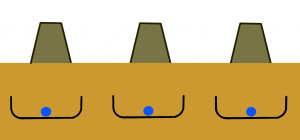
Let us summarise the message and how we work.

What our gut brain does

Our gut consists of trillions of cells which communicate with each other to form a genuine brain. Our gut does much more than help us digest food - it decides what and how much we will eat, it will help manufacture the array of complex chemicals needed to replace our body parts as they wear and age, and it will host our immune system to protect us from all the germs and diseases which will attack us during our life.

Where does our Gut Biota come from

We get some before birth, more during birth, others from breast feeding, and yet more from physical contact,, then more from food. Our gut biota begins to stabilise around age three but is still flexible in our teens but then we become set in our eating habits making it more difficult to change.

But it actually all starts much earlier, it is quite a journey - from compost - to a worm - to the soil - to a plant - to our mum - then at last to us. That is just the way the world is, and has been, for a few million years - until we started eating plastic food.

What we need to do

We need to educate future mums on the importance of eating plants grown in soil full of beneficial biology. They need to start eating these plants before birth and then feed their children these plants until their eating patterns are established, certainly up to the age of three, but preferably into their teen age years.

Where do they get this food?

The Gbiota club is a group of people who really understand the importance of soil biology and how it affects our health. Within the club are suppliers who will breed up the biology in their soil which they put into Gbiota boxes which they seed and grow until the plants are ready to harvest, using the principles of tipping and growing baby greens.

Mums can buy these boxes to supplement their diet for themselves and their children, feeding the soil biology with kitchen waste. When the harvesting cycle is finished they can either swap their old box for a replacement one or reload the boxes themselves.

Ecological balance

beneficial biologyWhen I was a kid bread would go mouldy within a few days, now it is virtually indestructible by the elimination of the micro-biology. But is the elimination of this micro-biology wise? It is the micro biology which turns dirt into soil making essential nutrients available to us.

True - there are harmful microbes, but the natural world has evolved over millions of years, into a system where the beneficial biology out breeds and controls any harmful biology.

This is a totally sustainable system, the indiscriminate killing of all microbes is not. It leaves a vacuum which will eventually be filled by something which could be far worse.

This picture shows beneficial biology in an experimental Gbiota box - it is releasing nutrients and keeping any harmful biology at bay.


How do they contact a Gbiota club member who can supply the boxes?

They should first contact Bernadette at bee@gbiota.com giving their location where she will locate a local member for you.

How much do they cost?

Typically a Gbiota box costs $68 and with a refund of $25 when the box is exchanged or they can be rented on a subsription basis.

How many boxes are needed?

As a guide one box per family member. If you are reseeding yourself you will need extra boxes to cover the time the plants are germinating.

What do I need to tell the local club member?

You need to select the plants you want. The club member can advice on what plants to choose based on locality and season. Common plants are spinach, broccoli, alfalfa, linseed, cress, celery, purple amaranth, kale and Asian cabbage but there are many more to choose from.

Milder plants are recommended in the early stages of weaning as the baby builds up it gut biota.

How do I know what I am buying

It is just a fact of life that people are different and will react differently to different foods, but Gbiota club members supplying the boxes agree to adhere to a strict procedure in producing the boxes.

How do I pay?

This is up to the local club member but typically they will deliver to your home where you can pay directly - but others will prefer for you to pay on line.

What is the legal structure

Gbiota club members supplying Gbiota™ boxes are independent business. They agree to produce the boxes based on the Gbiota principles and are licensed to use the trade mark name Gbiota™.


alice4


Loading

About Gbiota

Gbiota box story

The Gbiota box story


Technology should benefit the community

nannaGo to any supermarket and you can buy a lettuce or cabbage for a couple of bucks. It is truly incredible that they can produce, transport and put these on the shelves so cheaply - this is possible because of a whole range of innovative technologies from chemicals, automation and genetics.

I am a great believer in technology, over hundreds of thousand of years it has enabled us humans to survive and become the dominant creature on our planet.

But I believe technology must work for the benefit of the community and not just make a few people very rich.

I was a pioneer in the computer revolution and for my pioneering work on computer aided engineering I was selected by the Institute of Engineers as one of Australia's top one hundred innovators, but when I look at the food industry I see that innovation is focused on profits and not the health of the community.

Food that looks perfect but lacks the essentials

The products may look amazing, clean and perfectly shaped as though they had been made in a factory but what about the nutrient value? Modern food is lacking the mineral which are essential for a complex creature like us humans but which the much simpler plants don’t need, or only in small amounts. (See Technology)

But what is seriously lacking in modern food are the microbiology and fibre needed for a healthy gut.

I see very sophisticated data on how much carbohydrate, sugars, fats, minerals and vitamins we should be eating. I can look up and see how many micro-grams of selenium, zinc and magnesium we should be eating on an average day.

We are very strong on the bio-chemistry but what about our micro-biology?

Our gut brain

gut brain connectionBut the point is that over hundreds of thousands of years we have evolved a gut brain that automatically looks after us, without us even thinking about it - and it does it much better than weighing micro grams of minerals.

Our gut brain consists of trillions of cells which communicate with each other and send out signals saying we need to eat more of this or that or simply stop eating as we are satisfied.

It automatically monitors our bodies so it knows if we have had a couch day and tells us to reduce the amount of food, if we have been out in the hot sun it knows we need some extra salts and if we have been on a long hike we need to get the sugar levels up. Our gut brain is a very clever organ.

I spend many years of my life writing computer code, I understand how code works but I have absolutely no idea how the code works in our guts - and neither does anybody else. All we can do is marvel how well it works.

Unfortunately our modern food system does not look after our gut brain so we suffer many diseases related to poor diet but instead of fixing our gut brain we spend all this time and energy on creating an artificial process to control our diet.

Principles of Gbiota beds

gbiota bed principlesThat is why I developed Gbiota beds - to feed our gut brain. These large in ground beds work well and are well suited to commercial use by competent growers - but they do require some skill and understanding to make them work.

The microbes in the soil enter the plants which we eat so they become natural pre and pro biotics but we need to feed and water the microbes. The beneficial microbes need the soil moist, but not too wet, when they will out breed any harmful microbes. If the soil is too wet these harmful microbes will predominate - a process of ecological balance.

The key to maintaining that Goldilocks moisture level, not to wet not too dry, just right is the leaky dam and the partial flood and drain system. Water is pumped into a compost tube where it absorb the nutrients, flows down to the base of the bed where is spreads and starts wicking upwards to wet the root zone - just like in the wicking beds I pioneered some twenty five years ago.

But in a Wicking bed the water just stays in the base of the bed until it gets used up, this stagnant water can lead to the growth of the harmful microbes - in other words they become pongy. But in the Gbiota bed the water slowly leaks out through the leaky dam so there is never any stagnant water.

In a full sized commercial Gbiota bed water is pumped, for just a few minutes, several times a day, by a pump and timer system.

This is a very effective system well suited for commercial growers who obviously need a market for Gbiota food.

There was a clear need for a simpler system where people, may be just living in a flat, could have fresh Gbiota food growing in their own home.

This led me to develop the Gbiota box

The Gbiota box system

So I have now developed the Gbiota box so anyone can grow their own Gbiota food - even if they live in a flat and have no growing skills.

I am setting up a network of local suppliers who can manufacture and supply these Gbiota boxes so people can buy one or more boxes directly and have fresh Gbiota gut food growing at home.

breast feedingManufacturing these Gbiota boxes would be a very nice home business for the handyman who would be providing a service to their local community.

How to make these Gbiota boxes is described elsewhere on this web in the various articles and videos but now I want to describe how the user, may be a young mum who wants her kids to have a healthy gut can manage the Gbiota boxes she buys from the local supplier.

On Arrival

They come with plants already growing ready to be harvested. The most effective way is to use tipping where the tips of the plants are harvested where they can be made into green smoothies, wraps, sandwiches or whatever way suits. (see tipping video).

The micro farm

Anyone looking at a Gbiota box can be forgiven for thinking this is just for growing fruit and vegetables - and of course they are partially right. But the real point is to breed the beneficial micro biology for our gut and this is really like managing a dairy farm except that the animals are a lot smaller than normal.

But like any farm the animals have to be fed and watered - even if they are a bit on the small size.

The supplier of the box will have already loaded the box with these tiny animals and an initial burst of food and water. The new owner has the job of feeding and watering the animals - something a young mum would be very familiar with.

Let us start with water - Goldilocks moisture - not too wet and not too dry.

Moisture

The bed is watered by simply trickling water into the compost tube. A compost tube is simply a tube in the soil made from compost, as the water soaks through the compost it picks up nutrients from the compost to feed the microbes and the plants.

Some people prefer to have a proper pipe to hold the compost, this is a nice clean way of doing it, but I prefer to have a simple hole filled with compost - technically better but a bit messier - not a problem for a young mum used to changing nappies.

The water, or more correctly the compost tea trickles down to the base of the bed where it will spread over the base and start to wick upwards from the base.

This is exactly the way that the millions of Wicking Beds around the world work.

But the Gbiota box has a swivel drain.

box wicking b edWhen the pipe is pointing upwards the box act just like a conventional wicking bed.  Water (or compost tea)  is stored internally in the box.  But it is stagnant and will encourage the growth of harmful micro- biota if left.

When it is pointed downwards it acts like a true Gbiota bed with the partial flood and drain system so the soil is never wet for any length of time so the soil is kept moist which encourages the beneficial micro biota.  But it does need topping up with water more often.

boxgbiotaThe boxes are made with a soil dam so the box can be used with the drain pipe permanently pointed downwards so it is acting as a full blown Gbiota bed. This does mean that the bed may need to be watered every day (depending on weather).

The box must be raised with a container to catch the water. From a technical view point this is the best way of operating a Gbiota box but in the absence of an automatic pump and timer it does mean watering daily.

But, despair not, the box can be used as a hybrid Wicking and Gbiota box.

Before watering simply twist the drain pipe upwards when the box will become a conventional Wicking box. Trickle the water in until there is water in the sight tube (note it may take a bit of time for the water to trickle through - it is a good idea to measure out about half a litre of water and add this shot at a time with a bit of a wait in between, to see if the water has reached the sight tube.

The box can be left in Wicking Bed mode for a few days, then the drain pipe swivelled to point downwards when if becomes a Gbiota box.

While it is possible to go up a week in Wicking Box mode I would recommend draining at least twice a week and allowing a day between rotating the drain tube and refilling.

But the microbes are hungry little beasts and we have to feed them.

Feeding the microbes

boxwasteThe microbes must be fed. Fortunately there favourite food is kitchen waste which can be recycled back into healthy food. They, and particularly us, will need some additional minerals but the micro-grams needed can be added at minimal cost.

When the beds are made the lower layers are filled with compost but this will get consumed and will need replacing on a regular basis.

Soil develops a structure so we do not want to be remaking the bed but we must add the organic waste, preferably to the base of the bed where the conditions are best for composting.

We do this by refilling and remaking the compost tube. We can put a new compost tube in different places in the box to allow the organic waste in the previous tube to fully decompose.

It is best to chop up the compost, typically food waste, but making into a smoothie in a blender means the worms, already in the bed when it was supplied, will be better able to digest the waste.

boxbottlesharpThe material in the compost tube should be soft so you can refresh the tube pushing a bottle with a tapered top to rework the tube.

boxpistonThen when the tube is opened flip the bottle and push the square base to make a nice hole.

If you have made a compost smoothie you can fill the tube with this compost smoothie then push the bottle back into the tube where it will act like a piston and help distribute the compost below the surface over the rest of the bed.

boxcompostreadyCompost tube ready to go using the bottle method.

If all that sounds too complicated just dig a new hole and fill with food scraps and just leave it to the worms which are already in the bed when you bought it.

The bottle method is a nice easy way of making compost tubes but if the soil is hard then it is back to the old fashioned way of digging a new hole and spreading the soil around the bed. I don’t want do hurt the worms and am not squeamish so I just dig the new hole by hand or using a trowel, or better still a piece of pipe, so I can make the new hole without hurting the worms.

boxbiominWe also recommend covering the compost tube with some Biomin which contains a broad spectrum of minerals and some fresh biology.

You don’t need very much, your supplier may be able to provide 1 Kg packs which will last one bed about three months. (About a tea spoon per day) If you look at supplement jars in the chemist you will see they only contain micro grams so feeding Biomin to the plants is a very cheap way of getting minerals into your diet

Swap or reseed

Suppliers may offer a change over plan where you simply return the box to them in exchange of a new box with the plants already ready for harvesting or you can reseed yourself.

Before reseeding the bed - the box will need topping up with compost which is fuel for the microbes. This should placed a the bottom of the box which is done by making a new compost tube by filled with chopped compost (or a compost gel from the blender).

Seeding is done in the normal way but I recommend covering the seed with a layer of Biomin and fine soil or Vermicast and gently watering until the plants have put down their roots.


Loading

About Gbiota

Opportunity

Opportunity

What’s for dinner mum?

What one family has for dinner will not change the world - but what a few billion families have for dinner will.

We all have to eat and the way we are currently growing our food is slowly but inevitably destroying our planet’s ability to grow the food we need. We are destroying our soils and aquifers on which our lives depend and making ourselves sick in the process.

Many of our modern diseases, like diabetes, heart attacks, obesity etc., are directly linked to a poor diet and while no one is saying that a poor diet caused Covid, the fact is that the majority of the people who died from Covid were eating a poor diet. Diet is certainly an enabling factor in many modern health issues.

Profits before the community

It is simply a classic case of putting short term profits for a few ahead of the long-term benefits of the community as a whole.

The food industry is the world’s largest industry and fits this pattern - but how do we create the needed change to a sustainable and healthy food system so our grand kids and their grand kids will be eating healthy, nourishing and tasty food?

Not just technology

For many years I thought this was just a question of developing the right technology, where our food was produced in a fully sustainable way. Developing this technology has been my obsession for many years and that turns out to be the easy bit.

All food is based on carbon, fortunately there is plenty of carbon dioxide in the air and sunlight to convert it into food, but it does need water and some critical minerals for photosynthesis to work.

We need a range of minerals for our health, these were generally available in virgin soils but are becoming depleted with modern agriculture. Fortunately there is a virtually inexhaustible supply in volcanic rocks, we just need the micro biology in the soil to release the minerals and we also need water which is recyclable.

We have the technology we need to create a fully recyclable health food system - that is not the problem - the real problem is: ‘how do we design the needed change to a recyclable system and make them happen?’

There are many people already committed to this change seen through a growing trend to regenerative farming, organics and permaculture but we are still lacking key ingredients.

Aspirations and result

It is fine to have aspirations for a better world but what matters in the end is the final results. To achieve this better world we have to overcome two critical problems.

Manipulation of the truth

The first is manipulation of the truth. Reading Noami Oreskes seminal book Merchant of Doubt you will appreciate just how insidious the manipulation of data has become from tobacco, acid rain, the ozone layer and global warming where the true facts have been massaged to either prevent or delay action on critical issues.

Nowhere is this more true than in food and supplements. Getting this message out to the wider public is critical in creating a sustainable and healthy food supply.

The power of the wallet

The second problem to overcome is creating an economically viable system. It is no good having the healthiest food in all the world if only the rich can afford to buy it. Healthy food needs to be affordable.

Also growers have utes that need fixing, kids who want money for school outings and husbands and wives that need a beer or a glass of wine. The system must be economic for the growers and not just rely on a passion for the land.

To resolve these critical problem, whether we like it or not, we must look on future food generation food as a business.

Here are the basics of the business plan.

What we do

Gbiota™ (trade mark of Cohort International Pty) develops innovative technology for growing plants to improve health particularly gut biota. (Hence the name Gbiota)

We do not manufacture or sell any physical products. Our business is purely intellectual property.

Our technology centres on improving gut health by breeding beneficial biology in organic waste, which then enter the roots of the plants, to act as pre and pro biotics which then enhance the gut brain.

Benefits of our technology

The benefits of our technology are:

- controls the appetite so people don't over eat and become obese

- produces the chemicals to replace body parts as they wear

- enhances the immune system

- organics and food waste are converting a waste product into food and as a bye product reduce green house gases.

Our users

We provide the technology free of charge to home growers, in the belief that this creates a user base who will help to spread the information about the technology and provide credibility.

We live in an age lacking confidence in the sources of power - big business and even some of our Governments. People now rely much more on real people they know and trust. They may be not the ideal source of complex technical information but at least they are trustworthy, not manipulating the truth for profit.

Running an operation like this costs money, which has come from me and my past success as an early pioneer in computer aided engineering (see My Story) but this project needs to continue and grow long after I am not here so it needs a source of revenue.

So our plan is to license the technology - for a reasonable and equitable fee - making it available to commercial growers as the direct source of our revenue.

Promotional strategy

Our immediate customer base are commercial growers who are often small farmers who do not undertake significant generic market development themselves.

This means an important part of out strategy is to create a market for these growers - which is otherwise known as ‘umbrella marketing’.

The target customers are of this marketing are the section of the community that are sensitive to the ‘eating healthy food’ concept. There are three key groups:

1) Mothers with young children. The baby’s gut biology comes initially from their mother before and particularly during birth. Then from breast feeding and later from the food supplied by their mother. Currently there is no vaccine available for kids who are susceptible to the delta virus.

2) Older people who generally have a weakened immune system.

3) People concerned about the effect of human activity on our planet particularly the destruction of our soils and global warming which has a direct effect on our food production.

While none of these groups are our direct customers we need to promote to them to create a market for our direct customers - the local farmers and suppliers. Our promotional efforts have will be focused on these three groups plus the local farmers.

The Gbiota box

This is a special project initiated by the delta virus. It enables people in lock down to grow their own food, recycling their kitchen waste to grow fresh food with all the associated health benefits, at a minimal cost.

While this project may have been initiated by the spread of the delta virus it is thought that there are many people who would like to grow their own food but are not sure how to go about this. The Gbiota box would be prepared by local suppliers, (may be just people working from home in the lock down) already seeded with plants, ready to harvest.

This is believed to be a significant market in its own right but would help to develop the Gbiota concept amongst the commercial grower market.

Problems in marketing

Our promotional activity is dominated by our web sites and the social media activity of our supporters. Honest influencers really do influence.

The technology of growing plants to enhance gut biota is complex and not particularly appealing (it is all about good and bad bugs and a bit yukky to some).

This means our web sites look complex, which may be an initial deterrence. However, once people understand what we are trying to do they become quite dedicate followers and are happy to read long and detailed technical articles.

The web is now saturated with promotions for health products often with little technical backing but very sophisticated marketing and presentation.

This has led to a great deal of cynicism within the public who are now quite resistant to what they perceive as high pressure and unethical advertising.

Our big opportunity

We live in an age of cynicism. People are fed up with being lied to by mega global corporations with neo-monopoly power, by Governments who pay more attention to these economic collossus than the needs of their people.

They want to live in a society with equity and compassion, not to be dominated by greed.

However, for the Gbiota movement to provide value, it must survive as an economic entity.

Above all Gbiota is a social movement to make the world a better (or at least habitable) place for our grand kids and their grand kids, to enjoy a life that their ancestors (that's us) have struggled to create.

That is a powerful motivator.

Opportunity knocks

This is a great opportunity to built a multi national organisation which is has that magic combination of benefiting humanity while being profitable.

If I were half my age I would be grabbing at this chance but now I have to look for other people to take this to fruition. If that is you please contact me here.

Colin Austin 13 Sep 2021

Loading

About Gbiota

Introduction to Gbiota

The health and even the future of our species depends on the micro-biota in the soil and in our guts.

Gbiota™ - feed our gut brain

YanomamiIt is just a fact that the Hudza tribes in Tansania, the Yanomami tribe in the Amazon and people eating wild food and people living in the various blue zones have a far healthier gut biome than people eating a modern western diet.

They may be all different but they have two things in common

- their food is based on how plants and soil have evolved over millions of years by the sustainable recycling of organic waste

- their societies are based on prioritising the needs of the community.

The Gbiota project follows these two leads. Our technology is based on studying how biology, soil and plants have evolved together over millions of years.

We cannot all go and live in the Amazon but we can study what they eat and how it is grown. It is simple - they eat a wide variety of plants grown in moist forest litter. This breeds a healthy soil biology which enters the plants that they eat. A spinach leaf grown in soil with an active biology will have over eight hundred separate species of micro biology.

I developed the Gbiota™ growing system based on this natural process using recycled organic waste to breed the beneficial biology. There are plenty of local growers who want to grow using regenerative agriculture. You just need to form a local buying group and I can provide all the technology and advice on how they can set up their Gbiota beds.

This is not a project run by big business for profit - we don’t spend any money on advertising - we just rely on people sharing this information, for real with friends or by social media.

If you share our views please study the key post indicated then contact me here.

The importance of gut biology

Gut Micro-biology is essential for our health. There are trillions of cells made up from thousands of species. But this is much more than trillions of dumb cells - they communicate with each other and our head brain to form an intelligent control system to manage our bodies to do some very important jobs.

Our gut brain does three very important jobs,

- it control our appetite so we have enough food without overeating and getting fat and sick

- it manufactures the complex chemicals we need to replace our body parts as they age

- it hosts much of our immune system so protect us from pandemics

Modern soils in chemical industrial agriculture lack this essential biology and nutrients. Many of the chemicals used are claimed not to harm us but they certainly harm the soil biology on which our lives and future generations depend.

Gbiota food provide this essential biology and nutrients missing in our modern food.

Gbiota beds

Gbiota bed Gbiota beds were developed specifically to grow plants to feed our gut brain (Gbiota™). Beneficial biology is breed in a blend of soil, organic waste, manure, mineral and inoculants.

The biology enters the plants via the root system so they act as pre and pro biotics feeding our guts.

Moisture levels are controlled by a partial flood and drain system to ensure the beneficial biology dominates.

It is a totally sustainable growing system.

Licensed growers

gbiota bannerGrowers are licensed to use this technology and sell through the normal channels, on line, farmers markets or conventional retail. Growers are expected to follow protocols so the customer can buy with confidence in the way the plants have been grown. This is indicated by the Gbiota symbol.
And we want to see the technology used for the benefit of the community, rather than make a few mega corporation and individuals excessively rich.

This is a social movement driven by dedicated individuals. We put the needs of today’s community, our grand kids and their grand kids first.  If you share our views join us.

It is just not possible to explain a complex topic like food, health and gut biology in a three word slogan so I have now organised this web like a book with a preface (home page),  overview, introduction (index) and a series of posts which follow on from each others like chapters in a book.

If you are not familiar with my background it is worth reading ‘My Story’ first.

Next Read overview

Or skip to index which leads to more detailed posts

Food and health is a complex business, dont believe the ubiquitous  manipulatives adds trying to sell you pills or magic potions, they just want your money. Just eat good food, it works better and is much cheaper.

If you share our views please study the key posts as indicated then contact me here. This is a community project which requires cooperation from people who see the need for change for our health and future generations.

I would appreciate any comments or suggestions on how to make the message clearer and more readable.

Letter to Minister

Forward Opportunity

Backward gbiota-boxes

Loading

About Gbiota

Gbiota boxes

Our Gut Biota

The battle of the bugs

Growing plants as natural pre and pro biotics to strengthening our gut and immune system is smart in the middle of a pandemic.

Why Gbiota beds

The purpose of GBiota beds is to breed beneficial biology in the soil. This biology enters the plants growing in the soil so when we eat the plants they act as natural pre and pro biotics as well us providing valuable nutrients but the key point of Gbiota beds is to provide us with the beneficial biology.

Gbiota boxes

Gbiota boxes work on exactly the same principles as commercial Gbiota beds but enable anyone, even if living in an apartment, to grow their own Gbiota food themselves.

They are typically purchased from a local supplier with plants already growing ready for harvesting. The local supplier may offer a service to reseed and replant the box so no skills are needed so everyone has access to healthy fresh plants.

Ecological balance

The world is full of microscopic organisms, many want to breed in and on us - some some good some bad. The beneficial biology - given the right conditions - will out breed and control harmful biology in a system of ecological balance.

We have evolved with this micro-biology which now forms an essential part of our gut - trillion of cells made up from thousands of species. But this is much more than trillions of dumb cells - they communicate with each other to form our gut brain forming an intelligent control system which

- controls our appetite so we have enough energy but don’t overeat

- manufactures the complex chemicals needed to replace our body parts as they age

- hosts much of our immune system so protect us from pandemics

We were smart and won

Our ancient ancestors survived and flourished with just the protection of their inbuilt immune system and we became the dominant creature on earth. We know by studying modern hunter gatherers that they had a much healthier gut biota which supports our immune system.

They ate plants grown in forest litter, full of minerals, organic material and soil creatures.

This microscopic biology would enter the plant roots, and our ancestors would eat the plants which were natural pre and pro-biotics.

Not so smart

Protected by real advances in medical science we forgot the lessons of the past and changed our diet and started to eat 'plastic' food, very clean and hygienic, but lacking this essential beneficial biology and minerals so we become more susceptible to diseases - not so smart.

We remembered

This led to the modern day development of Gbiota™ beds (Gut Biota) which work on exactly the same principles that allowed our ancestors to flourish in hazardous conditions - but using modern technology.

We replace forest litter with the organic waste, particularly food waste which often ends up in landfill creating green house gases. We add the essential minerals, biological inoculants and worms to grow plants which are natural pre and pro biotics to ensure we have the beneficial gut biology and trace minerals essential for health.

Professional Gbiota growers can supply ready to eat plants but can also supply Gbiota boxes, with plants already growing so people can easily grow their own GBiota food using their own organic waste at minimal cost.

The hardware for the box is simple, just make a hole add the fittings and connect a length of Ag pipe. See video How to grow food for a strong immune system

Forward introduction-to-gbiota

Backward immune


Loading

About Gbiota

Anthropocene

Food the challenge of our time

B12 What should I eat so I am fit and healthy - what can eight billion people eat so they are fit and healthy - what will my great grand kids be able to eat so they are fit and healthy?

feed the world Today I want to talk about the who, how and why of answering these questions. We may think that the digital revolution is the epicentre of technical innovations but the food industry has seen a similar level of innovation.

atomic bomb

 Innovation has brought great benefits to our society but just because something is new does not automatically mean that it is good. Is the atomic bomb and land mines which blow peoples legs of years after the conflict has finished good? Is food that makes us feel hungry so we end up fat and sick good?

We must learn to manage innovations so it works for the benefit of the community. If you read ‘My Story’ you will see my life has been one of innovations so I will give a few basic rules for successful innovation and how these can lead to innovations which will provide the billions of people that will inhabit the earth with food that will make them healthy.

The Anthropocene

We entered the Anthropocene on the 6th August 1945 the date of the first atomic bomb. It was then clear we had the means to destroy all human life on earth. That was almost eighty years ago - how come we are still here? The answer is information and understanding that information. The man behind the red button clearly understood that pressing the button would be the end humanity - so we are still here.

Now we face much slower and more insidious threats. Is global warming a threat? If coal and oil had never be discovered we would still have an advanced civilisation but running on the enormous power from the sun - in one hour there is enough energy falling on the earth to meet all our power requirements for the next year. We would simply have developed the technology to harness that power.

The why haven’t we? Because of the manipulation of information which is the real threat we face. And the biggest threat we face is from manipulation of information about food. We are destroying our soils, we are making ourselves fat and sick from a poor diet.

Deaths from Covid

covid deathsLet me just give one simple but dramatic example. There are numerous studies by qualified researchers that show that the people who die from Covid are either on a poor diet or subject to stress (which releases Cortisol which shuts down the immune system).

Virtually all the people that die from Covid have a weakened immune system from poor diet or stress.

Just think how different the world would be if people did not die from Covid.

We know that diet affects the immune system so it would seem reasonable that Governments around the world would be having programs to improve the populations immune strength. Yet they are not and why? Because of the flow of information.

The biggest threat that humanity faces is from poor food - yet we are fully capable of growing all the food we need to feed the global population - food that will keep them healthy.

We have the technology - the danger comes from the manipulation and control of information. That is what I want to talk about here.

Let me tell you the story of food.

Once upon a time

pre-human Let me tell you a story, sorry no magic fairies just goodies and baddies and Pre humans.

Once upon a time, a very long time ago, a couple of millions years, there were creatures that lived in the forests that were to evolve into the most successful and dominant creature on earth. We can call them pre-humans. They were forest dwellers.

For some two million years pre-humans were tree dwellers eating plants grown in highly biologically active soil so we evolved our gut brain.

Forest floor

forest litter The forest flood was covered with dead and dying things that were once growing, plants and animals and their poop and dead bodies - probably the most biologically active area on earth. And the forest floor was just nicely moist not too wet and not to dry so living in abundance on this forest floor litter were minute creatures we now call micro biology - millions of species.

Some were simply bad and would infect these pre-humans and they would die - others turned out to be particularly good for these pre-humans - in fact without them there would be no modern humans.

Forest litter rich in biology

gut brain connectionPlants would grow in this forest litter and these plants would be full of micro-biology which the pre humans would digest when they ate the plants.

These micro-organisms began to breed inside these pre-humans - it was nice and warm with a plentiful supply of food. Now a very remarkable thing happened. Very lucky because had it not happened you would not be here to read this post.

Every one of these micro-organism or cells began to communicate with its neighbours and although each cell was not particularly smart there were trillions of them so together they formed a brain with true intelligence, and then they began to communicate with the pre-humans brain by a combination of electric (nervous) and chemical signals. We now call this the gut brain connection and is just totally essential for these creatures (and us) to survive.

Our gut brain -benefits

 greedy personThis was extremely fortunate as this gut brain did some extremely important jobs, it told the pre humans when they needed food, it made them hungry and needed to eat and when they had eaten enough it told them they were full and should stop eating.

This was particularly important as they lived in the branches of the trees and were safe from the ferocious creatures below. The pre-humans that did not have this intelligent gut would overeat and get fat and fall out of the trees and be eaten by the ferocious creatures below.

The nasty side of evolution

 It is a bit difficult to breed inside a ferocious monster and evolution is all about breeding so the pre-humans without a smart gut brain simply became extinct.

replacement partsBut the gut brain did yet more - as their body parts wore out the gut brain would send signals and often produce the chemicals needed to replace these parts.

This relationship between the micro biology and the pre humans was very beneficial for both and went on for some two million years and became the norm. The pre-humans could not exist with the micro biology and the micro biology in our gut needed the pre-humans.

Good bugs and bad bugs

 This was all good but as we all know in life good things often have a bad side and the bad side was the harmful micro biology - often this was in the food that the pre-humans were eating, there were no bottles of hand disinfectant swinging in the branches of the trees, but the beneficial micro biology worked together to defeat the harmful micro biology.

For a start the beneficial biology would simply out compete the harmful biology so they had no food and simply died out.

But the good biology and the pre humans developed a very effective system to fight off the harmful micro biology - our immune system - the beneficial biology in our gut housed, fed and trained the immune system. Still a tough battle but enough of the pre-humans survived the attacks by the harmful microbes to survive and prosper for some couple of million years.

Micro organisms

good bug Good mircro-organisms would end up in the gut of these pre-humans where in the nice warm surrounding they would breed forming a colony. Some of these micro-organisms would be good and others bad.

Both the good and bad organisms would breed inside the gut competing for food and space. If the bad organism won the pre-humans would end up sick or dead. If the good organisms won the pre-humans would survive and breed and lead to us - modern humans.

bad bugWho won depended on the conditions inside the gut - if these pre-humans ate the sort of food that favoured the good organisms the goodies would win if they ate the sort of food that favoured the bad organism then the baddies would win and those pre-human would die and not breed so they would become extinct.

The good organisms and these pre-humans formed a relationship in which both flourished - what we now call synergy. The pre-humans would provide the micro-organisms with food and a nice warm place to breed while the organisms would provide the pre-humans with services they could not live without.

The importance of gut biology

cells communicateGut Micro-biology is essential for our health. There are trillions of cells made up from thousands of species. But this is much more than trillions of dumb cells - they communicate with each other and our head brain to form an intelligent control system to manage our bodies to do some very important jobs.

Our gut brain does three very important jobs,

- it control our appetite so we have enough food without overeating and getting fat and sick

- it manufactures the complex chemicals we need to replace our body parts as they age

- it hosts much of our immune system so protect us from pandemics

Modern soils in chemical industrial agriculture lack this essential biology and nutrients. Many of the chemicals used are claimed not to harm us but they certainly harm the soil biology on which our lives and future generations depend.

Our friendly gut bugs - what they do

They would digest the food that these pre-humans could not digest themselves - they would make chemicals - we now call hormones which would tell these pre-humans they were hungry or full so they did not starve or overeat and get fat and sick - they would make complex chemicals which was need to replace the pre-humans bits as they wore out and they would support the pre-humans immune system so they could fight off any bad micro-organisms that happen to come by.

Climate change (this time natural)

Hunter gathers

Hunter gatherers But then something truly bad happened. The climate changed, this time due to natural causes, but the results were disastrous for the pre-humans as the trees which had provided protection simply died out and they were left in open land - easy prey for the ferocious beasts.

When the trees disappeared and we became hunter gathers, we learned the benefits of technology and cooperation. We developed technology for hunting and started to eat meat and cook.

But much of our diet was still based on plants so we maintained a healthy gut to fight off local infections and we lived in small groups so large scale infections simply could not happen - they were disabled.

Bad as it may have seemed this led to the creation of modern humans some two hundred thousand years ago who made two very important discoveries.

Forming cooperative groups and developing technology (sort of)

The first is now absolutely built into human nature, as they say it is in our DNA and that is forming groups and cooperating together. One human is an easy meal for a ferocious beast. A group would have been a feast except for one reason - we developed a technology.

This technology may seem totally insignificant with modern technology but had these humans not developed this laughably simple technology then none of us would be here today.

The key to our success - technology and cooperation

monkey throwing stone And that technology is that we learned to throw stones at the ferocious beasts - and the barrage of stones hurt so the ferocious beasts decided it was better to chase a few antelopes which could run much faster but had not developed the technology of throwing stones.

Humans continued to develop technologies typically with beneficial result but sometimes disastrous.

Agriculture

early ag Then we developed agriculture which enabled the population to significantly increase. But there were side effects. We created the city which made us much more prone to infectious epidemics which killed large numbers of people.

We also had no understanding of soil biology so we destroyed our agricultural soils. This led to a pattern throughout the world of civilisation developing in an area and thriving for several hundred years then when the soil was no longer productive the civilisation either collapsed and was overtaken by fresh civilisations or they simply moved on to a new area with fresh soil.

But despite these problems we were still eating food grown in biologically active soil so although we were under attack from infections with many deaths overall the population expanded and at an ever increasing rate.

Cause and enabling black death

black deathOne of particular relevance to today epidemic is the black death. This teaches us a very valuable lessen for today, the difference between cause and enabling and the power of dis-enabling.

Scientist estimate that the black death had been around for some two thousand years without killing that many people then in 1,300ad it spread like wild fire and in some areas killed half the population.

There is no way the black death was caused by some new technology developed by humans - but its spread was enabled by a human technology.

The new technology was a quantum jump in the improvement of boats. These boats were now sailing around the known world unknowingly carrying rats and their fleas which were the real carriers.

At first humans had no idea what caused or how to fight the black death but they did develop quarantine which slowed the spread and allowed time for the development of better weapons. Quarantine is a dis-enabling technology we still try and use today.

Another very simple dis-enabling technology was the adoption of the bed raised above the floor, so people no longer slept on the floor which created a barrier to infection. Hygiene was also improved. All these use the process of dis-enabling - they don’t cure the disease but they are effective.

London SewageThe next great plague was cholera some five hundred years later in the 1800’s. Like the black death there was no immediate medical solution and is was initially solved by the process of dis-enabling. This time initially by a very smart guy called John Swan who at first simple removed the handle from a contaminated pump.

But it did lead to the major engineering works of the London sewage system, still one of the engineering masterpieces in history.

In both of these cases the immediate solution was dis-enabling and later more sophisticated solution were developed.

The modern age

modern agThen we entered the age with modern agriculture particularly the development of synthetic fertilisers and improve genetics.

Food production increased at a staggering rate and population with it. In a period of eighty years the population increase by a factor of 3.4.

Such an increase in population is completely unprecedented and we really have no idea of the implications - other than we are right bang in the middle of the Anthropocene with multiple threats from nuclear war, climate change, epidemics which has enabled our modern life style and the one that may be even the most important - how we feed ourselves.

The plastic age

The happy relationship between micro-biology and modern humans lasted up until about fifty years ago. Then modern humans entered what I call the plastics age - not because we started to eat plastics but because plastics are clean and inert and we started to eat food that was clean and inert, devoid of life and often wrapped in plastic.

It was cheap, convenient and tasted good but we never really felt satisfied, or more accurately our gut biology was not satisfied, so it sent out signals for us to eat more

And that was not good for us humans, we became fat and sick and prone to infections but it was a disaster for these beneficial organisms which had been our friends and looked after us for millions of years.

But humans have survived through many catastrophes by our ability to innovate.

The technology explosion

Modern humans have been developing new technologies at an exponentially increasing rate, the development of new technologies like Artificial Intelligence and DNA sequencing would have been unthinkable just a few decades ago.

In just a few hundred years we have progressed from a hand made cottage industry to modern manufacturing with mass production, the steam engine, the car and aeroplane.

Then on the 16th July 1945 there was the demonstration of a new technology which meant humans had entered the Anthropocene, the era where our technology had reached the level were we could destroy all human life on the planet. I am of course talking about the Atomic bomb which should make every living person stop and think about how we manage this mastery of technology we have acquired.

When we look back over the history of innovation and technology we see a distinct pattern.

Motive for innovation, power, money and sometimes humanitarian

Some technology is developed purely for humanitarian reasons - to make the earth a better place to live in - but sad to say much of the technology is developed either for power or money.

genghis kans army Genkis Kahn must be the one of the great examples of technology giving power. His technologies of the stirrup and the reversed bow gave him a technological superiority in battle which made him virtually invincible. He could easily have conquered the entire region from the shores of the Atlantic to the shores of the Pacific.

But for some unknown reason he turned his troops around as he was riding into Europe defeating all his enemies and went back home. Who knows why? May be he just missed his girl friend.

But many technologies are now developed for money, and there is a distinct pattern. The technologies benefits a significant number of users who are willing to pay more for the perceived benefits of the new technology and so generates large amounts of money.

That’s good

But typically new technology creates a neo-monopoly. It may not be a legal monopoly but more like a mateopoly where are few individuals or corporation together control the technology and create simply amazing wealth (for themselves).

That’s good for them - but no one else.

And on the other side are people who are severely disadvantaged by the new technology, often loosing their job and livelihood and having the value of their assets destroyed.

That is not good.

This is nothing new - this has been the pattern of innovation throughout history - what makes it all so different is that we are now in the Anthropocene, we now have the technological capacity to destroy life on our planet.

It could be the atom bomb, it could be global warming with its floods and droughts but it could be and is most likely to be something as simple as food.

The process of successful innovation

Understand the problem

We must really understand the problem - or else we will end up on the wrong road with a clever but useless gizmo. With food people say we have a problem in feeding the eight billion people on earth. That is not true - we are already producing enough food to feed thirteen billion people - it it just the wrong sort of food.

Paradigm busting

We must be prepared for a bit of paradigm bashing. The old paradigm to loose weight - eat less exercise more - simply does not work.

Silo hopping

Dump the silo - experts live in their silos with a high degree of expertise in a narrow discipline - this is breeding ground for paradigms. We need to go Silo hopping, throw in a bit of ecology, evolution, psychology.

Manage ignorance

Science may not be the driver of innovation - there is a saying that science is the art of truth - engineering is the art of ignorance. Many of the great advances have been made by making something that is useful and works by managing to overcome ignorance. Then once that advance is shown to be important science has developed the basic understanding which leads to substantial improvements in the technology.

The steam engines was developed and proved to be usefull - then science, particularly Carnot, developed the thoery of thermodynamics.  The steam engines was not developed because Carnot developed the theory of thermodynamics.

Simplest solution that works

Aim for the simplest solution that works, we live in an era of unrivalled complexity which means good ideas often fail from fragility and poor ergonomics.

Distributing the benefits

Innovations should lead to benefits for the community at large. People who innovate or manage innovation must consider how those benefits are distributed - do they benefit society as a whole, or do they just make a few people very rich and harm other people, even if it is just a loss of jobs and income. These are factors which must be considered and planned for.

Innovation - the plan

We live in an era with unprecedented levels of sophistication. There are major investments in very sophisticated food technology like creating artificial meat using genetic engineering. But where do the basic raw materials come from, are they sustainable, will they just be available for the rich people leaving the poor people starving and can they really feed the expected ten billion people?

Would it be cynical to think that such ultra sophisticated technologies are being developed by the ultra rich so in the event of some food crisis they would have access to food but this would be of little benefit to the bulk of the population.

Rethinking technology

We are already supporting some eight billion people from food that comes from the sun and the soil, actually we are producing enough food to feed the anticipated growth in population for many years to come - we simply waste an enormous quantity of food which is not good for our health.

Can we do that better?

The basic of the Gbiota system

The simple fact is that for a couple millions years our pre-humans ancestors were happily and successfully living on plants grown in highly biologically active nutrient rich soil and had an immune system strong enough to defend them from the harmful biology.

Then fifty years ago we switched to a very different agricultural system which destroyed the soil biology.

How smart was that and can we re-trace our steps to a growing system based on an active soil biology which stood us humans in good stead for all those years?

That is the basis of the Gbiota system.

It is so simple that it hardly seems reasonable to call this an innovation.

But let’s go through the logic. For two million years we survived and created a beneficial gut biology by eating plants grown in the moist, biologically active, nutrient rich forest litter.

We simply cannot repeat that process because we have chopped down most of the trees and there are simply too many of us.

Mimicking the forest floor

gbiota bed principlesBut we can mimic the conditions of the forest floor. We produce an incredible amount of organic waste which often ends up in land fill creating green house gasses.

We keep animals which produce an awful lot of poop and we ourselves are animals making yet more. This may be full of pathogens which have the potential to kill us but we have the technology to manage the eco-system so the good bugs can out compete the bad bugs.

We also need minerals but these are readily available in volcanic rocks dust. Not everyone has their own private volcano but they typically will live near a quarry where the rock dust is a by product.

We also need beneficial biology ranging from the micro-biology to worms but they are very happy to breed up from an initial inoculant.

All the needed raw materials are readily available as waste, at low cost, just needing minimal re-processing to turn them into a valuable resource.

Gbiota beds are simple - breeding beneficial biology in organic waste, this beneficial biology will enter the roots of the plants and when we eat the plants the biology, neatly wrapped inside the plants enter our gut biota.

This is really a very simple technology, people living in apartments can have their own Gbiota Bioxes and recycle all their food waste themselves.

There are many local farmers who can provide these Bioboxes and plants at economic prices to their local community.

The details of how to set up and manage Gbiota beds are on my web site under the Creative Commons system.

The information age

So what could possibly go wrong? We live in the information age, the internet is one of the top innovations of our era so surely who would expect there to be any issue in educating people about eating plants to enhance their gut biota and improving their health. Particularly as we are in the middle of a pandemic where a healthy gut biology and immune system could be the difference between living and dying.

Yet this abundance of information is the very source of the problem.

There is simply so much information out there - some of it perfectly valid and other just bogus information - it is simply impossible to review it all and work out what is genuine and what is fake.

Of course we do have mega corporation who are anxious to help us find the right information that they think we may like - for free. Unfortunately not the information that is necessarily correct but what we want to hear. This is not done by humans with real intelligence but by machines operating according to how they are programmed with no real intelligence.

Data manipulation

 breast feedingHow do I know? My interest is in gut biology and where does that come from initially? - from our mothers at birth and later from her milk. So I research this then get bombarded with advertisement and information appropriate for a pregnant lady.

How do I know it is a machine - any human with a scrap of real thinking capacity would think that an 82 year old male is unlikely to be pregnant.

The companies that provide these so called free service are making billions of dollars from providing this information to their advertisers and the food industry is one of the largest advertising budgets running into multi billions of dollars.

We live in a world of highly filtered information. The system promotes food which will earn money while information saying that gut health can be improved by eating plants grown in organic waste is filtered out as there is no money in such a simple idea.

The real world test

How do we resolve this issue? It is so simple - just get a few people to do a real world test. Anyone can set up a Gbiota bed, or find a grower who is willing to set one up. Eat Gbiota food for about three weeks and see how your food cravings change. It is not simply that you will eat less - you will want to eat less.

If you want to be more specific you can have your gut biota tested. As everyone's gut biota is unique this need to be done before and after changing your diet.

You can do this locally or you may be able to cooperate as part of the human gut project.

Human gut project

rob knight human gut project You can contact Rob Knight, Professor professor at the University of California, San Diego and the co-founder of the American Gut Project.

Then they can tell your friends and get them to run the test and tell their friends. No need for expensive advertising which no one believe any way - just the good old fashioned way of people talking to each other and sharing real life experiences.

Just make sure you are well stocked with toilet paper before running these trials.

Regenerative growers

There are plenty of far sighted growers who see the importance of soil and are already involved in regenerative practices. They would be perfectly willing to set up Gbiota beds but they have Utes to mend, money for their kids school excursions and the general costs of living.

They may be willing to invest the time and money in setting up GBiota beds and supplying Bioboxes but first they need to see there is a demand and it is economically viable.

So before approaching these growers we need to establish local gut food communities.

Local gut food communities

It just takes one person to start a local food community - but what sort of person?

Sadly we live in a world which is dominated on one side of the political spectrum by a belief that the profit motive and the power of the market will solve all the worlds problems and on the other autocratic regimes whose primary interest is their power.

They are both living in cloud cuckoo land, neither a lust for money or power are going to solve the problems of the Anthropocene. These problems will only be solved by people who believe in a third system which was pioneered years by Abraham Lincoln with his immortal phrase 'bad thing happen when good men stand by and do nothing'.

Valid years ago, still valid with the addition of 'good women'.

Of course they need to receive adequate financial rewards but the prime motivation must be to solve the problem of the Anthropocene for themselves, their grand kids and their grand kids.

That is the approach that will ensure that humanity not just survives but thrives and prospers into the future.

Information - bogus and clutter

We live in the information age so it may seem axiomatic that the internet would provide the perfect medium for getting the message out.

That simply is not true - there is so much information that our brains are cluttered with information, typically for profit, often bogus and sometimes malicious.

Simply creating posts on the internet is not a solution - the internet has a critical role to play but as a mechanics for transferring information - not as the primary motivator.

There was a time when people actually spoke to each other and although it has gone out of fashion it worked remarkably well.  I remember it with nostagia. It worked as a motivator and a source of credibility. It is no wonder we have the rise of the influencers - people want contact with real people.

But nothing beats the internet as a means for the bulk transfer of information.

Just one person can start the process - they contact their friends and guide them to the mass of information on the web. Armed with this information a new tier of people can keep the boulder rolling by contacting their friends and contacts (real of virtual) and soon we have a social movement.

But just having a group of motivated people is still not enough.

The group needs coordinating so it operates as a group and that is where the community section of the web comes into play. People can join or form a local group and communicate with each other to implement a plan.

Part of that plan if for one of more group members to make contact with regenerative local growers in their area who are prepared to set up Gbiota beds and supply either fresh plants or Gbiota Bioboxes with growing plants.

This is not - and for survival - should be a charity, even though the motives may be to benefit the community. For long term survival this must be economically viable with all people, not just the growers but the group organisers receiving a fair financial return for their efforts.

Generation of revenue is easily be achieved by the system of membership fees for growers and admin fees on the multi vendor web site, and transport and distribution fees - which are already in place.

How these funds are distributed should be left to the local groups to decide.

The immediate action is for people to join the community section of the web and then either join an existing group or from their own group.

Each local group takes the decision on how their group is run. This is why I call this the third force - not dominated by the desire for profits or power but a group motivated by Lincoln's saying "bad things happen when good men and women stand buy and do nothing". That is the how society will thrive and prosper into the Anthropocene age.

Gbiota symbol

Gbiota™ is a registered trade mark.

Forward updateaug21

Backward overview

Loading

Overview

Overview

Summary

How life works

The two great synergies

Life starts with energy which come from the sun. There is lots of it, in one hour enough energy falls on the earth to power humans for the whole year.

This energy is picked up by the plants which takes carbon from the atmosphere and hydrogen from water to make energy fuel - carbohydrates. There is plenty of carbon in the air and plenty of water in the oceans, it just needs the sun to make rain which tends to be too much or too little.

Plant exude sugarsPlants exude sugars from their roots to attract and feed microbiology, this collects water, minerals and complex chemicals from the soil and feed to the plants. This is one of the two great synergies in the world.

Some of this microbiology enters the plants so when we eat plants - or animals that eat plants - we get energy fuel, minerals and complex chemicals and microbiology.

This second great synergy is between creature, great and small, and the microbiology in the soil and in their guts. We need this microbiology to digest our food and replace our body parts.

We need sugars to power our bodies but we need just the right amount. If there is too little sugar there is not enough energy to power our bodies, if there is too much then the sugars will cause our body part to at first turn black, rot and then die. This is the curse of diabetes which years ago was very rare but is now common as we stop feeding our guts.

Fortunately our bodies are very clever at controlling our sugar levels. It does this by sending our signals and hormones, but these don’t just appear. The trillions of cells in or guts communicate with each other and our head brain to form a brain which takes the decisions to release the signals and hormones which control our body.

How we have moved from our evolutionary base

But these trillions of cells need to be fed and replaced. They have a short life, measured in days, they breed rapidly inside us - if they are fed the right food - and we are continuously eating food which contains their food and replacement micro-biology.

We don’t need a lot, nowhere near the amount of food we need for energy but is totally critical for our health.

That is why we need to eat gut food - Gbiota food.

sugary fatty foodsIn our evolutionary era we had plenty of gut food which came from nutrient rich biologically active soil, we had all we needed so we did not evolve to crave gut food. However energy food was in short supply there is not much energy food in the wild - so we evolved to crave energy food.

But the food for modern humans has changed - our modern food system has the technology of  producing the energy food we crave in large amounts but there is little incentive to produce the gut food - which we only need in small quantities - but it absolutely essential for our health.

Our bodes are smart enough to sense this lack and so send out signals for us to eat more - and we end up overeating on energy food rather than gut food.

Profits and social responsibility in the modern food industry

This is the great contradiction of modern food - too much of the wrong sort of food and not enough of the food we really need.

The food industry is the worlds largest industry and invested heavily in technology to improve production - with great success. In the last eighty years energy food production has increase by 4.5 while the population has increased by just over 3.

It has also produced the type of food that people have evolved to crave - sugary fatty foods. No one could criticise an industry which increases production to give people what they want.

In a capitalist society it the accepted norm that companies are in business to maximise profits for their shareholders and the market will resolve any issues. Again no one can criticise an industry for following the accepted norm.

It would be fair criticism that the industry has engaged in a marketing campaign to convince the buying public that their food is healthy, meaning complete, when it only supplies part of our dietary needs. This is simply deception.

This would not be important if the product was not life critical, say like computer games, but food is different - we all need to eat and the modern food industry has created an epidemic of chronic diseases. This need correction.

The Gbiota movement

The Gbiota movements prime focus must be to develop the technology and understanding of healthy eating but this only leads to results if the community is educated about food and there is the opportunity to buy food from growers who believe that companies have a responsibility to the community as well as making profits.

That is why the immediate aim of the Gbiota movement is to recruit people who appreciate that this is a cause and not just a profit opportunity and are prepared to act to make the world a better and healthier place. Interested contact me

Don’t worry about the earth - worry about us

 earth and sunOur earth has been spinning around the sun for some 4 billion years and we can expect it to be still spinning around the sun in another 4 billion years or more.

But will there still be people on it? A lot depends on whether we can feed the billions of people who inhabit the earth now and in the future.

bush fireWe may think of some cataclysmic failure from fire or flood from global warming, but it may be totally unspectacular.

Our health is totally dependent on the microbiota in our guts which in turn is dependent on the microbiota in the soil.

We are systematically destroying our soil microbiota and we have no idea how this will affect the ability of the human species to survive.

gut brain connectionWeakened immune systems are making us more susceptible to epidemics like Covid - that could just be a warning shot across our bows.

Maybe we should take soil and gut biology a bit more seriously - as though our lives actually depend on these minute critters.

megacity But I don’t want this to be a story of doom and gloom. Humans are the dominant creature on earth because we are smart, innovative and cooperative.

But we are also empathetic. I have four grand children - right now too young to have children themselves but that will come in the next decade or so, may be too late for me to see my great grand children.

digital ageBut I want my great grand children to have the right sort of food to eat and I want them to live in a society where they can be free of the wars, conflict and socials tensions I have had to put up with in my life.

We may live in the digital age and expect immediate answers to our problems but that is not the way the world works. We have to understand the problems then work away at the solutions.

The Gbiota technology, like all science and technology, is based on established building blocks. Here is the basic science on which Gbiota beds are based

gut brainThe first is the role of our guts. We understand that our guts

- form part of an intelligent control system which determines our appetite (e.g how much we eat,)

- manufactures some of the essential complex chemicals needed to replace our body parts

- is home to much of our immune system.

soil biologyThe second is that our gut biology or Gbiota is determined by the soil biology in which the food we eat is grown. At birth we received a major burst of biology from our mums and then from breast feeding but after that our gut biology is determined by what we eat.

Plant will absorb energy from the sun which they use to make specific sugars which they exude from their roots to attract and feed specific microbes to the local rhizosphere or root zone. Later these will enter the plant and hence our guts.

spinnach leafA spinach leaf may contain some eight hundred different species of micro biology. Other plants will supply a different range of species so by eating a varied diet we can build a very complex gut biology.

Eating healthy food is more effective - and much cheaper - than taking pills to make some company very rich.

hunter gatherersThirdly in our evolutionary period as hunter gatherers there was a natural abundance of both biology and minerals in the soil which led to a healthy gut micro-biome. In this period there were less than a million people on earth so there was no issue - if an area became depleted we just move on to a fresh area. We continued this until recently with the great expansion in the US.

modern agFourthly in the last sixty years or so we have adopted chemical industrial agriculture. This has been amazingly effective in the production of food as fuel made up from carbon and hydrogen. While population has increase by a factor of 3 fuel food has increased by a factor of 4.5 so there is an apparent abundance of food with our supermarkets brimming full of convenient and tasty food.

supermarketHowever the lack of the soil biology which created healthy gut biology has led to an epidemic of chronic diseases stemming from overeating because our bodies are not satisfied - such as diabetes, heart attacks, dementia etc.

There is no suggestion that this has caused the current Covid epidemic but it has certainly enabled the virus to spread and cause so much problem throughout the world.

intensive careAll this is well understood by conventional science and provides the basis for the Gbiota technology. There are numerous papers on these subject some of which are linked here in references.
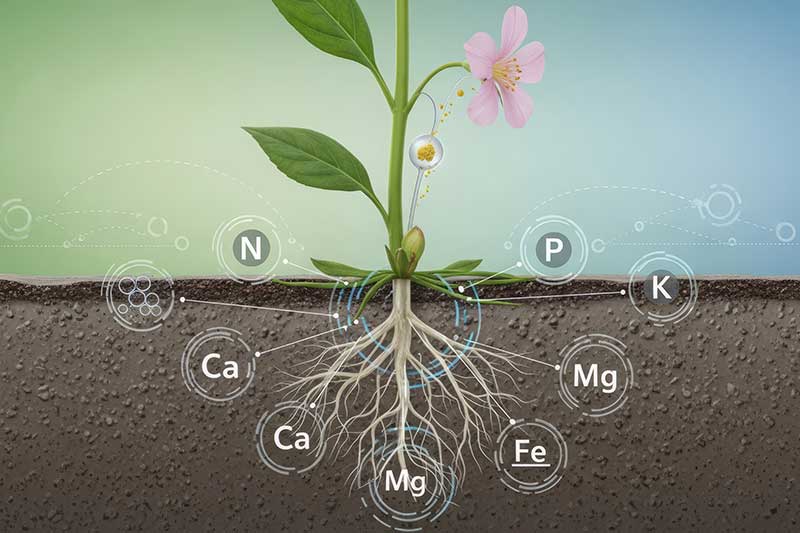
The purpose of the Gbiota technology is to regenerate our soils at a fast enough rate so our current population of 8 billion people (and growing) can have access to healthy soil and gut biology and trace minerals now we have reached the limit of our available land.

It is much more than a better way of growing a few cabbages it is facing the problem of how our great grandchildren are going to enjoy a healthy life on this planet.

But it is not sufficient to just develop the technology - we have to plan how this can be implemented in a way that benefits the community as a whole and not just monopolist corporations. A network of micro farms supplying the local community seems the most practical approach.

This web is structured rather like a book with this being the preface. The next post is like the introduction giving an index of how the Gbiota technology actually works. This then links to more specialist post going into greater detail.

Forward anthropocene

Backward index

Loading

About Gbiota

Gut Biology Sources

https://hormonesbalance.com/articles/why-does-organic-farming-leave-us-depleted/?

https://www.healthline.com/nutrition/giloy-benefits

https://www.embopress.org/doi/full/10.15252/embr.202051069

https://www.ncbi.nlm.nih.gov/pmc/articles/PMC6780873/

https://sustainablefoodtrust.org/articles/soil-stomach-plant/

(PDF) Does Soil Contribute to the Human Gut Microbiome?

https://www.theatlantic.com/health/archive/2013/06/healthy-soil-microbes-healthy-people/276710/

https://tastingthefuture.com/2019/11/07/unearthing-the-science-between-soil-and-gut-health/

https://www.sciencemag.org/news/2020/05/meet-psychobiome-gut-bacteria-may-alter-how-you-think-feel-and-act

https://www.agriculture.com/crops/soil-health/soil-health-means-better-human-health

https://www.theatlantic.com/health/archive/2013/06/healthy-soil-microbes-healthy-people/276710/

https://www.agriculture.com/crops/soil-health/soil-health-means-better-human-health

https://www.researchgate.net/publication/335340302_Does_Soil_Contribute_to_the_Human_Gut_Microbiome

https://www.researchgate.net/publication/335340302_Does_Soil_Contribute_to_the_Human_Gut_Microbiome

https://f1000research.com/articles/7-1588

https://www.ecofarmingdaily.com/build-soil/soil-fertility-biodiversity-and-the-gut-microbiome/

https://www.washingtonpost.com/science/uncovering-how-microbes-in-the-soil-influence-our-health-and-our-food/2019/09/27/81634f54-a4ba-11e9-bd56-eac6bb02d01d_story.html

https://www.ncbi.nlm.nih.gov/pmc/articles/PMC7403703/

Heritable Gut Microbiome Study

https://backyardvitality.com/fastest-growing-foods-get-self-reliant-now/?

https://timesofindia.indiatimes.com/most-searched-products/home-decor-and-garden/garden-and-outdoors/air-purifying-indoor-plants-upgrade-and-refresh-your-space-with-greenery/articleshow/84142358.cms


https://foodrevolution.org/blog/b-vitamins-benefits/

https://theecologist.org/2009/sep/10/how-set-your-own-local-food-co-op

https://www.organicbuyersclub.org/

https://www.naturalfarmerspantry.com.au/?gclid=Cj0KCQjw0K-HBhDDARIsAFJ6UGhCldpZgR1OKaWB2OciQKZ2Jq410GwK6sDWmUpdWmF0lWH8Cvf7v5kaApcnEALw_wcB

http://www.coopdirectory.org/bp003.htm

Average Waist Size For Women and Men

https://www.liveforless.com.au/introduction-food-co-ops/

9 tips for starting a local food co-op


Loading