The Gbiota Biobox is designed to do one simple but powerful thing: turn cheap, everyday organic waste into living soil that feeds your gut brain, not just your stomach.
In this post I want to show just how easy it is to grow gut–brain food. But before I start, let me explain why it is so important to have a healthy gut brain and how the food cycle works.
Energy, nutrients and gut food
We need food for energy, food to maintain and repair our bodies, and food to feed our gut brain. Go back in time and our food was naturally full of nutrients and microbes but low in energy, so we evolved to crave energy foods – sugars and fats.
Then, some fifty years ago, our food system changed. It became full of energy food but low in nutrients and microbes.
Our gut brain is intelligent. It sees that we are low in critical nutrients and microbes, so it sends out signals for us to eat more food – but we just eat more energy food, so we get fat and sick. This has led to the modern chronic diseases like heart attacks, strokes, dementia and, fastest growing of all, diabetes.
So we need to change our diet. We can still keep eating energy food, which is cheap and readily available, but we need to add food that contains the essential nutrients and, above all, food that feeds our gut brain – our control system.
Nutrients are easy to get; there are literally mountains of rocks full of minerals. But we cannot digest rocks. We need microbes in the soil to break them down and make them bio-available, and most importantly, we need to breed the microbes which will form our gut brain.
Breeding microbes
Breeding microbes is easy. They breed incredibly fast in soil with waste organic material – the stuff we generally consider waste and which is essentially free.
But there are beneficial microbes which make us healthy, and bad microbes – germs – which can make us sick or even kill us.
Generally, beneficial microbes need to breathe air and breed better in moist but aerated conditions, while the harmful microbes breed faster in anaerobic conditions without air.
If we eat plants grown in soils that are full of nutrients and living microbes, then we can expect to be healthy.
How water moves through the soil is actually a complex subject, but to grow plants that will keep you healthy, you don’t need to know that, or even the species of microbes in the soil. There are thousands of species, and even expert microbiologists don’t really understand how each specific species affects our health.
Breathing the soil – flood and drain
What we do need to understand is the principle of partial flood and drain, which is at the core of the Gbiota technology.
It is really very simple: we flood the base of the soil and, as we flood, we wet the soil and expel all the stale air in the soil. Then we let the soil drain and, as the water drains away, it sucks fresh air into the soil so it actually breathes.
Dirt to soil – composting
The other thing we really need to know is a bit about how dirt is turned into soil.
Take a lump of clay. When it is dry, it is like a lump of concrete and nothing can grow in it. When it is saturated with water it forms a sticky, gluey mess with no air, and only a few very specialist plants can grow in it – hardly any food plants.
Dirt is turned into soil by the living soil creatures, and it is essentially a two-stage process.
Stage 1 – in-soil composting (labile compost)
In the first stage, the soil creatures feed on organic material and produce sticky chemicals which make the soil particles stick together and form aggregates – small granules – so the clay behaves more like sand, with plenty of spaces for water and air to flow through the soil.
But this process of in-soil composting produces many toxic chemicals – growth inhibitors – which prevent plants from growing properly. We call this labile compost, meaning fresh and still “hot”, and it is not good for growing.
Stage 2 – mature soil
As the soil compost matures it becomes less toxic, so plants can readily grow. This is the second stage of composting. The plants then exude sugars from their roots which feed the beneficial microbes.
This creates the essential life cycle on which we all depend. The plants capture energy from the sun, which they use to create sugars that feed the soil life, and the soil life then breaks down the rock particles to make the nutrients that the plants – and we – really need.
The Gbiota process follows this two-stage process and is really very simple. The Biobox is just a convenient way to make that cycle happen on a balcony, in a backyard, or anywhere space is tight.
Gbiota is not about total self-sufficiency; it’s about filling the holes in our modern food system by growing the missing piece of our diet—fresh plants loaded with living microbes and bio-available minerals.
What should I grow?
“What should I grow?” sounds so simple, but it is not. Gbiota is about correcting deficiencies in our modern diet, not about being totally self-sufficient. I have tried full self-sufficiency and it is not easy – actually, it is just plain hard work and boring.
Gbiota is about filling in the holes left by our modern food system. That system is dominated by shelf life. We get food from all over the world via a highly complex distribution system which may be effective, but it takes time from harvest to table.
Microbe deficiencies – they breed and die fast
Modern growing involves a lot of chemicals, so even when plants are growing, the soil is often deficient in microbes. By the time that food reaches the table, any microbes that may have existed have long since died.
These are the very microbes that would naturally form our gut biome, the master regulator for our bodies. This is the number one deficiency in our food system.
Nutrient deficiencies
The second major problem is nutrients. Plants need a limited range of nutrients, but we, as animals, need a far bigger and more complex range.
There is simply no incentive for growers to ensure that the complete spectrum of nutrients is in our foods. Until shoppers carry a mass spectrometer in their shopping bags, they have no way of knowing what is actually in the food they are buying.
Inevitably, the profit motive results in growers ensuring that those nutrients essential to make the plants look healthy are added, but there is no financial incentive to add the nutrients essential for human health.
The net result is that our food is lacking critical nutrients.
Common deficiencies
The key nutrients commonly lacking are:
Magnesium – affects everyone.
Iron – particularly affects women.
Zinc – particularly affects men (at least those still enjoying a bit of hanky panky).
But just adding minerals to the soil is not enough – microbes are needed to break them down so they become bio-available.
Microbes first, minerals second
So the number one objective is to grow food full of beneficial microbes, and number two is to include those missing nutrients which we have evolved to need.
The two are not separate. Microbes in the soil are essential to breaking down the minerals that may exist in the soil so they become bio-available.
Just burying a galvanised roofing sheet into the soil is not enough. It may be full of iron and zinc – two of the critical minerals we are short of – but until they are broken down into complex chemicals that make them bio-available, they are useless.
Microbes are critical
Whichever way we look at it, getting the right microbes – which are naturally present in healthy soil – is critical for our health.
So maybe we should ask, “Where do these microbes come from?” That seems a perfectly good question to ask, but it is not the most critical.
Microbes are simply everywhere. I have just read that every breath we take typically has four fungal spores floating around in the air. Should they decide to set up home and breed, our immune system would soon sort them out. Our bodies are a quite remarkable machine, as you would expect after a few million years of evolution.
We do need to introduce microbes in the first place, which is not a major challenge, but the real question is how to encourage beneficial microbes to breed while discouraging harmful ones that may end up killing us.
Eco-balance
That is what Eco-balance (which is at the heart of the Gbiota technology) is all about.
Partly this is about conditions – particularly the moisture level – which is why I spend so much time talking about avoiding soils which are saturated for any length of time.
But to breed, microbes have to be fed. Partly that comes from decaying organic matter, but plants also exude sugars which are food for microbes.
Different species of plants exude different sugars which attract particular species of microbes – for example, sunflowers are particularly good at attracting and feeding mycorrhizal fungi.
We need a broad spectrum of microbes
The key message is that we need to be growing a broad spectrum of plants so we end up with the broad spectrum of gut biota needed for a healthy intelligent control system.
Companion planting
There is yet another reason for having multiple plants. Cruciferous vegetables, members of the cabbage family, are among the most nutritious vegetables – something well understood by the hordes of insects which devour them at astonishing speed.
We don’t want to use toxic chemicals; they will just kill off the microbes we are trying to breed. But by growing companion plants and harvesting at the baby green stage, it is possible to have a viable crop.
Harvest at the adolescent stage
Companion plants may provide some protection, but as soon as they are attacked by insects, their natural protection mechanism is to produce bitter chemicals so they don’t taste good.
However, if the entire crop is harvested at the baby green stage as a mixture, it will still taste sweet and be highly nutritious.
Ease of use – Ecobox and Tribox
The aim of the Ecobox system is to create a system where people who do not have gardens or gardening skills (my nominally fictitious character Mary, the single mum with three kids and three jobs) can have ready access to fresh vegetables full of beneficial microbes and nutrients.
Keen gardeners take a great deal of interest in the intricacies of gardening – the nutrients, the soil pH, the various species, etc. But the Marys of this world simply do not have the time, so we have to rethink how we can make this accessible.
Within the Gbiota movement we have growers who really enjoy these intricacies, so the plan is simple:
They set up Gbiota beds to breed beneficial microbes and worms.
They add minerals to grow the needed living, nutrient-rich soil.
They produce the variety of seeds needed for successful Gbiota Triboxes and make these available online.
This inoculant is highly concentrated, so a 4 kg pack is sufficient for up to four Tribox towers for three months.
While we are setting up local growers, I can supply these inoculant and seed packs – at least in Australia. (Contact me at colin@gbiota.com if you are interested in becoming a Gbiota grower breeding beneficial microbes.)
Steps in setting up an Ecobox
These are the main steps needed to set up a Gbiota Ecobox.
1. Select boxes
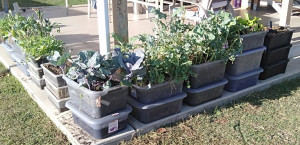
Select suitable nesting boxes from the local hardware store. Twenty litres is a good size, but a bigger box can be partially filled and used as a terrarium.
The exact boxes are not critical as long as they nest. One box is not enough; four to six towers may be needed for a continuous supply.
2. Drill holes
Drill holes in the bases and lids. I have been using multiple holes, but I am now trialling just one large central hole; it is easier and saves the bother of ensuring the holes line up between levels.
3. Order inoculant and seeds
The inoculant and seeds are then ordered online (from a local supplier or www.pickandeat.shop).
4. Collect organic waste
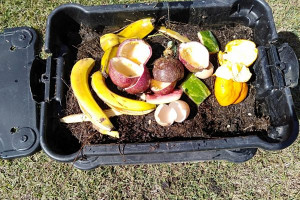
Collect organic waste. Typically this will be kitchen waste, which may take some time to accumulate, but to get started any waste such as grass clippings can be used. Failing that, commercial potting mix can be used.
5. Fill breeding (middle) box with organic waste
The middle breeding boxes are partially filled with whatever organic waste is available, while the growing boxes are filled with whatever growing mix is available.
6. Add inoculant to boxes
The inoculant is then divided up between the growing and breeding boxes. This inoculant contains both living microbes and worms (and worm eggs), so it needs to be placed in the boxes immediately on arrival.
A layer is first placed on the surface and thoroughly watered.
7. Seed, cover and water
The selected seeds are then spread over the surface. Generally, baby greens will be grown, which require a higher density of seeds than when growing specimen plants.
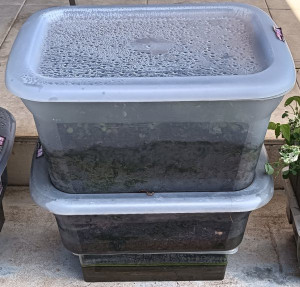
A light sprinkling of water is then applied and, possibly, a lid placed on the box to form a terrarium to keep the seeds moist and to stop birds eating the seeds, if that is a problem in your area.
8. Water regularly when needed
The boxes can be watered with clean water if needed, if the soil starts to dry between flushings.
9. Flush soil blood through both boxes
At least once a week the soil blood must be collected from the bottom water reservoir and poured onto the plants in the top growing box.
This is important, as the brownish-looking liquid (I call it soil blood) is full of living creatures and nutrients and will become anaerobic if left standing. It must be kept in circulation.
10. Start harvesting using tipping
The plants may be ready to start harvesting between two to four weeks after seeding.
Only the tips of the leaves are harvested, leaving the remaining leaves to power plant growth.
If they are regularly harvested the plants will remain in this adolescent state for quite some time, simply trying to regrow. Plants remain sweet and tender in this adolescent stage.
If they are not harvested regularly, they will move into the adult state, when they can become bitter – particularly if they are attacked by insects. Once they have moved from the adolescent to the adult stage there is no going back.
11. Reseed (partial or full)
To keep a continuous supply of vegetables, extra seeds can be planted in between existing plants.
12. Swap breeding and growing boxes
After a period of between eight to twelve weeks, the mix in the middle breeding box should be ready for growing.
The level will have dropped, so additional soil from the top box can be added. Then the boxes are swapped so the breeding box now becomes the growing box and the now partially emptied growing box becomes the new breeding box.
Plant groups
Below is a list of the various plant groups. They offer a wide choice, but there are three that really stand out:
Baby broccoli – one of the most nutritious plants and easy to grow.
Linseed – good for Omega-3, which is critical for heart conditions.
Alfalfa – the workhorse of baby greens and also improves soil quality.
The advantage of multi-crop planting is that there is always some plant that will flourish. Some plants seem invincible whatever happens. I always have some spinach, long leaf lettuce (an indestructible Chinese plant) and purple amaranth growing in my garden so I always have some veggies available.
Baby greens
Baby Broccoli
Chinese Broccoli
Alfalfa
Linseed
Purple Amaranth
Ruby Chard
Sorrel
Tatsoi
Mizuna
Salad veggies
Lettuce
Celery
Chervil
Cress
Watercress
Mustard
Radish
Rocket
Spring onion
Legumes
Adzuki Bean
Mung Bean
Cruciferous vegetables
Broccoli sprouting
Cabbage red
Cabbage green
Kale
Kale Red Russian
Bok Choy
Herbs
Basil sweet
Chicory
Coriander
Dill
Kohlrabi
Mustard
Shiso
Oregano
Parsley
Sage
Thyme
Lemon Balm
Diabetic-supporting plants
Fenugreek
Echinacea
Bitter Melon
Spinach
Silverbeet
Zucchini
Root crops
Carrot
Onion
Beetroot
Jicama
Ask for help if needed
This is a very simple system which is easy to learn, but if it all looks a bit complicated then do what I do with my mobile phone – get my granddaughters to sort it out for me. They really enjoy making us oldies look stupid.
Well, your granddaughters may be whiz kids on their mobile phones but they may not know too much about growing, so come to me at colin@gbiota.com for help – that is why it is a subscription site.
A Gbiota Tribox is a simple three-box system that lets you grow real, microbe-rich soil and baby greens
on a balcony or veranda, turning kitchen waste into gut-brain food even if you live in a flat.
In this post I show how to build and maintain a Gbiota Tribox.
Growing your own soil
Growing soil is the key to the Gbiota technology, so may I explain how it works.
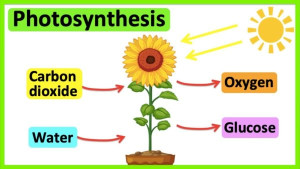
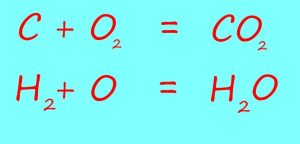
Plants absorb energy from the sun. They use this energy to break down the bonds between carbon and oxygen
from the carbon dioxide which the plants absorb from the atmosphere, and hydrogen and oxygen from the water
which they absorb from the soil.
This takes a lot of energy which is then stored in the plants as complex hydrocarbons that go on to form
our energy food.
Modern agriculture produces large amounts of energy food and we are not in any danger of running out of
energy food in the near future.
But this process of photosynthesis requires certain chemicals to make it work. We have known how photosynthesis
works since it was first described by Jan Ingenhousz in 1779. It is certainly not a new discovery and we know
the precise chemicals needed to make it work. The modern fertiliser industry produces these chemicals on a grand
scale where they are widely used by modern agriculture, which can and does grow crops without using any soil at all.
Dirt
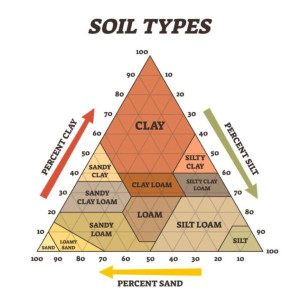
Dirt is just finely ground rock particles. If the particles are very fine we call it clay, a bit coarser is silt,
then sand and finally gravel.
The rock particles are inert; they are insoluble so by themselves they do not provide any nutrients to the plants.
However, they can attract liquids which contain soluble nutrients that attach to their surface.
This is how much of our current food is grown—in inert dirt—with chemical fertilisers attached to the surface of
the fine particles and readily available to the plants.
Soil
Soil is decidedly old fashioned—going back a few billion years—when microscopic organisms like bacteria and,
particularly, fungi began to break down the insoluble rocks to form soil that contains nutrients readily available
to the plants (bio-available).
The plants died, creating organic waste. Other creatures, animals and eventually us evolved, creating yet more
organic waste which was happily recycled by a complex array of microscopic organisms both in the soil and in
creatures like worms, beetles, ants and other re-generators.
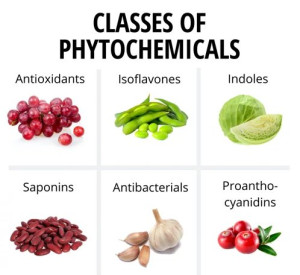
Phyto-chemicals
This was a much more complex process than the relatively simple process of photosynthesis.
Plants became masters of chemistry, developing a whole range of chemicals to protect themselves from attack by
insects and animals, and to attract other animals and birds to eat their seeds and spread germination.
Human evolution and our gut brain
All this time, animals were evolving with this complex array of phyto-chemicals and microbes—and eventually us humans,
who became dependent on these phyto-chemicals and microbes.
Nowhere is this more evident than in our gut brain—a combination of the intelligence created by
trillions of cells communicating in our gut, just like in a supercomputer, and our head brain.
This gut brain is our control system which regulates our bodies. If it does not work, we get fat and sick, and this
is the root cause of the modern epidemic of non-infectious diseases.
The basic cause is that our modern chemical, industrial agricultural system is simply not feeding our gut brain.
The solution
So what is the solution? Simple—we go back, study our evolution, and see that we need to grow real soil full of
beneficial microbes and nutrients.
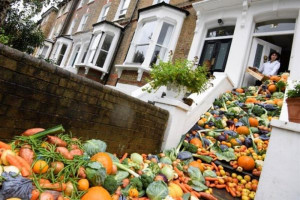
And how do we grow soil? Again simple. We collect up all the organic waste we can find—certainly food waste, which
is a major social problem both wasting resources and creating greenhouse gases—add minerals for the microbes to convert
into complex soil chemicals, and add microbes and soil creatures such as worms, which will breed continuously in the soil.
You then grow plants in this soil teaming with microbes and bio-available minerals and eat them shortly after picking
before the microbes die.
I live in a flat
Mary is not a farmer; she lives in a flat, works in the accounts department of a big company and has three kids, no time
and no growing experience.
That may be true—but she still has a gut brain which needs feeding and she still needs all those complex chemicals,
like the phyto-chemicals needed to replace her body parts as they age and wear.
That is why we developed the Gbiota Tribox. It may be a bit of a Do-It-Yourself project but it is very do-able.
This is what you need to do.
Social benefit
It is just a simple fact that humanity is going through a bad patch. We are putting far greater demands on the earth’s
resources than it can supply. We see this very dramatically with climate change—with floods, droughts and heat waves—
but technically these are problems we can resolve. We have the technology to prevent climate change and we have the
technology to solve that other big problem—degradation of our soils.
But a very present problem is those mega corporations who put short-term profits ahead of social benefit. It is my
opinion that all companies should have to provide a social benefit; that is certainly my objective with Gbiota.
The Gbiota Tribox is something that virtually everyone can benefit from, and the food actually costs less than buying
from a supermarket.
I understand that many people who read my posts are relatively affluent, have large gardens and take growing their own
food—which will make them healthy—very seriously. There are plenty of articles on this web site for them.
The Gbiota Tribox was developed to provide healthy food for virtually all people.
It is a social movement and I welcome people to adopt the technology and spread the word so it becomes a genuine
social movement.
Logistics
A Tribox goes through a natural cycle. Ideally, the middle box for growing soil is fully loaded with organic waste,
minerals, inoculants and worm eggs, then simply left for the natural breeding and decomposition process which will
take at least eight weeks.
The top box for growing plants will go through a similar process of germination, growing and harvesting.
I strongly advocate growing baby greens—that is, the stage beyond microgreens, when plants have immature leaves and
roots that are already extracting nutrients and microbes from the soil, but have not yet reached the stage where they
are under serious insect attack and start producing bitter chemicals to repel them.
Again this means a cycle of at least eight weeks.
Obviously a lot depends on the size of the family and the space available for growing, but I think in terms of having a
base of some four Triboxes, with a new box being set up every two weeks.
I expect most people will be using kitchen waste as their main supply of organic waste (grass clippings are great if you
have access).
It is possible to use the middle box to store the kitchen waste as it is produced; it just means lifting off the top box
and loading the middle box.
It just suits my life, but I prefer to collect the kitchen waste and store it in a sealed container for a couple of weeks,
by which time I have enough waste to pretty much fill the middle box and load it with the minerals and inoculants and then
never touch it again until the end of my eight-week cycle.
By this time the level has dropped significantly, so I now make this my top box for growing plants and take the mature top
soil out of the old top box to top it up.
This means I am seeding into mature soil and giving the soil at the bottom of the box more time for further decomposition.
I then use my old top box as my middle box so I am continuously swapping.
I will start off a new box every couple of weeks.
This is a system that works for me, but you can work out a system that works for you.
Choosing the box
You can buy suitable boxes from your local hardware store or supermarket.
I recommend the type that nest with a lid with a lip so the boxes can be nested.
You will need to lift these boxes, so they should not be too large. Twenty litres is a manageable size, but you can use
a bigger box and make it into a terrarium with just the base being filled.
The bottom box, which just holds the flushings, can be the same as the other boxes with a lid, but it is also practical
to use a smaller box with no lid. This does save a bit of time when watering, but it is not a big deal either way.
Terrariums are great as they need hardly any watering and they keep the flies, insects and birds away. The soil is always
moist so it makes germination very easy—often seeds just sprinkled on the soil surface will germinate in a terrarium.
Thirty litres is a good size for a terrarium box.
It is important that the flushing in the bottom box is not allowed to become stagnant. I aim to re-flush twice a week but
sometimes I get a bit hectic midweek, so I just water the top box with clean water and re-flush at the weekend.
Not perfect, but we don’t live in a perfect world.
Supplies
At this moment I am working out how to set up a supply system.
I am working with a seed company to produce seed mixes with a variety of varieties under different categories. The categories
I am looking at are coniferous vegetables (members of the cabbage family), diabetic plants (like Fenugreek), herbs and spices,
green smoothie mix (linseed, alfalfa), soil regeneration plants, etc.
I am also working with growers to produce a complete mix of minerals, inoculants and worm eggs.
At this moment I can supply limited volumes in Australia only. I suggest you email me at
colin@gbiota.com. You will need to tell me your location as some states have
restrictions on entry.
You may also like to look at a previous post on Gbiota TriBoxes called
Gbiota easy.
For most of my life I worked on making plastic products faster, better and cheaper — but the real breakthrough came when I turned those same innovative skills toward growing food that feeds the gut brain and prevents diseases like diabetes.
In and Out of Plastics
I moved into plastics when I left university, back when new engineering plastics were just coming onto the market. They were an exciting challenge for a young engineer to learn, and in my defence, this was long before a five-cent battery had to be wrapped in fifteen layers of blister packs.
But the world kept changing. The population grew, the food system changed, and people became fatter and less healthy. I began to worry, not just about having enough energy food, but about food that would actually keep us healthy over the long term.
At the same time, I was getting older. I had written a book about plastics production called Faster, Better, Cheaper, and I started to question whether I really wanted to spend the rest of my life helping to make plastic bits faster, better and cheaper.
Into Food to Keep Us Healthy
I felt an urge to do something that genuinely benefited the community.
I decided to see whether my innovative skills could be used to find better ways of growing food that keeps people healthy and is truly sustainable. I sold the company, which gave me enough money to undertake speculative research – the kind of research governments rarely fund.
Speculative research is just a posh name for doing daft things and hoping you stumble upon a significant breakthrough.
Looking at the world, it was clear to me that one of the biggest threats from climate change is to food production. That is where I decided to focus.
I no longer wanted to make plastic parts cheaper; I wanted to make it easier for people to grow food that prevents them losing their health — and their legs — to diabetes.
Innovation – Paradigm Busting
Real breakthroughs in research usually come from doing off-the-chart experiments that are almost certain to fail but lead to new ways of thinking.
Now I had the financial freedom to do totally stupid experiments that might, just might, lead to a big breakthrough. I wasted a lot of money, but it was my money – no grant committee to impress.
I burned through millions of dollars hoping that something good would turn up, and eventually it did. Every year, over four thousand Australians have a leg amputated because of diabetes. I now know how much of that can be avoided. I reckon that is worth blowing a few million.
Steps in Innovation – Ask “Why?” Like a Four-Year-Old
The first step in innovation is to study everything that is known in an area without jumping to solutions. You immerse yourself in the problem and keep asking “why, why, why” like a four-year-old.
Freed from the need to earn a living, I set off on multiple world trips to study how people grow food, especially in remote areas of Asia, Africa, the Americas and the Middle East.
In some places, particularly mountainous regions of China, people remained fit and healthy into old age, with no sign of our modern chronic diseases like diabetes. They had been farming the same land for thousands of years and the soil was still healthy and fertile. In other areas, especially in parts of Africa, the soil was depleted and people were less healthy.
Again, the question was: why, why, why?
Diabetes Strikes Close to Home
Then diabetes hit close to home. My wife, Xiulan – a medical doctor and gynaecologist – became diabetic. Her foot started to turn black and doctors began talking about amputating her foot.
The medical experts explained that diabetes was a progressive chronic disease. She would need steadily stronger drugs, then insulin injections, and would likely die young from complications such as kidney failure.
That assessment might have been reasonable twenty years ago, but it no longer matches the latest science. The fact that we were being given advice based on outdated information was an ominous warning of trouble to come.
No Chop – We Will Do It Our Way
I was not happy with the idea of seeing her lose a foot. She has nice legs, and I felt I owed her more than passive acceptance. So I did what innovators do: I kept asking “why, why, why”.
Experts can provide a very detailed technical explanation of diabetes. First, fat starts to block the entry of sugar into muscles. This is called insulin resistance, and many people do not know they have a problem because the pancreas simply produces more insulin.
Then the pancreas itself becomes clogged with fat and can no longer produce enough insulin. The situation becomes critical and medications are required to control blood sugar levels. These drugs are very good at fixing the immediate problem, but they do not address the underlying cause.
Homeostasis – The Body’s Intelligent Control System
So again the question was: why? Why does the body start storing fat in the wrong places? Why does it happen so often in Western societies but not in those mountain communities in China where diabetes is almost unknown?
The obvious answer is that we eat too much sugary, fatty food. But that just raises another question: why do we eat too much sugary, fatty food?
Because we are hungry, you might say. But again: why are we hungry in that particular way?
To understand that, we must look back to World War II. In the Netherlands, the people endured extreme starvation and became thin and scrawny. After the war, when food became available again, obesity became a major problem.
The reason is homeostasis – the body’s intelligent control system that regulates temperature, breathing, heart rate, appetite and how much, and where, we store fat.
Our Bodies Are Smarter Than We Think
This control system is incredibly smart and has a memory. The period of starvation trained it to store fat aggressively. We still see this today in extreme dieting: people slash their caloric intake, lose weight, and then later become fatter than ever. They have trained their control system to store fat – the exact opposite of what they wanted.
Diabetes is not just a medical issue; it is a systems-control problem. If we do not feed the gut brain properly, it reprograms our bodies to store fat and crave the wrong foods.
Innovation Step 2 – Test, Test, Test
After the review and “why” phase, the next innovation step is testing whether the ideas actually work.
I set my wife up with continuous blood sugar monitoring so I could compare food intake with blood sugar levels in real time.
My first engineering job had been with a company that made control systems for power stations. What I saw on the blood sugar graphs looked identical to unstable control systems I had seen on industrial equipment.
She would eat, and her blood sugar would rocket up. Then it would crash to dangerously low levels as the insulin surge kicked in. Then it would climb again as the body hunted for sugar from wherever it could. It was a classic unstable control loop.
Diabetes: A Control Problem, Not Just a Medical One
This convinced me that diabetes is not just a simple medical condition; it is a control-system failure.
From my time in the remote mountains of China, I already knew what a stable system looked like: people eating food grown in living soil, full of diverse microbes, and staying lean and healthy into old age.
We get fat and diabetic because the control system is broken – because we are not feeding our gut brain. When the gut brain is starved of the right signals, it makes us feel hungry so we overeat.
If we want to be healthy, we must feed our gut brain the food that gut brains need.
“Sorry – No Yaks in This Apartment Block”
The catch is that we need a solution suited to modern life. It is not practical to have a yak wandering around an apartment block, dropping manure on the carpet.
So we substitute the yak with worms and create a two-pot growing system. In one pot, people grow their own living soil; in the other, they grow fresh vegetables in that living soil.
The pots cost only about 40 cents. The main inputs are organic waste, volcanic rock dust and an inoculant. It is incredibly cheap and almost anyone can use it, even in a flat.
It is actually cheaper and more reliable than buying from the supermarket.
I call this the Gbiota system because it is all about feeding the gut biome – the gut brain.
Saving Thousands of People from the Chop
I believe this is a major innovation that could save thousands of people from losing their legs to diabetes.
The next challenge is getting this innovation into public awareness. I have built a multi-million-dollar multinational company before; I know how to create paradigm shifts and change an industry.
I also know that pouring money into advertising is largely a waste. The internet is already saturated with companies trying to sell pills that will not fix your health but might inflate their bank balance.
Create a Social Movement
What we need is a social movement: people using the system themselves, seeing that it works, and becoming ambassadors for it.
This is not just about diabetes, though that is the most visible outcome. It is about building communities where people are genuinely fit and healthy.
Our health system is in crisis. Yes, we need more GPs and more funding, but the top priority should be prevention, not patching people up after they are already sick.
Prevention as the Priority
The most effective way to tackle the health crisis is to run programs that help people become naturally fit and healthy, so they rarely need to see a doctor.
Governments spend millions on drugs, especially for diabetes, where pharmaceutical companies enjoy a lifelong captive market.
They would save a fortune by focusing on prevention and building a population so healthy that doctor visits become the exception, not the rule.
Victory Gardens – A Proven Model
We need ambassadors for prevention. I think back to the Victory Gardens of my childhood. During wartime, a simple government scheme led to some 40% of fresh food being grown by amateur home gardeners. It cost the government almost nothing – just a few posters and speeches – because it had the support and energy of the people.
The government provided leadership, but it was the public’s participation that made it a success.
Social Action – Good People Doing Something
I cannot do this alone. I am just one person, with no power against the machinery of government.
People have different skills. I happen to be good at innovation and speculative research, but I have no idea how to organise a protest movement or national campaign.
What I do know is that we need one. There is a saying: bad things happen when good men stand by and do nothing.
To my mind, having your leg chopped off because of a do-nothing government department is a “bad thing,” and good people need to act.
While you have been reading this, two Australians will have had a limb amputated because of diabetes. At least one, and possibly both, might have been spared if they had heard about homeostasis and followed the simple idea: grow gut brain food.
We Live in a Community
Humans are the most successful species on the planet for two reasons: we are intelligent, and we cooperate to form communities.
The price of living in a vibrant community is that we each contribute to its wellbeing according to our skills and capacity.
I do not have diabetes, and now that my wife is on a grow-gut-brain-food diet, there is little danger she will lose her foot.
I have not blown all my money on daft ideas, and I could easily live a quiet life. There is no logical need for me to spend my time and energy helping people avoid diabetes.
But I want to feel that I am contributing to my society according to my abilities.
Right now, the community needs to know that they can, if they wish, stay fit and healthy and reduce their risk of amputation simply by growing gut brain food. Whether they choose to act is up to them – but they deserve to know it is an option.
So I ask you, whatever your skills or capacity, to help raise awareness. That might mean telling a friend, posting on social media, or joining a movement that presses governments to inform the public.
It feels good to contribute to your community. It is far more satisfying than sitting back and playing bingo.
Who Has the Skills to Run a Movement?
We need people with the skills to organise a health movement and breathe life into do-nothing bureaucracies.
If you want to live a long, healthy life in a society that values fitness and wellbeing — and if you would rather avoid losing a leg to diabetes — then do something useful for the community. Form or join a health movement, or contact your local MP.
We Need a Strong, Proactive Public Service
We need a strong, active public service that genuinely serves the public and protects us from mega-corporations driven solely by profit.
We need a public service that puts people first. That is the essence of a functioning democracy, and it is currently under threat.
I am 83 years old, still fit and healthy, but it is up to younger people to build this movement. I feel I have done my bit.
If you agree with this theme and have relevant skills — even if it is simply sharing on social media — please contact me at colin@gbiota.com.
The Gbiota tribox is a simple three-box stacking system that breeds beneficial soil microbes in organic waste,
captures their “soil blood”, and uses it to grow baby greens that feed your gut-brain.
Gbiota easy
We have known about our intelligent control system for some seventy years—going back to when people who were
deprived of food during the war later became fat, as their control system had been trained to store any fat it could.
Years later we find ourselves in a health crisis that starts by people becoming overweight. The classic advice is to
cut calories which, although well intentioned, still trains our intelligent control system to store yet more fat.
I try to make people aware of the importance of feeding our gut-brain. This message seems well accepted by a dedicated
number of home gardeners but has little impact on the bulk of the population.
I tried persuading people to form groups where keen gardeners help less advantaged people living in flats who do not
have the time and skills to grow their own gut food.
Well, if you don’t try you will never succeed—and this was a bit of a damp squib. So I thought I must try a new
approach and see how easy I could make it for people with no time, space or even interest in growing their own gut food.
The Gbiota stacked bin (tribox) is my solution: a lazy-friendly way to turn kitchen waste into gut-brain food.
The basic principle behind the Gbiota system is common to all methods, but there are many ways of applying this in practice.
A living soil is created (yes, we make soil) by breeding microbes in organic waste and minerals with inoculants
such as worms, soldier fly larvae, and a starter of living microbes.
Initially, water is flushed through this soil to create what I call soil blood (because it does a similar
job to our blood)—a somewhat yukky-looking liquid which, under a microscope, is full of an array of creatures large and small.
This is then flushed again through soil in another zone where plants are grown.
We eat the plants, which are natural pre- and probiotics, and feed our gut-brain.
Pretty simple.
The flower pot method
The flower pot method, using 40-cent flower pots, I described in an earlier post:
how-to-gpots.
It is the cheapest way I know of applying this method.
The stacked boxes I describe here are even easier to use, but they do need $10 boxes rather than 40-cent flower pots
(though you only need about half as many).
Stacking boxes
To make one unit (you will probably need about four units to provide a continuous supply of gut-brain food) you need
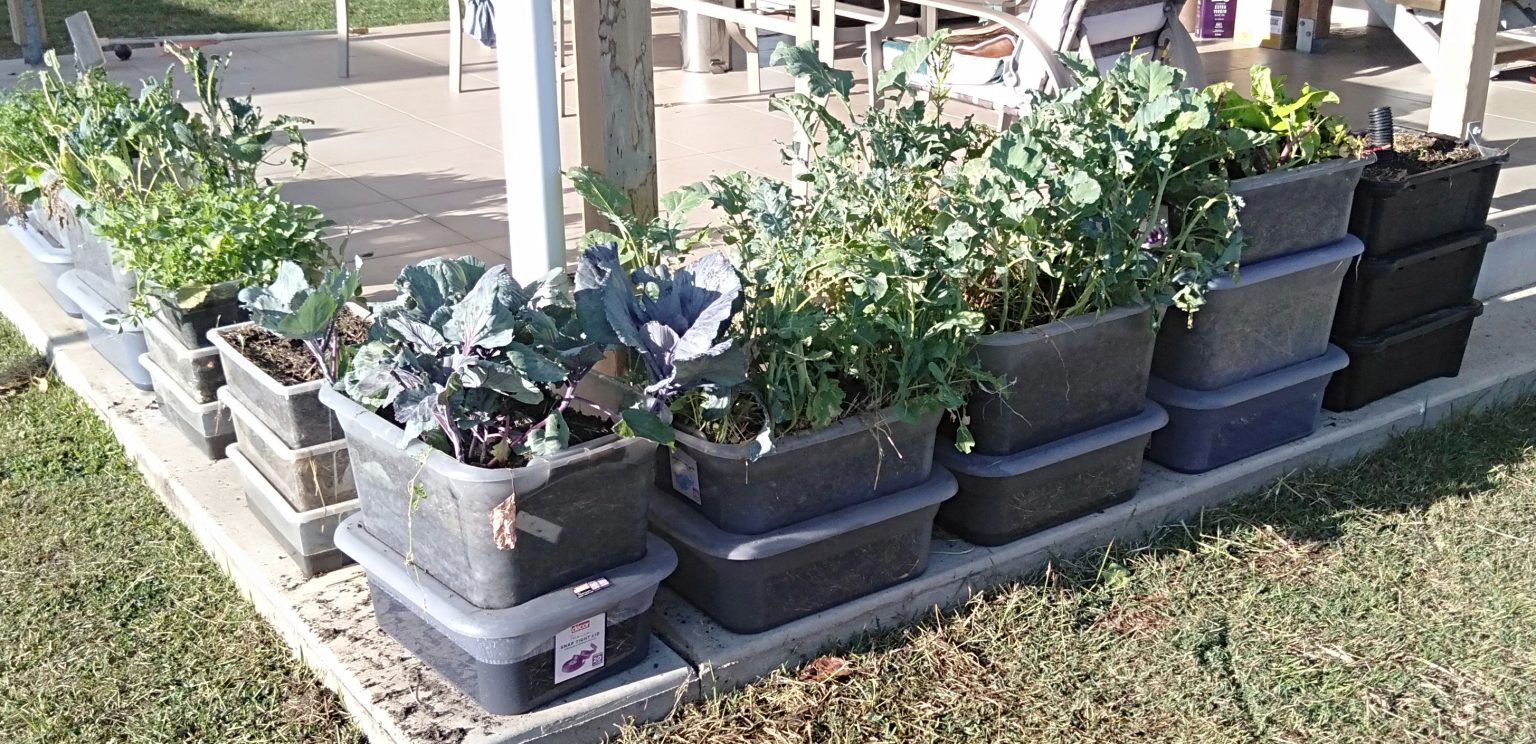
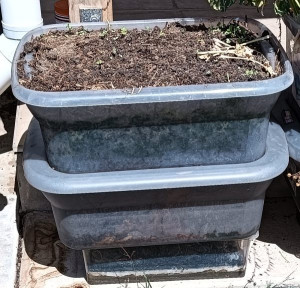
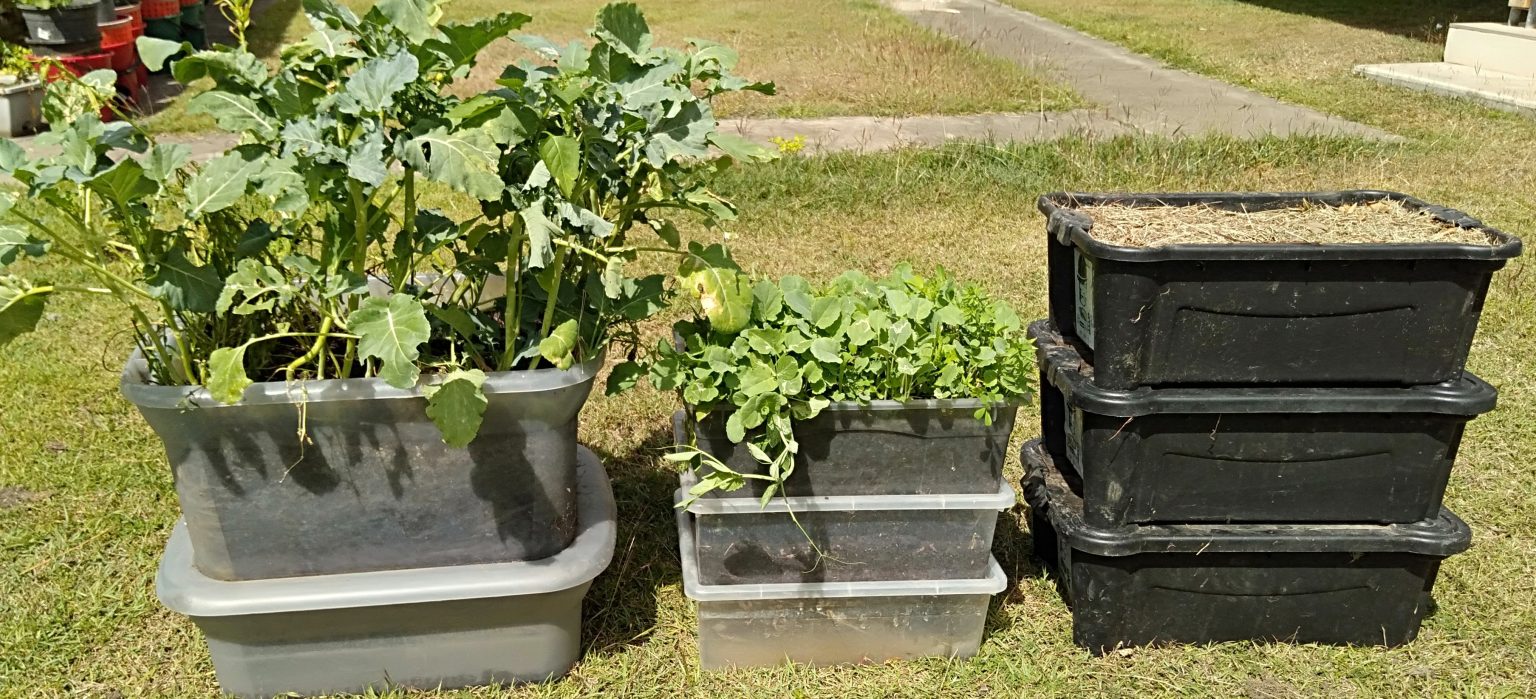
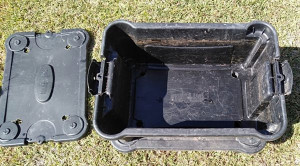
three stacking storage boxes—boxes that can be stacked with the one above fitting into the lid of the box below.
All the boxes I have seen in my local stores are stacking boxes and vary in size and price from a few dollars per box
up to about $15 per box.
Modifying the stacking boxes
The bottom box you do nothing with—this is the reservoir to catch the soil blood.
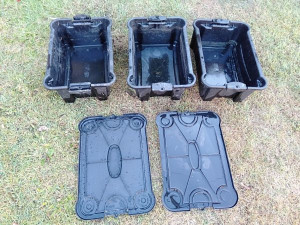
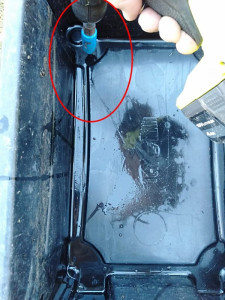
The box above is the breeding box. You drill holes in the base of this box and in the lid of the box
below so the soil blood can drain into the bottom box.
You load the breeding box with any organic waste you can lay your hands on. Kitchen waste is the obvious choice, but any
organic waste will do, including:
your next-door neighbour’s cat which whinges on your windowsill at midnight,
his son who arrives back at 1 a.m. on his motorbike and revs it to full bore,
his daughter who insists on playing the latest Taylor Swift hit at 2 in the morning,
and maybe himself, who mows the lawn at 5:30 a.m.,
and let’s not forget his wife who screams continuously that she cannot think with all this noise.
Anyway, hopefully you get the message—any organic waste.
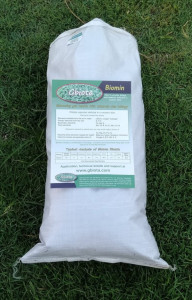
Then come the minerals—just dial up rent-a-volcano or buy a bag of rock dust if the volcano won’t fit in the empty house next door.
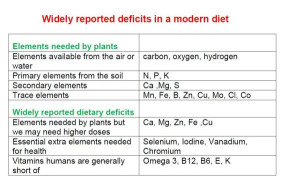
It pays to check that your rock dust has the right minerals. Most people are short on magnesium, women on iron and men on zinc
(one night of hanky-panky can exhaust a man’s store of zinc). Blood and bone is a good source of zinc and other minerals.
There are many articles on food and health on this web site.
Food and the gut biome
has a table showing minerals that are widely deficient.
Then add the decomposers. You can buy worm eggs; soldier fly larvae and other maggots just appear with household waste.
If you leave out some old slices of bread the local pigeons may supply you with some free pigeon manure—no credit cards needed—or
you can buy some professionally created inoculant for $2,000. But the pigeon manure has worked fine for the last two hundred thousand
years, so it can be classified as “showing promise”.
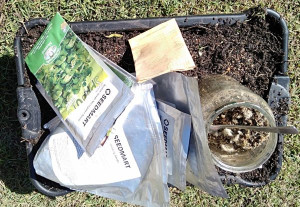
Again you drill holes in the base of the top box and in the lid of the box below. This top box is where you grow the actual plants.
You will need some soil for a starter. Most people, including me, hate clay—but it does have very fine particles that nutrients cling to,
and after a few cycles the organic matter will have created aggregates that give the soil a beautiful texture.
If all else fails you can buy a bag of potting mix from the supermarket, just to get you going.
Whatever else, this soil must be free draining. Trust me—if the soil does not drain freely you will end up with a
squelchy, horrible, pongy mess that will breed the wrong sort of microbes, like E. coli, which will test your immune system. So:
free draining it is.
After a while, the organic matter from the breeding box below should give you adequate drainage. If not, some fine driveway gravel may
do the trick (though it is really heavy), while Vermiculite or Perlite are very light and improve the soil texture.
But the most important aerator of the soil is our friendly worms.
Seeding
Now you need to seed. The whole point is to breed microbes, and different plant species emit different sugars to attract
different species of microbes.
As the name of the game is to create as diverse a range of beneficial microbes as possible, I make a mix of multiple species.
Currently my magic seed mix has some 26 species of compatible plants which create an excellent mix of baby greens—really the end product.
Cycling
A typical cycle, from harvest to harvest for a box, is about eight weeks. With four boxes you will be restarting a box every couple of weeks.
This is where the beauty of stacked boxes comes in. Whenever you have kitchen scraps you just lift off the top box and the breeding box lid
and toss in the scraps.
By the time it comes to rotate the box after eight weeks, you simply tip the old soil from the top box onto the decomposed waste, make that
box the new top box, and use what was the top box as the breeding box.
But don’t forget to move the worms back to the lower box—it is amazing how they will have bred up. You will need the kids to help you think
of names for them all—they are now your pets.
The best way I have found of watering is to collect up the soil blood from some or all of the box stacks and measure roughly how much fluid
you will need for the liquid to saturate the growing and breeding boxes so a reasonable amount actually flows down to the bottom water
reservoir box.
This soil blood will be used on the next cycle and will flush the root zone with fresh microbes and minerals suspended in it.
Gently pour this onto the soil in the top box so it floods. This will soak down through the growing and breeding boxes, mimicking the
flood-and-drain cycle.
This will expel the stale air, and when the soil blood flows down to the bottom water reservoir it will suck in fresh air.
I prefer to push a short piece of Ag pipe into the soil and fill through that so the soil blood fills from the base upwards.
It is basically breathing the soil.
This is not quite as good as a proper flood-and-drain system where the soil is totally flooded from underneath, but it is a lot quicker
and seems to work pretty well.
As long as you apply enough soil blood so it goes right down to the bottom water container, they all seem to work pretty well.
In the attached video I am reseeding and covering the surface with grass clippings in a vain attempt to fool the local pigeons who have now
learned my boxes are a good source of seeds. But they do leave a calling card of fresh inoculants, commonly known as pigeon manure.
Have fun flipping
Alternatives
There are some alternatives to this three-box stack system that some people may prefer.
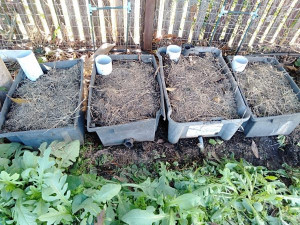
The growing and breeding boxes can be combined into one large box. This has the advantage that the plants have a bigger root area.
The disadvantage is that kitchen waste is normally generated daily, but this cannot be put straight into the breeding area and must be
stored separately in some compost box or bag until the box is refurbished.
When the crop is finished and the box is being replenished, it is simply emptied and reloaded with compost on the bottom and the growing
soil on top. This is best if the box is flooded from below like in a normal wicking bed.
The best way is to have a long swivel tube so the box can be completely flooded from the filler tube, then the swivel tube twisted to let
the box completely drain.
A compost tube can also be used. Organic waste can be placed in the tube and the box filled by watering through the compost tube.
The tube can be moved to refurbish the soil and increase the time between full refurbishments of the box.
I have many boxes using this system and it is a good way of growing, but more complicated than the simple three-box stack.
If you want more details just email me at
colin@gbiota.com.
There are many problems with our modern food system — mineral deficiencies, poor nutrition, and degraded soil — but nothing is more important than feeding our control system: the gut brain that regulates the entire body.
Traditional Communities Hold the Clues
In isolated mountain regions of rural China, diabetes is virtually nonexistent. Families have been farming the same land sustainably for thousands of years. Their methods are simple but shockingly effective — and very different from modern industrial agriculture.
One major difference is their attitude toward waste. What we politely call “shit,” they call fertiliser. Old women walk fields gathering animal and human manure, placing it carefully around each plant. Every cabbage in a field may have a small radial fan of manure around it — a nutrient-rich micro-ecosystem feeding living soil biology.
Now compare that to modern Chinese cities like Shanghai or Shenzhen, where vegetables are grown hydroponically or in sterile soil, transported long distances, and purchased in supermarkets. The vegetables look perfect — but their living microbial content is nearly zero.
Genetically, the city people and the mountain villagers are the same. They eat similar vegetables. The difference is the microbial content of the food they grow and eat.
It becomes impossible to ignore the obvious — how we grow our food shapes our health far more than we realise.
Modern "Diabetic Plants" vs. Living Soil Plants
There is a long list of plants promoted for helping diabetes — Fenugreek, bitter melon, Emla, Ginseng, Goji berries, and many more. Many people buy these as extracts or pills. But were they grown in living soil? Were they harvested and eaten while the microbes were still alive?
A plant grown hydroponically or in dead soil, shipped for days, then processed into a pill does not contain the living microbiome of a plant grown in nutrient-dense soil that is alive with beneficial microbes.
Microbes Matter — More Than We Realise
Scientific research shows that gut microbes strongly influence weight and metabolic health. Transplant the microbes from a fat mouse into a skinny mouse and the skinny mouse becomes fat — and vice versa.
Growing microbe-rich plants is easy. Even people in apartments can grow plants in living soil, and it costs far less than supermarket vegetables. The only downside? Our current food and pharmaceutical industries earn far more money keeping the system as it is.
We Can’t Use Yaks in City Apartments — So We Need New Methods
Rural communities fertilise their fields using Yak dung, but urban environments obviously cannot. That is why Gbiota technology exists — to recreate the ecological function of living soil in a clean, modern, simple system anyone can use.
It really is not difficult to fix the problem. The biggest barrier is awareness. As the saying goes (often attributed to Lincoln):
"Bad things happen when good men stand by and do nothing."
If you know someone with diabetes, please tell them about this work. Encourage them to grow a few microbe-rich plants at home and measure their blood sugar before and after. The results speak for themselves.
We may live in the misinformation age, but people still trust people they know. That is how real change begins.
Learn how living soil supports human health. Discover how beneficial microbes, nutrient-dense food, and simple growing methods can help you improve your gut microbiome and overall wellbeing. Explore the Gbiota resources, videos, and community.







 Then come the minerals—just dial up rent-a-volcano or buy a bag of rock dust if the volcano won’t fit in the empty house next door.
It pays to check that your rock dust has the right minerals. Most people are short on magnesium, women on iron and men on zinc
(one night of hanky-panky can exhaust a man’s store of zinc). Blood and bone is a good source of zinc and other minerals.
There are many articles on food and health on this web site.
 Then add the decomposers. You can buy worm eggs; soldier fly larvae and other maggots just appear with household waste.
If you leave out some old slices of bread the local pigeons may supply you with some free pigeon manure—no credit cards needed—or
you can buy some professionally created inoculant for $2,000. But the pigeon manure has worked fine for the last two hundred thousand
years, so it can be classified as “showing promise”.
Again you drill holes in the base of the top box and in the lid of the box below. This top box is where you grow the actual plants.
You will need some soil for a starter. Most people, including me, hate clay—but it does have very fine particles that nutrients cling to,
and after a few cycles the organic matter will have created aggregates that give the soil a beautiful texture.
If all else fails you can buy a bag of potting mix from the supermarket, just to get you going.
Whatever else, this soil must be free draining. Trust me—if the soil does not drain freely you will end up with a
squelchy, horrible, pongy mess that will breed the wrong sort of microbes, like E. coli, which will test your immune system. So:
free draining it is.
After a while, the organic matter from the breeding box below should give you adequate drainage. If not, some fine driveway gravel may
do the trick (though it is really heavy), while Vermiculite or Perlite are very light and improve the soil texture.
But the most important aerator of the soil is our friendly worms.
 When the crop is finished and the box is being replenished, it is simply emptied and reloaded with compost on the bottom and the growing
soil on top. This is best if the box is flooded from below like in a normal wicking bed.
The best way is to have a long swivel tube so the box can be completely flooded from the filler tube, then the swivel tube twisted to let
the box completely drain.
A compost tube can also be used. Organic waste can be placed in the tube and the box filled by watering through the compost tube.
The tube can be moved to refurbish the soil and increase the time between full refurbishments of the box.
I have many boxes using this system and it is a good way of growing, but more complicated than the simple three-box stack.
If you want more details just email me at


