Key Points

Key Points

This is the Gbiota story in a nutshell

You can read my story here but essentially I had taken a life changing decision to move to focus on water, which I saw as a totally critical resource. In 1995 I started to promote Wicking beds, I did not invent them they are natural phenomena and totally amazing. There is a clay pan which gets filled with stuff that just blows in. Any rain that falls is captured over a wide area, seeps down to the clay where it flows to form an underground water reservoir. Water wicks up to feed a green and verdant oasis in the middle of a dry and barren landscape. They are very water efficient with little loss from evaporation or leakage past the root zone. They took off like wildfire - not as I intended to ensure our future food supply but to save work as a self watering pot. There are many articles in Wicking beds and a video on this site. Much later, in 2015 I learned about the importance of gut biology and how it was possible to breed the beneficial gut biota in the soil in a modified Wicking bed I called a Gbiota bed. This was based on the partial flood and drain system using what I called a leaky dam which would partially flood the bed then allow the water to drain away. At that time we were in the middle of a long dry period and there was not issue with water logging which breeds the wrong sort of biota so they worked very well. Then the weather changed with La Nina and flooding and water logging of my beds. It hit me like a ten tonne truck that we have technology to deal with droughts, increasing the efficiency of water use (Wicking beds may use a third of the conventional usage) and amplifying rainfall by concentrating the rain over a large area into a much smaller area but where was the technology to deal with floods? That’s when I developed the Wicking Soaker bed system. This can happily deal with rain that falls on the beds themselves but it is necessary to protect the beds from external flow. There are two type of floods those that flood backwards from some choke in the natural river systems (which we can’t do much about) and water flowing at speed from uphill catchments (which with a bit of site planning we can do something about). Unfortunately you can only test these methods when there is a major flood which make experimentation and verification a bit of a problem. Flooding is clearly a major threat to the worlds food supply leading to food shortages and price hikes.

Life span and health span

But we don't want just any food - we want food that will make us healthy. Life span has been increasing steadily over the years due to a combination of medical services, hygiene and sanitation. By contrast health span has been reducing, even kids are showing reduced health, particularly from chronic, non-infectious diseases.

Information and vested interests

These issues on health were not widely understood. We may live in the information age but we are saturated with information - some right some wrong. Vested interested have shown they are willing to manipulate the truth if it means making more money. It started at scale with the tobacco industry, and was adopted by the fossil fuel and food industries. They don’t lie directly jut select the facts that suit their argument. Climate has always changed (correct fact) fossil fuels are not causing climate change (invalid implication). Sugar is essential (correct fact) energy bars are healthy (invalid implication).

Selected information

We are flooded with information, so much that it is possible to find facts that support any particular view point. We live in an age of information silos it where it is difficult to stand back and take a holistic view of a particular problem. Yet this is the only way we can develop a valid view on complex issues. This is the great weakness of the information age - expecting simple answers to complex problems. “For every complex problem, there's a solution that is simple, neat, and wrong.” H.L. Mencken.

Valid and relevant Information

The key purpose of the Gbiota movement is to make valid and relevant information on how food affects health widely available. We do not make or sell anything - we just supply information for others to implement.

Paradigm busting

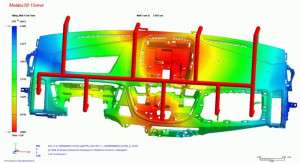
Colin Austin (that’s me) was a pioneer in the use of computers to solve complex engineering problems (Computer Aided Engineering). The company I formed (Moldflow) became Australia’s leading exporter of technical software and world leader in its field. I was selected as among the top one hundred innovators by the Institute of Engineers. Have no doubt this was not because I was spectacularly brilliant but because I looked and challenged the conventional wisdom, the current paradigm, and was prepared to say this is just wrong. But I decided that my real interest lay in soil and water which were critical to human survival so I sold my company to see if the paradigm busting attitude could give results in this critical area. But my wife became diabetic and we are told this was a chronic disease with no cure. When it looked as though she would need to have her food amputated when it turned black it was time to put all my paradigm busting abilities to work. It would be wrong to say she cured her diabetes but by changing here diet it became very manageable and she still has her foot. The conventional food paradigm was simply wrong.

Global population

In the last eighty years the global population has tripled (simply staggering). This has created an equivalent pressure to increase food production which has been well and truly met by the food industry. In fact food production has increase 40% faster than the global population but the food balance is wrong.

The Calorie Paradigm

The food industry is obsessed with calories. That is not wrong - it is just a restricted view about what food actually does. We are warm blooded creatures so we need food as fuel to keep us warm and provide energy - some 80% of the food we eat is just burned as fuel. Calories matter but they are only part of the story. An even more important part is our gut brain.

Jelly fish and our gut brain

Humans are not like Jelly fish flapping aimlessly around. We are a highly complex organism which needs an intelligent control system - that is a combination of our gut and head brains. This intelligent control system manages our appetite so we want to eat the right amount of the right sort of food, it manages the production of the complex chemical to replace our body part as they age and wear and it hosts and trains much of our immune system.

Our very complex gut brain

There are trillions of cells of thousands of different species in our gut. They communicate with each other, just like in a supercomputer, to take real world decisions. The simple fact is that we have no idea how the code in this supercomputer actually works. But we do know that we can change the species of microbes in our gut by simply changing our diet and that as we change the species the decisions it takes are very different. It can change us from being fat or skinny, timid or risk taking and in fact our whole personality. The species we have in our guts is key to our health.

The great food paradigm shift

We need to replace the current food paradigm which is obsessed with calories to a new food paradigm that focused on the food we should be eating to feed our gut.

From soil to gut

For millions of years creatures, including the early hominids, have been eating gut food with the beneficial microbes breeding in the soil - they never thought about it or took any decisions - it just happened. The beneficial microbes bred in the soil and in the guts of creatures that lived in the soils, they entered the plants which the creatures ate packed up in the plants which act as pre-biotics so they can survive the journey to our gut where they act as pro-biotics. A totally natural process tested over millions of years and we never paid any attention to it - it just worked.

What we forgot

But we just forgot about it or never even thought about it - with the tripling of the global population we were just obsessed with getting enough calories.

The result

It is a sad result - we simply do not have the healthy gut that protected previous generations had so we endure epidemics of both chronic diseases like diabetes, heart disease and dementia but also infectious diseases. Our poor gut does not cause these problems - it just enables them to turn into epidemics.

Two things to do

First we have to work out how to grow the beneficial microbes in the soil - that is the easy bit and something I have been working on for years. Secondly we have to solve the problem that faces every innovator, how to get adoption eg setting up a system of growing gut food at scale and getting people to eat gut food. Innovators are rarely able to promote their own innovations - for that they need early adopters who are prepared to pioneer a new technology.

Early adopters and the Wicking-Soaker bed

The most favoured early adopters are likely to be home growers - they are the group who will benefit most from having a healthy gut from home grown gut food. I developed the Wicking-Soaker bed to make it as easy as possible for these home growers to grow their own gut food in their garden.

Kales and Kales

The challenge we face now is to get the message out that there are Kales and Kales. Kale may be a considered a wonder food by some, but if it is grown in dead inert soil without life and the critical minerals it is pretty useless as gut food. The message is simple - get the soil right and everything follows on.

Why not join the Gbiota movement

The Gbiota movement is not some operation run by some mega global operation - it is a grass roots movement of those weird people who have failed to be convinced that as long as there is food in the supermarkets now everything is fine and dandy. We are not dumb donkeys but think ahead for the future of our grandkids.

Loading

No dumb donkeys

No dumb donkeys

We live in the digital age where we seem to expect that any problem can be solved by a few minutes’ search on the internet. If you think this is the way to feed eight billion people food that will keep them healthy (so they don’t get fat and sick and have their legs chopped off from diabetes) – and all in the middle of climate change with floods and droughts and a global political system which is decidedly wobbly – then you are wrong and this is not the site for you. Life wasn’t meant to be easy. But I have prepared a series of posts which analyse the key issues to develop a plan and appropriate technology to solve this horrendous problem.

Food and the Gut biome (read here)

This first article discusses food and the gut biome. The simple fact is that people eating fresh food grown in soil full of minerals and teeming with beneficial biota (such as the few remaining hunter gatherers and people living in the blue zones) have a far healthier gut biome than modern man does eating a conventional diet. But, and there is always a but, in the last eighty years population has trebled, and there is just no way we can feed the current population in these traditional ways. But let’s stick with the facts – while the population may have trebled over these eighty years, our production of food has increased some 40% faster than the population has increased. There is no “absolute” shortage of food; the problem is that there are big holes in our food production and distribution systems with a surplus of some foods – like fuel – and not enough of the critical foods – like gut brain food. Despite any opinions you may have of our global leaders, we are not cold-blooded lizards but warm-blooded creatures – and we need food as a fuel to keep us warm and power our bodies. Some 80% of the food we eat is just fuel, and as long as we can burn it off it does not matter what sort of food it is – it is just fuel. So don’t panic – we have been incredibly successful in producing vast quantities of food for fuel to feed the eight billion people on earth. What we have missed is that we have an intelligent control system which regulates our bodies, particularly how much and what we eat. It is a combination of our gut and head brains, and for this intelligent control system to work properly we have to feed it the right kind of food – gut food. It may only be a small percentage of the food we eat but if we are to avoid getting fat and sick and having our limbs chopped off from diabetes, we must eat the food that feeds our gut brain. How did we miss this? We may have amazing capabilities in technologies like DNA sequencing yet we have no idea how the coding in this super-computer gut brain system actually works.

Water (read here)

It may be a bit difficult to get excited about water – it is just everywhere and we are so used to it that we fail to appreciate just how weird it is. But we all understand it is essential for life so, before we go off on some wild campaign to change the world, I’d like to take a bit of time to explain how this weird stuff actually works, how it moves through the soil and why it is so important for our gut brain.

How Gbiota beds work (read here)

Whether we like it or not, we live in a state of ecological balance. It is true that I can go to my local supermarket and I really don’t have to worry that I am going to be eaten by a tiger. Tigers, sharks and rhinos kill very few people but bugs do. They live in their own very tiny world of ecological balance – basically trying to out-breed each other – and that depends very much on moisture. Too wet and the bad bugs win and then us humans have problems. Too dry and the good bugs that we need can’t breed, so again we have problems. So how can we grow our food in soil with this magic Goldilocks moisture? We need to understand water and how it moves around the soil. This may help give us the technology of growing gut food – that is the easy bit. We now have to actually get the change to happen and that means understanding how the real world – particularly the world of innovation and adoption – works.

The real world

The real world is driven by a lust for profits and power, and fortunately for humanity a desire by a few to do the right thing for society. But the reality is that the mega corporate giants are not going to suddenly set up giant facilities to grow gut food until they see a demand. And that demand needs to be generated by the few prepared to do the right thing. Choices – grow gut food in your back yard, which is pleasant, or have your leg chopped off from diabetes – which is not so pleasant. This choice falls to individual people, probably home growers, who want to grow gut food for their families. Here we hit yet two more technical problems to resolve: The early Gbiota technology was developed thinking it would be adopted by technically sophisticated organisations – yet we are now looking to home growers to be the early adopters, and they want things to be simple. We also have climate change and these extreme weather events – the floods and droughts – which are going to make any sort of food production that much more difficult.

Soaker beds (read here)

So I did more development work, ending up with the Wicking Soaker Bed – dead simple and providing a level of protection against floods. Making it very easy for home growers to become early adopters. In the world of new technology and innovations the actual innovators typically find it very difficult to get their ideas accepted. Then along come the early adopters – hopefully in this case the home growers – and they, not the innovators, drive the process of adoption. Then a second wave comes – in this case we are looking for community growers – not exactly commercial growers but people growing for their local communities. They can expect to get paid for their efforts thus leading to the third stage which is the commercial growers who now see there is a genuine market. nb We don’t sell cabbages or anything for that matter; we survive as a subscription site which you can access for free for fourteen days. If not your scene just please cancel.

Loading

Soaker beds

Soaker beds

Wicking Soaker beds

I developed the original Gbiota beds to grow plants which act as natural pre and pro biotics by having a moist, not wet soil. It is very easy to make soil wet, just hump on the water which will breed up the harmful microbes. It is much more difficult get the soil just moist which the beneficial microbes prefer. I developed the original system using a system of pumps, timers and drains in about 2015 when weather conditions were very dry and they worked fine. But I learned two things. Many people do not want the bother of installing and maintaining pumps, timers and sumps.

soil-pump-colin-austin-gbiota


Freak weather

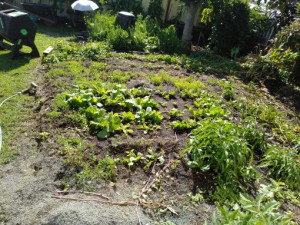
Then in 2020 the weather changed dumping massive amounts of water - multiple rains of over 100mm in a few hours. It is not just the water falling on my block - it is all that water falling on blocks higher than mine which create a torrential flow over my block which the then Gbiota beds just could not handle. The Ag pipe act as a natural drain but they can only handle so much water - no where near what we have in these monster downpours. This is thousands of tonnes of water moving at speed across my block, working out how to grow food with these extreme weather events is one of the key challenges facing us all. flat-bed-colin-austin-gbiota

My experiments

Dimensions

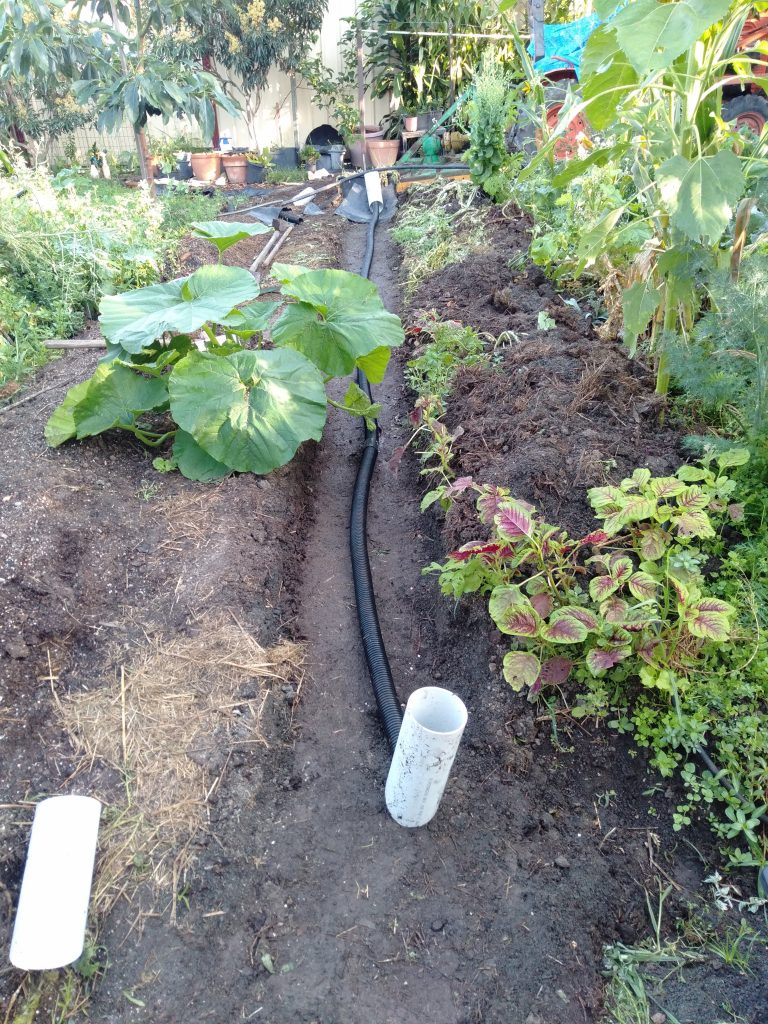
My first action was to build the beds as high above the ground as possible with drainage channels down the side. I decided to space each bed at one metre with a channel of around 200mm on each side of the bed for a flood channels and foot path. Most plants roots (and hence the plant) will simply die if they are left submerged for any length of time (with a few exceptions like cress and mangroves. But is if I can keep the top part of the roots free from water logging those roots will survive and the plant will survive and will rapidly regrow the lower roots. The level on my beds was already about 100mm above the parent soil so I dug down a depth of 200mm. For this installation I made my trench 400mm wide leaving an undisturbed zone of about 200mm on each side. I am not saying these are ideal - just what I did as my estimate of what is best - and they worked pretty good.

Setting up the bed

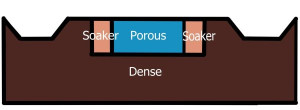
The diagram shows how I made the bed. In essence I simply dug a bath tub shaped trench, some 300mm deep,and 400mm wide into the parent soil. soaked-bed-diagram-colin-austin-gbiota
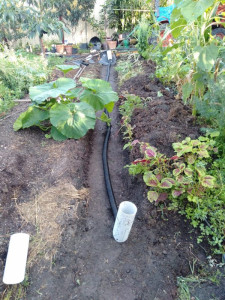
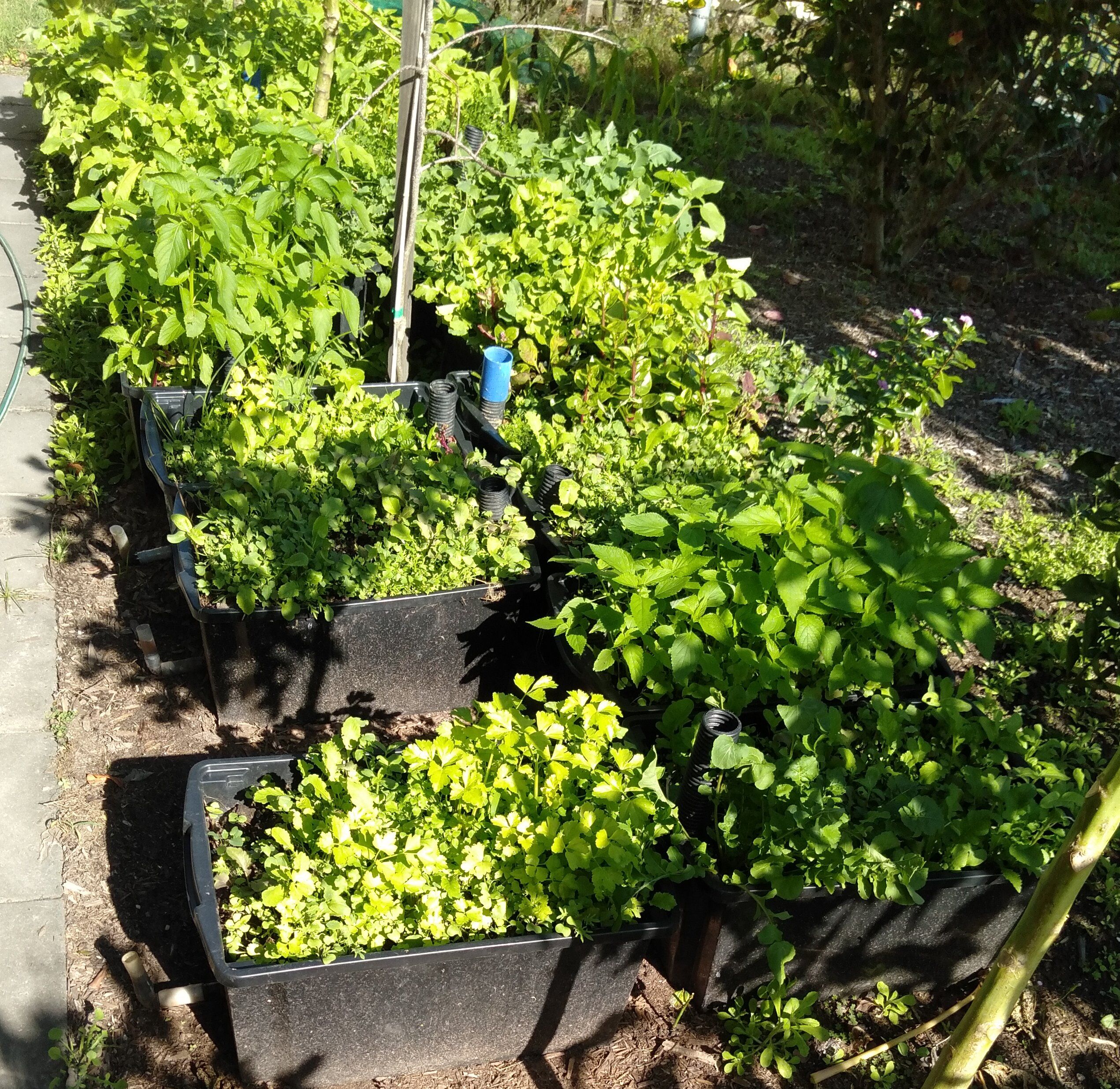
Along the sides and ends I left the soil in place. I filled this trench in the normal way I make Gbiota beds. I checked the bed was level. Laid Ag pipe flat along the base then added two sight tube for filling and inspecting moisture level. Then filled with a layer of organic waste, in this case grass clipping with all the food waste I could muster. Then a layer of manure with minerals, Dolomite to reduce acidity and Bauxite (local rock dust) which adds Magnesium plus blended rock dust (Biomin) to add trace minerals. Finally I load some top soil, seed and surface water to germinate. sight-tube-colin-austin-gbiota

Filling

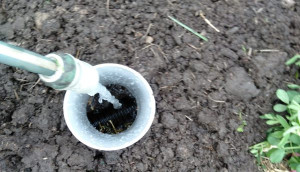
I then used a hose to partially fill the highly porous centre layer. There is a bit of trial and error here, I needed to fill with enough water so it would wick out to the surrounding soaker layers. But I did not want to overfill and be left with stagnant water sitting in the base for any length of time. filing-hose-colin-austin-gbiota
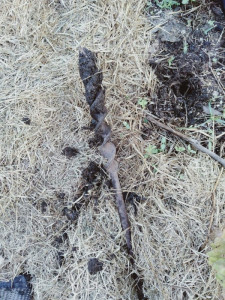
I used an auger to check the moisture levels in the soaker layer. It turned out to be pretty simple to find out just how much water to add so there was enough to wet the whole area without leaving stagnant water. I now had to wait until most of the water was used up which is obviously highly variable depending on weather and plant types. This is a bit more tricky as there is no magic rules to say when the moisture level has dropped enough to need refilling - it is just a question of checking the soil with the auger and watching the plants for any sign of drooping. To breed the beneficial microbes we need the soil moist but not wet. auger-colin-austin-gbiota

Plastic film or compaction

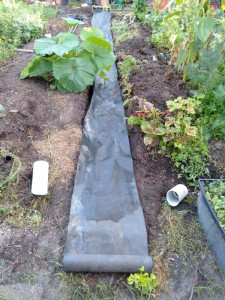
On all my previous beds I had used a plastic film to stop water leaking away. My soil is a duplex with a layer or real heavy clay underneath and a layer of silt on top. I decided to make two experimental rows. The first row would use a plastic film. While on the second row I compacted the soil with a sledge hammer. liner-film-colin-austin-gbiota

Compacted trench

To be honest - now I am growing crops I cannot really tell the difference and if anything the compaction bed is growing better but there is always a degree of randomness in growing experiments. I have no idea if compaction would work on a sandy soil - somethings in life you just have to try and see. My trench stopped about a metre from the end of the bed - this is part of what I call the soaker zone. I test the trench was level with water and scraped and dug until it was level (important, I think I may treat myself to a laser levelling tool). I laid a length of Ag drainage pipe along the base of the bed and used a couple of inspections tubes at either end. These were large enough (100mm for me to put my hand down and feel the wetness of the soil - ac critical part of the experiment. On the inlet side I did put a piece of plastic file under the inspection cum filler tube to stop the water soaking into the ground at the start - no idea whether it is necessary or not after all my banging. I back filled with several layers, the first was organic waste - I really wanted food waste but I have found we jut do not produce enough at home and I have exhausted the friendly local restaurants - so I made do with grass clippings which are abundant. Previously I have used sticks I have chopped up with my slasher - a sort of micro HugelKultur - works great but takes a long time to decompose and this was an experimental bed I expected to rework. The next layer is manure - I used chicken manure because, like with most things I use what is readily available (and cheap). I mixed this rock dust (basically Bauxite - full of magnesium) and Dolomite to reduce the acidity of the manure and add calcium. I also use a rock dust mix which is significantly more expensive but has a range of trace minerals. My soil is already full of micro-biota but is needed I would add some local inoculant. Again I have been using this soil for some time and it already has a plenty of worms - both native garden and red wrigglers but again I would add worm eggs if needed. The top layer is just the soil I have already dug out and is in good condition with a nice texture from years of feeding. Then I just seed and give an initial surface watering in the normal way. compacted-trench-colin-austin-gbiota

Watering

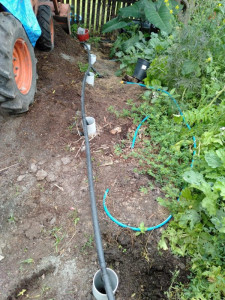
Now comes the critical bit - making the soil moist but not wet, which is what Gbiota beds are all about. You simply do not get significant water movement until the soil is saturated (even in drip systems). So I put a hose into the inlet tube and keep on filling until I see water has partially filled the end sight tube. I now have liquid water along the trench. This will start to flow sideways under hydraulic flow to the zone alongside the trench where it will start to wick upwards. It will also flow into the soaker zones at either end of the trench. This is the difference between the sump and pump system where any excess water drains back to the sump for recycling while in the soaker beds we are aiming to fill the trench with enough water to flow and wick into the soaker zones but with no excess which would give us saturated soil. As i already have a pump system I have connected the beds to the old manifold but this is just because it is there, a hand held hose works perfectly well. I expected getting this right to be a bit of an issue but having filled the trench to a depth of 50mm the water had moved with no saturated soil remaining. Filling does not appear to pose any problems (unless you leave the hose running while you have a cup of tea). Knowing when to re-irrigate is a bit more of an issue. I was hoping that I could just feel the soil at the bottom of the sight tube but having tried this I am not convinced as yet that just because the soil is still moisture in the sight that this means there is moisture throughout the remainder of the bed. In this case I resort to my friend the auger and just take samples at various point in the bed until I feel the moisture level is getting low. This is the big danger with all Wicking beds - just keep on topping up with water when it is simply not needed - that's when the soil starts to go putrid which means we are breeding the bad bugs. For a quicker check I have planted some water sensitive plants like tomatoes and Chinese Cabbage which show serious signs of wilting when they lack water but spring back as soon as water is available. watering-manifold-colin-austin-gbiota

Maintenance

The whole point of Gbiota beds is to breed the beneficial bugs that will eventually form part of our gut biota. In addition to the soil micro-biota we need to feed the macro-biota - specifically the worms. There is a lack of critical research studying how the soil microbes move from the soil and become established on our gut. My hunch is that worms (and other macro creatures) play a critical role in this as they have a gut just like us so I am anxious to keep them well fed. I have three basic strategies which all have the common requirement for avoiding those trillions of flies which love to visit when anything pongy is on offer. In the first system I simple dig down to the base of the bed and reload - but I don’t like overworking the soil so I just dig a 200mm trench to one side of the ag pipe this time and the other side next time. This won’t harm the bacteria and will only cause minor damage to the fungi with long hyphae but they the hyphae will soon regrow as the body itself has not been damaged. The second approach is just to use those small compost bins which can be placed appropriately on the surface and just let the worms come by on their evening wriggle and take the compost down to the depths. The third approach is to use the pathways as composting zones. I am simply laying down any suitable organic waste (eg food waste) and covering with my abundant supply of grass clippings. This of course will block the paths as flow channels when we get these extreme weather events. The idea is that when one is forecast I will rake up all the semi rotted material onto the beds themselves as a mulch leaving a clear flow path to the flooding water. Only time will tell. side-trench-colin-austin-gbiota

Loading

In-Ground Gbiota Beds

In-Ground Gbiota Beds

Sump Beds vs Basic In-Ground Beds

Sump beds were the first in-ground Gbiota beds developed to take advantage of the partial flood and drain cycle. They are automated with pumps and timers and are well suited to commercial or larger-scale growers. Many home growers, however, are put off by pumps, timers and wiring. To make Gbiota beds more accessible, we developed basic in-ground beds. These are extremely simple, very effective, and only need a manual check on water levels. For most home growers, the “tool kit” is just a spade, some Ag pipe, clay or plastic film, and a bit of energy to dig a shallow trench. Basic in-ground beds are almost embarrassingly simple, which is why they’re ideal for home and small-scale growers. They can even be partially automated later if needed. Understanding the drainage principles is important so you don’t end up with a soggy bed that favours harmful microbes.

Early Sump Beds

I started promoting wicking beds in 1995 to improve water efficiency and reduce watering frequency. Many of these early wicking beds effectively became self-watering pots. In 2015 I learned more about gut biota and its impact on health span. It became clear that the same wicking principles could be used to breed beneficial microbes by maintaining “Goldilocks” moisture levels in the soil – consistently moist but never saturated. flat-bed-colin-austin-gbiota
These early Gbiota sump beds were built during a dry period and used the partial flood and drain principle. The entire bed was raised above the parent soil and any excess water drained back to a sump. Beds were about two metres wide, lined with plastic sheet and hidden under the soil, so they appeared as large raised beds. The system was fully automatic, with overflow returning to the sump. The main challenge then was supplying enough water under very high evaporation and minimal rainfall. Over-saturation simply wasn’t an issue. In recent years, with heavy and more frequent rain events, beds needed redesigning to handle extreme rainfall and avoid prolonged saturation.

Sump and Pump In-Ground Beds

In-ground Gbiota beds have several advantages:
  • They stay connected to the existing soil life.
  • They can be built large enough to feed a family.
  • They can be automated and scaled.
I have built beds up to 50 metres long, but many growers will be happy with beds around 10 metres. Multiple rows can easily give you 50 m² of productive area. With current climate conditions and frequent storms, I now build all in-ground beds as raised ridges. Even in heavy rain, the top of the ridge stays above saturation so roots can survive and plants can regrow after flooding. The layout uses:
  • A sump or micro dam to collect drainage water.
  • Channels that collect drainage from multiple rows.
  • A pump on a timer that periodically feeds a manifold at the top of the beds.
  • Ag pipe along each row to distribute water and support the partial flood and drain cycle.
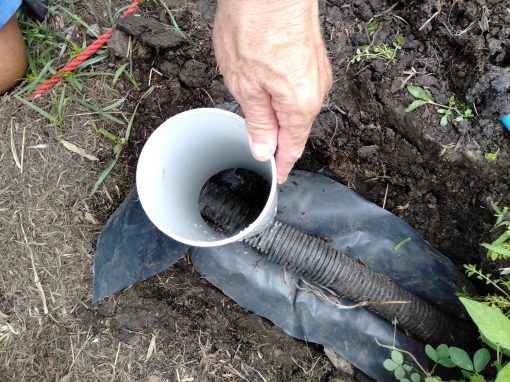
Earlier systems simply bent the Ag pipe up to the surface and used it as a fill point. With more intense rainfall, I now use a larger inspection/fill pipe sitting over the Ag pipe so I can see and feel the moisture level in the base of the bed.

How to Make an In-Ground Gbiota Bed

1. Dig the Trench

  • Dig a trench no deeper than about 300 mm. With heavy rains, a depth of about 200 mm or less is often enough when combined with a raised ridge.
  • Plan for the bed surface to finish above the parent soil level to improve drainage.

2. Create the Impervious Layer

Install a base layer to hold water long enough for it to wick:
  • Most commonly, use plastic film about 1 m wide with a 100 mm lip on each side, giving an 800 mm wet “channel” down the centre.
  • Alternatively, dig down to a heavy clay layer and line the trench with clay. This works but over time the clay may convert to more porous soil, so the bed may need rebuilding later.
The base must be flat and level. Test this by partially filling with water and checking for even depth.

3. Fit Ag Pipe and Inspection Tube

  • Lay Ag pipe along the base of the trench so it is level.
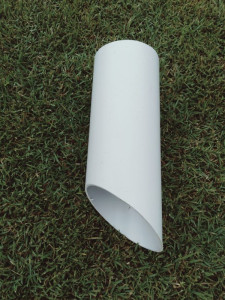
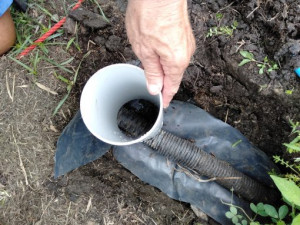
  • At the inlet end, fit a larger vertical filler/inspection pipe over the Ag pipe and cut the bottom at an angle. This should be wide enough for you to reach down and feel soil moisture.
  • At the outlet end, build a leaky soil dam at least 50 mm high so water must flood the base before it can escape.
The plastic film typically covers an 800 mm wide central base section. Wicking will lift water up and over the ridge and into adjacent soil, giving an effective productive width of around 1.5 metres, which is convenient for access.

4. Leaky Dam and Irrigation Cycle

The Ag pipe runs along the base, then up and over the leaky soil dam. The dam:
  • Holds water back until the base of the bed is flooded to about 50 mm.
  • Allows excess water to flow back into the sump once the level reaches the top of the dam.
With an automatic sump and pump, the bed is usually flooded once early in the day. This gives time for the water to wick up into the root zone and drain back to the sump during the heat of the day when evaporation is highest.

Filling the Bed with Growing Media

After the base and pipework are in place, fill the trench in layers:
  • Bottom organic layer: about 200 mm of organic waste (green waste, shredded plant material, food waste).
  • Manure and minerals layer: about 100 mm of manure, often blended with rock dust for additional minerals and improved structure.
  • Topsoil/growing layer: about 100 mm of good soil and/or finished compost for seed germination and root growth.
The finished surface should be raised above the original soil level to ensure good drainage during heavy rains.

Inspection Tubes and Moisture Management

In addition to the main fill tube, you can add one or more inspection tubes mid-row. These allow you to check whether water has drained away properly after irrigation or heavy rain. In wet periods, these tubes are useful for confirming that the base is not staying waterlogged. In practice, you can also use indicator plants (such as tomatoes) at key points in the bed: wilting suggests the soil is drying and irrigation is needed.

Feeding Worms and Soil Life

Worms are central to Gbiota beds. They:
  • Feed on organic matter and produce vermicast, a highly fertile soil.
  • Help shape soil structure and improve aeration.
Ways to feed them include:
  • Placing open-bottom compost bins on the bed so worms can access the compost.
  • Burying perforated containers filled with compost.
  • Periodically digging a narrow trench down to the base, refilling it with organic waste, manure and minerals, as when the bed was first made.
This trench method both feeds the biology and produces excellent structured soil. The excavated soil is valuable and can be reused in Gbiota boxes for growers who don’t have access to in-ground beds. Water will also wick up and over the edge of the plastic film into surrounding soil. This zone can be used for deep-rooted crops such as alfalfa to make full use of water and nutrients. Paths on either side of the bed can be mulched with lawn clippings to suppress weeds and feed worms.

Growing Soil for Gbiota Boxes

In-ground beds are not only for producing vegetables; they are also a way of growing soil for Gbiota boxes. You can periodically:
  • Dig out the soil in a narrow trench above the Ag pipe, or lift the pipe and dig to the base.
  • Refill the trench with fresh organic waste, manure and mineral-rich material.
This buried material decomposes naturally and is processed by soil life, creating a deep layer of vermicast and biologically active soil. This approach avoids fly problems common in open compost systems and keeps nutrients cycling within the bed.

Basic In-Ground Gbiota Beds (No Sump)

Many people don’t want the expense or maintenance of pumps, timers and sumps. Basic in-ground beds offer a simpler option that still uses partial flood and drain cycles, but with manual watering and no sump. Instead of returning water to a sump, basic beds use soaker or capture zones at one or both ends of the bed to make use of overflow water.

Layout of a Basic In-Ground Bed

In the test bed layout:
  • A central filler/inspection tube is installed over the Ag pipe.
  • The plastic film runs to the very end of the bed, with one or both ends open so water can escape into the soaker zones.
  • The Ag pipe stops about 1 metre before each end and is curled up to the surface.
  • The last metre on each end is filled with soil to form soaker beds that capture overflow water.
down-tube-colin-austin-gbiota
The soaker beds are ideal for water-loving plants such as lettuce, tomato, spinach or linseed, so excess water is not wasted. To check drainage, you can:
  • Feel the soil at the bottom of the inspection tube.
  • Observe the soaker-bed plants – wilting or stress can indicate dry soil.

Manual Watering and Moisture Cycles

If you are happy to water most days, a simple method is:
  • Trickle water into the inspection tube until about 50 mm of water has accumulated in the base. This is usually enough for a full hot day.
  • On days when you want longer intervals between watering, you can fill to around 100 mm, as long as you allow water to drain or be used by plants before watering again.
The essential rule is to maintain a deep wet–dry cycle:
  • Flood the base, let water wick up and feed the plants.
  • Allow liquid water to drain or be used so the bed is not waterlogged for more than a few days.
Even after liquid drains away, moisture held in the soil by surface tension will keep plants growing for several days, depending on climate and crop type.

Feeding Soil Organisms in Basic Beds

Feeding and maintaining biology in basic in-ground beds is very similar to sump beds. You can:
  • Use small compost bins on the surface.
  • Bury perforated containers of compost.
  • Dig narrow trenches down to the base and refill them with layers of organic waste, manure and growing medium.
This narrow-trench approach is very effective for keeping soil structure, biology and nutrient levels high, and for continuously growing high-quality soil for Gbiota boxes.

Loading

Food for health

Food for health

Download as .pdf

health-soil31aug22

Health starts in the soil

Colin Austin © 31st Aug 2022
This document is published under the Creative Commons system which means that it can be freely copied or republished without further permission - the only provision is the Standard Creative commons requirement that the source Colin Austin www.gbiota.com should be acknowledged.

Abstract

Part 1 reviews why we need to be breeding beneficial biota in our soils.

Historically four out of every five people died before their natural age from an infectious disease. Both medical science and our food system has responded by finding better ways of killing these pathogens. While largely successful we have also inadvertently reduced the number of beneficial biota which has led to an upsurge in non-infectious diseases such as diabetes, heart attack and dementia.

We have learned the hard way that we are totally dependant on these beneficial biota.

Part 2 is where we get practical and look at ways of breeding these beneficial biota in the soil. The focus is using organic wastes as the prime resource as it is clear that climate change is a threat to our food system and we need to move to a circular system based on recycling whatever is available.

Breeding the beneficial biota in food waste in a Gbiota bed does require space, time and skills which means its use is limited to experienced growers but we are promoting a system where skilled community growers prepare Wickimix - a growing media for wicking beds full of minerals and beneficial biota - is used to fill Gbiota boxes which gives access to healthy food to virtually everyone, even those living in apartments and with no time.

Fundamental shift

This is a fundamental shift in how Wicking Beds and our food system operates. Wicking Beds have been widely used for years and are seen as a self watering system to make life easier for gardener.

Gbiota boxes are still Wicking Boxes but there role is to change our food system so instead of all our food coming through the conventional system of mega farms and supermarkets some of our food will be grown at home in peoples houses or apartments providing plants deliberately grown to act as pre and pro biotics to feed our gut biota.

This is a very different ball game (or paradigm shift).


Part 1 The story of good and bad bugs

Four year old kids

Medical research is at an unprecedented level of sophistication so we should all be enjoying an unimaginable level of good health - yet we are not. We need to understand why, not at the level of the fashionable three word slogan, eat less exercise more or eat more greens we really need a deep understanding of what it going on.

Anyone who has experienced a four year old kid will know they just keep on asking question as they try and understand the world around them. We have to be equally frustrating as we keep on asking why, why why.

Simple solutions to complex problems

We live in an era of simple solutions to complex problems, inflation - just raise interest rate, health problem just take some magic pill - good for the advertising wiz kids but may be not so good for our health.

Let us take for example one of the most rapidly increasing diseases in this modern age - diabetes.

Diabetes

Every eight seconds some has a limb amputated from diabetes. Is diabetes serious? - big yes. Can it be solved by taking a pill - no way. Pills may help but they are no solution - so we have to keep on asking why.

Just asking why once does not give the answer, we just have to keep on asking why, why until we understand what is the real issue.

The first why tell us that with diabetes the blood flow is restricted so the limb starts to get gangrene. True but that does not help us much so we need to ask why do we get diabetes.

We know the feature of diabetes is high blood sugars which would normally be resolved by the Pancreas injecting extra insulin into the blood stream. But after a period of high insulin level the body becomes less sensitive to insulin which, at least initially, is not an issue as the pancreas simply make more insulin. On the road to diabetes but not there yet.

But after a period of time the pancreas begins to accumulate fat which reduces the capacity to create the insulin level to control the sugar level - then we have real diabetes.

amputated-leg-colin-austin-gbiota

Why does the pancreas stop making insulin?

So the next why is why does the pancreas become saturated with fats?

Because we are eating the wrong amount of the wrong sort of food.

But why? The answer to that lies in the gut biota - which controls appetite. The gut will send out hunger signals if either the gut biota is not correct or the body is short of critical nutrients - even if we are more than full of other foods.

We simply don’t feel satisfied if we are missing just one single essential nutrient or we have the wrong sort of gut biota.

Now we are getting closer to a solution - we need to ensure we are feeding our gut the right sort of food to get the needed gut biota and ensure that there are adequate amounts of the critical nutrients in our diet.

How we die?

But thinking like a four year old we have yet more questions. How we die? How long will I live? Kids just never give up.

Now you may have seen the statistics that a few generations ago the average age at death was in the low thirties and now is around eighty. Fantastic you may say - but it is more complicated than that.

Back then kids died from some infectious disease. Three out of five kids would die before they reached the age of 5 and another one would die in their teens so four out of five kids would die before the reached the age of thirty.

But if they lived until they reached thirty they were likely to live to an old age in fact typical of the age we are dying at now.

Although the average age at death may mathematically have been in the early thirties in reality very few people died in their thirties, they either died well before or long after the average age of death which mathematically was the early thirties.

Premature deaths

There is a certain age when we just die of old age - there may be some name on the death certificate but essentially it is just old age. But most deaths are premature - we die before we reach that age limit of some disease - it used to be some infectious disease which we have largely overcome but more commonly we will die prematurely from some chronic or non infectious disease.

But what makes us die Daddy?

Now that is a really penetrating question, stunningly so for a four year old. Infections used to be the most common cause of death, followed at a distance by accidents which were not properly treated so they died again from infection.

Before Covid I could have rabbited on about the enormous success we had had in beating infections and even so we have done a pretty good job.

But now deaths from Chronic or non infectious diseases have spiralled through the roof. Deaths from the side effects would be the classic example and no doubt our four year old will grill us on this.

The Covid paradox

Our smart four year old may point out how many people are dying from Covid so doesn’t that support the theory that we must kill of all those pathogens - whatever the damage to the good bugs.

But our smart four year old will ask why is it that some people get Covid and they don’t even know or the symptoms are so small it does not matter while millions of other people die despite the best medical technology.

I have yet to find a technical paper which has studied the relationship between Covid and gut biota but why some people die of Covid and others are hardly affected, has received medical research.

The two leading factors appear to be diet and stress. It is likely that people eating a healthy diet have a healthier gut biota which supports the argument that we should be paying attention to the good bugs.


Good bugs and Bad bugs

Let us not fool ourselves - there are really bad bugs which will make us really sick or even kill us. Modern antibiotics may have prevented us from dying from these bad bugs but they are largely still out there waiting to kill us.

So, throughout society we now take great precautions to prevent these bad bugs spreading and becoming a serious problem.

This is particularly true in our food industry and you can go into any Supermarket and be pretty confident there are no harmful bugs in the food you buy just waiting to kill you. OK there may be a very occasional outburst of E-Coli but they are pretty rare.

But there also good bugs which are totally essential for life, they are all over and in our bodies, particularly our gut. If you read any of my articles you will see it is almost impossible for me to write without saying how important our gut biota is, a real brain controlling our appetite, replacing our body parts and hosting our immune system.

Our gut brain is just essential for health and it is just a feature of modern life that in our efforts to avoid pathogens, the bad bugs, we have killed of many of the beneficial biota - the good bugs.

Much of our modern food system is really just large scale hydroponics with the nutrients being supplied by fertilisers and the soil doing little more than hold the plants upright.

Some growers will even go to the length of injecting methyl bromide into the soil to completely sterilise the soil and kill of all living creatures.

We are very good at killing everything but it is not so easy to kill the bad bugs and not the good bugs.

This is not healthy.

The punch line

So let me reiterate the punch line - we used to die largely from infectious diseases but we have managed to control the harmful bugs which kill us but we have also killed off the good bugs we need so we now largely die from chronic or non infectious diseases.

With the armaments of modern chemistry we are very good at killing things - but we don’t really have the technology of killing of the bad bugs without killing the good bugs on which our lives depend.

So what is the alternative? Ecological balance

Ecological balance

There has been some form of life on earth for the best part of four billion years yet the world is full of life - for a start there are some eight billion humans. How is it that so many humans have survived when there are all these bad bugs about?

These pesky four year old kids keep on coming up with the most penetrating questions.

But this time the answer is simple - ecological balance. If the conditions are right the good bugs can simply out breed the bad bugs. May be not eliminating them but reducing their numbers so they become manageable.

Most people have E-Coli in their guts and they do no harm and no one even knows about it.

That is what the Gbiota system is all about, creating the right conditions so the good bugs can out breed the bad bugs so we can live a healthy life by growing plants which we eat to feed our gut biology.

One critical factor entails managing the moisture level so the good bugs can breed away and it is not too wet which are the conditions the bad bugs will breed in.

First line of defence

Now let me be very clear on a key point. Eating a diet full of beneficial biota is the first line of defence in living a healthy life and may well protect us from becoming sick. But it is only the first line of defence and not an alternative to the benefits of our modern medical system.


Who has the best guts?

The Gut Biota is the hot topic in medical research so there is a sea of studies to ponder over. We understand that the trillions of cells in our gut communicate with each other acting like a super computer. But what is clear is that the variety of different species has a significant impact on how well our gut brain works - just a few cells of a specific species can have a major impact.

From these studies we learn that the groups living a more natural life have a much healthier and more varied gut. So what do they have in common? It is not some specific plant - that magic plant which will solve all our problems from some remote part of the world is just a marketing myth - may be a very profitable myth - but still a myth.

Some groups are living on Tubers, other wheat, other rice, some sweet potatoes - there is no magic plant. But all the food is grown in soil which is near natural - full of decomposing organic matter with no toxic chemicals and almost always eaten fresh. This is an important point to note.

But before you go and adopt a hunter gather life style by sharpening up the broom stick handle to convert it to a spear to capture an antelope for dinner there is one point to notice - there are just a few thousand people living an old life style - there are some eight billion people in the world and we would run out of fresh antelope within a few days.

We have to learn the lesson from the past but we have to use modern technology to apply the lessons.

To breed the beneficial microbes we need a broad spectrum of inputs some carbon, some nitrogen, a range of minerals, inoculants to start the process and air and water. We also have to consider the need to move to a circular society where we recycle our waste food and organic wastes.

In fact air and water are the most critical - if the soil is too dry the biota will not breed - or at the other extreme too wet - the soil becomes anaerobic so we will end up with harmful biota.

We need that Goldilocks moisture - not too dry and not too wet - just right.

That is what the partial flood, drain and wicking system is all about.

Testing

How do we know if the Gbiota system is working. DNA testing can identify the various component in in your gut. We all have different gut biota so it is really best to be tested before starting eating Gbiota food and after to identify the changes.

The Gbiota team can organise independent testing. The results can show a change in gut biota and identify a change in variety and a shift to species which are generally considered more beneficial which indicates a probability of better health.

A lot simpler is to see if there is a change in food carvings which indicate either a lack of critical nutrients of a poor gut biota. If cravings are reduces accompanies by a weight loss then it is working but this does not mean you will be resistant to some unknown pandemic yet to emerge.

Part 2 - The practical side - breeding beneficial biota

 All this may seems very theoretical but in Part 2 we get down to the nitty gritty practical side of making it all happen.

Breeding the beneficial biota in food waste in a Gbiota bed does require space, time and skills. It may be an excellent way of growing gut food but it does require land, time and skills to operate correctly which means use is limited to those with a garden and the skills.

We are promoting a system where skilled community growers set up in ground Gbiota beds to breed the beneficial biota to grow Wickimix a growing media for Wicking beds. This is used to fill Gbiota boxes which gives access to healthy foods to virtually everyone, even those living in apartments with no time.

Fundamental shift

This is a fundamental shift in how Wicking Beds and our food system operates. Wicking Beds have been widely used for years and are seen as a self watering system to make life easier for gardener.

Gbiota boxes are still Wicking Boxes but there role is to change our food system so instead of all our food coming through the conventional system of mega farms and supermarkets some of our food will be grown at home in peoples houses or apartments providing plants deliberately grown to act as pre and pro biotics to feed our gut biota.

This is a very different ball game (or paradigm shift).

Gbiota beds

I am including this section on Gbiota beds as they are important because they are used to make Wickimix, the growing media with the beneficial micro and macro biota and minerals which are used in the Gbiota boxes. There are some people who want to know how they work even though they will not be using the technology directly and is just background information.

We have separate detailed documentation and provide technical support on how to set up and run Gbiota beds as it is such a critical part of the process.

If you just want to have gut food growing in your own home skip this section and go to the section on Gbiota boxes.

Creating the conditions to breed beneficial micro-biota

The main purpose of a Gbiota bed is to grow the growing media (soil) but even to do that we need to grow plants - they capture the energy from the sun and carbon dioxide to make sugars which they exude from their roots to attract and help breed the beneficial biota that in turn provide the plants with water and minerals that the plant finds difficult to extract by themselves.

This link between the plants providing energy and the soil biota providing water and nutrients is the greatest deal in the history of the world.

This is how a Gbiota bed works. We have a sump which holds water or rather compost tea. A pump controlled by a timer, periodically picks up the water which flows through sub-surface pipes to saturate the soil in the base of the bed with any extra water returning to the sump. At the end of the cycle the compost tea drains back into the sump.

A key feature is when the pump is running and the trench filling it is expelling the gases - like ethylene - which act as growth inhibitors and when the water drains away it sucks fresh air back into the soil. Water will wick up into the root zone providing a steady supply of nutrient rich tea to the plants.

Not exactly rocket science but it must be done right for it to work, as it should, to breed the right species of beneficial biota which will enter the plants which we will eat to enhance our gut biota.

paper it is a fully automated system but there is a big difference between automated and maintenance free - after all we are dealing with what some may think is pretty yukky water which has a great capacity for blocking up the pumps and pipes. So maintaining the system and ensuring that the inputs are controlled to breed the right species of biota is not exactly the activity for a working mum with a bevy of kids.

Water - that weird stuff

We are so used to water that we probably never bother to think what weird stuff it is. We may just get a bit angry when it expands when it freezes and burst our water pipes and certainly one of the weird features of water is the way it expands when it freezes - that is highly unusual.

 But that is only the start. Water has a fetish - it just loves other things and itself.

Water has a tensile strength just like a steel rope - that is how trees work. Here in Australia we have the Mountain Ash which grows to over a 100 metres tall. How does water get to the top? Simply by waters tensile strength. Water evaporates from the leaves and water is literally pulled up from the root zone (which is filled with water by a combination of osmotic and wicking actions).

Water is also attracted to other substances, when you come out of a shower you are covered in water droplets that don’t run off. Water has a fetish about your skin and just holds on tightly to your skin.

But is also has a fetish about soil, at least most soils, so you can wet a bit of soil and the water will just stay there, it won’t just keep on going downwards under gravity nor far sideways.

This is great - if the water did not stay in one spot hugging the soil there would be no life on earth. The plant roots, certainly aided by the fungi and soil biota will suck the water and dissolved nutrients out of the soil and into the plants so we have food to eat. Great!

Clay sludge

This fetish of water in liking things leads to the peculiarity of the sludge which is formed when clay (or soil containing clay) get seriously wet. Technically sludge is thixotropic which means that when at rest it has shear strength - in other words is behaves like a solid. This is caused by the water molecules bonding to the clay particles.

 This is an effect that many frustrated gardeners have experienced when the put in a drain to get rid of excess water in clay and despite the care in making the drain slop downward the water appears to defy gravity by refusing to flow.

But once the head (water pressure) reaches a certain level the water bonds are broken, the water flows freely in a big gush.

This is how we get the ever increasing landslides, the water builds up to an over saturated level but at some point the system collapses with disastrous results.

While there is no danger of a Gbiota bed causing a land slide it is important that the bed drains properly so it is properly aerated. It is particularly important in the base of the bed where water must flow freely to distribute the water uniformly to the biota and plants.

This is important in managing the bed and why we need to ensure a high organic content.

The flood, drain and wick cycle

But how do we get water to move through the soil so it waters a larger area. We simply have to add more water so it becomes saturated with the larger pores in the soil full of water when it will wick across the soil. Water will then move to fill the smaller pores.

But we do not want soil that is so saturated that the harmful pathogens will breed up so we have to do what nature has been doing for years, go through a cycle of wetting and drying.

To get the beneficial biota to out breed the pathogens we have to use a deep cycle, in other words we wet the soil so the water will flow and wick to other areas then allow it to drain. This is what the flood, drain and wick cycle is all about and is at the heart of the Gbiota system.

A community grower, eg a grower who is growing the soil for other people in their neighbourhood will use pumps and timers (or a solar panels with pump) which will automatically generate this deep cycle.

A consumer will typically have to create this deep cycle manually - that is why I have spent so much time to explaining about the weird properties of water.

So I will use block capital to emphasise this key point DO NOT KEEP ON TOPPING UP YOUR BOX WITH WATER USE A DEEP CYCLE.

Top and bottom watering

An interesting experiment is to take an old fish box and fill with soil. Pour a little water on the surface and it will not go down to the bottom (defying gravity is one of water weird properties) it just sits there.

Add more water and the soil will become saturated and then the water will start to flow downwards. But soil is never uniform so it will find a crack in the soil and move downwards leaving an area which is not properly whetted.

But the worse thing is that the surface layer will be saturated and seal off the lower layers from the air - we have the worst condition which will breed harmful micro-biota.

Now compare this with the bottom feeding system of the Gbiota bed. We saturate the base of the bed - there is no avoiding this - water won’t move through the soil until there is a zone of saturated soil.

The water, using the wonders of surface tension and wicking action, will slowly wick towards the surface.

But soil is never uniform with small and big pores. Surface tension will work in the small pores pulling the water upwards, but there will not be enough surface tension in the larger pores so they remain full of air - which is what we want to breed the beneficial micro-biota.

There is always a gradient in wicking action so as we get nearer the surface only the finest pores will be whetted leaving a pathway for air to enter the lower soil levels.

But we have a layer of saturated soil in the base which we drain out - and as it drains it will suck fresh air into the soil above.

The water - or rather compost tea returns to the sump ready for the next cycle.

The water is always moving - it is a continuous cyclic process - with the water never being stagnant for any length of time which will breed the harmful micro-biota which at worst will send us scurrying for the toilet and at worse will make us seriously ill or - the ultimate - dead.

Like any good film there are goodies and badies and we are just fiddling the system so the goodies win. You can call it cheating or creating an ecological balance - as you wish.

Gut biota has a short life cycle

Another very important factor is that the plants need to be eaten shortly after harvesting. Some component of the complex biota inside the plants will have a half life of only twenty four hours.

This is essential for the health benefits but also they taste so much better when fresh. We don’t have taste buds for nothing - they evolved to tell us when food was healthy.

So while Gbiota beds may be a great piece of technology they are really limited to people with a garden, growing skills and time and are happy spending their time recycling waste food, playing with manures and piles of rock dust and cleaning out pumps when they get blocked up from the organic waste. (That’s me if you hadn’t got the message).

But the aim of the Gbiota system is that everyone should have access to healthy gut food. Not everyone has my obsession with recycling and doesn’t mind a bit of yuk.

So we have made a two stage process.

Experienced local growers with a garden, time and the necessary skills (and think it would be rather nice if their grand kids had real food to eat) will set up Gbiota beds with the prime aim of growing Gbiota soil - which we call Wickimix.

This has to be a local operation so the Gbiota team provides the training and support to local community growers so they can set up these Gbiota beds to grow Wickimix which is put into boxes to grow plants which can be picked and eaten without the excessive delays that inevitably occur with remote growing.

Biota boxes

Everyone has a gut and it essential for health that we feed it gut food. The Gbiota box system make gut food available to virtually everyone, even people living in apartments with not garden, time of gardening skills.

Nothing special about the box

The box can be any shape or size to suit. It could be just a simple 20 litre tote box from the local hardware store or a full sized container bed a couple of metres long, there is no magic about the box itself - it is what that goes into the box that matters.

It does need a drainage hole drilled in the base and a standard irrigation fitting with a bit of drainage pipe in the bottom - people can make these themselves or the local grower can provide these as a finished unit.

Choosing a system that suits you

Small boxes

Peoples circumstances vary. If you are living in an apartment with little space the easiest way is simply find a local grower and buy a small Gbiota box of baby greens already growing, just water when needed and then swap the complete box (with new Wickimix) for another one when finished.

Your grower will make, fill the box with Wickimix which is full of biota and nutrients and seed the box for you.

Dead simple, just give the box a bit of water and harvest the plants when ready and leave all the problems to the local grower. You don’t need much space, a balcony or a widow sill is fine (plants do need a bit of sunshine).

 Gbiota boxes have a swivel pipe on the bottom which shows the water level. You can simply swivel the tube and see if any water comes out. If there is still water in the bed do not water, just wait until there is no water running out. You can actually wait a day before you water as there will still be plenty of water in the soil.

If there is still water in the box after a week you should let it drain out (catch it in a container - it is full of nutrients) so the water is never stagnant for any length of time.

You may like to help the grower - and the world - by donating your food waste to your grower so it can be recycled.

These small boxes, which are light enough to be swapped, are such an easy way to have fresh gut food growing in your home or apartment.

If you are not used to growing they are a great way of getting started.

But if you are ambitious you can move up to larger boxes which are too big to move about.

Larger boxes

If you have a larger space you may want to set up a larger box which can grow much more food and start recycling your waste food yourself.

These large boxes are just too big to move so you will need to know how to operate them properly to create the right conditions where the beneficial biota will out breed the harmful biota.

How to make a larger home Gbiota box

Start by choosing the size of box you want, the same principles apply to all large boxes (eg boxes too large to be just swapped).

You can make them yourself or ask your local grower to do it for you.

Don’t get confused - Wicking Beds are often used as a self watering system Gbiota beds and boxes still use the Wicking principles but were developed to breed beneficial micro-biota and are actually a lot simpler than the self watering wicking beds.

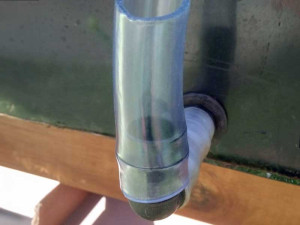
 Simply drill a hole of the right size to fit your irrigation fitting as shown as low as possible int the box. Connect this so a 90 degree bend with a swivel or sight tube on the outside and fit a piece of drainage pipe to the inside.

This can either just fit along the base or you can curl up to the surface. (The only reason for the curl is to help clean out the pipe should it get blocked - but you can also clean it out by connecting a hose pipe to the swivel tube. This can really amuse the kids as you can use the hydraulic pressure to lift the entire soil mass - great fun and teaches them about hydraulics.

Then make the compost tube. There are two ways to make a compost tube.

In soil compost tube

Take a length of regular pipe, about 100mm diameter and cut the bottom end at an angle of bout 45 degree (so the worms can get in) and the other end so it will sit about 200mm above the box.

Some people like to drill some holes just below the surface level of the soil, this makes another passage for the worms to enter and also lets the decomposed food waste flood out into the box.

I prefer to keep lifting the tube up as it fills which give more space for the food waste.

Normally you would put this in the box before filling so it will be empty.

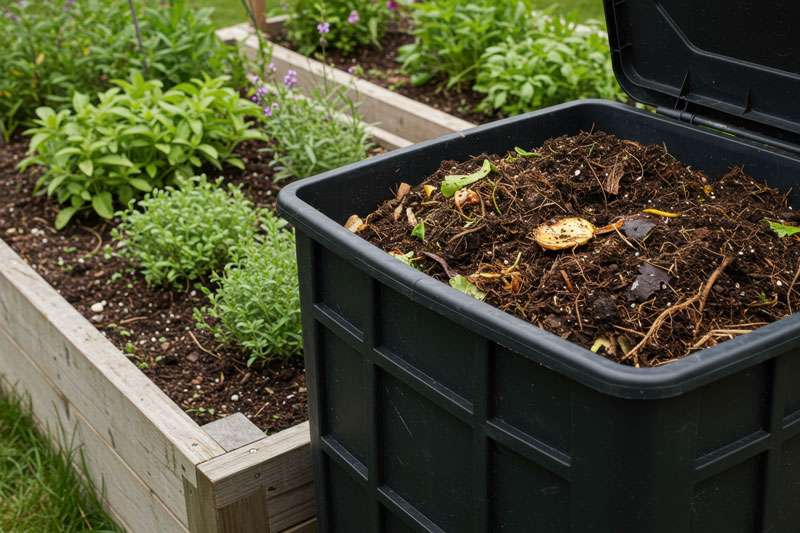
You just put your food waste into the compost tube and cover with Wickimix - just enough to keep those pesky flies out.

Use the tube to water which will flow out of the bottom end taking some of the composted food waste with it.

You may find that you are making waste food faster than it composts so you pull the tube out, clean out the tube and wriggle into the soil in another area and use the contents of the tube as a mulch.

Depending on your Yuk tolerance you may prefer to use a surface or on soil tube.

On soil tube

The on soil tube is even simpler - just a length of pipe, about 300mm long which you just press into the top of the soil (to hold it in place) and fill with compost and Wickimix as with the in soil tube. 100mm diameter is fine but in a bigger bed 150mm diameter by 300mm high gives a good volume.

This is simply wriggled into the soil so it is not easily knocked over and filled with food and organic waste and periodically covered with Wickimix before the flies become a problem.

When full it is simply emptied and the contents used as a mulch.

 But we want the water to go right down to the base, so simply make a hole by pushing a stick down to the bottom of the box or better still use an auger to make the hole.

I have a collection of augers and hole makers I have brought from the local market for a few dollars. But that is just me - a stick or trowel works fine.

Filling the box

I usually fill my boxes in a series of layers which may look good at the start but the box will end up full of worms which will happily move the soil around.

If I am feeling wealthy I may go and buy some Vermiculite (a fine water holding rock) and fill the base to a depth of about 50mm. Or if I want to play with my slasher I will chop any prunings and small sticks laying around to make a woody base layer.

It is important to have a porous, freely flowing layer in the base.

Next I will add all the food waste I can find and make a second layer then add a layer of manure which helps the food waste to rot down.

Finally I will fill the bed with Wickimix from my Gbiota bed or in your case your local community grower. That layer need to be at least 100mm thick so the plants have a zone to put down their roots.

Then just seed and cover with Wickimix in the normal way.

How to manage a larger box

Feeding

To keep the bed working at maximum performance we need to both feed and water the bed.

Food waste is simply pushed into the tube. If you have a climate anything like mine in about two days there will be a mass of vinegar flies and within a week an even bigger mass of blow flies - which is not nice.

You may be lucky and get some Black Soldier flies which is good, except if you are not used to the larvae they can be a bit of a shock first time you see them but they are really good at breaking down food waste.

But you can solve this problem and add extra nutrient to the system by collecting the food waste over a few days in a sealed container, or just out put them in he freezer, then put the waste into the tube and covering with a good layer of Wickimix. Wickimix contains worms and the biota to break down the food waste.

You may collect food waste at a faster rate then it is broken down in which case you can simply move the tube to another location, just pull out the tube, push out any remaining contents and then wriggle down into a new spot. It is a good idea to clean out the tube so the new food waste goes straight to the bottom of the bed.

Before refilling with food waste it is a good idea to add some porous material to the base, either Vermiculite or slashed up woody waste. This will keep the base porous.

Some people find this a bit of a messy operation (because it is) so an alternative is just to have a piece of pipe sitting on the soil.

You can water the bed from the tube. If the tube get full you can lift the tube up (either in or on ground tube) and simply flush the contents out flooding the top of the bed.

Watering schedule

I only start the proper Gbiota watering cycle when the seeds have germinated and the root system has developed.

As I explained, and is important, you do not want to have the soil saturated for any length of time as this will create the conditions where the pathogens can grow. The soil needs to be whetted enough to make the water spread throughout the bed, then allowed to drain - or at least the water used up so there is a period when the soil is fully aerobic.

It needs to cycle with the flooding expelling any foul gases then drained to suck in fresh air so the bed is aerobic for most of the time.

In a Gbiota bed this automatically done by the pump and timer system which works really well without any thinking but in a box it needs to be done manually. (There is no reason whey you cannot fit a pump and timer system to a box but for most people this is just too much of a bother but some people just like playing with pumps - I happen to be one of that weird breed).

The flooding process is done by putting the swivel tube so it is vertical then watering, normally from the Compost Tube.

Stop when you see watering entering the swivel tube as it will continue to fill as the water peculates down through the soil. Catch any water as you really don’t want to be wasting the overflow which is full of nutrients and beneficial biota.

Cycle lengths

The beds with pumps and timers are automatic and will operate on a daily cycle or even several times a day. But the Gbiota boxes are manual and most people do not want to be watering daily so the question is how long a cycle can be used without the beds turning putrid.

The answer seems to be that you don’t want to go for more than a week without the base of the bed drying out.

This seems to work fine but I prefer to use a cycle twice a week.

But here comes the good news;-

I also use a system where I plant some thirsty plant like tomatoes, lettuce or my favourite - spinach. They can suck the water out so fast that the free water (water in the base of the box) has been used up within two or three days but there is still enough water left in the soil pours to keep the plants moist.

This is really easy, never bother with the swivel tube, just fill the box until the water reached the top of the swivel tube then leave for a week. It is a very easy and convenient system but there is a bit of a learning phase to get the system working right by checking the water in the base of the bed is not going putrid by taking a sample using the swivel tube.

Mr Murphy visits

Mr Murphy, of the famous and very true law,’ if things can go wrong they will’ has a habit of visiting. When Wicking and Gbiota beds (and a Gbiota bed is really just a Wicking bed used to breed beneficial biology) are first made they generally work famously with a really active biota and excellent growth rates.

If you keep the worms and biota fed they can keep the bed working nicely for a very long time with a nice open porous soil, but if - for example - there is a series of heavy rains then any fine clay particles can wash down to the base - the biota stop breeding and the plants struggle.

Just empty the box, save the soil and reload the base of the box with fresh open organic material and put some of the soil back to fill the box and start again.

If you are into the philosophy of minimal soil disturbance (like me) just break the reworking up into stages, replace one half or third of the box, let the biota recover then do the next zone.

Getting started

The first question is do I want to be a grower or a customer.

If you want to be a customer - which means you just buy  boxes from a local grower which probably sit on a patio or by a window - all you have to do is find a local grower.

It needs to be local because the whole point of the Gbiota system is to enhance you gut biome which mean you must eat fresh.

But how do I find a local grower? What you really need to be doing is to set up a local group - nothing formal just a bunch of people talking to each other.

This is something you really have to do yourself but we have set up a social media site so you can make contact with similar minded people in your area. Just go to the Community on the menu and this will take you straight to the social media site (www.gbiota.club) where you can register.

This is a confidential site but you will need to fill in the areas which describe your location.

Hopefully this is self explanatory but if you have any problems then just contact me at colin@gbiota.com

I you just want ot be a home grower then all you need to is to sign up as a grower - you can go to account or you will be asked to register if you try and access any grower posts.

But the whole idea is to create a local community food system so we hope you will become a community or even a commercial grower.

You will need to tell other people that you are a a community grower so you should join the social media site by registering at the community on the menu.

As this is a social operation you may be happy just having people pop round to collect their vegetables of boxes but you can also use the shop facility which is the multi vendor site pickandeat.shop to become an internet trader.

Again I may suggest you get in contact with me first at colin@gbiota.com so I can guide you through the set up process.

Please note that Gbiota is a registered trade mark which you are automatically entitled to use by registering as a grower.

If you would prefer to chat (yes I am a real person) and I will try and sort out any problems by email but if I can’t solve your problem straight away we can end up on a Zoom or Skype call.

Next read Community food

Loading

Community food

Community food

Growing Gut Food

Colin Austin © 1st Aug 2022
This document is published under the Creative Commons system which means that it can be freely copied or republished without further permission - the only provision is the Standard Creative commons requirement that the source Colin Austin www.gbiota.com should be acknowledged.

Preface

In the last eighty years the global population has tripled however the food industry has increased the supply of basic energy food 40% faster than the increase in population and this can be expected to continue in the immediate future.

Our supermarkets are full of energy food and there is more than enough energy food to feed the planet - people are not starving because there is not enough food but for reason of equity, failed politics and distribution failures.

But even in the affluent west there has been a reduction in the mineral content of the food which is bad - but far worse is that the food no longer feeds our gut brain which is the intelligent control system for our bodies.

Our intelligent control system has evolved over thousands of years to tell us what and how much we should eat. Modern energy food is simply not feeding our intelligent control system - our gut brain so across the western world people are getting fat and sick.

It is not simply because we are overeating - it is because our gut brain is telling us to overeat to make up for deficiencies on our food system not because we have suddenly turned into little piggies.

On top of this we are now seeing the effect of climate change on our food system, with ever increasing droughts and even worse floods which destroy the soil.

This is a difficult problem which required serious thought, in today’s digital world we have come to expect complex problems to be solved by catchy slogans - eat less exercise more. Sorry you don’t solve complex problems by catchy slogans - this is a long article which goes into the details of the problems and how we can solve them.

large food companies

A key component it establishing local food communities to grow food which is genuinely fresh and contains the essential minerals which will feed our gut brain.

This is a process which won’t be driven by growers but by consumers using the power of the wallet to drive change.

brown-wallet-colin-austin-gbiota

Overview

Growers breed beneficial microbes in organic matter in the soil, also adding rock dust which is broken down by the microbes into accessible minerals forming nutrient rich biologically active soil.

This soil is placed into Bioboxes which are seeded and plants grown. The microbes and minerals enter the plants we eat. The boxes are supplied to customers who harvest and eat the plants full of living microbes to enhance the gut brain which controls appetite, manages replacement of body part as they age and wear and host much of the immune system.

Our gut brain is the key to good health.

Consumer get gut food which is genuinely health at an affordable price, growers get paid for what they like doing while the Gbiota team provide the technology of growing gut food.

What we urgently need are growers who can supply their local community.

Food for Health

How to thrive, be fit and healthy in the future crazy world

Abstract

 Colin Austin was selected by the Institute of Engineers as among the top one hundred innovators in Australia for his pioneering work on Computer Aided Engineering. But he started life with people, largely women digging up their lawns to grow food in the Victory gardens which supplied some 40% of fresh food in the war.

He now sees the supply of food that will make us healthy as the critical challenge of our era. He says while we have made dramatic increases in food production, with the advent of chemical industrial farming our food is lacking the essential ingredients for health.

colin-austin-gbiota


 We need to feed our gut brain which is our regulator and protector. We face the threat 24/7 from some infectious disease, maybe a cold, flue, Covid, Monkey pox or something totally new or from an internal threat - accumulation of fat in our pancreas causing diabetes, our arteries causing heart attack or our brain causing dementia.

Poor diet is not the cause - it just removes our protective shield.

He says we need a two pronged approach, the technology of growing food that will make us thrive and be fit and healthy plus changing to a local community based food system which provides food with the essential minerals and living biota that form our gut brain which controls out appetite, replaces our body parts and hosts much of our immune system.

You can read this now - delay until you are waiting in hospital to have your leg removed from diabetes - but leave it too long and a heart attack or dementia will mean it is too late.
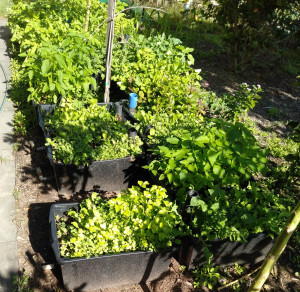
gbiota-boxes-colin-austin-gbiota


Health start in the soil

Summary

The aim of the Gbiota team is to provide expertise on how to grow food that leads to good health.

The basic technology is straight forward - just add essential minerals to the soil, breed beneficial biota in organic matter and carefully control the moisture level by a system of partial flood, drain and wicking action, then grow selected plants. But there are two fundamental issues.

Taste and food cravings

The bulk of the food we eat is for energy - it is just fuel - largely sugars, fats and carbs. In our evolution we were short of energy food so we evolved to crave energy food. Today our modern food system provides us with ample energy food - but we still have the cravings for energy food.

But we also need a whole range of complex chemicals, minerals, vitamins, phytonutrients, micro-biota etc which are not burned as fuel but from part of our bodies - we call these gut food.

In the young soils in our evolution these were abundant so we did not develop a natural craving for these foods - just a craving for energy food, sugars, fats and carbs. This is at the core of our modern health problems.

Given the choice of cheese cake or boiled Brussels Sprouts most people go for the cheese cake. But our gut brain detects the deficiencies and send out signals so we eat more - typically more sugary, fatty food.

This actually changes our gut biota, which makes us crave yet more sugary fatty food.

This is the core reason for lower health levels and the increase in non-infectious or chronic diseases like diabetes.

It is pointless just growing really healthy food if no one eats it so we have to make the food really tasty so people actually want to eat it. Variety is the key - I grow some 27 different varieties, both vegetables and herbs. When added to a conventional sugar fatty food it adds both flavour and health benefits.

Fresh and living

Healthy food contains a mix of complex chemicals and living biota which happily breed away inside the plants. When the plants are picked they start to deteriorate, within twenty four hours of harvesting some critical components will have dropped to half.

Fresh has come to mean not gone rotten which is very different from eating ‘living’ food.

The conventional food system with mega farms and long distribution systems simply cannot deliver food before this deterioration has become significant.

This is fine for home growers but how do we make ‘just harvested’ plants widely available to the non-gardeners?

This is the major challenge facing the Gbiota food movement. We need a system of setting up local food systems where customer can pick and eat before the critical components deteriorate.

Become a Gbiota™ grower

This article aims to give an overview of the gbiota technology and how the local food community system works.

It is not intended as an instruction manual.

This detailed technical information is available to registered Gbiota™ Growers who are expected to follow the guide lines to ensure that quality is preserved. Having assured quality benefits both customers and growers.

The Gbiota team role is to support the growers with technical and umbrella marketing services - we are not in the business of supplying Gbiota produce.

Introduction

 Despite what they try and tell you health does not come from some health bar full of sugars and fats - nor does it come from an extract from a plant in some remote corner of the world.

Adverts may say its existence was revealed by the last remaining monk who happened to die last Wednesday but passed the magic secret on to an executive of some mega company who just happened to be hacking his way through the jungle and just five jars are available on special.

old man having fun

The Internet may be one of the greatest innovations of our era but it has been taken over by the modern version of the snake oil salesman.

Simply eat real food grown in real soil and don’t be taken in by the manipulative marketing.

snake-oil-con-man-colin-austin-gbiota

Health starts in the soil

 Health start in the soil and the trillions of microscopic creatures that make dirt into soil. These minute bugs process the minerals essential for our health so they are available in our food and they enter the plants which we eat where they form part of our gut brain which controls our body. They are essential for life.
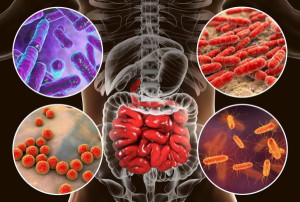
gut-brain-2-colin-austin-gbiota

The fake world

 In our fake world of manipulated promotions and famous celebrities we have been destroying the very microbes that make real soil and allow life to flourish.

This fake world may feel a lovely comfortable place to stay, but every eight seconds someone has a limb amputated from diabetes.



But if you are ready to move on from this fake world we can regenerate soil to grow real food to keep us healthy.

We can breed these beneficial microbes in waste food, organics and manure so they can regenerate real soil to make us healthy.

It is not so comfortable as the fake world, there are no famous celebrities whose job is just to be famous but if you can handle the thought of rotting fish heads and chicken manure then welcome to the real world - and you may just keep your leg or fight off Covid.

So let me start with the story of soil.
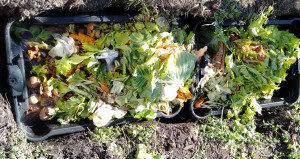


The story of soil

A long time ago (actually four billion years)

When the earth was first formed, some four billion years ago, is was just rocks which contained a broad spectrum of minerals.

 Microbes very slowly broke these rocks down forming soil but it was very slow as there was no energy to drive the system.

break down rocks


But eventually - after some three billion years there was enough soil produced for plant for plants to grow leading to the greatest innovation of all time - photosynthesis. The plants would take the energy from the sun to make sugars which they exuded from their roots which fed the soil microbes leading to an explosion in the growth of soil.

Rocks are insoluble so we can’t digest them but the soil biota break them down turning the minerals into soluble compounds animals, like us can digest.
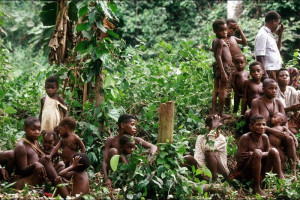


Food cravings

Animals appeared that ate the plants then other animals that ate the animals that ate the plants. Eventually our ancestors appeared which did both. They were a successful creature - we had abundant food for our bodies (I am going to call this gut food) but we needed energy food - sugars and fats - so we evolved to crave sugary fatty foods which was in short supply - but did not develop cravings for gut food, which was abundant.

Hello agriculture

 Then we developed agriculture which increased our supply of energy food but the soil was still young so there was plenty of microbes in the soil to continue to break down the rocks and release the minerals.

Agriculture led to cities with large populations where disease could readily spread and babies and young people died at an incredible rate - four out of five people would die before reaching adult hood. Those that survived lived a long life.

The prime cause of death was infectious diseases which killed the young.

They will tell you that the average age at death was 32 and that is technically true. It is just that so many people died really young it shifted the average - those that lived into adulthood had a long life. Very few people dies aged 32, That statistics for you.

Missing minerals

 We grew plants in this soil and over many years the minerals in the soil became depleted, but we learned we could use chemicals to fertilise the plants.

It worked and modern chemical industrial agriculture was borne. But diseases like diabetes, heart attacks and dementia increased.
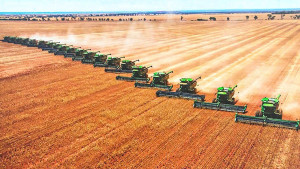
modern-farming-fertiliser-field-colin-ausitn-gbiota

Then after the second world war we developed synthetic fertilisers creating the chemical industrial agricultural revolution which increased agricultural output dramatically.

But it killed of the microbes in the soil so the rocks were no longer being broken down to release minerals. Farmers compensated by using chemical fertilisers containing the minerals to grow the plants.

But we need more minerals than plants do so we became deficient in certain minerals.

You are probably aware you are low in Magnesium because the majority of the population are low in Magnesium.

If you are a female you probably also realise that you could be low in iron.
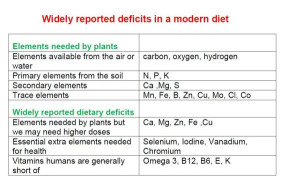


If you are male then you may not have caught up with the sniggering that if you are a sexually active male that one night of happy frolicking can deplete your zinc reserves. That is bad as zinc is important to our immune systems.

But the choice is not just between Covid or a happy night. By modifying your diet, you can ingest more zinc together with all the other minerals - magnesium, calcium, zinc, iron, copper, selenium, iodine, vanadium and chromium that are essential for health - all readily available from volcanic rock dust.

And no - you do not need you own private volcano - volcanic rock dust it readily available and it continuously being replaced - totally sustainable - as are the other key inputs - waste food and organics and manures.

But these shortage of minerals are something new - there used to be plenty of minerals in our food and we evolved with them over hundreds of thousands of years.

Food balance

 There is nothing wrong with eating energy food, even though sugars, fats and carbs are considered harmful. We need energy and could not survive without energy food. But we also need, in much smaller quantities, gut food - the mineral, vitamins and living biota which are essential for health.

It is a question of ratios. If we don’t eat enough gut food out gut brain senses the deficiency and send out signals for us to eat more. And if we just eat more energy food we will still not feel satisfied and will eat yet more which is the road to chronic diseases.
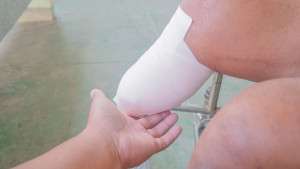
amputated-leg-colin-austin-gbiota

Our Gut Biota (they really matter)

Even more important - the microbes in the soil enter the plant which we eat and forms our gut brain which controlled our bodies. Out gut brain regulates our appetite, replaces our body parts as they wear and age and hosts our immune system.

Medical science is continuously improving and we have gained control over many infectious diseases. The main cause of death swapped from infectious disease to non infectious, or chronic, diseases like diabetes, heart attacks and dementia. (That just changed with Covid, hopefully only temporarily).

On balance our life span did not change that much but our health span reduced.
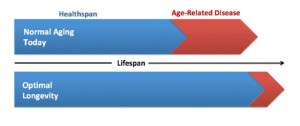
health-span-data-colin-austin-gbiota

Cussed Covid

 Then along came Cussed Covid and changed the rule book and we went back to the old pattern where infectious diseases killed more people that chronic or non infectious diseases.

Does that blow my argument that we should be eating food grown in mineral rich, biologically active soil? Well exactly the opposite. Doctors wanted to know why some people died of Covid while others seemed to dash around like normal even though they had Covid.

As expected they found that people who were fully vaccinated tended not to die. Lucky for them - they whole medical profession would have looked a bit of a dork if vaccination increase the risk of death. But they found two other factors - diet and stress.

Stress was expected - as it is well known that when stressed our bodies get flooded with cortisol which shuts down our immune system. Evolution had decided that if you were being chased by a hungry tiger looking for an easy meal - which is generally stressful - that it is better to shut down anything that is not needed and run that bit faster.

Diet also was a major factor, people eating a poor diet - high in sugars and fats - low in nutrients - were prone to dying from Covid.

That was also expected, we already knew that our Gut Biota is an important contributor to our immune system.

Whichever way we look at it - eating healthy food grown in healthy soil leads to a healthy gut leads which in turn leads to a healthy body.

Do I really have to spend half this article saying the bleeding obvious? Lets get down to the real issue - how to get real healthy food.

The three big challenges

OK we know what we have to do - sounds so simple - just persuade people to eat plants grown in nutrient rich, biologically active soil. How can that be difficult?

There are three problems

- to work out how to make the nutrient rich biologically active soil and make the plants readily available at an affordable price

- to show that it actually works

- to persuade people to change their diets.

Making nutrient rich biologically active soil

 This should not be a problem because that is exactly what has been happening in nature for thousands of years.
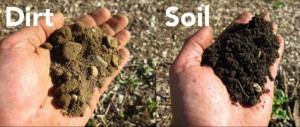


The snag is that it takes centuries to make soil naturally - it is a slow process and with our modern chemical agricultural system we are using it up much faster than it is being made.

But we do understand the process and with a bit of smarts and controlling the conditions we can make healthy soil much faster.

We need minerals - it is easy enough to get the minerals - there is plenty of volcanic rock (and it keeps on popping up) with a broad spectrum of the needed minerals.

But that is pretty useless as it is not soluble so we need the microbes to break down the rocks to form the complex soluble compounds we need.
forest-colin-austin-gbiota

We need the microbes to break down the rocks.

Microbes are particularly randy, making rabbits look like nuns - all we have to do is feed them and create the conditions for them to breed.

 Food waste is particularly good for breeding the microbes but virtually any waste organic material will work. To get the process to work fast we need nitrogen and we can readily get that from manure.

Getting a load of food waste, manure and rock dust is not exactly rocket science.

But there are thousands of different sorts of microbes and we just want the beneficial ones and to do that we have to control the conditions. We need the right moisture level - not too wet and not too dry, Goldilocks moisture and we must keep it moving so it does not become stagnant.

But this is what I do - in my younger days I was a pioneer of the computer simulation of fluid flow and if I am honest this is really pretty simple to do with the partial flood and drain and wicking system that is really at the centre of the Gbiota technology.

I and many growers have been using this for years - it works fine - so we can tick this problem of making soil and growing plants off the list of problems to solve.
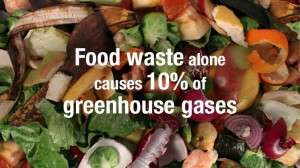
food-waste-colin-austin-gbiota

Proving it works

We live in the digital age which unfortunately has been hijacked - particularly by companies trying to convince people that their product - whether it is some health bar, packaged food or some bland looking pill is actually healthy - even though it is not.

Modern advertising is very effective, clever manipulation based on psychology - very effective but people are now getting very cynical and are looking for sound evidence.

The sort of question people will ask is

- how do I know that eating real food grown in real soil will actually make me have a longer health span (and live longer)?

- how do I know that this will stop them chopping my leg off as it turns black from diabetes?

- how do I know it will prevent me getting dementia or any of the classic chronic diseases.

- how do I know that it will reduce the risk of dying from Cussed Covid.

 People may be interested in general trends but they really want the answer to is how it affects them, and people are very different so it is virtually impossible to answer for single individual. Statistics and probabilities are just not convincing.

The question is ‘How will it work for me?’

It is next to impossible even to even show a statistical trend. Fancy trying to get volunteers for that gold standard double blind test with one group eating hamburgers the other group eating real plants, blasting Covid viruses up their noses and counting the number of dead bodies.

 But there is one very simple experiment we can do which gives information on a specific individual - and that is to monitor food cravings. Our gut brain is smart enough to send out food craving signals when it decides we are not getting the right sort of food.

That is the primary mechanism why people become overweight - their gut brain says I am not being fed properly with the right balance of energy to gut foods, so it says - go out and eat more and more - and if that more is yet more energy food - sugars and fats - then people get fat and sick.

Cravings Food | Gbiota | Colin Austin

Answering the ‘will it work for me’ question.

It is however straight forward to carry out a test to see how a particular individual will respond.

Our gut Biota has a short life so it only takes a couple of weeks to find out if the food cravings have disappeared. If this works for a particular individual it is obviously sensible for them to keep on eating that diet.

But food craving are a complex issue.

Much of our modern highly processed food contains flavouring which are addictive (don’t ask me to make a polite comment on the ethics of that).

The food industry spends a lot of big money on promotion and they do it very well using all the techniques of psychological advertising to convince us to buy their food.

Then unfortunately there are people like me (sorry to say) - I can look at the last piece of cheese cake and it will hypnotise me so I have no option but to put it out of its misery and into my tummy.

That is why I have a good swig of my green smoothie before putting myself under temptation.

This may not satisfy the most fastidious academic but it really boils down to a personal decision - do I want to reduce the risk of them chopping my leg off from diabetes and becoming decrepit in my older years or do I start eating real food now?

If the answer is yes we have to move onto mechanics of developing a ‘real’ food supply chain.

Changing the food system (or a bit of it anyway)

The key issue is that the beneficial biota and some of the phyto-nutrients in the plant will begin to deteriorate as soon as the plant is picked.

Fresh is a misused word - it has come to mean not gone rotten - we really need a new word which means still maintaining its original nutrients.

How about we use the word ‘living food’ meaning that the micro-biota in the food is still alive.

This is where the conventional food chain fails.

The conventional food chain having large farms supplying over long distances certainly aims to provide food that has not gone rotten - but simply cannot supply living food eg before the micro-biota and the nutrients degenerate - what I call gut food.

But it is very good at supplying energy food - sugars, fats, and carbs. We need lots of energy food, it is just fuel and it does not matter whether it is old or new - as long as it has not gone rotten.

Energy is by far the largest component of the food we need - at least 80% - probably more. The supply chain is already there and working fine - so why change it - at least for now? What we should focus on is gut food which may only be a small part of our diet but is absolutely critical.

It comes down to this ratio of gut food to energy food. It can be as simple as sprinkling freshly cut leaves onto a traditional meal. There is a whole area of technology on how plants can act as sugar blockers and slow down the absorption of sugars into the blood stream which leads to sugar spikes.

Just Google sugar blockers but there is a couple of slides below.

I should just emphasise the importance of eating a wide variety of plants. I use a mix of conventional vegetables like Broccoli but also add a range of herbs. This is important for health but it just makes the food taste so much better. Healthy food only works if people actually eat it.

This is something that local growers - either community growers or smaller commercial market gardeners supplying their local community can do very well.
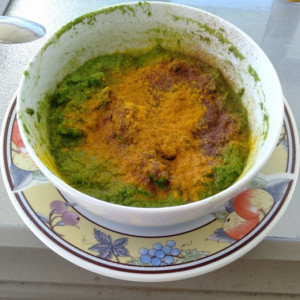
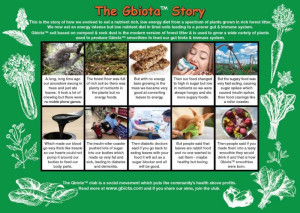
green-smoothie-colin-austin-gbiota

the-gbiota-story-stamp-colin-austin-gbiota


plants


 Local community food

 It is not rocket science - we just need healthy soil full of minerals and the soil biota which can break down the rock and form our gut brain which controls our bodies.

The biota in the soil and in our guts has a short life but breeds rapidly. Even within twenty four hours there is a significant drop in nutrition.

Modern chemical industrial farming is very effective at supplying us with energy food - sugars and fats. We have evolved to crave these but they are just not able to provide that nutrients and living biota we need for a healthy gut.


 This can really only be done by growing food locally in nutrient rich, biologically active soil so it can be eaten shortly after picking.

That is why we need a local community food system.

There are two parts to the Gbiota project - the first is the technology of breeding the beneficial biota in the soil the second is a social movement where growers and consumers cooperate together in a local community food system.

The most effective system is for a grower to recycle food waste, add manure and minerals and use the partial flood and drain system to give the Goldilocks moisture level to breed the beneficial biology to create the nutrient rich soil full of beneficial biota.

This soil can be used to grow plants or to load into Bioboxes for customer to grow their own plants.

They can start with just a bare box and take care of all the growing themselves, they can have a box with specific plants growing or they can have a box loaded with an array of companion plants to give a broad spectrum of plants and their biota which are grown as baby greens.

This is the most effective when coupled with the twin box system which makes everything so easy for both grower and consumer.

The twin box system

 A grower will supply two Bioboxes to a customer. The first is empty and will be filled with kitchen waste - the second is growing plants ready to be harvested.

After a period the boxes are swapped for new boxes with the grower using the kitchen waste to grow more soil and replace the box with growing plants with new plants ready for harvesting.

The grower and customer may enter into a long term relationship where the Bioboxes are swapped on a routine basis. This ensure the customer has a stable supply without having to worry about breaks in the supply chain while the grower has an assured demand and can plan and grow in confidence that the there is a demand for the work invested.

Action plan

You have got so far and maybe you have decided this all makes sense - but what to do next?

If you are a potential customer is it is simple - just go to gbiota.com click on community and register as a customer. The aim is to link you up with a local grower so it is important to give enough details of where you live to help this linking.

If you are a potential grower it is a bit more complex.

Probably the first thing is to contact me at colin@gbiota.com so we can set up a Skype or Zoom link and have a bit of a chat and got through the next steps - which are -

- register on gbiota.com/community as a grower

- go to gbiota.com/shop and register as a vendor and create you own home page - this, like everything in the wonderful world of computer, is pretty easy when you know how, but a mystery if you don’t - but we can talk you through so don’t throw the computer at the wall in frustration just yet.

As part of this process you will create your own icon on the geolocation map which will help potential customers find you and make contact

All this is free

- go to gbiota.com and register as a community grower. This is a subscription area which give you access to all our publications on how to grow gut food. Currently there is a grace period where you just pay $5 for 100 days, if things don’t work out as you expected then you can cancel at any time. After that you make a regular monthly payment of $10.

This entitles you to access to all the growing publication, support by either email or a video call (don’t be cautious about asking for help, we have all had to face the weird problems in going from instructions to the real world)

- create your gbiota bed, the in-ground gbiota bed, to start growing soil. You will need to access a sources of organic waste (often provided by your customer when you get going, manure and volcanic rock dust (if you are in Australia we have organised for the supply of Biomin from an Australian company, if you are overseas then you need to search for volcanic rock dust.)

- create you own local customer base. We can help in locating potential customers and you can use our web as a source of more contacts. We operate under the Creative Commons system (apart from the grower section) so you can copy, and circulate without asking for further permissions (just acknowledge source).

You may start with neighbours and friends but you may want to use social media and other promotions to expand your operation. (Note our current focus is on community growers eg for people who are doing this as a paying hobby with a strong focus on social benefit. If you operate a commercial business supplying food products as your primary source of income then you need to upgrade to becoming a commercial grower.)

- set you own prices, terms and conditions. This includes transport or collection of boxes. They are your customers and the deal is directly between you and your customers, our role is purely to provide information, technical support and web services.

- get going. We strongly recommend you use our subscription services where you enter into an ongoing relation with your customer. This benefits both customers, who get a secure supply chain at a good price, while the grower gets a regular and reliable business.

- have a party to celebrate becoming a successful gbiota grower.

Summary

The aim of the Gbiota team is to provide expertise on how to grow food that leads to good health.

The basic technology is straight forward - just add essential minerals to the soil, breed beneficial biota in organic matter and carefully control the moisture level by a system of partial flood, drain and wicking action, then grow selected plants. But there are two fundamental issues.

Taste and food cravings

The bulk of the food we eat is for energy - it is just fuel - largely sugars, fats and carbs. In our evolution we were short of energy food so we evolved to crave energy food. Today our modern food system provides us with ample energy food - but we still have the cravings for energy food.

But we also need a whole range of complex chemicals, minerals, vitamins, phytonutrients, micro-biota etc which are not burned as fuel but from part of our bodies we call these gut food. In the young soils in our evolution these were abundant so we did not develop a natural craving for these foods.

Given the choice of cheese cake or boiled Brussels Sprouts most people go for the cheese cake. But our gut brain detects the deficiencies and send out signals so we eat more - typically more sugary, fatty food.

This actually changes our gut biota, which makes us crave yet more sugary fatty food.

This is the core reason for lower health levels and the increase in non-infectious or chronic diseases like diabetes.

It is pointless just growing really healthy food if no one eats it so we have to make the food really tasty so people actually want to eat it. Variety is the key - I grow some 27 different varieties, both vegetables and herbs. When added to a conventional sugar fatty food it add both flavour and health benefits.

Fresh and living

Healthy food contains a mix of complex chemicals and living biota which happily breed away inside the plants. When the plants are picked they start to deteriorate, within twenty four hours of harvesting some critical components will have dropped to half.

Fresh has come to mean not gone rotten which is very different from eating ‘living’ food.

The conventional food system with mega farms and long distribution systems simply cannot deliver food before this deterioration has become significant.

This is fine for home growers but how do we make just harvested plants widely available to the non-gardeners?

This is the major challenge facing the Gbiota food movement. We need a system of setting up a local food systems where customer can pick and eat before the critical components deteriorate.

Become a Gbiota™ grower

This article aims to give an overview of the the gbiota technology and how the local food community system works.

It is not intended as an instruction manual.

This detailed technical information is available to registered Gbiota™ Growers who are expected to follow the guide lines to ensure that quality is preserved. Having assured quality benefits both customers and growers.

The Gbiota team role is to support the growers with technical and umbrella marketing services - we are not in the business of supplying Gbiota produce.

Getting started

The first question is do I want to be a grower or a customer.

If you want to be a customer - which means you just buy a box from a local grower which probably sit on a patio or by a window - all you have to do is find a local grower.

It needs to be local because the whole point of the Gbiota system is to enhance you gut biome which mean you must eat fresh.

But how do I find a local grower? What you really need to be doing is to set up a local group - nothing formal just a bunch of people talking to each other.

This is something you really have to do yourself but we have set up a social media site so you can make contact with similar minded people in your area. Just go to the Community on the menu and this will take you straight to the social media site (www.gbiota.club) where you can register.

This is a confidential site but you will need to fill in the areas which describe your location.

Hopefully this is self explanatory but if you have any problems then just contact me at colin@gbiota.com

I you just want ot be a home grower then all you need to is to sign up as a grower - you can go to account or you will be asked to register if you try and access any grower posts.

But the whole idea is to create a local community food system so we hope you will become a community or even a commercial grower.

You will need to tell other people that you are a a community grower so you should join the social media site by registering at the community on the menu.

As this is a social operation you may be happy just having people pop round to collect their vegetables of boxes but you can also use the shop facility which is the multi vendor site pickandeat.shop to become an internet trader.

Again I may suggest you get in contact with me first at colin@gbiota.com so I can guide you through the set up process.

Please note that Gbiota is a registered trade mark which you are automatically entitled to use by registering as a grower.

If you would prefer to chat (yes I am a real person) and I will try and sort out any problems by email but if I can’t solve your problem straight away we can end up on a Zoom or Skype call.


Download as .pdf

communityfood31aug22

Loading

How Gbiota beds work

How Gbiota beds work

Partial Flood and Drain in Gbiota Beds

Gbiota beds and Gbiota boxes are based on wicking-bed principles but are specifically designed to breed beneficial soil biology and support gut-healthy food. Conventional wicking beds are often used as self-watering pots. Many have a base filled with inert material such as stones. The water in this lower reservoir is intended to stay relatively clean and can stand for long periods without going putrid, as long as it remains inert. Gbiota beds are different. They are filled with organic material that feeds beneficial microbes and soil creatures. This biology-rich zone must not stay saturated for long periods, or it will favour harmful microbes and lead to anaerobic, smelly conditions. In Gbiota boxes, drainage is controlled by a swivel tube at the very base. This allows the water to be fully drained after irrigation so the bed can return to a moist but aerated state. The goal is to keep the soil at what we call Goldilocks moisture – not too wet and not too dry. In Gbiota beds this Goldilocks moisture is achieved using a leaky dam. The dam holds water back just long enough for it to wick evenly through the bed before the excess drains away. In newer soaker beds, the design uses zones where water can spread and wick into special areas, again followed by drainage. This cycle of partial flooding and draining is critical. During the flood phase, stale air and gases (such as ethylene from decomposition) are pushed out of the soil. As the water drains away, fresh air is drawn in, giving the soil biology the oxygen it needs to thrive.

Hydraulic Flow – Spreading Water Evenly

To spread water along the length of a bed we rely on hydraulic flow. The base of the bed must include a layer that is largely impervious to water so it can build up and move sideways. This base can be created by:
  • A plastic liner or membrane
  • A natural clay layer
  • A compacted soil layer
Most Gbiota beds are long, so we use an Ag pipe (or similar perforated pipe) along the base to move water quickly along the bed. Water then flows a shorter distance sideways through the soil to irrigate the full width. ag-pipe-colin-austin-gbiota Traditionally the Ag pipe was bent up to the surface to act as a fill point. In newer designs we often add a larger vertical fill/inspection pipe so you can see the water level when filling manually. The lowest layer around the pipe is a coarse, porous zone that helps distribute water. This can be made from:
  • Wood chips or shredded branches (a micro hugelkultur layer)
  • Vermicast or coarse compost
  • Channels made and maintained by worms and other soil creatures
We do not want to saturate the full depth of the bed for long periods. Excess water should either drain away via an outlet or be monitored through the fill pipe so you can stop filling at the right level. The water needs to stay in the base long enough to wick upwards to the root zone (often several hours), but not long enough to become stagnant and encourage harmful biology.

Food for Soil Biology and People

To breed soil biology we must feed the bugs as well as the plants. A new Gbiota bed is usually built in layers:
  • Bottom layer – porous base: Coarse material such as wood chips, shredded branches or coarse vermicast to create air-filled pores and water pathways.
  • Middle layer – organic waste: Food scraps and green organic waste that break down to feed microbes, worms and other soil life.
  • Manure layer: Animal manures (e.g. from chickens) to add nitrogen and accelerate decomposition.
  • Top layer – growing media: Finished compost and good-quality soil for seed germination and root growth.
In practice this structure is only temporary. Once the bed is operating, worms and other creatures quickly mix everything into a biologically active, crumbly soil—essentially vermicast-rich topsoil with a strong microbial population. As crops grow, you will need to re-feed the bed from time to time with new organic materials, manures and minerals. The exact timing and quantity depend on the type of bed, climate and crops, but the principle is the same: keep the biology well fed so it can keep feeding you.

Loading

Food and the gut biome

Food and the gut biome

About food


Before describing how Gbiota beds work I need to have a bit of a preamble about food..

Energy food

The bulk of the food we eat is just burned for energy. We are really just a walking talking thermodynamic machine just like any other thermodynamic machine from a steam engine to a rocket ship.

We are also a warm blooded creature so we need fuel just to keep us warm. It has been estimated that 80% of the food we eat is simply burned as fuel.

It is dead simple - we just burn carbon and hydrogen to give of carbon dioxide, water and lots of energy. It really does not matter what the food is, sugar, carbohydrates, fats or whatever - it is just energy.

woman-and-fast-food-colin-austin-gbiota


Body building food

But unlike a steam engine we are continuously replacing our body bits from birth until death. Some bit we replace very quickly, like hair - other bits like teeth we do not change much throughout our life.

When people say I am not the man I used to be they are right, every three months or so on average I have a new body.

The chemistry is complex but bio-chemist with their sophisticated tools like mass spectrometers have it pretty well sorted out.

children-smiling-in-garden-colin-austin-gbiota

They can tell us what chemicals our bodies needs and what foods we should eat - easy enough to look them up to see the range of common and trace minerals we need from simple calcium, through magnesium and zinc etc to the trace minerals like selenium.

But we don’t just need the mineral which is generally insoluble - we need a very specific compound containing that mineral. That specific compound may be produced in our gut or it may be produced in the soil by the microbes or fungi.

That is the second type of food and while it does not seem to have been rigorously investigated we can guess that some 15% of the food we eat is just for replacement.

trace-minerals-table-colin-austin-gbiota

 Gut and Brain food

Now comes the difficult bit, our bodies have a built in control system - it is a combination of our two brains - one in our head and the other in our gut. We can’t separate them as they work so closely together.

And whatever people may like to tell you we have no idea how this control system actually works.

We do know that in our gut and head brain there are trillions of cells which communicate with each other to provide intelligence and take decisions. It is like having a super computer inside out bodies continuously taking decisions.

We run up a flight of stairs and begin to pant and puff and our heart rate starts to increase, we feel tired and our muscles seem to not want to work.

That is all decided by our intelligent control system and we know a bit about this by studying the chemical and electrical signals racing around our bodies.

But we have really no idea how the code that drives this control system actually works.

gut-brain-2-colin-austin-gbiota

It is a bit like having a mobile phone. I am not good at mobile phones but I have flotilla of grand daughters who - with a great deal of eye rolling and muttering about stupid oldies - will show me how to use them. They do this because they understand that while oldies may appear to be stupid they can actually be useful acting as free Uber drivers, driving instructors or later as lenders of cars to go to their parties.

So with a bit of a struggle I can actually use my phone - but I still have no idea of the code that is driving the phone.

colin-with-grandkids-colin-austin-gbiota

And I probably never will - it is the nature of code. You see at one time my day job was writing complex computer code to solve coupled simultaneous equations to solve engineering problems, particularly fluid flow which was my speciality. I knew the basic mathematics - that has been known since the days of Newton and Fourier but I did not know how to solve these non-linear coupled partial differential equations directly.

So I had to use a method then called predictor corrector, then the name changed to self learning then artificial intelligence or pattern recognition. But whatever flash term is the fashion of the day it is still basically organised trial and error.

moldflow-colin-austin-gbiota


You make a guess for the answer and put that into the equations and get an error. Based on that error you make another guess and with a bit of luck the error is smaller so you make a third guess. As you do this you build up a picture of how they work so can make better and better guesses until you have a solution which is good enough.

So you write up the code and the calculations are so complex that you have absolutely no idea how it is going to work. So you test and re-code until you get it to work and then you may have something that is useful.

That is what it is like with a mobile phone.

But our brains are a level of complexity higher. With a computer the chips are standardises and you know how they should work. Our gut brain is another story - there are not just trillions of cells but there are thousands of different sorts of cells which work in different ways.

But - and this is the crunch line - they keep on changing with what we eat and so will give different answers.

At least with a mobile phone I can plug it into any charger and it will work the same. Now imagine if the food that the mobile phone lives on - electricity - varied from day to day and charger to charger.

One day you could take a selfie and you would look like a beautiful princess - the next day you recharge your phone on a different charger and take a similar selfie and you look like a frog.

That is what we face with when we think about food to feed our gut brain. We change our food, our gut biota changes and thinks in a different way - one day we have food cravings and want to eat all the time - then we change our diet and change our gut biome and feel full and can’t stand to eat another thing.

Observations of real experiments show this is what happens but how can we expect to understand why it is happening.


But we know this is what happens by experiments of fat and skinny mice. If we change their gut biota (by the simple process of pooh swapping) we can make a fat mouse skinny and a skinny mouse fat.

We can do the same with humans by a more refined process of faecal transplanting.

fat-and-skinny-mice-colin-austin-gbiota

Good and bad bugs - ecological balance

It is just a fact of life that are beneficial and harmful microbes or more directly good and bad bugs. Throughout human history we have face the dangers of bad bugs with the bulk of the people dying from some infectious disease before they reached maturity.

But some eighty years ago we began to develop the technology of killing off the bad bugs, with antibiotics and toxic chemicals and our food system became relatively inert - free from any bugs (good or bad). This seemed to work and we dramatically reduced the death rate from infectious diseases and the population exploded - trebling in less that my life span.

But we learned the hard way that when we killed off the good bugs that we fell prey to chronic or non infectious diseases.

Learning how to breed the good bugs while controlling the bad bags is the great technical challenge we face.

The solution can be termed ecological balance.


Douglas Adams wrote : "The answer to the ultimate question of life, the universe and everything is 42.

This may be very profound but it still does not answer one question. Over some million years we have developed a brain - an intelligent control system which decides what and how much we should eat.

Then humans - with all their wisdom developed a food system which destroyed this brain - this wonder of nature - with a crappy food system and substituted it with a complex system of weird and wonderful diets - often requiring us to measure out every calorie and micro gram of each ingredient that we eat which has left us fatter and sicker than ever.

It is a great pity Douglas died before he could explain this mystery to us all.

Gbiota food

Gbiota food is really about growing food to feed our brain. To do that we have to feed the microbes that already are living in our gut - that’s a pre-biotic.

But we also have to breed new microbes in the soil, which will go into the plants that we will eat and hence from part of our gut brain - that’s a pro-biotic.

To breed these microbes we have to feed and water them - for that we need the food that the microbes want to eat and that will include many of the minerals that we need as well.

Now the snag is that there are good bugs which will make us strong and healthy and bad bugs which at best just want to use as a comfy home to breed in - but unfortunately they often get it wrong and kill us.

To breed the good bugs - without the bad bugs taking over - we have to manage the conditions, which means food and water.

Food is the easy bit of that battle - water is the difficult bit. Bugs just don’t breed well without any water. The good bugs like it moist but not too wet (aerobic) while the bad bugs breed when it is wetter (anaerobic).

We need that magic Goldilocks moisture level.

I need to talk about that most mysterious substances we take for granted - water.


Loading