July 24, 2025
Your guide to Gbiota boxes
8th June 2026
This guide shows you how to set up and manage gbiota boxes or beds.
It is a lot easier to understand from a video. Here are some suggested videos to watch
Summary
This guide shows you how to set up and manage gbiota boxes or beds.
It is a lot easier to understand from a video. Here are some suggested videos to watch
Summary
Mechanically, it is very simple.
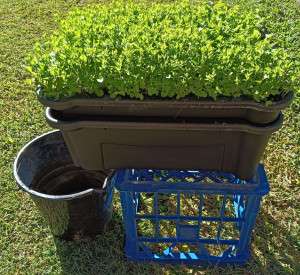
Choose a box that suits you. I recommend one light enough to lift (no more than 50 litres), but you can use a much larger box; however, you won’t be able to lift it, so you need to be able to drain it.
Fit a swivel tube into the base, and then slide a mole pole through the swivel tube.
A box has three layers: the bottom layer is the sponge layer for holding water, which wicks up, the middle layer is the Rhizosphere or root layer; and the top layer is the germination layer with a light soil.
Fill the base with organic waste to a depth of at least half the box depth, but no more than 50mm from the top of the box. Grass clippings, straw or sugar cane mulch are good for the base, followed by kitchen or other scraps.
Spread a module on Wickimix. A standard module is 5 litres and can fill 0.15 square metres (the size of a typical gbiota box).
Add a further 10cm of soil or potting mix.
Thoroughly wet out with the swivel tube in the up position.
Sprinkle seeds on the wetted surface.
Cover with a final layer of potting mix of vermiculite.
When the seeds have germinated, typically after a week, drain the box by turning the swivel tube down and catch the liquid in a suitable container.
When fully drained (that takes a day), turn the swivel tube up.
Put this liquid into a watering can (about 10 litres) and fill it up to the top with water.
Gently pour this onto the soil, taking care not to harm the seedlings.
Let the liquid soak into the soil for at least a day, but preferably no more than two or three days. Rotate the swivel tube down to drain (If it smells or there is no drainage, then that is too long).
Leave the swivel tube in the down position for several more days. Typically, a full cycle takes a week, but in extreme heat or if the plants look stressed, then irrigate more frequently.
If possible, grow plants that can be tipped, e.g., just the tips harvested and the plants regrow.
When they get old and tough, top up the box reseed.
Initially, the surface will have dropped, so add a new layer of organic waste and a germination layer.
After a period, the level will have stopped dropping. Dig a hole to the bottom of the box, extract soil from the base to use on the new top layer, and refill with fresh organic waste (e.g., bury the new waste).
Gut health is the aim; nearly free food is a bonus.
Gbiota is about enhancing gut health.
The people with the healthiest gut microbiome on Earth are the Hadza tribe, who have lived in Tanzania for at least 50,000 years on a hunter-gatherer diet. Until modern-day scientists discovered their remarkable guts, the Hadza had no idea whatsoever about gut health.
In the last twenty years, gut health has been at the centre of modern scientific research, and who has the worst gut health on record? Modern man.
There is a story to tell there, but not now. I just thought you ought to know that the Hadza tribe’s gut health has had a big influence on my thinking in developing the Gbiota system.
For the last 200,000 years, some communities have enjoyed long and excellent gut and general health, while others have suffered from infectious diseases and died young.
More recently, we have largely overcome infectious diseases and are now faced with non-infectious or chronic diseases.
Food matters
This is clearly due to the food they ate, so surely we can benefit greatly by studying what these various groups have been eating over the ages.
Now, modern medical science is fully aware of the benefits of a healthy gut, but it falls short in telling us how to achieve one.
And there is a good, simple reason for that: microbes have a very short life, typically a half-life of about a day.
The microbes we have in our gut today may (or may not) be the same species as we have tomorrow or the day after, but they are not the same microbes; they are the daughters and granddaughters of today’s microbes.
This means that we cannot make a one-off change in our gut biota; we have to continuously breed new microbes, and we have to do this for the entire global population.
Introducing Mary
Tell Mary Jones, the single mum with three kids and two jobs, that she has to start breeding her own microbes, and expect an immediate and angry response.
“Don’t you think I have enough on my plate already?”
What Mary, and most people, do not realise is that they are already breeding their own microbes. Microbes are a randy lot, and on the job within twenty minutes of being created, and at it until they die, probably tomorrow morning.
The question is: are they going to be the beneficial microbes that lead to a long and healthy life, or are they going to be the harmful microbes that make us fat, sick, and die young?
The question is not whether we breed our gut microbes; we already do. It is a question of whether we are breeding microbes that are goodies or badies.
That is what Gbiota is all about: how to breed goodies and not badies.
Feed the microbes
So the very first thing I want you to know is that microbes have to be fed; they eat almost anything and everything, including organic waste, so the very first thing I want you to do is start collecting organic waste. They are not fussy creatures and will happily eat anything you can give them.
You may think that in an ideal world, you would compost the waste first. That is not true; composting is a wasteful process that releases large amounts of carbon dioxide and other gases into the atmosphere, harming both us and the atmosphere.
On the other hand, totally raw organic waste can include growth inhibitors. Plants are like humans, not necessarily friendly creatures, and their trick is to expel these growth inhibitors from their roots to keep other non-friendly plants away.
Scientists have a nice name for this labile compost. They wanted to call it nubile compost, but that had too much implication of young girls.
So, if it is possible to pre-treat your waste, take the opportunity. The best way is to have a worm, or, even better, a soldier fly larvae box, or, at the extreme, a complete spectrum of nature’s recyclers.
Not Batman, Wickimix
That is what I do with Wickimix, so if you fancy buying a box of Wickimix and using that bin as a pre-processor, it is a pretty good idea. But if you can’t for any reason, just put the fresh organic waste in a production box and let Biomin do its thing.
Selecting the boxes
You can use any box you like. There are only two considerations: depth and weight. You can grow most plants with a depth of 250mm, but you can get away with a shallower box on some crops.
The next thing is weight. I like to keep the size of my boxes down to about 50litres. I can lift them when full. Bigger boxes get a bit too heavy for me, so I have to ask my granddaughters to help, and I put up with a lot of eye-rolling and muttering, and the ultimate threat of not helping me with my mobile phone.
You can buy boxes from us if you want, but we are really not in the business of selling boxes; our business is selling microbes. Your choice.
Swivel tubes
Microbes need water and air. If they don’t have fresh air and become anaerobic, the harmful microbes will prevail. An essential feature of the Gbiota process is to create the right balance of air and water so the goodies win and the badies lose, as used to occur in the last scene of classic films.
We do that through a process we call flood and flush: we flood the soil to expel the stale air, then drain it so fresh air is sucked in. We are making the soil breathe.
We also catch the liquid that drains out, which is rich in nutrients and beneficial microbes. We call this soil ‘blood’ because it serves the same function as our blood.
If you are not convinced of the benefit of breathing and circulating blood, I suggest you run a little experiment without. It will only be a very short experiment with a climactic finish.
Flood and flush
We do this with the swivel tube, we turn the swivel tube up and flood (or at least the lower layer of the box), then after a period (typically at least a day) we rotate the swivel tube to down and allow the soil blood to drain out, which we catch to recirculate, and so suck in fresh air into the soil.
Such a simple device for so much benefit.
You can buy the parts from most irrigation stores, but if you live in a city, it can be difficult to find a decent agricultural irrigation store, so we sell all the bits you need.
All you have to do is drill the hole for the rubber grommet (17mm). This needs to be a clean hole, and it is better to wobble the drill a little bit so it cuts the very last bit cleanly. Finish with a rat-tail file or sharp knife.
I recommend you glue the grommet and fitting in place so they do not rotate. If the rubber grommet rotates, it will eventually leak, and you will have to empty the box and glue it in place.
Job done. You can fit a piece of ag pipe to drain into the swivel connection or use a Compost Tube. I will go through the pros and cons later, but they are just a luxury add-on.
Mole sticks or ag pipes?
I find a mole stick the best (I call them moliepolies, but that is just me being silly).
Poke the mole sick through the swivel tube fitting and load the base of the box with organic waste. I prefer to lay a layer of grass clippings, as it provides better flow over the base.
Next is the layer of organic waste, probably largely kitchen waste; tree prunings are fine, but they take a long time to decompose, and the aim is to feed the microbes.
Fill to between half full and nearly 50mm from the top. The level will drop as the organic matter decomposes, but this is good as it means you an easily add new layers for new organic waste.
You need some freeboard at the top so you can flood without the water overflowing the box.
Then load the Wickimix onto the organic waste. The standard Wickmix kit is only about 5 litres, which is not enough to fill the box, so top up with a good-quality soil if you have some, or, if not, with regular potting mix.
Potting mix
Potting mix varies in quality depending on the amount of fertiliser added. Wickimix contains minerals, particularly trace minerals that are generally missing, and the organic waste will contain significant N, P, and K, so buy cheap.
Fill the box to near the top, but leave a rim around the top so the box does not overflow when you water.
Wetting up the box
I recommend you saturate the box now. Set the swivel tube to up and pour water onto the top. You will find that the soil level will drop, and you can give it a few pushes to settle.
It may look as though it has dropped too much, but don’t worry, there is still plenty of room for the roots.
Seeding
You can now seed. (I have a separate article on what to grow).
Everyone seems to have their own views on how to seed. Larger seeds I tend to sprinkle on the surface, smaller seeds I prefer to mix with soil and spread the mix. I find that gives me a better distribution, but there again, I always seem to be in a hurry.
I sometimes use Wickimix as the seed cover, but Wickimix is expensive and potting mix is cheap and does the job.
I have also used a thin layer of grass clippings, which is not ideal, but is free; probably best of all is vermiculite. It is so light you can pour it on thick, and the seedling will grow through, and it holds a lot of water to help the seeds germinate.
Rotate the swivel tube up and gently flood the box. If you are too happy-go-lucky with a big bucket, you will end up with all the seeds at one end.
I may leave the swivel tube in the up position while the seeds are germinating. It helps keep them moist, and it should only be a week, and the water won’t go putrid in that time.
The great debate – trowel or compost tube
I have used the compost tube method for many years, but now I am beginning to change my mind.
The reason is more social than technical.
I have been twittering on about gbiota boxes for many years now and have a following of dedicated gardeners who, if I am honest, just enjoy messing about in the garden and exploring new ways.
But are these dedicated gardeners the people we need to focus on? A keen gardener is almost certainly already enjoying a healthy diet with produce straight from the garden.
Here’s Mary again
Now take Mary, my hypothetical single mum with three kids and two jobs. She is soon to join that half of the population that is suffering from some form of chronic disease.
She races through the supermarket on the way home from her second job, tossing what looks like a good meal tonight for her and the kids. She will rip off the multiple layers of plastic, put the highly processed food in the microwave for five minutes, and they will be sitting down for dinner.
There is little to feed their gut microbes, which produce the hormones to say stop eating, so Mary and her kids will be putting on the fat. Shortly, Mary will be tested for diabetes, but worse, her kids are being set up for a lifetime of chronic disease.
What they forgot – ease of use
I see it as my role in life to prevent that from happening, and that means making Gbiota as easy to use as possible.
Growing food at home may seem much more complex than buying food from the Supermarket. But is it really? For most of my 86 years, I have been growing some food (not all, just the ones that really matter) at home. It is not more complex, just walk down the garden, see what is ready to eat, pick, go back to the kitchen and bingo, dinner.
This is the simplest way I have devised to manage Gbiota boxes.
Have a box set aside to collect the kitchen waste. If you feel up to it, drop a few worms to start the recycling process. They are good pets; they don’t yap at visitors or need to be taken for a walk on a freezing-cold night.
When enough scraps have been collected, out with the trowel.
The trowel method
With the trowel, you dig a neat, small hole to the base of the box, use the what should now be well decomposed organic waste, which will look like real soil as a mulch around the existing plants, saving a bit as topping for your hole, then load the hole with the virgin waste and cover with the saved soil.
Next time you water, you can use the hole to direct the water to the base of the bed. You can also have fun with your mole stick to refresh the channel in the base of the bed and make a series of vertical holes throughout the bed.
If you completely destroy the soil’s structure, it will take ages to recover; if you only disturb a small area, it will quickly recover.
If you cut your finger with a knife, it will soon recover; if you pierce it through your heart, it will never recover.
The compost tube
The compost tube is, in theory, better, but I am not convinced it is in practise.
You dig a fresh hole in the soil, then push the compost tube into the hole. The compost tube is just a piece of pipe with the base cut at 45º to provide clear access at the base.
You can load fresh organic waste into the tube.
You may need to use the mole stick to make a hole in the organic waste.
You can use a hose to flush any rotted waste from the tube into the base of the bed.
You can move the compost tube to a new spot, but what seems to put people off is that they need to put their hand down the tube to push out the organic waste, which will almost certainly stick there.
Now, for me, that is part of the fun of growing, but there is no way I can persuade my granddaughters to put their hands down a tube filled with rotting organic waste, worms and soldier fly maggots.
But it does have advantages. The water goes straight to the sponge layer at the base of the bed. You can use the compost tube as an immediate bin for your daily scraps. Flushing pushes much of the waste straight to the base of the bed, where it is needed.
It is really a question of which you prefer. All I can say is that after many years using compost tubes, I have converted to the crude process of digging that little hole and loading in the half-processed (thank you worms) food waste.
On the other hand, I am getting old, grumpy, and fed up with everything I buy or do being so full of options and features that I have to spend hours learning how.
Watering
Now comes the critical bit, knowing when to flood and flush.
I wish I could give you some hard and fast rules, but I can’t – it all depends on temperature, how much water the plants are using, the nutrient concentration, etc.
But what I can tell you is to use your nose. If it has the nice sweet smell of good compost, then you are doing it right. If it has the horrid, acidic, putrid smell of foul compost, then you have problems.
But do not despair. I have filled it to the maximum water level, been away on trips and come back, and it smells really bad. But I have given it several flush-throughs, and it has recovered just fine.
Quick tips
But I have a couple of guides. You rotate the swivel tube up, and if, like me, you are pushed for time, then leave the swivel tube in the up position as long as you think is reasonable, that could be a full week in winter and only a day in mid-summer.
Rotate the swivel down. If water (or more correctly, soil blood) flows out without smell, then you have done it right. If no water comes out, or it comes out with that horrible pong, then next time make it shorter.
If in doubt, drain. Swivel early rather than late.
It is exactly the opposite when it comes to when to irrigate next. You really want the water level to drop to zero before you irrigate again. That way, all the soil is exposed to fresh air.
Even when there is no liquid water, a significant amount of water is held in the soil and sponge layers, so the plants are unlikely to go into stress. But even if they do, they will have revived by the next morning after watering with no harm done.
Please water me
Plants are very adaptable; they droop their leaves, saying, “Please water me,” and as soon as they get water, they spring back to life with no damage.
So the rules are:- turn the swivel to drain too early rather than too late, turn the swivel to flood and irrigate too late rather than too early.
Because my life is a bit of a buzz, I typically irrigate on Sundays and drain on Wednesday, and that works most of the time.
If we have an exception hot period, I will fit in an extra irrigation, but if it rains, I will still irrigate on schedule and find a way to store the excess soil blood, which is a valuable entity, full of nutrients and beneficial microbes.
Dropping soil levels
You may feel a bit of panic as you see your soil levels dropping. Well don’t, that is because the microbes are eating the organic waste, which is exactly what they are supposed to do.
So you have to top up, but here is the snag – you want to put the fresh organic waste at the bottom of the box.
If the drop is really serious, as typically happens with a new box, you can load a fresh load of organic waste, then top with Wickimix as though you were starting from scratch. That is normal with a totally new box, but after a few iterations, the level stabilises, and you want a way to add extra organic waste to the bottom layers without disturbing the soil structure.
That is important, the creatures of the soil, the worms, larvae, beetles, etc., have been busy making a good soil structure with plenty of channels through the soil for the roots to grow in and establishing a fungal network for the transfer of nutrients through the soil, so please resist the temptation to dump all the soil and start from scratch.
Instead, you have two options: the trowel or the compost tube.
The next article is on what to grow. But here are a few quick tips.
I am great fan of linseed. It provide omega-3 which is beneficial for cholesterol and the heart but apart from the health benefits it is a touch little plant that you can cut the tips off to make a smoothie and it will keep on growing back.
Gbiota may be all about health but making life easy is equally important
Alfalfa is another great plant which give more organic bulk than Linseed and also captures nitrogen from the air.
We can’t get past Broccoli which many people consider the king on health plants. It is easy to grow but the catapillers have also read this article so attack with force.
We don’t use toxic sprays which kill of the microbes but a good soaking with soapy water sorts them out.
Then we need some bulk greens. Bok Choi and Wombok are great as are Spinnage, Kale and Swiss Chard. I am a particular fan of Swiss Chard as it is a tough little plant that fights of the insects and can regrows well after tipping providing continuous leafy vegetables with minimal effort.
We also want salad vegetables, lettuce, radish and tomatoes. They grew well in Gbiota boxes but the soil can be so rich that radishes don’t swell.
Root crops grow well in Gbiota boxes but take a fair bit of time. I am fond of beetroot but potatoes take up so much space they are best grown in Gbiota garden beds.
Berries grow well in gbiota boxes and you can adjust the Ph in each bod to suit their specific needs, for example blueberries need a slightly alkaline soil.
I am a great fan of blackberries which grow wild, useful when I lived in Victoria but in Queensland where I now live they are classified as a toxic weed. You can still grow them but only specific varieties which are not that easy to locate.