
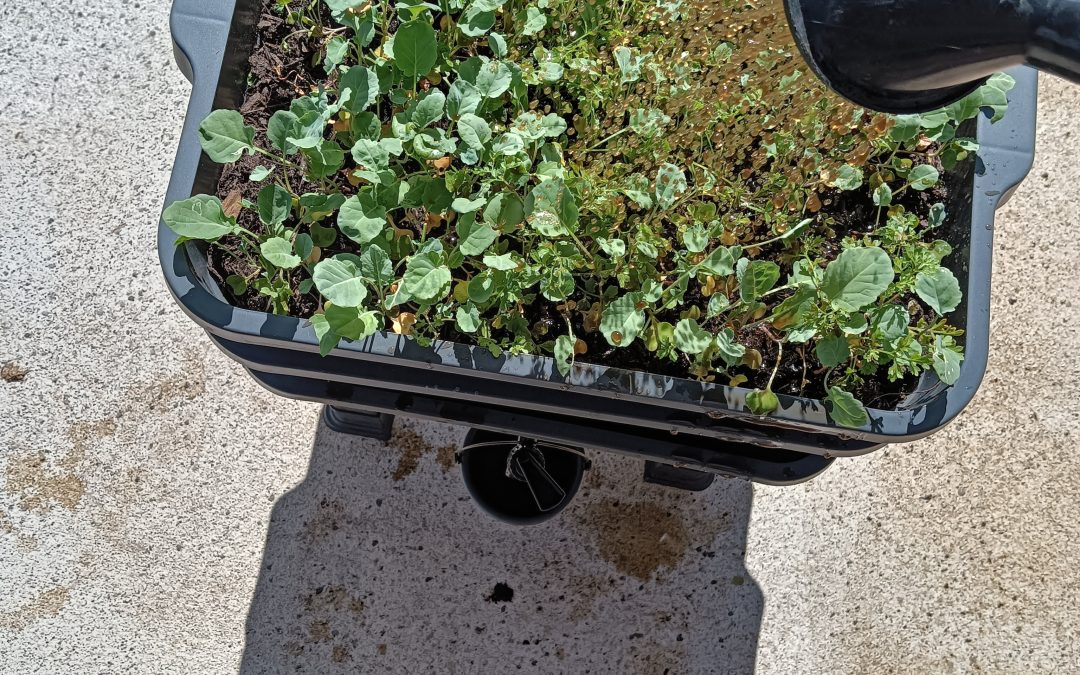
Water Well
How to water is a key part of the Gbiota technology. We can learn a lot by studying how natural ecosystems work, then figure out how to apply that knowledge in the modern world.
How rain is formed
Let’s start with rain. It may seem simple: water evaporates from the oceans, rivers and lakes, condenses in the clouds and falls back to Earth.
But it is not that simple. Water vapour needs minute particles to condense; in a totally pure environment, water will stay as vapour until the temperature is well below its normal freezing point.
But the air is never pure. Humans are very good at pollution, but nature does its bit with pollens and aromas evolved to attract insects, but also very good at seeding rain.
Much of the rain in heavily treed areas comes from plants evaporating water from their leaves.
But the key point is that rain typically contains an assortment of nutrients which land on the leaves and help the plants to flourish.
In a thunderstorm, the rain may also contain useful amounts of nitrogen.
The lesson is that plants naturally absorb nutrients through their leaves.
Preparing the flood
Even my model user, Mary, the single mum with three kids and two jobs, can
imitate this natural process with her watering can and rose.
She regularly waters her Gbiota worm boxes with fresh water and collects the runoff. As she lets the water flow through the box, it may be dilute enough, but if it is dark, she may need to dilute it; now she has what she needs: dilute soil blood, Goldilocks soil blood, not too strong and not too weak.
She measures out enough soil blood to wet out a daughter box so it reaches the drain hole with some to spare. The amount is found by experiment over time but is typically about 10% of the total volume of the daughter box.
She sprinkles this onto the box, and now comes the interesting bit.
Water moving through the soil
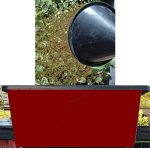 She sprinkles the water onto the box at a much faster rate than it can drain away, forming a saturated band of soil.
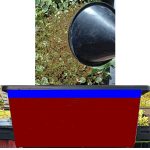 This forms a saturated band of soil with the flow front gradually moving down the box.
 Water drains away from the bottom of the band, but soil is never uniform, so it drains down through crevices, and the lower layers never become fully saturated, leaving areas where the soil is not fully wetted.
 After she finishes sprinkling the soil, water in this band drains down to lower levels and gradually shrinks as the soil absorbs it, but she has applied enough water to reach the bottom of the box.
 But she has adjusted the leaky plug or swivel tube so water accumulates in a saturated layer at the bottom of the box.
 Water will wick up from this layer, wetting the soil that the initial burst of water failed to wet.
It will not be saturated, but it will be at the maximum amount of water the soil can hold, normally called field capacity.
Plant roots extract water from the soil, pulling it up by the tensile strength of water as it evaporates under the sun.
But at night, there is no force pulling the water up, so it will flow back into the roots, not necessarily where it started, smoothing out the water distribution in the soil.
But the bottom of the box may still be saturated, with no air, which can lead to harmful microbes breeding.
Breathing soil
To prevent the soil from being saturated for any length of time, it must be drained.
You can do this manually with the swivel tube or automatically with the leaky plug.
Because the leaky plug is automatic, the bottom of the box is less likely to become saturated, but make sure the plug is leaky and not rammed in so hard that water can’t drain out. It should drip steadily, not flow continuously, so it takes time for the box to drain.
If you’re unsure whether the box has a saturated layer of water, pull out the plug and see if any water drains out.
In Queensland, where I live, we still get what’s labelled a once-in-a-hundred-year rainstorm, but they now seem to occur twice a year.
These can easily saturate the entire box, in which case you need to pull out the plug or twist the swivel tube to get maximum drainage.
