
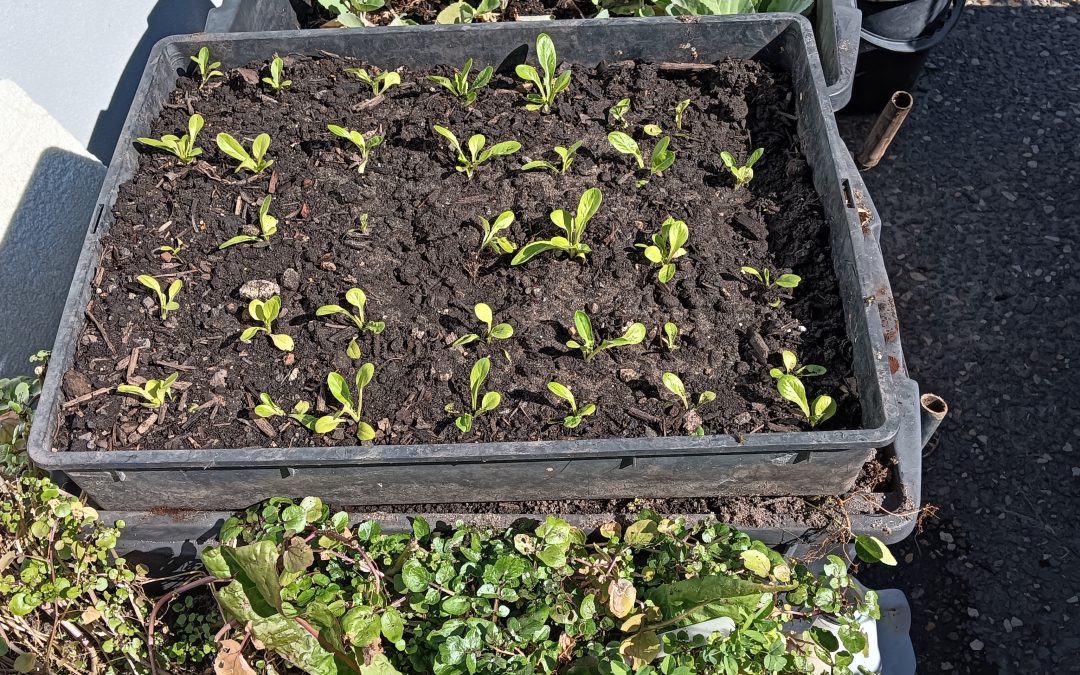
Daughter beds
In my previous articles, I have talked about how we use soil blood to supply nutrients and microbes for the next irrigation.
But if you don’t want your plants to suddenly die, there is an important fact I need to explain.
Plants take up water, nutrients, and microbes from the soil by osmosis, when the stronger solution absorbs fluid from the weaker one.
Normally, the solution in the plant root is stronger than in the soil, so the flow is into the plant, and all is well.
But the soil blood coming from the Gbiota boxes, with an abundance of reprocessed food waste can be very strong, as we can see by a very dark, almost black colour.
If this soil blood is used directly for the next irrigation, it can be so strong that we get what is called reverse osmosis, where water is sucked out of the roots of the plants, and they die.
This can be very dramatic; one day the plants are growing vigorously in nutrient-rich soil, and the next morning they are all dead.
This may seem a major disadvantage, but we can turn it into a major advantage by creating a system of daughter boxes.
These can be very simple, virtually any convenient, inexpensive box.
I spend my life experimenting with Gbiota boxes, so it is a dynamic situation, but I will describe my current technique.
I drill a hole, about 20mm diameter in the side of the box near the bottom.
I fill about one-third of the box with organic waste to act as the sponge layer. I fill the rest of the box with soil that has been well-aggregated so it stays porous.
If necessary, eg the soil is too dense, I will mix vermiculite in with the soil.
I partially block the hole with a piece of cloth, not too tight so it blocks the hole so it cannot drain but tight enough to hold in place.
I seed in the normal way.
I take my black-looking soil blood, dilute it until it is straw-coloured, and measure out enough to saturate the soil; then I water the plants in the normal way with a watering can with a rose.
The mechanics of this may sound simple but are important.
When I water the surface, it wets the soil, with a flow front moving down the soil profile.
But soil is never perfectly uniform, and water will find a crack and flow down it without properly wetting the soil.
Eventually, it will reach the base of the box, but the cloth plug will restrict flow, so the base will become saturated.
The water will then, by a combination of wicking, evaporation and condensation, wet out the bulk of the soil.
Over time, the water will leak out from the leaky plug, and as the water leaks out, it will suck in fresh air.
The soil breathes, maintaining a balanced water-to-air ratio essential for breeding the right microbes.
There is a knack to packing the cloth plug just right. It should give a steady drip so the box fully drains.
Previously, I used taps to manually control the flow, but life being what it is, it is easy to forget and let the box stay saturated too long. The leaky plug system solves this human problem.
I am still learning, but it looks as though one Gbiota worm box can support up to 4 daughter boxes.
These daughter boxes can be stacked while the seeds germinate, so you can use more boxes in a restricted space, like a balcony. It looks like a very simple, effective, and inexpensive process.
However, in my experience with innovations, the good sides show up first (note AI), and the bad things show up later, so I am running a trial over time.
