The Gbiota Biobox system is about breeding beneficial microbes in organic waste to grow plants as powerful pre and probiotics for your gut–brain.
People will have different organic waste streams and also different food needs. This means I cannot write this post as a hard-and-fast instructional manual, so I am going to describe what I do – which I know works.
You may have to modify this to take into account your supply of organic waste and how many mouths you have to feed.
Rotating Boxes
Baby greens
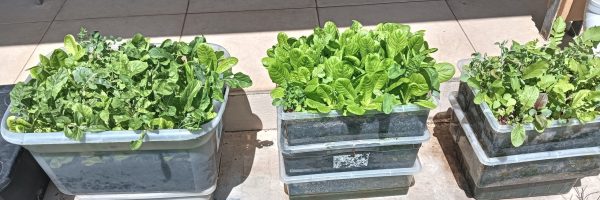
My basic system is centred around baby greens and tipping. Basically, I am eating adolescent plants – between classic microgreens and mature plants.
I do this because I live in Bundaberg, Queensland, where insects are a major problem and I can beat the insects to the leaves. If I let them mature to full-grown plants, the insects will win without toxic chemicals – which I just don’t use, as the aim is to breed beneficial microbes.
I may use soapy water from the washing machine, which de-waxes the caterpillars so they dehydrate and die.
Queensland is pretty extreme with its insects and this may not be such an issue for you.
I grow a broad spectrum of plants in each box. Some, like rocket, can be harvested shortly after seeding, while others, like broccoli, take a lot longer.
I just cut the tips off the leaves and use these to make green smoothies, salads or just regular vegetables for cooking. I am harvesting the first plant leaves within four weeks and, if I keep on ‘tipping’, I will still be getting food as the plants simply regrow.
If I stop tipping (for example if I am away on a trip) the plants will just go to the mature stage.
I do have some boxes, outside the rotation, that I use for plants with a longer life, like berries and tomatoes.
Getting started
We start with the boxes – basically any box will do, but a typical storage container is readily available from the shops. We will need to lift the box so it is a good idea to use a size that will not be too heavy; about 20 litres is good.
To get a continuous supply of gut–brain food we will need several boxes – at least four, but six or more is better.
These will be rotated and, as we collect kitchen waste to make our soil, we will actually be making soil – but we will need some soil to get started.
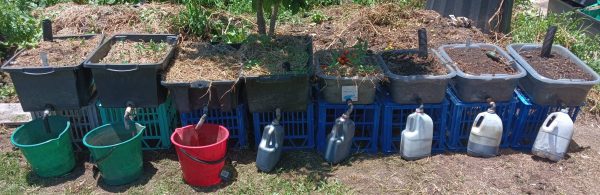
We drill a hole near the base and, using a rubber grommet and fittings from most hardware or irrigation suppliers, fit a swivel tube which enables the box to be drained.
Now we start collecting kitchen waste, which we will probably do on a daily basis, so it is good to have a box with a tight fitting lid so we don’t get flies or smells.
The rotation
Using tipping, the life of a box is about twelve weeks, so I will use six boxes and start a new box every couple of weeks. This is more than enough for my wife and me, but a large family may need more boxes.
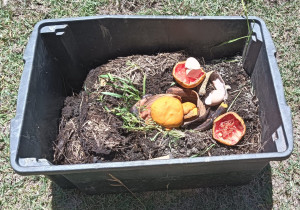
The major input is kitchen waste, which is produced daily, so I have a box with a fitting lid to collect the waste. This does not have to be a growing box – it could simply be a plastic bag which is emptied into a growing box – but it saves work to use a growing box to collect the waste and go straight to a growing box. It is not a big deal either way.
One reason why I start a new box every two weeks is that this is about as long as kitchen scraps can be stored before they get smelly and attract those cussed vinegar flies which are a real pain where I live, but may not be an issue for you.
Please note I am continuously improving the Gbiota system which makes documentation a bit of a challenge; there is an updated version in the more recent article at Gbiota soil.
I usually put a layer of grass clippings on the base of the empty box as this helps water flow across the base, but it works fine without. Vermiculite is even better than grass clippings, but grass clippings work fine and are free for me and I have to pay for Vermiculite.
Labile compost
As this food waste decomposes it will act as a growth inhibitor (labile or young compost is not good for growing) so I don’t want this affecting the growth of my seeds and plants in the top of the box.
So I cover the food waste with a layer of grass clippings and then a nitrogen-rich fertiliser. I use a mix of chicken manure, bauxite rock dust (which is full of magnesium – one of the critical minerals we are short of), some dolomite (to balance the pH but which also contains minerals), some blood and bone (which contains zinc – one of the other minerals we are short of) and the inoculant which contains the microbes as a starter, worm eggs and in my case other creatures, particularly soldier fly larvae (which just come) and a collection of other soil creatures.
Earth composting
People will tell you that you should not put things like citrus skins and onions etc. into compost. That may be true for high temperature composting and dedicated worm farms.
But we are earth composting (in the soil) so we have a broad spectrum of soil creatures and fungi that consume pretty much anything.
I get this mix straight from the Gbiota beds in my garden but, if you live in a flat, you will need a storage box to hold this mix.
I usually get a truck load of chicken manure and rock dust from my local garden supplier, but if you live in a flat you won’t be too popular having a ton of chicken manure delivered. You can, however, buy all the necessary ingredients in nice clean packages from your local hardware store, and a Gbiota grower (currently me) can supply the inoculant in small packages (4 kg).
This contains worms and, more importantly, their eggs, plus a broad spectrum of microbes. These have a short life so need to be put into the storage box with the nutrients and organic waste so they keep alive and keep on breeding.
Storage boxes
Normally the packages for commercial fertilisers (and our inoculant) are far more than needed for one box, so you can have one (or several) boxes to store these and organic waste until you are ready to start your next growing box.
This has a big advantage: the organic waste is decomposing while in storage mode.
If you like, you can accelerate this early decomposition by growing tough crops. Alfalfa is good, as it is also adding extra nitrogen which helps decomposition and is a good food.
One box works for storing for the typical twelve-week cycle, but this will still contain young compost. If you have the room it is really better to have two boxes – one to store the day-to-day collection of waste, and then a second box that can stand allowing the waste to decompose and also time for a quick crop. Plants exude sugars which feed the microbes and help soil formation.
Breeding the microbes
You don’t have to worry about the microbes – they are a randy lot and will breed without problems – but worms are actually quite delicate creatures which need the right conditions.
The box with the growing media (in my case soil from my Gbiota beds, but you can use potting mix if starting from scratch) is where we are making soil.
Later we will use soil from a box that has just finished being harvested.
Every couple of weeks a new box is started and an old box emptied – that is the soil-making cycle.
About organic waste
Before I started I thought I would have a plentiful supply of kitchen waste but it turned out that when I started reusing it, it suddenly became a valuable property which got to the point where I was fighting with my wife over banana skins.
But I did have a good supply of grass clippings – which are a grossly underestimated asset. My neighbours now dump their grass clippings onto the nature strip and I go and pick this up, and one neighbour uses a grass cutting service which he now brings to my house for the odd six pack.
If you live in a house with a garden you could probably do the same thing, but if you live in a flat you may not be so lucky – but you can probably chat up a few of your neighbours to give you their kitchen waste.
Also you can do what we do – collect coffee grounds from your local coffee shop and maybe food waste from your local restaurant, but that did not work for me as they just dumped it into a bin with all their other rubbish and I got fed up with sorting it out.
Local councils also vary a lot. Ours is not so progressive, but many councils have green waste services and there are companies who supply compost in bulk.
Not too strong
Kitchen waste is very concentrated, so we will need to dilute this with something like grass clippings if they are available (grass clippings are really great and, even if you don’t have a lawn, are readily available from a gardening service). There are plenty of alternatives readily available as potting mixes, bagged compost, blood and bone, rock dust etc.
You will also need to add some inoculant – this is soil full of trace minerals and living creatures, particularly worms. You are essentially setting up a temporary worm farm.
Inoculant is available online from Gbiota – email me at colin@gbiota.com for current status, or soon from a designated local grower.
After a couple of weeks or so (it all depends on the amount of food scraps and the number of people) your box will be about half full.
This is what we would call labile compost and is not suitable for growing plants in directly.
So we now move into stage two and take that box out of the kitchen and put it in the garden, on a balcony or at least on a windowsill with some sunlight, or at least artificial growing lights – but sunlight is free and we want to keep costs low.
If we are just starting with no filled boxes we will need to fill the box with some growing medium – garden soil if you have a garden or potting mix if you don’t.
This is also a good time to add some additional nutrients such as rock dust or blood and bone fertiliser which contains a spectrum of minerals.
Seeding
Now is the time to get the soil really wet ready for seeding. Everyone has their own pet version of seeding. I simply sprinkle the seeds on the wet surface and press the seeds into the wet soil, then cover with grass clippings.
Vermiculite is really good for this top layer but costs money. I often use grass clippings or simply soil.
Good and bad bugs
Breeding microbes is easy – they are a randy lot and will start breeding within twenty minutes of being created, so it is very easy to get dramatic exponential growth.
There are good bugs, which will keep us healthy, and bad bugs which will make us sick and even kill us.
The only real way to solve this is by the conditions. If you get the right conditions – essentially a combination of food, air and water – the good bugs will not only out-breed the bad bugs, they will simply dominate the food supply so the bad bugs just don’t stand a chance of getting established.
We all have bad bugs, like E-coli, in our gut but they do us no harm as there are so few of them because they have been out-competed by the good bugs.
Flood and drain
Water does not readily move through the soil as it attaches to the soil particles and does not move until the soil approaches saturation point – which is really too high for optimum growth.
The solution is to flood the soil so the water moves through the soil until it is totally saturated, which will expel any stale air in the soil. Then allow the water to drain away, which will suck fresh air back into the soil.
Now starts the critical process of flood and draining.
I will make the swivel pipe vertical (or at least at an angle) so the box does not drain.
I like to connect my swivel tube to an internal Ag pipe to the end of the box and use a simple Ag pipe as a filler pipe, but if I have young seedlings and it is very hot (I live in Bundaberg, Queensland, which is hot and dry) I will simply pour fluid directly onto the surface.
I will partially flood the box – I can either use a short swivel tube or just adjust the angle with a longer swivel tube.
The box must not be left in this flooded state for days on end. My preference is to partially flood all my boxes then go back to the first bed and let each bed drain. If I am home for a bit I will just drain the box into an old 3-litre milk container just after I have filled – this is real quick and easy.
I use a down pipe to view the water level which tells me if I need to water. That is typically two or three times a week.
If I am busy I may not be able to cycle (fill and drain) every day, but I will make sure I cycle at least once a week and then allow an hour or so after filling so the fluid has time to wick into the soil.
The rule is that the fluid must be regularly cycled so it never becomes stagnant and pongy – but sometimes rules can be broken and the plants still survive.
This partial flood and drain is a key part of the Gbiota system.
Soil blood
Another integral part is the circulation of what we call soil blood.
Think about our bodies. We have specialist organs like our lungs and digestive and immune systems, and everything is distributed about the body by our circulating blood.
It is similar with soil. The bottom of the boxes are full of decomposing organic waste with trillions of microbes and other soil creatures busily converting this organic waste into soluble nutrients – we call these bio-available, as the body can use them.
When we flood the base of the bed, these soluble nutrients and a broad spectrum of microbes mix with the water to become the equivalent of our human blood.
When we drain the bed we capture this nutrient- and biologically-active “soil blood”, which we then use to flood the root system of the plants.
This works incredibly well, but we must regularly cycle this soil blood so it does not become stagnant.
Again, this cycling is a key feature of the Gbiota system.
Next go to Gbiota soil.
The Gbiota Biobox is designed to do one simple but powerful thing: turn cheap, everyday organic waste into living soil that feeds your gut brain, not just your stomach.
In this post I want to show just how easy it is to grow gut–brain food. But before I start, let me explain why it is so important to have a healthy gut brain and how the food cycle works.
Energy, nutrients and gut food
We need food for energy, food to maintain and repair our bodies, and food to feed our gut brain. Go back in time and our food was naturally full of nutrients and microbes but low in energy, so we evolved to crave energy foods – sugars and fats.
Then, some fifty years ago, our food system changed. It became full of energy food but low in nutrients and microbes.
Our gut brain is intelligent. It sees that we are low in critical nutrients and microbes, so it sends out signals for us to eat more food – but we just eat more energy food, so we get fat and sick. This has led to the modern chronic diseases like heart attacks, strokes, dementia and, fastest growing of all, diabetes.
So we need to change our diet. We can still keep eating energy food, which is cheap and readily available, but we need to add food that contains the essential nutrients and, above all, food that feeds our gut brain – our control system.
Nutrients are easy to get; there are literally mountains of rocks full of minerals. But we cannot digest rocks. We need microbes in the soil to break them down and make them bio-available, and most importantly, we need to breed the microbes which will form our gut brain.
Breeding microbes
Breeding microbes is easy. They breed incredibly fast in soil with waste organic material – the stuff we generally consider waste and which is essentially free.
But there are beneficial microbes which make us healthy, and bad microbes – germs – which can make us sick or even kill us.
Generally, beneficial microbes need to breathe air and breed better in moist but aerated conditions, while the harmful microbes breed faster in anaerobic conditions without air.
If we eat plants grown in soils that are full of nutrients and living microbes, then we can expect to be healthy.
How water moves through the soil is actually a complex subject, but to grow plants that will keep you healthy, you don’t need to know that, or even the species of microbes in the soil. There are thousands of species, and even expert microbiologists don’t really understand how each specific species affects our health.
Breathing the soil – flood and drain
What we do need to understand is the principle of partial flood and drain, which is at the core of the Gbiota technology.
It is really very simple: we flood the base of the soil and, as we flood, we wet the soil and expel all the stale air in the soil. Then we let the soil drain and, as the water drains away, it sucks fresh air into the soil so it actually breathes.
Dirt to soil – composting
The other thing we really need to know is a bit about how dirt is turned into soil.
Take a lump of clay. When it is dry, it is like a lump of concrete and nothing can grow in it. When it is saturated with water it forms a sticky, gluey mess with no air, and only a few very specialist plants can grow in it – hardly any food plants.
Dirt is turned into soil by the living soil creatures, and it is essentially a two-stage process.
Stage 1 – in-soil composting (labile compost)
In the first stage, the soil creatures feed on organic material and produce sticky chemicals which make the soil particles stick together and form aggregates – small granules – so the clay behaves more like sand, with plenty of spaces for water and air to flow through the soil.
But this process of in-soil composting produces many toxic chemicals – growth inhibitors – which prevent plants from growing properly. We call this labile compost, meaning fresh and still “hot”, and it is not good for growing.
Stage 2 – mature soil
As the soil compost matures it becomes less toxic, so plants can readily grow. This is the second stage of composting. The plants then exude sugars from their roots which feed the beneficial microbes.
This creates the essential life cycle on which we all depend. The plants capture energy from the sun, which they use to create sugars that feed the soil life, and the soil life then breaks down the rock particles to make the nutrients that the plants – and we – really need.
The Gbiota process follows this two-stage process and is really very simple. The Biobox is just a convenient way to make that cycle happen on a balcony, in a backyard, or anywhere space is tight.
Gbiota is not about total self-sufficiency; it’s about filling the holes in our modern food system by growing the missing piece of our diet—fresh plants loaded with living microbes and bio-available minerals.
What should I grow?
“What should I grow?” sounds so simple, but it is not. Gbiota is about correcting deficiencies in our modern diet, not about being totally self-sufficient. I have tried full self-sufficiency and it is not easy – actually, it is just plain hard work and boring.
Gbiota is about filling in the holes left by our modern food system. That system is dominated by shelf life. We get food from all over the world via a highly complex distribution system which may be effective, but it takes time from harvest to table.
Microbe deficiencies – they breed and die fast
Modern growing involves a lot of chemicals, so even when plants are growing, the soil is often deficient in microbes. By the time that food reaches the table, any microbes that may have existed have long since died.
These are the very microbes that would naturally form our gut biome, the master regulator for our bodies. This is the number one deficiency in our food system.
Nutrient deficiencies
The second major problem is nutrients. Plants need a limited range of nutrients, but we, as animals, need a far bigger and more complex range.
There is simply no incentive for growers to ensure that the complete spectrum of nutrients is in our foods. Until shoppers carry a mass spectrometer in their shopping bags, they have no way of knowing what is actually in the food they are buying.
Inevitably, the profit motive results in growers ensuring that those nutrients essential to make the plants look healthy are added, but there is no financial incentive to add the nutrients essential for human health.
The net result is that our food is lacking critical nutrients.
Common deficiencies
The key nutrients commonly lacking are:
Magnesium – affects everyone.
Iron – particularly affects women.
Zinc – particularly affects men (at least those still enjoying a bit of hanky panky).
But just adding minerals to the soil is not enough – microbes are needed to break them down so they become bio-available.
Microbes first, minerals second
So the number one objective is to grow food full of beneficial microbes, and number two is to include those missing nutrients which we have evolved to need.
The two are not separate. Microbes in the soil are essential to breaking down the minerals that may exist in the soil so they become bio-available.
Just burying a galvanised roofing sheet into the soil is not enough. It may be full of iron and zinc – two of the critical minerals we are short of – but until they are broken down into complex chemicals that make them bio-available, they are useless.
Microbes are critical
Whichever way we look at it, getting the right microbes – which are naturally present in healthy soil – is critical for our health.
So maybe we should ask, “Where do these microbes come from?” That seems a perfectly good question to ask, but it is not the most critical.
Microbes are simply everywhere. I have just read that every breath we take typically has four fungal spores floating around in the air. Should they decide to set up home and breed, our immune system would soon sort them out. Our bodies are a quite remarkable machine, as you would expect after a few million years of evolution.
We do need to introduce microbes in the first place, which is not a major challenge, but the real question is how to encourage beneficial microbes to breed while discouraging harmful ones that may end up killing us.
Eco-balance
That is what Eco-balance (which is at the heart of the Gbiota technology) is all about.
Partly this is about conditions – particularly the moisture level – which is why I spend so much time talking about avoiding soils which are saturated for any length of time.
But to breed, microbes have to be fed. Partly that comes from decaying organic matter, but plants also exude sugars which are food for microbes.
Different species of plants exude different sugars which attract particular species of microbes – for example, sunflowers are particularly good at attracting and feeding mycorrhizal fungi.
We need a broad spectrum of microbes
The key message is that we need to be growing a broad spectrum of plants so we end up with the broad spectrum of gut biota needed for a healthy intelligent control system.
Companion planting
There is yet another reason for having multiple plants. Cruciferous vegetables, members of the cabbage family, are among the most nutritious vegetables – something well understood by the hordes of insects which devour them at astonishing speed.
We don’t want to use toxic chemicals; they will just kill off the microbes we are trying to breed. But by growing companion plants and harvesting at the baby green stage, it is possible to have a viable crop.
Harvest at the adolescent stage
Companion plants may provide some protection, but as soon as they are attacked by insects, their natural protection mechanism is to produce bitter chemicals so they don’t taste good.
However, if the entire crop is harvested at the baby green stage as a mixture, it will still taste sweet and be highly nutritious.
Ease of use – Ecobox and Tribox
The aim of the Ecobox system is to create a system where people who do not have gardens or gardening skills (my nominally fictitious character Mary, the single mum with three kids and three jobs) can have ready access to fresh vegetables full of beneficial microbes and nutrients.
Keen gardeners take a great deal of interest in the intricacies of gardening – the nutrients, the soil pH, the various species, etc. But the Marys of this world simply do not have the time, so we have to rethink how we can make this accessible.
Within the Gbiota movement we have growers who really enjoy these intricacies, so the plan is simple:
They set up Gbiota beds to breed beneficial microbes and worms.
They add minerals to grow the needed living, nutrient-rich soil.
They produce the variety of seeds needed for successful Gbiota Triboxes and make these available online.
This inoculant is highly concentrated, so a 4 kg pack is sufficient for up to four Tribox towers for three months.
While we are setting up local growers, I can supply these inoculant and seed packs – at least in Australia. (Contact me at colin@gbiota.com if you are interested in becoming a Gbiota grower breeding beneficial microbes.)
Steps in setting up an Ecobox
These are the main steps needed to set up a Gbiota Ecobox.
1. Select boxes
Select suitable nesting boxes from the local hardware store. Twenty litres is a good size, but a bigger box can be partially filled and used as a terrarium.
The exact boxes are not critical as long as they nest. One box is not enough; four to six towers may be needed for a continuous supply.
2. Drill holes
Drill holes in the bases and lids. I have been using multiple holes, but I am now trialling just one large central hole; it is easier and saves the bother of ensuring the holes line up between levels.
3. Order inoculant and seeds
The inoculant and seeds are then ordered online (from a local supplier or www.pickandeat.shop).
4. Collect organic waste
Collect organic waste. Typically this will be kitchen waste, which may take some time to accumulate, but to get started any waste such as grass clippings can be used. Failing that, commercial potting mix can be used.
5. Fill breeding (middle) box with organic waste
The middle breeding boxes are partially filled with whatever organic waste is available, while the growing boxes are filled with whatever growing mix is available.
6. Add inoculant to boxes
The inoculant is then divided up between the growing and breeding boxes. This inoculant contains both living microbes and worms (and worm eggs), so it needs to be placed in the boxes immediately on arrival.
A layer is first placed on the surface and thoroughly watered.
7. Seed, cover and water
The selected seeds are then spread over the surface. Generally, baby greens will be grown, which require a higher density of seeds than when growing specimen plants.
A light sprinkling of water is then applied and, possibly, a lid placed on the box to form a terrarium to keep the seeds moist and to stop birds eating the seeds, if that is a problem in your area.
8. Water regularly when needed
The boxes can be watered with clean water if needed, if the soil starts to dry between flushings.
9. Flush soil blood through both boxes
At least once a week the soil blood must be collected from the bottom water reservoir and poured onto the plants in the top growing box.
This is important, as the brownish-looking liquid (I call it soil blood) is full of living creatures and nutrients and will become anaerobic if left standing. It must be kept in circulation.
10. Start harvesting using tipping
The plants may be ready to start harvesting between two to four weeks after seeding.
Only the tips of the leaves are harvested, leaving the remaining leaves to power plant growth.
If they are regularly harvested the plants will remain in this adolescent state for quite some time, simply trying to regrow. Plants remain sweet and tender in this adolescent stage.
If they are not harvested regularly, they will move into the adult state, when they can become bitter – particularly if they are attacked by insects. Once they have moved from the adolescent to the adult stage there is no going back.
11. Reseed (partial or full)
To keep a continuous supply of vegetables, extra seeds can be planted in between existing plants.
12. Swap breeding and growing boxes
After a period of between eight to twelve weeks, the mix in the middle breeding box should be ready for growing.
The level will have dropped, so additional soil from the top box can be added. Then the boxes are swapped so the breeding box now becomes the growing box and the now partially emptied growing box becomes the new breeding box.
Plant groups
Below is a list of the various plant groups. They offer a wide choice, but there are three that really stand out:
Baby broccoli – one of the most nutritious plants and easy to grow.
Linseed – good for Omega-3, which is critical for heart conditions.
Alfalfa – the workhorse of baby greens and also improves soil quality.
The advantage of multi-crop planting is that there is always some plant that will flourish. Some plants seem invincible whatever happens. I always have some spinach, long leaf lettuce (an indestructible Chinese plant) and purple amaranth growing in my garden so I always have some veggies available.
Baby greens
Baby Broccoli
Chinese Broccoli
Alfalfa
Linseed
Purple Amaranth
Ruby Chard
Sorrel
Tatsoi
Mizuna
Salad veggies
Lettuce
Celery
Chervil
Cress
Watercress
Mustard
Radish
Rocket
Spring onion
Legumes
Adzuki Bean
Mung Bean
Cruciferous vegetables
Broccoli sprouting
Cabbage red
Cabbage green
Kale
Kale Red Russian
Bok Choy
Herbs
Basil sweet
Chicory
Coriander
Dill
Kohlrabi
Mustard
Shiso
Oregano
Parsley
Sage
Thyme
Lemon Balm
Diabetic-supporting plants
Fenugreek
Echinacea
Bitter Melon
Spinach
Silverbeet
Zucchini
Root crops
Carrot
Onion
Beetroot
Jicama
Ask for help if needed
This is a very simple system which is easy to learn, but if it all looks a bit complicated then do what I do with my mobile phone – get my granddaughters to sort it out for me. They really enjoy making us oldies look stupid.
Well, your granddaughters may be whiz kids on their mobile phones but they may not know too much about growing, so come to me at colin@gbiota.com for help – that is why it is a subscription site.
Learn how living soil supports human health. Discover how beneficial microbes, nutrient-dense food, and simple growing methods can help you improve your gut microbiome and overall wellbeing. Explore the Gbiota resources, videos, and community.