Better gut health starts with living food grown in biologically active soil.
Better gut health from food
Microbes
All life is totally dependent on microbes. They break down the minerals in the soil, forming complex chemicals essential for life. They are part of our bodies, particularly in our gut where they form a real brain with intelligence which controls much of our bodily function, particularly appetite. We need the good bugs.
But there are bad bugs which make us sick or kill us so we try and kill them first. But we also kill off the good bugs on which our lives depend.
Our great challenge is to find a way of breeding the good bugs, on which our lives depend, while controlling the bad bugs.
Our intelligent control system
Our bodies are smart – deficiencies lead to food cravings and getting fat and sick.
Modern diseases, like diabetes, dementia, cancer and heart attacks have increased with our modern food.
These are related to the amount of fat in our bodies. The now obsolete view was that weight could be controlled simply by eating less and exercising more.
Medical researchers at the forefront of medical science now understand that our bodies have a set point for weight and will adjust our appetite and energy expenditure to maintain that set point. Extreme diet may reduce fat in the short term but raise the set point so in the long term lead to an increase in body fat.
The new thinking is that deficiencies (such as lack of beneficial microbes, gut and brain food, essential minerals, omega 3, etc.) in our modern food system lead to a rise in the set point so we end up fatter and sicker than ever.
The modern approach, which is slowly being accepted, is not simply to cut down on food intake but to ensure that our food contains all the essential ingredients so the set point is naturally lowered. This is the new approach of “avoiding deficiencies”.
Fresh is more than not gone bad
The solution sounds easy – eat food, freshly picked, grown in soil teeming with beneficial microbes and nutrients – Gbiota food.
This is what our ancestors did (without knowing it) and how we have survived to date.
This is fine for people with a garden and the time and expertise to grow some of their own food. We know how to grow food in soil full of essential nutrients and beneficial microbes and many people have already set up their own Gbiota beds for their own use.
Watch these four videos:
https://youtu.be/Zk2JGGxqwkhttps://youtu.be/4jXdusOYLFYhttps://youtu.be/xccG5Zq3CNQhttps://youtu.be/0BOnJUXSyTU
These home gardeners have the benefit of being able to pick and eat their food without delay, before the beneficial microbes die.
Society has changed
But what about people living in flats or who simply do not have the time to grow their own Gbiota food?
Go to any supermarket and you can’t help but be impressed by the vast array of foods from all over the world. You may also notice the number of wobbly bums and tums and think that all these people are simply overeating. They may well be – but the issue is far from simple.
We measure energy by calories and carbon by grams
It is now common to use calories as a measure of the amount of food we eat. Calories are a measure of the amount of energy that the food is potentially capable of generating when eaten. But calories give no idea of the chemical composition of the food. That requires us to look at the number of grams of specific chemicals in our food.
The 80%, 15% and 5% balance
The bulk of the food we eat is purely for energy. Food contains carbon and hydrogen which is simply burned off to provide energy – it is just fuel to deliver calories as heat or mechanical energy.
Some eighty percent of the food we eat is simply burned as fuel for energy. Our modern food industry has done an incredible job of providing us with low cost, readily available and tasty fuel.
But we also need food containing complex chemicals to replace our body parts as they wear and age. Farmers are very good at using fertilisers to provide just the right amount of nutrients to grow plants but we humans are much more complex than plants, so a plant may be very healthy and look great on the supermarket shelves but still be missing some key nutrients that we as complex humans need.
This is not a technical problem but one of economics and selling. A customer has no idea of the nutrients in a plant at the supermarket so the supermarket focus is on having good-looking fruit and vegetables for sale.
We don’t need a lot of these complex chemicals and only about 15% of our diet is used for replacing body parts.
But we also need to feed our brains, both of them – the one in our head – and the other in our gut. Our gut brain is particularly important as it controls our appetite and hence largely how much food we eat.
Why our intelligent control system is so important
Of course we do have will power and can go on a diet but our intelligent control system is incredibly powerful and persistent and eventually most people fail to override their food cravings.
This food for our gut brain may only be some 5% of our total diet but is incredibly important.
In the past there was no problem in getting enough gut food. People were simply eating fresh fruit and vegetables, picked and eaten straight away before the critical microbes died. Then we changed our food production system with a long delay from when the plants are harvested to when they are eaten.
We changed a system that was working (for money)
Our diet naturally contained an adequate supply of pre and probiotics which kept us healthy but then we changed the system so it no longer worked.
Of course there are some exceptions – frozen peas which are frozen straight after picking would still have beneficial microbes still alive but frozen, ready to be thawed and eaten.
We don’t have to change the entire system back to pre-industrialised agriculture – there are simply too many people on earth – but we do have to make the change so just a small percentage of our diet acts as natural pre and probiotics.
Changing the system (to one that works)
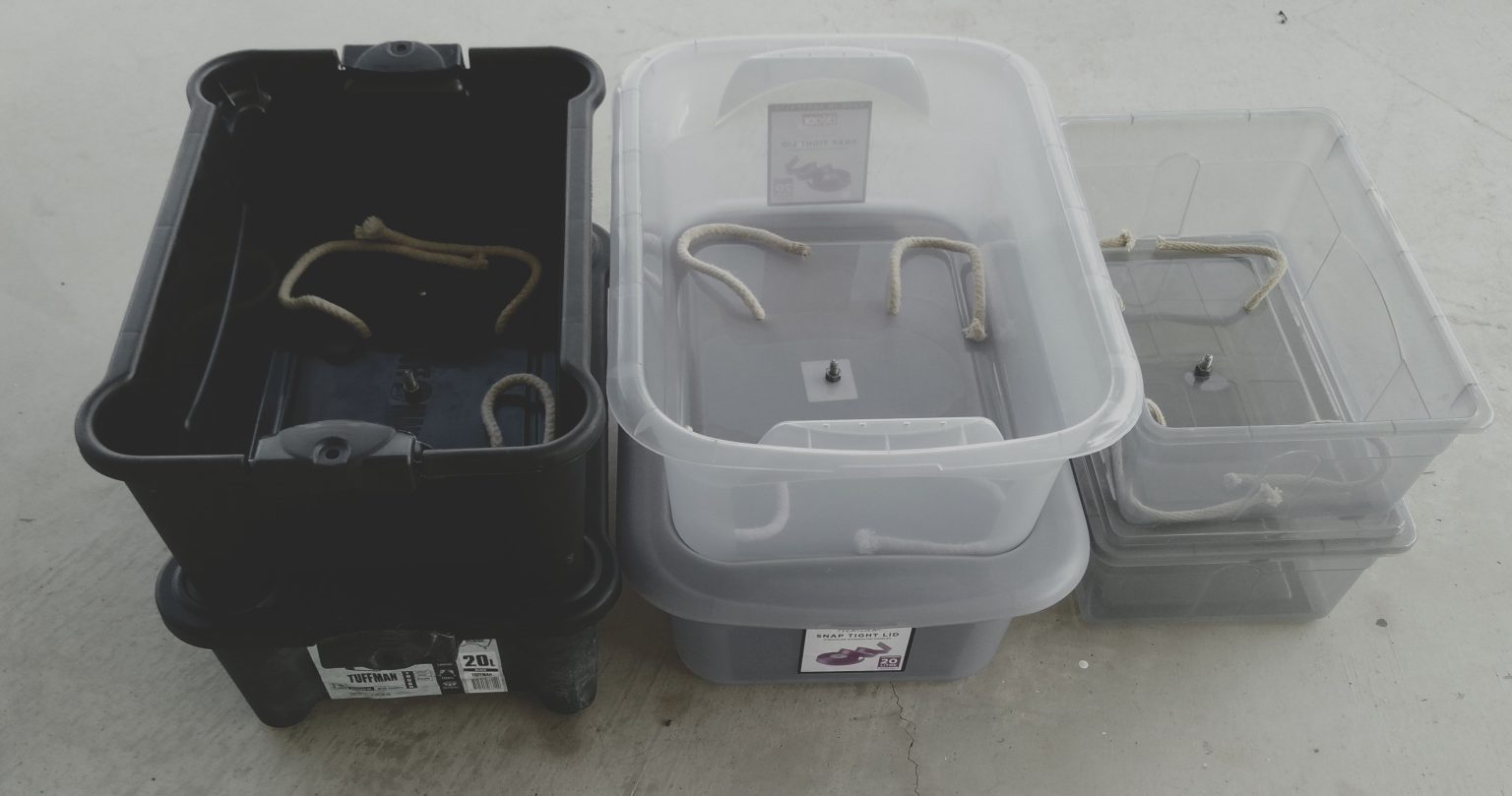
And that is where our couple of plastic boxes come into play.
In the system I have been developing there are two players, the customer and the grower.
The customer
The customer probably lives in a flat, with a couple of kids and a full time job and has no time for messing about growing plants even if they had a garden.
She will probably order online a box of living plants, ready to be harvested.
The grower will deliver the box and normally pick up an old box – plus hopefully a bag of waste food and organic waste.
At home the customer actually has another box which is the water container. She fills this with water and places the soil box on top.
The soil box has pieces of rope dangling down which go into the water, which will then wick up into the soil box.
The bottom box is simply filled with water and may contain enough water to last for much of the plants’ life but it is sensible to check the water level just once a week.
The simplest (and often the best) system is to use the tipping method. The tips of the plants are trimmed and can be used to make a green smoothie, or the tips are simply used as accoutrements by sprinkling onto the meal.
When the plants are reaching the end of their lives she simply orders a replacement box from her grower.
Now the customer can have access to fresh plants which they can pick and eat straight away.
Dead simple and convenient. The key point is that the plants are full of nutrients and beneficial microbes and act as both pre and probiotics which are genuinely fresh as they are just picked and eaten.
It probably works out cheaper than buying already harvested plants from the supermarket and all that is needed is a balcony, verandah or windowsill with sunlight.
If the box has a transparent lid it can be used to make a micro greenhouse in winter or to give some protection from pesky flies in summer.
The top box is filled with what looks like soil but we call Wickimix and it is full of beneficial microbes happily feeding away on the nutrients in the soil, which brings us to the role of the grower.
The grower
But now comes the tricky bit – where does all this Wickimix come from?
Making Wickimix is the prime job of the grower. It is true that you can get all the nutrients we need from chemical fertilisers. The fact that much commercial food is lacking in key trace elements is simply that the customer has no way of knowing if the produce contains these critical trace elements – the plants look fine and healthy – but it costs extra money to include those trace elements.
But what you don’t get from a bag of fertiliser is the beneficial microbes. We need these for two reasons – the first is that the microbes (particularly the fungi) are needed to break down the minerals into the complex and soluble chemicals we need and secondly those microbes in the soil find their way into our gut to form our intelligent gut brain.
So where does Wickimix come from? The answer is simple – a local grower who has set up Gbiota beds to recycle waste organic material by breeding the beneficial microbes.
Making Wickimix
So what goes into Wickimix? A bit of clay makes a really good base as the fine particle size of clay gives a large surface area for nutrients to cling to.
But then we need organic waste. People who are into composting, which can become a bit of a cult culture, know full well that to get a good high-temperature compost requires very careful balance of carbon, nitrogen and air for the compost to work so they are very selective about what goes into their compost.
Then we need the critical minerals and an inoculant.
Low and high temperature composting
Gbiota beds are very different; they use in-ground composting which is a much slower process but virtually any organic waste can be used. It does not use high temperatures but relies on the mass of creatures which live in the soil. There are just an incredible number of different sorts of creatures and there will be some creature which will process any organic waste.
Ultimately microbes will finish off the process but these may be the microbes inside their guts, with the creature, whatever sort it is, starting the first phase breaking down and feeding on the organic material.
Just go and ask my friends the ants and termites who have got this down to a fine art.
People often ask me where the microbes which end up in our guts come from. The answer which most people don’t like to think about is from the guts of creatures living in the soil.
It is a long chain, from the soil creatures, to their guts, to the soil then into the plants we eat and finally into our guts.
I am sure there are many advertising executives who would baulk at the idea of selling worm pooh or bug pooh as a health food, even if indirectly, but it is simply the way the world works and has worked for millions of years.
Breeding microbes
The purpose of a Gbiota bed is to breed beneficial microbes while controlling the harmful microbes. This is done by creating the conditions where the beneficial microbes simply out compete the harmful microbes.
The key tool is to control the moisture level so the mix is moist but not too wet. This is achieved by a subsurface irrigation system and allowing the water to spread by wicking action.
A certain amount of local soil, hopefully clay, is mixed with organic waste, minerals and inoculant to start the process. They look like a conventional raised bed but with the gap between the beds filled with the raw materials and just left to compost, when the Wickimix is dug up and put into the Gbiota boxes.
Typically the local grower would load the Wickimix into the boxes and grow the plant to the stage where they are ready to eat and collect the old boxes when the plants get old, with possibly a bag of food waste for recycling back into Wickimix.
The local grower system is really the way to go. The Wickimix can be loaded into the box and delivered fresh and relatively cheaply locally. This means a change in thinking about how a small proportion of our food is managed.
From centralised to local
The question is how to bring about that change? Well it is simply a fact of life that we have to implement major changes in the way the world works. The days of mass central production are numbered as this is the only way humans will survive when there are over eight billion people on this earth.
The days of extracting raw materials from finite resources will disappear into the history books and we will live in a world based on local recycling.
We can see this already happening in many areas of our lives, just look at electricity where mega coal mines and massive power stations are being replaced by local electricity produced by wind or solar power.
The message that we need to get out is that this is the way to have a prosperous, wealthy and sustainable society.
And that message will come from individual people seeing the need for change and getting our politicians and leaders of big business to be part of implementing this change.
Making change happen
It is never easy to change a system, particularly if it appears to be working. But it is not. Every eight seconds someone has a limb amputated from diabetes which is largely the result of our modern food system.
But humans are the dominant species on earth for a number of very simple reasons. We are intelligent and cooperative, adaptable and willing to change if needed.
But change does not just happen; it starts with a handful of people, the pioneers who see the need for change and make it happen. Maybe on a small scale and against serious obstacles – but they make it work. Then other people see it working and follow suit until it becomes mainstream with just a few people bucking the trend.
And that is how I see the change to a local gut food system happening.
These pioneers may be consumers who want change and persuade local growers to provide Gbiota boxes or it may be growers who see an opportunity for change to create a business while making the world better able to handle the inevitable food crisis.
But it will be individual pioneers who will start the process of change.
If you want to be part of this process of making the world both sustainable and prosperous please contact me at colinaustin@bigpond.com.
Avoiding deficiencies: gut biology, weight control and the Gbiota food solution.
Preface
For many years now I have been promoting the importance of gut biology and how we can simply and cheaply improve our gut biology by growing plants in soils teeming with beneficial microbes and nutrients.
These are not just my views but are based on studying many leading researchers in the field. Unfortunately we live in an era full of promotion of magic solutions, mostly pills based on weird plants from odd corners of the world. These are the modern version of the snake oil salesmen.
My contribution is the development of the Gbiota bed and box system to breed the beneficial microbes and to make this technology widely available at an affordable price.
So I thought I would write this blog showing where I have gleaned much of my information.
The basics
Modern diseases like diabetes, dementia, cancer and heart attacks have increased with our modern food.
These are related to the amount of fat in our bodies. The now obsolete view was that weight could be controlled simply by eating less and exercising more.
Medical researchers at the forefront of medical science now understand that our bodies have a set point for weight and will adjust our appetite and energy expenditure to maintain that set point. Extreme diet may reduce fat in the short term but raise the set point so in the long term lead to an increase in body fat.
The new thinking is that deficiencies (such as lack of essential minerals, omega 3, beneficial microbes, gut and brain food etc) in our modern food system lead to a rise in the set point so we end up fatter and sicker than ever.
The modern approach, which is slowly being accepted, is not to cut down on the food intake but to ensure that our food contains all the essential ingredients so the set point is naturally lowered. This is the new approach of “avoiding deficiencies”.
Our bodies are smart – deficiencies lead to food cravings and getting fat and sick – and we know how to grow food in soil full of essential nutrients and beneficial microbes.
Recent videos
This video shows how a young medical student, Nana (who by some fluke just happens to be my granddaughter), is aiming to set up local food clusters to create a marketplace for food grown in soil rich in nutrients and beneficial microbes and is creating a trial to provide confirmation of this “avoiding deficiencies” approach. Watch:
https://youtu.be/0BOnJUXSyTU
And if you are interested in participating in this important project please contact me. These three videos explain more:
https://youtu.be/Zk2JGGxqwkshttps://youtu.be/4jXdusOYLFYhttps://youtu.be/xccG5Zq3CNQ
Save my foot
I will start my story with my wife, Xiulan, a medical doctor, who some ten years ago became diabetic. We were told by our medical adviser that “diabetes was a chronic disease, meaning long term, there was no cure, it would just get progressively worse needing stronger and stronger medicines, eventually insulin injection and that she could expect to die young from some side effect of diabetes”.
Now this was not some guy in the pub but our professional health adviser relaying what was the current medical view.
But the story gets worse, her foot started to turn black and the doctors started to talk about amputation and how good modern prosthetic limbs were.
Where were the wonders of modern technology that would save her foot? See save my foot.
I am pleased to say my wife changed her diet and still has both her feet. But there are some 400 million people formally diagnosed with diabetes, and a much larger number of people, in some areas half the population, are overweight and probably pre-diabetic.
This is an epidemic that is new. There have always been some people that are overweight and diabetic but not on this scale.
Something has gone seriously wrong. We need to find out what and fix it so we can be happy, healthy, wealthy and wise.
How to fix things
Thomas Edison, one of the world’s most prolific innovators, laid out the process of innovation: “study everything that has been written about a subject then put it to one side and start from scratch”.
So I started reading. I just checked my library records – 3,728 books plus countless technical articles and papers on the web. Most were just a waste of time but below are some of the critical ones.
Then we have to put them to one side and start from scratch to find out how to fix things.
These are just some of the books I studied – and the answer slowly emerged.
Why we get fat
The basic laws of conservation of mass and energy are totally valid for a biological system. If we eat too much and do not burn it off we get fat.
In addition to these laws of conservation there is a measure of the quality of energy (entropy). We take in food which has a high quality of energy and breathe out carbon dioxide with a low quality of energy.
This is generally controlled by a totally subconscious type of control system. For example our temperature control system is totally subconscious – we cannot change our body set point temperature which is set at 37°C.
Neither can we control our heart rate, but we have some limited control over our breathing rate, and even that only for a short period of time.
With food we have a little more control. Our body may try and control our food intake by sending out hormones to tell us whether to eat more or stop eating to maintain the set point. We may try and override or change the set point by how much we eat but that is not easy – our intelligent control system has evolved over millions of years and is highly effective.
That is the real reason why so many people are overweight.
We may be eating more than enough to power our body but if we miss out eating food that will feed our gut brain, which forms part of our food control system, or our diet is deficient in key nutrients we will still feel hungry and eat far more than needed.
This is the prime reason why so many people eating in a modern food system are overweight. It is called the food deficiency effect – we eat too much of certain foods and not enough of the critical foods.
There are of course many reasons why we overeat: leptin intensity (leptin is the hormone that makes us feel full), a lack of food in our past history which makes our body crave food, features of our DNA which make us crave food, or bad habits we picked up when young which show up later in life.
Professor Roy Taylor – Reversing type 2 diabetes
I will start the review of critical thinkers in this field with work done by Professor Roy Taylor. In his book Roy explains that diabetes is really about fat. There are really two stages to diabetes. The first stage is when the body becomes resistant to the insulin which controls our blood sugar level but many times people are just unaware as the pancreas simply makes more insulin to cope.
(That is why there are far more than the 400 million people with diagnosed diabetes – we could be talking billions of people.)
Then in the second stage fat enters the pancreas which can now no longer produce insulin. His solution was simple – go onto a low calorie diet.
So it was all about fat and no one really wants to be fat and waddle about like a duck so fat was a much broader problem than diabetes – just go to any shopping centre and about half the people are fat and overweight.
Ruben Meerman – Big Fat Myths: when you lose weight where does the fat go?
But this is where the story gets interesting. Ruben Meerman, a science physicist and writer, wrote a book challenging the conventional wisdom of focusing on calories.
His point was simple – we don’t eat calories, we eat food which we measure with kilograms, not calories. True, food can be burned to produce energy but it is the carbon and hydrogen in the food that makes us fat.
We can simply turn this carbon and hydrogen into carbon dioxide and water which we can breathe out. So his solution was the classic “eat less, exercise more”.
He did make the point that it is much easier to prevent getting fat than to lose fat later, which is really saying that we should be teaching our kids about how we get fat.
Our kids at school should be learning about this, even if most are still skinny. It is all to do with the number of fat cells. If you have a lot of fat cells that are not yet filled you will still be skinny but will explode in later life as the fat cells fill.
We may get fat because we eat too much but the real question is why do we eat too much?
Dr Andrew Jenkinson – Why We Eat (Too Much): The new science of appetite
Basically he said “wait a minute – we have to ask why people eat too much and get fat”. He said our bodies have a natural control system which determines how much we want to eat, it decides on a natural set point, what it thinks is the ideal weight, and however much you try to lose weight by going on fancy diets you will certainly lose weight in the short term but will gain it back in the long term as your automatic control system wins the battle.
In fact he said just restricting the amount of food so you are continuously hungry makes your control system raise the set point so you go through a period of yo-yo dieting, getting fatter and fatter on each cycle.
He put forward the argument that we get fat because of deficiencies in our diet which are sensed by our control system, raising the set point which makes us hungry.
His argument is that we should eat more, not less – well not quite – we should eat more of the food which supplies us with the range of nutrients that we need and then we will naturally want to eat less.
He did point out there were many reasons why we get fat; we could be leptin resistant (leptin is one of the hormones that makes us feel full and stop eating) or lack the sensors to respond to leptin.
Mariette Boon and Liesbeth Van Rossum – Fat: The Secret Organ
These two doctors are from Holland which is interesting because this is where there is real world experience of what happens when people were starved as they were at the end of the war but when food became available they tended to put on a lot of weight.
This is important because it shows our bodies are not some dumb donkey but have real intelligence and are doing a lot of work in our subconscious brain deciding how much and what sort of food we should eat.
Tim Spector
I could mention hundreds of scientists who talk about gut biology but Tim Spector’s book Spoon-Fed – Why almost everything you’ve been told about food is wrong, and The Diet Myth have such good titles and his work with identical twins as part of the nature vs nurture battle, so I have selected him as my gut biology guru.
The key point is that our gut, with its trillions of cells working and communicating together, forms a real brain. We know a great deal about the species of microbes that inhabit our gut and how they change with what we eat but we really have no idea of the code that makes it work.
The point is that we do have an intelligent control system and our gut, with the trillions of cells communicating with each other, forms a genuine brain which cooperates with our head brain to form our intelligent control system.
We have no idea how our gut brain works but we do know that our head brain (which forms part of our intelligent control system) is continuously learning and changing – so what we want and how much we want to eat is influenced by our experiences from birth.
We may not know much about how our gut brain works but for that we may have to look at books like Swarm Intelligence by Marco Dorigo and learn how it works from studying interesting things like slime moulds, ants and bees.
But we do know for sure that our gut brain is a critical part of the equation.
Dr Elaine Ingham
But if we want to understand where our gut microbiome comes from, the answer is from the soil – and there the one person whose work is so prolific is Dr Elaine Ingham.
We do know that the soil microbes move into the plant roots by osmosis so the plants become natural pre and probiotics.
But she does make some remarkable claims that it is possible to continuously harvest crops without applying any additional minerals.
This I debate. The effect of adding additional minerals to depleted soils is just an experimental fact. But her key point that minerals need the microbes to make them available is very valid and important.
The species of microbes in our gut may be the critical issue but our intelligent control system can sense any deficiencies in the minerals in our food and make us hungry.
Defining the problems
We can understand the problems we have to solve. From a purely technical viewpoint we have to ensure that our gut brain is working properly by ensuring a healthy gut biome and we have to ensure that our head brain, which we know is continuously learning, is well trained to eat the right sort of food. In practice this means a diet which is rich in plant foods that act as pre and probiotics, and is rich in essential minerals and vitamins which are commonly lacking in our modern diet.
This, of course, is what the Gbiota project is all about and is described – and the information continuously updated – on my web site www.gbiota.com.
But solving the technical problem is actually the easy bit and just the start of the problems. There are two other much more difficult problems to overcome.
Problem 1 – Logistics
The first could be called logistics – which is a rather boring word for an emotional topic. It means ensuring that the solution is economically acceptable – people have to be able to afford the food that will make them healthy.
There is an immediate logistical issue that the microbes that are needed for a healthy gut biome only have a short life so the plants which act as pre and probiotics must be eaten shortly after being harvested – preferably within twenty four hours – which is just not possible with the current food distribution system.
The Gbiota bed and box system allows the beneficial microbes to be bred in the beds, then the soil transferred to a box to grow fresh food in people’s houses or flats.
This is probably a cheaper system than the conventional warehouse-style distribution system, but it is different, which means people accepting change.
We also have to consider the global logistics. In days gone past people would eat food that was grown locally in soil that was naturally fertilised by waste organic matter. People then had good gut health. The modern poor gut health arose from the switch to the modern industrial-chemical food system which arose from the economic benefits (to the mega food companies) which gave much higher production per unit of area.
We have to achieve similar productivity per unit of area but without destroying the microbiome.
We can do this locally but we also have to be able to feed the eight billion (and rising) population in a sustainable way in potentially an even smaller area.
The problem of global food production has been considered by many writers – I list some of the key thinkers here.
David Montgomery – Dirt: The Erosion of Civilisations
If we want to talk about minerals who is better to study than a geologist with a burning desire to ensure we survive on our planet.
His argument is that all sorts of creatures have been on this earth for millions of years without getting needlessly fat. Having fat level out of control is just not normal. Many animals, like bears, get fat before they hibernate but it is a controlled increase in body fat.
Gary White – The Worth of Water: Our Story of Chasing Solutions to the World’s Greatest Challenge
George Monbiot – Regenesis: Feeding the World Without Devouring the Planet
All these authors are well respected scientists in their own right and are just a small sample of the research that is being conducted. I have tried to show that if we look at the evidence from all these people we have the technology to counter one of the great threats to our health.
Now we need to ask if this is both economically viable – i.e. will people buy or grow the food that will make them healthy – and if it is sustainable in the long run.
So we need to look at whether the solution can be applied when virtually all available land is being used and the resources are stretched to the limit with the eight billion people on earth.
Problem 2 – Persuasion
Will the solution be accepted?
We live in the digital era where we are subject to a mass of information (or what is portrayed to be information). We simply do not have the time to work out what is true or false and what makes it even worse is the level of sophistication of modern manipulative marketing.
This is the major issue in creating change to our food industry – here is a list of the many books on the topic.
Brad McKay – Fake Medicine: Exposing the Wellness Crazes, Cons and Quacks Costing Us Our Health
Naomi Oreskes – The Merchants of Doubt
Brad Smith – Tools and Weapons: The Promise and the Peril of the Digital Age
Peter Scott – Hot Air: The Inside Story of the Battle Against Climate Change
David Grimes – The Irrational Ape: Why Flawed Logic Puts Us All at Risk and How Critical Thinking Can Save the World
Patrick Alley – Very Bad People: The Inside Story of the Fight Against the World’s Network of Corruption
Ron Gonen – The Waste-Free World: How the Circular Economy Will Take Less, Make More, and Save the Planet
Niall Ferguson – Doom: The Politics of Catastrophe
Peter Lewis – Webtopia: The World Wide Wreck of Tech and How to Make the Net Work
Simon Hammond – Brutal Truths: Surviving in a World of Lies, Taboos & bullsh#t
Philip Lymbery – Farmageddon: The True Cost of Cheap Meat
Sinan Aral – The Hype Machine
David Sumpter – Outnumbered: From Facebook and Google to Fake News and Filter Bubbles – The Algorithms That Control Our Lives
John Yudkin – Pure, White and Deadly: How Sugar Is Killing Us and What We Can Do to Stop It
Peter Wohlleben – The Secret Network of Nature: The Delicate Balance of All Living Things
Edison’s formula for innovation
OK we have worked our way through the first part of Edison’s formula: study everything that is known about the particular subject, then clear the bench and start afresh.
We can be more than sure that the basic laws of physics – the laws of conservation of mass and energy – are still working.
So if we put more carbon into our mouths than we eject from our bodies by breathing out as carbon dioxide, pooping, peeing or sweating, then we will put on weight.
But we can be equally sure that it is not as simple as telling people to eat less and exercise more because our intelligent control system will override our willpower long term.
I am not a medical doctor. I was initially trained as a mechanical engineer – the type of engineer that makes machines – and every machine has a control system, even if it is a simple on/off switch.
But my very first job was working for a company that made industrial process controllers so I know how important the control system is and how the classic proportional–integral–derivative controller works.
But much later in life I became immersed in computer software and at one time I wrote some software for irrigation control which I called self-learning software but we now may call artificial intelligence, where we use the software to learn the characteristics of the system – in this case how much water the plant was using under current conditions – then use that knowledge to predict how much water to apply based on weather forecasts. A sort of anticipatory control system.
Like, if you see a hot head in a yellow ute doing wheelies then steer clear because he is going to do something stupid – not logic, just anticipation.
If we just go out telling people to eat less and exercise more we can expect a high failure rate; there are very few people with the determination to override their intelligent control system.
Don’t believe me? That approach has been tried for years – now just take a walk around the local shopping centre and count the number of wobbly bums and tums.
It has not worked – and as they say you don’t make a new hole in the right place by continuing to dig an existing hole in the wrong place.
While it may be true that the key to weight loss is to lower the intake of carbon and increase the expulsion of carbon (eat less, exercise more) we have to change the intelligent control system so we want to eat less and exercise more.
The first step is to change our gut biome. There is no issue that changing the gut biome leads to weight change – but it is not clear whether this is just correlation or causation.
If you bring up a kid on ice cream it will have a gut biome that feeds on ice cream and will send out signals to eat more ice cream and the kid will get fat.
If you change the kid’s gut biome (by feeding him fresh green peas) the gut biome will change, which will change the way the intelligent control system works so (eventually) the kid will stop craving ice cream and start craving green peas.
Whether that shows there is causation between gut biome and being fat or just a correlation is a debate for scientists with nothing better to do – the simple result is that the kid stops craving ice cream (well a bit anyway) and loses weight.
So the solution to excess weight is to ensure the diet contains the required pre and probiotics and also the required essential minerals and nutrients missing in a modern diet. That will change the gut brain. It will also help if we train the head brain to prefer food that contains the microbes and nutrients – which means starting young and keeping at it.
So we know what we need to do – we have the technology in the Gbiota system – now we have to make it happen which means a head-on battle with the billions of dollars the food industry spends on manipulative advertising.
Tough job but it could mean millions of feet not being chopped off and billions of people enjoying happy, healthy, wealthy and wise lives.
Even tougher with no money or support from a major institution.
But we do have the model of a little kid in Sweden who sat out in the freezing cold (not exactly the ideal conditions for promoting climate change) with a cardboard plaque saying ACT ON CLIMATE CHANGE.
How did that happen? She only influenced a handful of people directly – but those people influenced a second tier of people who in turn influenced a third tier. A few fires and floods helped and now I see the figures are that some 70% of the population now believe climate change is real and action is needed.
This little kid did not influence billions of people directly – it was a wave effect.
I have to adopt the same strategy. I just have to convince a handful of people that eating a diet rich in pre and probiotics and critical nutrients and eaten fresh is something they should both adopt and act on to convince other people.
I don’t have fires and floods to help convince people but I do have the fact that every eight seconds someone has their foot amputated – and who wants to waddle around like a duck?
So if you want to help in this social action contact me at colin@gbiota.com.
Learn how living soil supports human health. Discover how beneficial microbes, nutrient-dense food, and simple growing methods can help you improve your gut microbiome and overall wellbeing. Explore the Gbiota resources, videos, and community.