
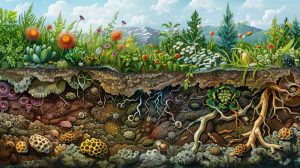
Why Metabolic food?
You may think Gbiota is just about recycling your kitchen waste to grow vegetables and save a bit of money.

And yes, we do that, but it is a pea compared with a whale. It is about what sort of society we, and our grandchildren, want to live in.
So what is metabolic food, and why does it matter?
We can grow food in two ways: aim for maximum production, or produce metabolic food.
Most people aren’t really interested in how food works, but if they are, they will ask me to explain what Metabolic food is, why it matters, and how we grow it.
I will explain that, compared with other animals, we have a very small stomach and an excessively large brain, which takes a lot of energy; with our small stomach, we have little space to store energy, so we need to eat regularly.
How our bodies work
Think of our bodies like a car.
A car needs four things.
 It needs fuel for energy. No energy – no go. Just like us.
We all need energy, and we get it from the sun. Right now, humans don’t do photosynthesis; in the future, we may evolve to replace our hair with leaves, but for now we depend on plants, algae, or plankton that can.
Secondly, it needs a structure. This comes initially from the car manufacturer, but later we will need to buy bits and pieces as they wear.
 Our bodies are much more complicated than a car, and they have one very clever feature. When bits wear, we don’t have to take it to a garage; our bodies continuously replace body parts as they age and wear, and we don’t even have to think about it or ring up the garage to see if they have the needed parts in stock.
Our bodies regenerate even while we sleep.
Pretty neat, but we do have to feed it the right food to replace the parts; that is a job for metabolic foods.
 Third, a car needs a mechanical way to control it: a steering wheel and at least two pedals, one to speed up and the other to slow down.
Our bodies have a similar arrangement, which we often call the gut-brain axis. We see this in our bodies producing both electrical signals, which stop us from touching a hot stove, and chemical signals, hormones, that make us feel hungry so we eat when needed and stop when full.
Fourth, a car needs a driver; even in the age of self-driving cars, they need a person in charge to say where to go.
This driver needs intelligence, even if it’s only to look at the fridge, see you are out of milk, and drive to the supermarket to buy more. The driver needs a learning period, even if it’s just to know we need milk and where the Supermarket is.
 Our bodies need the equivalent of this driver that has to learn. Some people say this learning starts before birth, but certainly at birth learning begins, even if it’s only to find mum’s nipple.
And it continues throughout life. Even an older person like me is still learning, even if I need my granddaughter to show me how to use a mobile phone.
Why we need to feed our gut-brain
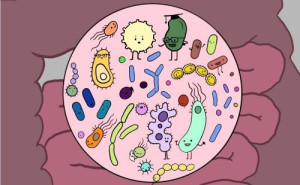 In our bodies, the equivalent of the driver is our brain, which continuously receives electrical signals from sensors throughout our bodies, processes them, learns from them, and sends signals back to the appropriate recipient.
A particularly important recipient is the intelligent microbes in our gut. When they receive the instruction, they manufacture hormones that make us feel hungry so we eat, and feel satisfied when we have enough food.
It may not seem like a particularly glamorous job, but if our bodies didn’t do it, the human race would have either starved to death because it didn’t know it needed to eat or got so fat that we couldn’t run away from a lion that understood it was hungry and needed to eat.
Energy and Metabolic food
Energy food is chemically very simple: just carbon and hydrogen we get from the air or rain without any difficulty, and it makes up the bulk of our food.
But the human body is actually very complicated, and we need Metabolic food.
It needs many minerals: magnesium, iron, zinc, manganese, selenium, iodine, etc. But we can’t just go and chew on an old wrecked car to get our iron. Apart from breaking our teeth, the iron, or whatever minerals we are interested in, has to be combined with other chemicals, free radicals, to become soluble and bioavailable.
Then we need a whole range of vitamins, maybe in very small quantities but still essential.
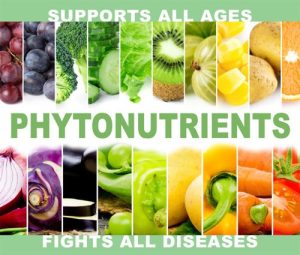 Next we need phytonutrients, specialised chemicals produced by plants. A single tomato has over a thousand separate phytonutrients. There are over thirty thousand edible plants. So I can be a boring sort of person, and I haven’t even got to the complicated bit.
We need microbes to form the intelligent control system that regulates our bodies; without them, we would be little more than jellyfish.
If I am going on a bit about phytonutrients, then wait until I get going on the intelligent control system which regulates our bodies. You see, I am an engineer, and I started my first job in 1958, most likely long before you were born, working for a company that made industrial control systems, and these can get pretty nifty.
Self-learning systems
Over time, they can learn how a particular machine works and fine-tune themselves to control complex machines to a fraction of a degree. Engineers have been developing these self-learning control systems for years, long before anyone had even heard the phrase Artificial Intelligence.
 The human body is a remarkable self-learning system. Let me give you an example. When you were born, you had no idea how to ride a bicycle, yet not long after turning three, you could be zooming around with an apparent complete understanding of self-correcting gyroscopic forces.But the truth is that at three you have zero understanding of self-balancing gyroscopic forces. Still, your remarkable self-learning, intelligent control system learned by trial and error (yes, you had to fall off a few times) the operating characteristics of your bicycle, which baffles many engineering undergraduates.
But this all depends on you eating the right metabolic food.
Growing metabolic food
My job at Gbiota is to walk you through this complex area so you can grow your own metabolic food without me breaking any records for being the most boring person ever.
 So if a few worms don’t put you off, and you don’t mind the other creepy crawlies that turn dirt into soil and grow metabolic food, then why not join the Gbiota club and enter the fascinating world of self-learning intelligent control systems that nature evolved to give us the edge over the jellyfish.
The Gbiota club is not a gardening club; it is a social movement to create a society worth living in, where food is grown for people’s health and sustainability.
Mention sustainability, and you are branded a green woke, but I reply: look at Nauru, which once had the highest income per capita in the world but, when the guano ran out, became one of the poorest. We cannot extract resources ad infinitum; we have to learn how to create a circular economy.
But health is the short-term goal.
So what am I asking you to do?
The world’s food industry is dominated by mega-corporations with immense resources, operating in a neo-monopoly.
Making grotty cardboard placards and marching in the street is pointless; it will have minimal impact.
We need to be smart and use the power of the wallet.
I realised many years ago that we needed technology to grow metabolic food. I was a pioneer of computer-aided engineering and was recognised as one of Australia’s leading innovators. I felt it was my role in life to develop technology to grow metabolic food sustainably.
Grow your own metabolic food
 You don’t have to grow all your own food; that’s impractical, but it is practical to grow the metabolic food your body needs, which is only a fraction of your total food consumption.
The bulk of the food we eat is energy food, just fuel.
Right now, we have a viable technology that lets virtually anyone, even people living in an apartment, grow their own metabolic food.
That has been my project for the last thirty years.
But technology by itself is useless; it has to be applied, widely used, and proven viable. Then it develops a life of its own and grows naturally.
That is the point of the Gbiota club: have lots of people grow their own metabolic food, showing that food cravings are satisfied and people feel healthier.
They show their friends, and soon the idea that food should be grown purely for profit is replaced by the idea that food is a community benefit and should be grown sustainably.
Then we will have a society that is worth living in.
I am busy reworking this web; it will be in two parts: metabolic food, then how to grow it. In the meantime, you can contact me directly at colin@gbiota.com.
